


The war in Iran is now in its third week, with no signs that either side has plans to stop fighting.
In the last 16 days, U.S.-Israeli strikes have succeeded in killing Iranian Supreme Leader Ali Khamenei and more than 40 other Iranian leaders. American attack planes have carried out more than 6,000 combat missions, according to Adm. Brad Cooper, the head of U.S. Central Command. A large-scale strike on Friday against Iran’s critical Kharg Island destroyed more than 90 targets, including bunkers for naval mines and missiles. “Iran’s entire ballistic missile production capacity — every company that builds every component of those missiles — has been functionally defeated, destroyed,” Defense Secretary Pete Hegseth said last week.
More than 1,400 Iranians have been killed, and another 18,000 have been wounded, according to the country’s health ministry. 13 American service members have been killed and approximately 200 have been injured. Iran — now led by Khamenei’s son, Mojtaba Khamenei — has fired more than 300 missiles or drones at more than a dozen Middle Eastern countries, Cooper said this morning, including a drone attack today at Dubai International Airport. Israel is also moving forward with a massive ground invasion of Lebanon, expanding the conflict further.
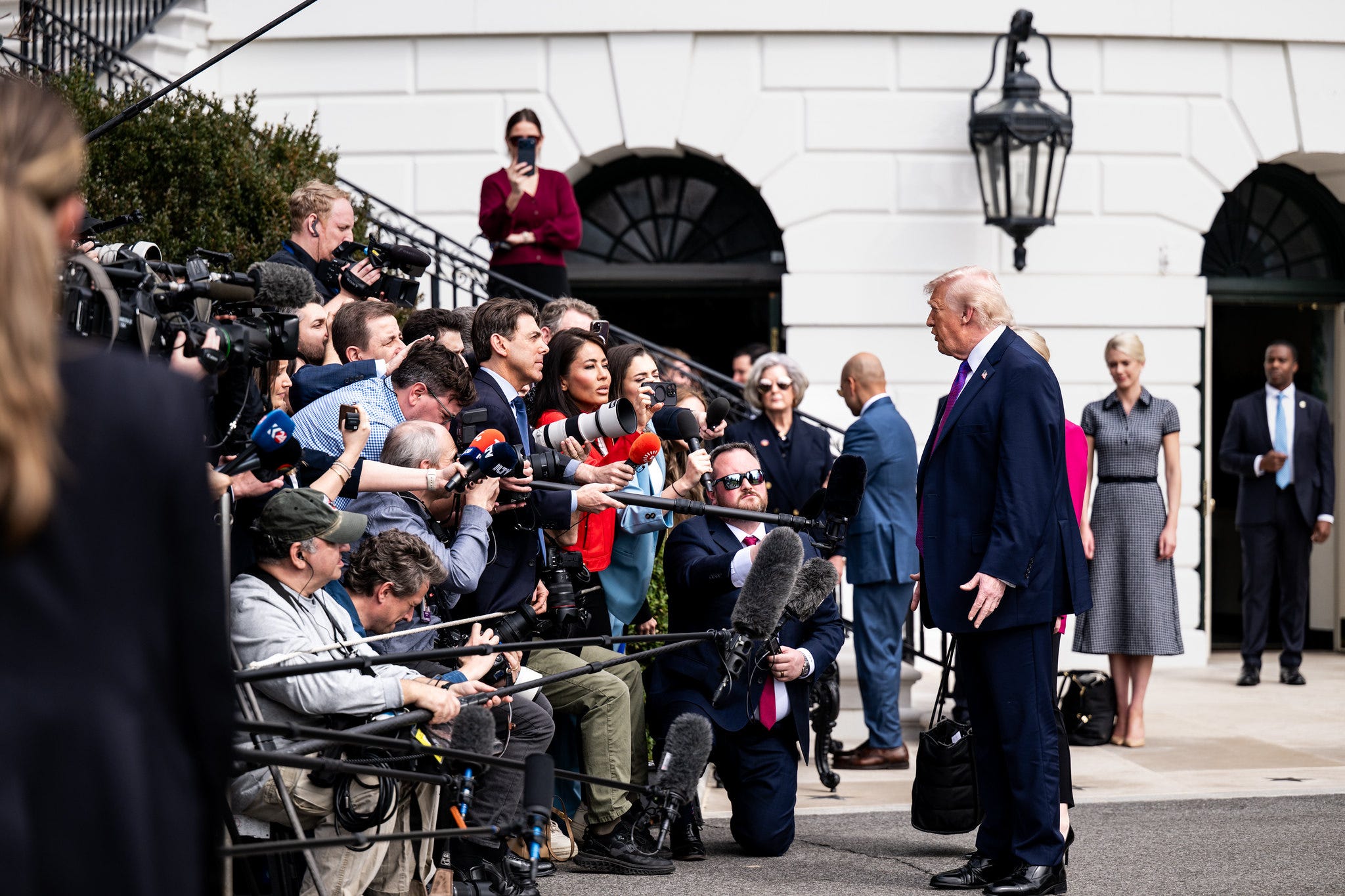
To hear President Trump tell it, the war has basically been won. “We’ve essentially decimated Iran,” he told the Financial Times in an interview on Sunday. “They have no navy, no anti-aircraft, no air force, everything is gone.”
With one exception. “The only thing they can do is make a little trouble by putting a mine in the water,” Trump added. “A nuisance, but the nuisance can cause problems.”
Trump was referring to Iran’s estimated arsenal of more than 5,000 naval mines, which the country has begun laying in the Strait of Hormuz in order to blow up oil tankers passing through the channel, which carries about 20% of the world’s oil. Iran has also launched missile attacks against commercial vessels in the strait, which has seen traffic effectively screech to a halt. (Zero commercial vessels passed through the strait on Saturday, the first day since the war began where not a single ship crossed in either direction.)
Iran’s ability to effectively close the Strait of Hormuz is the country’s most powerful source of leverage; even if Trump soon decides he wants to end the war, continued Iranian attacks on the strait could ensure that the conflict is prolonged. This is an economic threat to the U.S., which makes it a political threat to Trump as well. World oil prices have been pushed above $100 a barrel, while average U.S. gas prices have hit $3.72 a gallon, their highest level in more than two years.
The degree to which Trump planned for the strait’s closure — one of the most highly anticipated forms of Iranian counter-attack — before launching the war remains an open question. CNN reported on Thursday that Trump officials had “acknowledged to lawmakers during recent classified briefings that they did not plan for the possibility of Iran closing the strait in response to strikes,” although the network later amended its report on Friday to exclude that detail, clarifying that officials did brief lawmakers on long-standing military plans to address a disruption to the strait, although sources familiar with the briefing said there were no “near-term solutions” offered.
According to the Wall Street Journal, Trump was briefed before the war that Iran could close the strait in response to any American attack. “Trump acknowledged the risk,” according to the Journal, but decided to move forward with war anyway, reasoning that “Tehran would likely capitulate before closing the strait—and even if Iran tried, the U.S. military could handle it.”
Finally, the New York Times has reported that “Iran’s willingness and ability to disrupt the global economy by choking off the Strait of Hormuz was greater than [Trump administration] officials had anticipated, as was Tehran’s capacity to widen the war across the region.” According to the Times, a frustrated Trump pressed Gen. Dan Caine, the chairman of the Joint Chiefs of Staff, at a meeting last week about why the U.S. could not immediately reopen the strait, and was told that it was because “even one Iranian soldier or militia member zipping across the narrow neck of the strait in a speedboat could fire a mobile missile right into a slow-moving supertanker, or plant a limpet mine on its hull.”
However much Trump prepared for a potential threat to the Strait of Hormuz, he is focused on it now, so much so that he is doing something that he opted against doing in the run-up to the war: asking allies for help. In addition to largely opting not to sell the war to Congress or the American public, Trump also barely consulted allies (outside of Israel) before attacking Iran or attempted to put together a broader offensive coalition.
In the third week of the conflict, however, he is now belatedly beseeching U.S. allies — and even one major adversary — to join the war effort. “Hopefully China, France, Japan, South Korea, the UK, and others, that are affected by this artificial constraint, will send Ships to the area so that the Hormuz Strait will no longer be a threat by a Nation that has been totally decapitated,” Trump wrote on Truth Social on Saturday.
With Trump having done little before now to include them in deliberations, most of the countries Trump name-checked have reacted hesitantly. Japan’s prime minister said today that the country has no plans to dispatch naval vessels to escort ships passing through the Strait of Hormuz; the UK and South Korea issued statements that did not give a clear “yes” or “no” answer. France has not yet responded.
Trump appeared to threaten the NATO alliance if other countries don’t help to protect the strait. “If there’s no response or if it’s a negative response I think it will be very bad for the future of NATO,” he told the Financial Times.
If few allies are rushing to assist the U.S., you can imagine the response from America’s adversaries. A Chinese spokesperson said this morning that its energy supply is “relatively strong,” suggesting that the country has no plans to help the U.S. secure the Strait of Hormuz. A much larger share of China’s oil imports (about 40%) pass through the strait than the U.S.’ share (about 2%), but China also has a friendly relationship with Iran, which has said they only plan to strike tankers flagged to the U.S. and its allies.
The Strait of Hormuz is “only closed to our enemies, to those who carried out unjust aggression against our country and to their allies,” Iranian Foreign Minister Abbas Araghchi said at a press conference this morning.
As Trump searches for a solution to his oil problem, his newfound role as a wartime president has hardly blunted his stream-of-consciousness approach to political communication; whether his frenzied posts and comments are an attempt to ensure that a war-skeptical American public don’t focus too deeply on the war, or simply a continuation of the communication style he naturally prefers, is anybody’s guess.
On Truth Social yesterday, Trump returned to a familiar hobbyhorse, uncorking an almost 1,000-word screed against judges thwarting his agenda. In one post, Trump complained that the Supreme Court “knew where I stood, how badly I wanted this Victory for our Country,” but still ruled against his sweeping global tariffs. In another, he said that U.S. District Judge James Boasberg “suffers from the highest level of Trump Derangement Syndrome,” after Boasberg quashed the Justice Department’s attempt to subpoena Federal Reserve Chair Jerome Powell.
Trump has also repeatedly paused from discussing the war to demand that Congress pass the SAVE America Act, which would require individuals to provide proof of citizenship to register to vote and photo ID when casting a ballot. The Senate is set to take up the House-passed bill this week, although there does not seem to be enough Republican support for ending the legislative filibuster to pass the measure at a 51-vote, instead of 60-vote, threshold, as the president has called for.
With the SAVE America Act at the top of Trump’s agenda, neither chamber of Congress has shown much momentum towards funding the Department of Homeland Security (which has now been shut down for 30 days) — or much interest in having a say in the conduct of the war.
Trump told Fox News Radio on Friday that he will end the war when he feels “in his bones” that it’s the time to do so. So far, he has said he is not ready to agree to a ceasefire. Instead, he is potentially on the verge of expanding the conflict even further: according to Axios, Trump is considering an operation to seize Iran’s oil depot on Kharg Island, which would require boots on the ground.
When announcing on Friday that he had struck Kharg Island by air, Trump said that he had chosen to spare Iran’s oil infrastructure on the island, which handles about 90% of Iran’s crude oil exports, making it critical to the country’s economy. “However, should Iran, or anyone else, do anything to interfere with the Free and Safe Passage of Ships through the Strait of Hormuz, I will immediately reconsider this decision,” he added.
About 2,500 Marines are now deploying to the Middle East, potentially for use in a ground invasion on Kharg Island. Sen. Lindsey Graham (R-SC), a close Trump adviser, seemed to be pushing for such an operation in an X post on Saturday.
“If Iran loses control or the ability to operate its oil infrastructure from Kharg Island, its economy is annihilated. He who controls Kharg Island, controls the destiny of this war,” Graham wrote.
“Semper Fi,” he added, conspicuously invoking the motto of the Marine Corps.
Might suggest mentioning the Epstein-class global sexploitation scandal EVERY time the war is mentioned.
As in, ‘the Epstein obfuscation war’, or ‘the Epstein obfuscation war with Iran’, or ‘the Epstein obfuscation wars with Venezuela and Iran’, … Cuba, Nigeria, Greenland, Canada, … or ‘the Epstein Sexploitation World War’.
Just so we don’t forget we’re sending our kids to die, to keep a sexual predator felon from being impeached a 3rd and final time. Who the hell is still defending this??
I feel like I'm living in some sort of alternate reality where those supporting the war - in any branch of our government are following a leader whose speech and policies show no connection with reality. What am I missing