


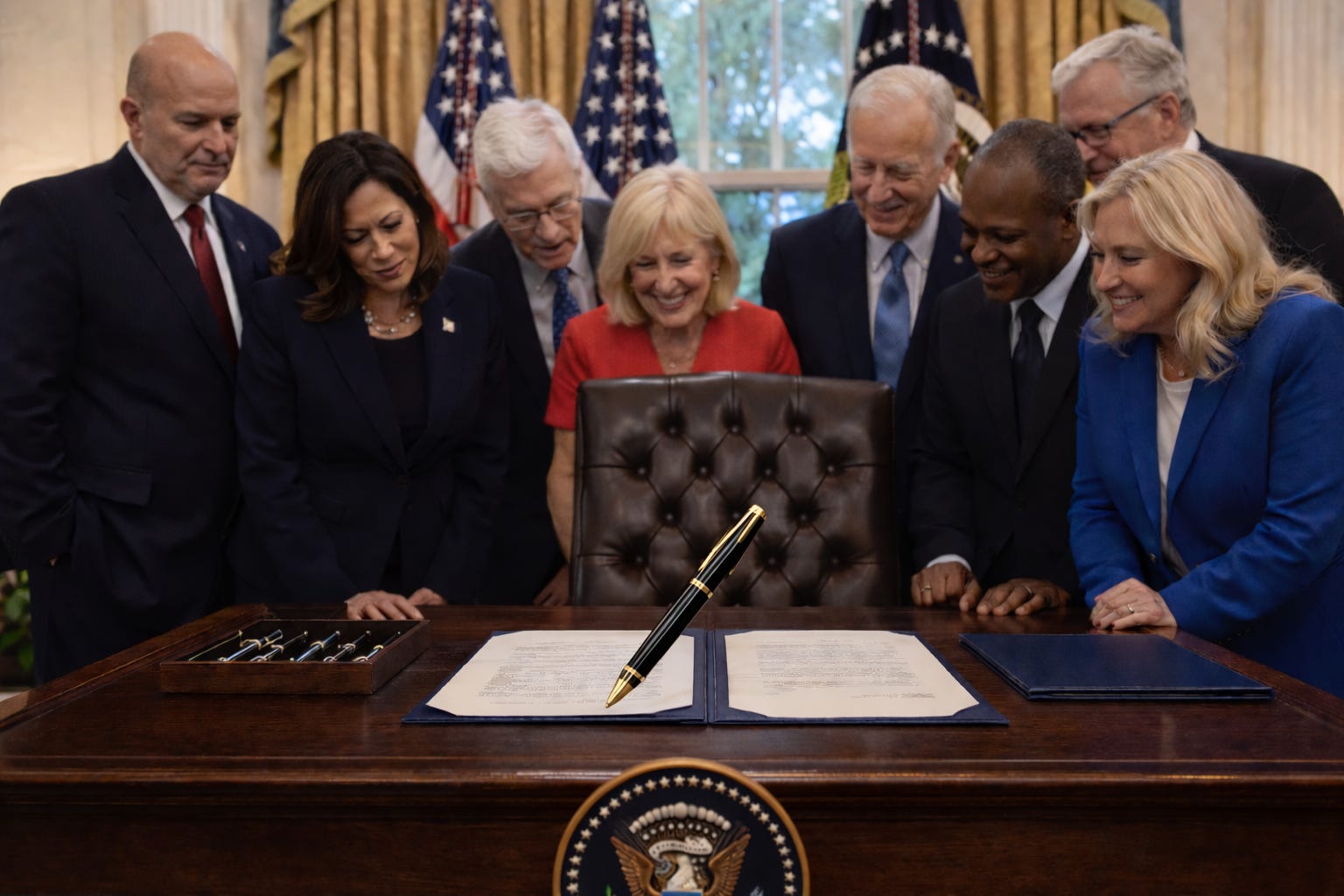
President Trump is threatening to boycott the legislative process.
In a Truth Social post on Sunday, Trump insisted that the Senate take up the SAVE America Act as its next order of business. “It must be done immediately. It supersedes everything else. MUST GO TO THE FRONT OF THE LINE,” he said.
The measure, at least in Trump’s mind, keeps getting bigger. The version of the SAVE America Act that passed the House in February would require everyone in the country to provide proof of citizenship when registering to vote and photo ID when casting a ballot. In his Truth Social post, Trump said that the legislation should expand to include another change to election rules: “NO MAIL-IN BALLOTS EXCEPT FOR MILITARY - ILLNESS, DISABILITY, TRAVEL.” And he also called for two other additions that have nothing to do with voting: provisions banning transgender participation in women’s sports and gender reassignment surgeries for children.
And here comes the threat: “I, as President, will not sign other Bills until this is passed,” Trump said, “AND NOT THE WATERED DOWN VERSION - GO FOR THE GOLD.”
As a practical matter, this ultimatum doesn’t matter much. According to Article I, Section 7 of the Constitution, unless both chambers of Congress are adjourned, if the president neither signs nor vetoes a piece of legislation, it automatically becomes a law after 10 days (excluding Sunday). Notably, Trump did not threaten to veto all other bills until the SAVE America Act is passed, which would suggest that bills in the meantime will simply become law by presidential inaction.
The SAVE America Act (even without Trump’s proposed additions) is not backed by any Senate Democrats, placing it a long ways away from receiving 60 votes in the upper chamber. Unless the Senate heeds Trump’s demand to abolish the filibuster (which Republicans have so far resisted), that makes the bill highly unlikely to pass in the foreseeable future, which means Trump could go the entire rest of his presidency without a legislative signing ceremony, letting bills become law without taking the chance to receive public credit for them. (Or he will simply violate his Truth Social vow.)
There are currently six bills that have been passed by both the House and Senate, which are poised — if Trump does keep his word — to become law without a presidential signature. Three would award Medals of Honor, to Vietnam War veterans John Ripley and James Capers and Afghanistan War veteran Nicholas Dockery. The others concern tribal land, an Alaska Native village corporation, and a National Conservation Area in Nevada.
More are coming down the pike. Lawmakers are ignoring Trump’s demand that the entire legislative process be held up for one controversial bill, and continuing to churn out much less polarizing — but consequential — pieces of legislation behind the scenes. Some of them will make it very hard for Trump to keep his pledge, forcing him to choose between his push for the SAVE America Act and the natural inclination of any president to visually tie himself to popular legislation with a high-profile signing ceremony, especially before the midterms.
The clearest example here is a bipartisan housing package that is gaining traction on both sides of the Capitol.
I first covered these talks back in July, when the Senate Banking, Housing, and Urban Affairs Committee unanimously approved the ROAD to Housing Act, the first major housing package advanced by the panel in years.
The bill has now been renamed the 21st Century ROAD to Housing Act. In its latest form, the measure is 303 pages, containing a variety of policy ideas to combat the housing crisis and increase the supply of housing. The measure advanced in the Senate in a sweeping 90-8 vote last week; it is expected to receive final approval from the chamber in the days ahead.
Meanwhile, the House passed its own, 202-page housing bill, the Housing for the 21st Century Act, in a similarly lopsided 390-9 vote last month. Even as the cost of housing has skyrocketed, it has been more than a decade since either chamber of Congress has comprehensively addressed the issue — and now, all of a sudden, both of them are, in a strikingly bipartisan fashion.
There are still some kinks to iron out. The Bipartisan Policy Center has a great comparison of the two bills, but in short: both measures include provisions to streamline environmental reviews of new housing projects, increase federal multifamily housing loan limits, expand access to small-dollar mortgages, reform affordable housing grants, help veterans access housing, and increase the use of pre-approved home designs so that builders can be permitted to build homes faster.
Provisions in the Senate version, but not the House version, include the creation of a federal grant program to help fund home repairs and a $1 billion innovation fund to support communities modifying their land-use rules to build more housing. Provisions in the House version, but not the Senate version, include a new eviction helpline and the modernization of banking regulations to expand local lending. Once the Senate passes its bill, the two versions will have to be reconciled before a unified package can be sent to the president’s desk.
Notably, the latest version of the Senate bill includes a provision — championed by Trump in his State of the Union address — that would ban large institutional investors from owning more than 350 single-family homes and require them to sell their newly constructed rental properties to individuals within seven years of building them.
The Senate bill also includes a provision that has generated some controversy, banning the Federal Reserve from issuing a digital version of the U.S. dollar, known as a Central Bank Digital Currency (CBDC), though only through 2030. Many House conservatives are fiercely opposed to a CBDC, and threatening to oppose an eventual bicameral housing bill if it doesn’t include a permanent CBDC ban.
Regardless, if more than 90% of both the House and Senate will have approved separate housing packages by the end of this week, it will raise pressure on both chambers to negotiate a compromise. With 87% of Americans in agreement that finding affordable housing in the U.S. is “very” or “somewhat difficult,” a new law aimed at combatting this problem will doubtlessly be very popular — the exact sort of thing that would be great for Trump to tie himself to ahead of the midterms, to show that he is addressing voters’ urgent economic concerns.
The process of negotiating a final housing law will probably take months, though it’s highly unlikely that the SAVE America Act will be passed even by then — meaning Trump will have to choose between taking the political win of embracing the housing law and hosting a signing ceremony, or continuing his ill-fated legislative boycott.
One interesting thing about Trump’s Truth Social post is how it shows that he really only thinks about legislating through the logic of the reconciliation process.
The reconciliation process, you’ll recall, allows majority parties to skirt around the Senate filibuster and advance bills with only party-line support. It’s how the Inflation Reduction Act got passed under Biden, and the One Big Beautiful Bill Act got passed under Trump.
Reconciliation bills encourage partisan legislating. They also encourage parties to stuff all sorts of unrelated policies into one big bill, since opportunities for reconciliation bills are limited. Trump apparently wants to do this with the SAVE America Act, transforming it to become not just a voting bill, but also a host for other, unrelated Republican Party policy priorities.
The ironic thing about this is that, politically, stuffing things into one big beautiful bill is probably a defect of the reconciliation process, not a benefit. It leads to unwieldy, distracted packages like the Inflation Reduction Act and the One Big Beautiful Bill Act, which both lacked a coherent policy vision or subject area, and thus proved difficult for Biden and Trump, respectively, to sell to the public. (Trump has already tried rebranding his big bill as the Working Families Tax Cuts Act, recognizing that the current name may accurately reflect the fact that a lot of different things are stuffed into it, but gives no information about its contents, making it hard for the public to latch onto it.)
It’s probably better for a president to pass multiple different bills through Congress rather than one big one, but Trump really only knows how to legislate in the context of reconciliation, where bills are stuffed to the gills and where there is no need to consult the other party. However, reconciliation bills must be related to revenue or spending, which means the SAVE America Act would not qualify. Whether as a package, or as individual component parts, it needs to go through the normal, bipartisan legislative process where 60 votes are a requirement.
I’ve written before that legislation rarely gets through that 60-vote threshold on the most polarizing, attention-grabbing topics — which means bills on these topics either go through the partisan reconciliation process (e.g. health care bills) or fail (e.g. election-related bills proposed by both parties). This leads to the prevalent sense that Congress is highly partisan and highly deadlocked. But, as I’ve also written, underneath the surface, there are constantly bills being passed through the bipartisan legislative process, which might not be polarizing but can still be highly consequential. The 21st Century ROAD to Housing Act is a great example.


Matthew Yglesias and Simon Bazelon have called this second legislative route “Secret Congress”; Kevin Kosar has recently termed the first route “Toxic Congress.” Trump’s recent threat is as perfect a depiction of these two Congresses, and the overlooked nature of the first one, as you can imagine. He is literally pledging to prioritize the partisan legislative process over its bipartisan companion, promising not to sign anything in the second bucket unless his one big demand from the first bucket gets through.
However, bills in the first bucket are doomed to fail unless they concern revenue or spending, which means this is just a way of publicizing guaranteed failure while hiding achievable successes. Because he is saying he won’t visibly sign any of these forthcoming governing achievements (though they will become law anyway), he is only making “Secret Congress” more secret, pushing it further into the shadows. Prioritizing failure over achievement isn’t the most intuitive way to market a presidency, unless one thinks their electoral success is more premised on angering their base about things not accomplished than pleasing swing voters by alerting them to things that have gotten done. Trump, to be clear, is far from the first president to make this bet, which is why “Secret Congress” remains so secretive in the first place — and part of why Americans remain so dispirited about their legislature, despite the fact that more is getting done than they may think. Toxicity sells, many presidents and lawmakers have found; governing often doesn’t.
But promising not to sign any “Secret Congress” bills while trying to focus all public legislative attention on a “Toxic Congress” bill is a particularly blatant way of doing this.
Even amid the SAVE America Act controversy, and a war, and a partial government shutdown, and numerous other partisan controversies, the bipartisan legislative process keeps on humming in the shadows, as the housing bill shows. There are other bills advancing, too. The Senate unanimously passed a major child online privacy bill last week, one day after the House Financial Services Committee unanimously advanced a bill reauthorizing and reforming the Defense Production Act, an important Korean War-era statute.
The tragedy of it all is that, if Trump and other presidents paid attention to what gets passed (and how) and what doesn’t, even some polarizing bills currently in the “Toxic Congress” bucket would probably get passed. In the Biden era, various gangs of lawmakers succeeded in negotiating bipartisan bills on gun control, electoral reform, and other hot-button issues.
Set a gang loose on the SAVE America Act and there’s at least a chance they could come up with a broadly supported compromise, just like Tim Scott and Elizabeth Warren were able to do on housing. Maybe Republicans get voter ID (backed by 81% of the public) and Democrats could get Election Day-as-a-national holiday (backed by 72% of the public). There are plenty of reasons to think that this effort would fail, including the fact that Democratic-aligned interest groups are much more opposed to voter ID than Democratic voters. (Then again, now that the politics of voter turnout are shifting, maybe there will be a change in thinking in the coming years.)
But it’s revealing that Trump didn’t even try to fashion a bipartisan compromise, following in the footsteps of other major bills that actually are advancing across party lines as we speak, even in these most partisan of times. Nor has he done so on other issues where his executive actions could potentially be converted into a popular, bipartisan legislative agenda. On the SAVE America Act and other issues, he’s skipped straight to the partisan demand, bypassing the “Art of the Deal”-style attempts at legislative negotiation that he at least considered in his first term.
In the ultimate triumph of “Secret Congress,” however, bills will literally keep becoming law without him, even if he refuses to sign them. The legislative process marches on. The only question is whether Trump wants to play a role in it.
Damn good reporting and analysis, as always. This is more insightful than like 90% of the stuff I read in Politico, Roll Call, or The Hill
Solid analysis, well worth the read--thanks for putting all this into context. A couple of things occur to me--Trump tends to overestimate the power of his threats to Congress--with such a small majority, the GOP doesn't have the votes, even in the reconciliation process, to give him what he says he wants. As with any other second term president, his power over legislation lessens every day he is in office simply because he can't (one assumes) run again. But refusing to sign a bill makes him sound powerful to his base, few of whom have studied the Constitution in much depth.
I noticed that the bill awarding the Medal of Honor to Kareem Dockery is named the "Nicholas Dockery Act," using his middle name. Rep Jim Baird, from Indiana, the sponsor of the bill, refers to him as Kareem in his press releases. But the final bill uses that middle name alone. I noticed that all the folks receiving Medals of Honor--and all extraordinarily deserving--are white men. My 27 years in the Army helped me understand that there's almost always some political dimension to the award system, especially with the highest award. I imagine that this current review of awards is not dissimilar to what happened under earlier administrations, where records were reviewed for overlooked folks, like African-American and women soldiers.