


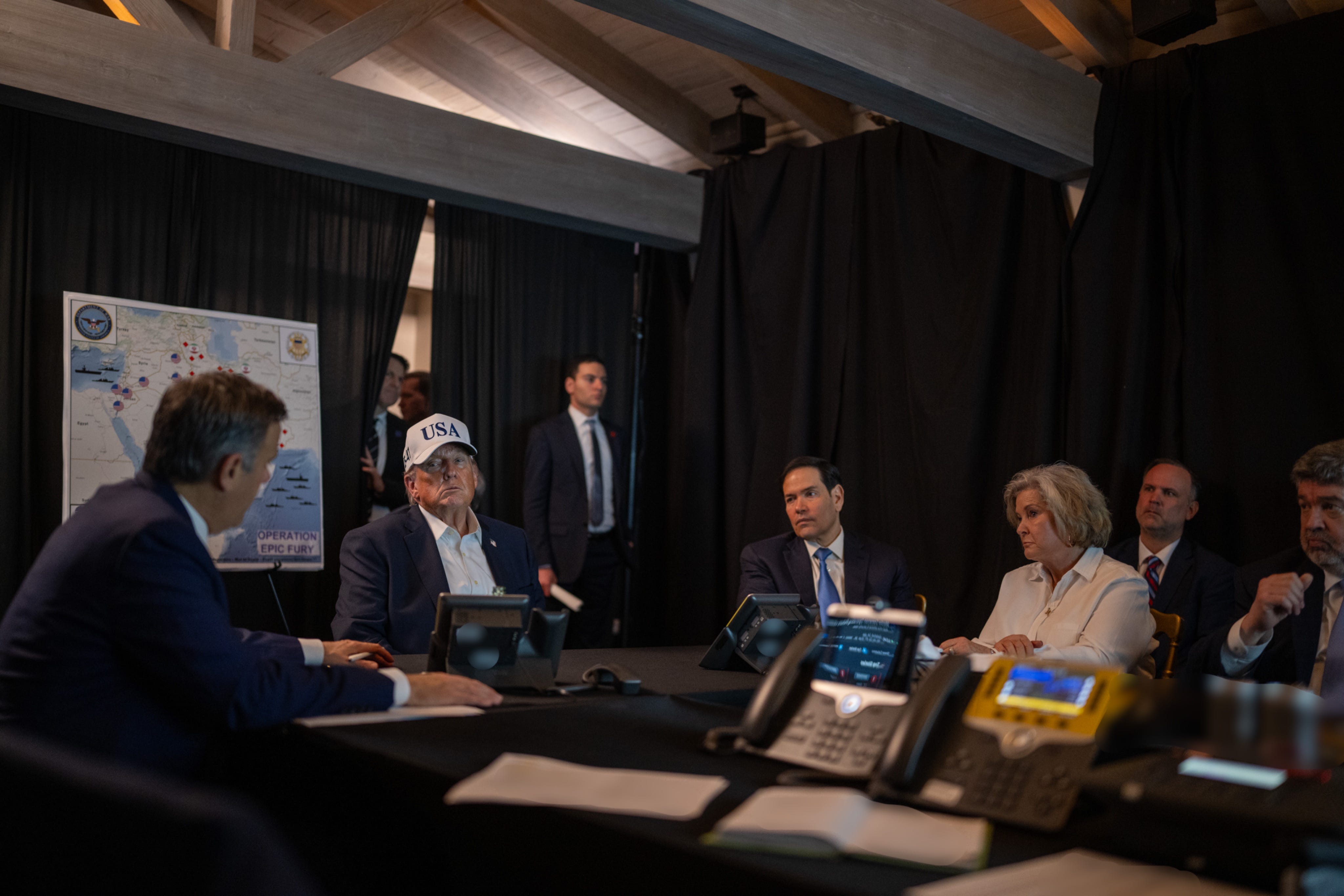
The first few days of a new war are the most crucial to win public support, which is why a military blitz abroad is usually accompanied by a flurry of activity at home.
In their book “Selling War to America,” NYU professors Eugene Secunda and Terence Moran write that voters are typically dazzled by these messaging campaigns, which are planned down to the minute. “Americans will always buy a war if it is marketed properly,” they write.
So far, Americans do not seem to be buying President Trump’s war with Iran: according to a Reuters/Ipsos poll, just 27% of Americans approve of the operation. (43% disapprove; 29% said they weren’t sure.) But then again, Trump doesn’t really seem to be marketing it. The U.S. has launched its most significant military operation in at least a decade, but from listening to the president, you’d barely know it.
Trump has shorn the playbook typically used by the White House to place the U.S. on war footing. There has been no Oval Office address by the president, dramatically announcing an attack. There has been no speech by the Secretary of State at the UN, urging allies to join an international coalition. Defense Secretary Pete Hegseth did not hold a briefing at the Pentagon until this morning, more than 48 hours after the war started.
Incredibly, that briefing today was the first time a U.S. official spoke live on television since the war started Saturday morning. Not a single Trump adviser appeared on the Sunday shows — which means the U.S. was outmatched on American television by Iran, whose foreign minister gave an interview to George Stephanopoulos. We’ve heard nothing from Vice President JD Vance or Secretary of State Marco Rubio, who also serves as National Security Adviser. Even ubiquitous spokespeople like Stephen Miller have gone silent.
The president’s main commentary has come from his Truth Social feed, where he posted an eight-minute video to announce the war at 2:30 a.m. on Saturday and then a six-minute follow-up around 4 p.m. on Sunday. Both messages were pre-recorded. When he announced the death of Ayatollah Ali Khamenei, Iran’s supreme leader since 1989, on Saturday afternoon, he did so by posting a paragraph on social media.
Trump has also spoken to several reporters who have his phone number and seem to have called him up spontaneously, representing outlets from the New York Times and the Atlantic to the Daily Mail and MSNOW. But these calls typically last only a few minutes, without the ability for the public to see Trump, or even hear him, since audio of these calls is rarely posted. He did not speak about the war live and in public all weekend.
For a president so attuned to the visual dynamics of everything, including combat, who typically loves to appear non-stop on television, it was an odd choice to announce a war basically how Theodore Roosevelt would have, with a series of print interviews.
The result has been a war that hasn’t really felt like one, led by a commander-in-chief who has appeared as a disembodied voice, quoted in news articles, but rarely seen: like the Wizard of Oz presiding behind the curtain, except behind a telephone. None of the urgency and bravado that usually comes with selling war to the American public has been on display.
The commentary we have heard from Trump has often been strangely nonchalant. In his video on Sunday, Trump announced that three Americans were killed in a counter-attack by Iran against a U.S. base in Kuwait. (A fourth death has since been confirmed.) “And sadly, there will likely be more before it ends. That’s the way it is. Likely be more. But we’ll do everything possible where that won’t be the case,” Trump said. Has any American president ever responded to the likelihood that American troops will die by saying, “That’s the way it is”?
Later on Sunday, returning to the White House from Mar-a-Lago, Trump was briefly seen by reporters, and peppered with questions about his plans for Iran and whether he had a message for the families of the service members killed. All he did was stop to look at new statues of Thomas Jefferson and Benjamin Franklin he had installed in the Rose Garden. “Unbelievable statues,” Trump said. “Come and look at them.”
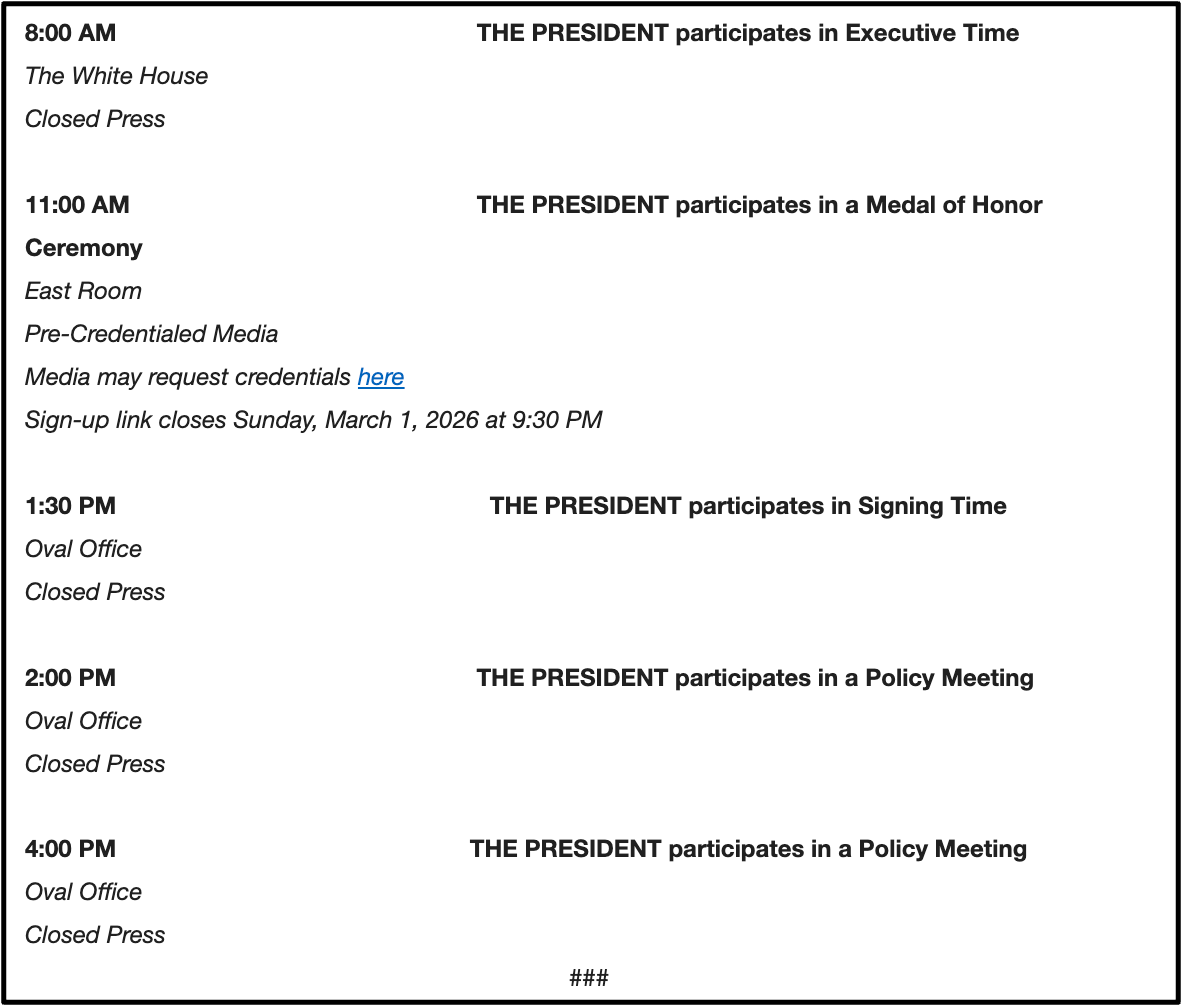
In general, his routine does not seem to have been altered by becoming a wartime leader. He still attended a GOP fundraiser at Mar-a-Lago on Saturday night. His schedule today includes blocks of “Executive Time,” “Signing Time,” and two unspecified “Policy Meetings.” He has no plans to speak specifically about Iran, although he has a pre-scheduled ceremony to award the Medal of Honor to three veterans (from World War II, the Vietnam War, and the war in Afghanistan) where he will presumably address the current conflict. White House press secretary Karoline Leavitt does not have a briefing scheduled.
Trump has also continued his normal posting cadence on Truth Social, mixing important communications about the war with posts about Georgia prosecutor Fani Willis and a 2024 news article about being endorsed by Lady Gaga’s father.
Why isn’t Trump using his usual full-force tactics to win public buy-in for the war?
Perhaps because he knows it’s a tough sell. Trump has called himself a “President of Peace,” and was elected promising to get the U.S. out of wars, not start ones. His anti-intervention rhetoric was key to his victory in 2024, including his success winning over young men and many of their favorite podcasters.
First, we were told that Trump would eschew foreign intervention. Then, we were told that he had adopted, in Trump’s words, the “Donroe Doctrine” (advancing U.S. control over the Western Hemisphere) and, as the Atlantic called it, “the One and Done Doctrine” (only using military force in short bursts, like bombing Iran last June or capturing Venezuelan leader Nicolás Maduro earlier this year).
The war with Iran puts the lie to both alleged doctrines: Iran is not in the Western Hemisphere, and even Trump acknowledges that this operation won’t merely consist of killing the Ayatollah and getting out. He told the Daily Mail that he expects the war to be “about a four-week process,” and told CNN that “we haven’t even started hitting them hard.”
Trump may be hoping that, instead of making the case to Americans why the current war fits with his previous philosophies, he can simply downplay the operation and try to limit his time in public view — so that he can ride in and take the credit if the war goes well, or try to distance himself and reduce attention to the war if it goes poorly. Ultimately, Trump knows, most voters only care so much about foreign affairs one way or the other; most members of the public would likely prefer he spend his time on the economy, but maybe they are checked-out enough on international matters that it at least won’t hurt him politically (especially if he doesn’t push it in their faces), even if it also doesn’t help.
The other possibility is that Trump hasn’t yet decided what to say.
This is the second time in as many months that Trump has toppled a foreign head of state and, as with Venezuela, it’s unclear whether he entered the operation with a coherent strategy or reason for launching the attack.
That fact could help explain why Trump’s advisers have also mostly stayed away from the spotlight at the outset of the war, because the justification is so fluid that they run the risk of contradicting him or each other.
Trump administration officials anonymously told reporters on Saturday that the U.S. had received “indicators” that Iran was planning to use ballistic missiles against American bases “potentially preemptively,” which they said was a key reason for the U.S. attack. But according to CNN, Pentagon officials acknowledged to congressional staffers at a briefing Sunday that Iran was not planning to strike U.S. forces or bases in the Middle East unless Iran was attacked first.
“This is not about choosing Iran’s next leader or forcing regime change,” Rep. Anna Paulina Luna (R-FL) said on CNN. But Trump has suggested that this is about both: in his initial message on Saturday, he appeared to call for regime change, urging the people of Iran to “take over your government.” Contrary to Luna’s statement, and Sen. Lindsey Graham’s (R-SC) that “the people will pick” Iran’s next leader, Trump has also suggested that the decision lies with him, telling the New York Times that he has “three very good choices” for the country’s next leader.
Secretary Hegseth tried to square the circle this morning by saying, “This is not a regime change war, but the regime did change.” It is not clear what it would mean to be in a non-regime-change-war that nevertheless achieved regime change. If Khamenei’s death can be considered a regime change — and Hegseth is saying that it should be — then this would almost have to be a “regime change war” by definition, since it was the U.S.-Israeli attack that killed him. Khamenei did not die by accident.
Then again, it’s not even clear that Hegseth is correct that the regime has changed, or that Trump is pushing for that outcome, since he has vacillated on that point. Although he called for a popular uprising on Saturday, he has at other points suggested that he would be comfortable with keeping one of Khamenei’s deputies in charge, much like he did with Delcy Rodríguez in Venezuela.
“What we did in Venezuela, I think, is the perfect, the perfect scenario,” Trump also told the Times.
In short, the vacuum of clear statements from Trump or his top advisers has led to a confusing mess of assertions from Republican lawmakers and anonymous officials that has created uncertainty about why the U.S. went to war or what comes next. In addition to Luna and Graham quickly being contradicted on whether the U.S. would pick Iran’s next leader, Rep. Mike Turner (R-OH) said on CBS News that Secretary Rubio told him privately “that we did not target Khamenei and we were not targeting the leadership in Iran,” appearing to suggest that Israel had killed the Iranian leader alone. All indications, including from the White House, are that this is not true; it would be helpful to hear from Rubio directly about what comments Turner might be referring to.
And then, of course, when Trump has spoken, through reporters, he has contradicted himself on both his mission and strategy, and hardly helped improve the image of a careful plan for the day after. Trump told ABC News that the next leader of Iran is “not going to be anybody that we were thinking of because they are all dead”: the U.S. had killed its own preferred successors in the attack. “Second or third place is dead,” Trump said.
One way Trump’s march to war has been similar to other presidents’ has been his decision not to seek authorization from Congress. Just as he has barely sold the war to the public, he has also expended little effort to persuade lawmakers: he had the House and Senate arrayed before him last week at the State of the Union, and he barely spoke about Iran. (Of course, that also would have been a great opportunity to make his case to the public.)
The Constitution gives Congress the power to declare war, but it also designates the president as commander-in-chief, a fact that presidents have often used to launch major military operations without congressional approval, from Harry Truman in the Korean War to Ronald Reagan’s invasion of Grenada to Bill Clinton’s bombing of Kosovo.
The War Powers Resolution of 1973 states that the president only has the power to “introduce United States Armed forces into hostilities” without congressional approval in the case of “a national emergency created by attack upon the United States, its territories or possessions, or its armed forces.” (Many presidents have argued that the resolution is unconstitutional.)
The resolution also creates a process for lawmakers to fast-track measures requiring the president to remove U.S. forces from hostilities. Democrats in both the House and Senate are set to use this process to force votes later this week on resolutions requiring withdrawal from Iran.
Both votes will likely fall mostly along party lines, but not strictly, in keeping with the fact that foreign interventionism — and particularly when related to Israel — has opened splits in both parties in recent years.
A handful of hawkish Democratic lawmakers, including Sen. John Fetterman (D-PA) and Reps. Josh Gottheimer (D-NJ) and Greg Landsman (D-OH), have expressed support for the Iran operation.
On the right, Trump is the one who breathed new life into the Republican Party’s isolationist wing over the last decade; now, he has all but neutered it. In his short time in the Senate, JD Vance made anti-interventionism his calling card; when he endorsed Trump’s 2024 campaign, he did so with an op-ed headlined, “Trump’s Best Foreign Policy? Not Starting Any Wars.” Meanwhile, Director of National Intelligence Tulsi Gabbard has spent her career railing against Middle East interventionism and the idea of going to war against Iran.
Neither Vance nor Gabbard have commented on the operation since it started, which is highly unusual for the Vice President and Director of National Intelligence in any administration — let alone one where every presidential action is normally followed by praise from his subordinates.
According to a Wake Up To Politics analysis, 98 out of 100 U.S. senators have issued statements on the Iran operation. The two exceptions are Sens. Josh Hawley and Eric Schmitt, both Missouri Republicans who have established themselves as two of the chamber’s leading isolationists. Rather than risk abandoning either Trump or their principles, the pair has chosen to stay silent.1
The few GOP isolationists who have openly criticized the operation are mostly only those who have already alienated themselves from Trump, including Sen. Rand Paul (R-KY), Rep. Thomas Massie (R-KY), and former Rep. Marjorie Taylor Greene (R-GA).
Whether hawk or dove, many Republican lawmakers are likely worried about the political impact of launching an as-yet-unpopular war in an election year — especially without even trying to make it popular and, seemingly, just hoping it will fly under the radar.
Of course, there are many ways this could go. The best-case scenario for Trump is a democratized Iran, which still likely wouldn’t bring much of a domestic political benefit, but would at least burnish his legacy. (He may then go for a three-peat, attempting to dislodge the leaders of Venezuela, Iran, and then Cuba.)
The worst-case scenario is a drawn out war: boots on the ground, American casualties, draining U.S. munitions. Not only would this be politically costly on its own terms, it could also be doubly damaging for Trump because it could run the risk of hurting the economy: the price of oil is already surging after the attack.
There is also the middle-case scenario, where Iran plods on approximately like Venezuela: led by a functionary from the old regime, not mired in chaos, but also with little having changed on the ground, while the situation has mostly dropped out of the American headlines.
Colin Powell’s “Pottery Barn rule” of foreign conflicts — You break it, you own it — is often cited, but might not necessarily apply to Trump, who is all too happy to foment chaos and then leave a situation if it isn’t going to his liking, without feeling any sense of ownership.
Within this middle case, Trump’s hope would be to cow the new functionary leader — like Rodríguez in Venezuela — into fearing that he may attack them next, so that they will do his bidding, although it’s unclear what exactly doing Trump’s bidding would look like. (Simply not attacking the U.S.? Or moving towards democracy?) The downside would be if that person doesn’t listen to Trump, and because Iran has a very different ideology and sensitive location than Venezuela, continues to attack the U.S. and its allies, potentially leading the middle-case scenario into the worst-case scenario of all-out war.
Trump, supremely confident in his abilities to steer things towards the best- or middle-case based on his experience in Venezuela, seems ready for whichever scenario comes. “I don’t have the yips with respect to boots on the ground — like every president says, ‘There will be no boots on the ground.’ I don’t say it,” Trump told the New York Post.
It is a big gamble to assume the American public — especially one to whom a concrete case was never made as to why the war was started in the first place — will feel the same.
I think you're making the assumption that he has some large goal in mind, but I don't think he does. There's literally no plan here except the military attacks. That's why he's not doing what other presidents have done in terms of selling this war.
Several months ago, an anonymous Republican insider said what surprised him most about Trump in his second term is that "just doesn't give a f*ck." This may be an example of exactly that, his utter contempt for the American people--he'll shaft his own voters as well as his political opponents simply because he can. This is the result of his improbable re-election and the GOP-led Congress choosing to neuter itself.
A man who thinks like this honestly does not care about casualties. Speaking as a Gulf War veteran, I find that the scariest part of all.
Trump's "sales pitch" (in so many words): "I know that some troops will die, but, that's a chance I'm willing to take."