


Happy Friday! Janet Mills is out, Jay Powell is staying put, and the DHS shutdown is about to end.
But the week’s biggest news arguably came from the Supreme Court, where the justices handed down their decision in Louisiana v. Callais, a landmark ruling on redistricting and the Voting Rights Act.
There are a lot of takes flying around about the VRA decision. It’s caused what you might call a “horseshoe reaction”: on either end, you have Democrats who are mournfully saying the ruling was a sweeping one, and Republicans who are gleefully agreeing. And then you have voices in the middle on both sides, who say the ruling will have a more limited impact.
To get the real answers, I spoke to one of the sharpest minds out there following redistricting: Zachary Donnini, the Director of Data Science at VoteHub, which is a great platform for election analysis, maps, and data.
What’s so great about Zachary is he’s a mapmaker himself, someone schooled in the art of slicing and dicing congressional districts to produce different results. It’s hard to really understand the Callais decision and what it will mean without looking at the maps themselves. In our conversation, Zachary pulls up election maps he’s created, in order to give a sense of some of the extreme gerrymandering scenarios that could result from this decision.
He’ll walk us through the sorts of maps we can expect after Callais, the lingering questions left open by the ruling, and the ways each party can take advantage of the decision. Plus, he’ll also give us a look inside redistricting software, to get a sense of how these party operatives produce maps that are slanted one way or the other.
The full conversation is available for paid subscribers. I think it will be worth the watch — but if you prefer to read, I have an overview of the Callais decision for you below, plus takeaways from my conversation with Zachary about what to expect and which districts to watch in the weeks and months ahead.
Let’s dive in!
How we got here
The Voting Rights Act (VRA) was signed into law in 1965 to combat racial discrimination in elections. The law includes several provisions, many of which have come before the Supreme Court in recent years.
Section 5 of the VRA required certain states and counties with a history of discrimination to preclear any changes to their voting laws with the Justice Department. The Supreme Court struck that down in 2013, in a case called Shelby County v. Holder.
Section 2 of the VRA prohibits racial discrimination in voting practices. The Supreme Court previously limited that section in a 2021 case called Brnovich v. DNC, which made it harder to bring challenges under the VRA against state election laws.
Louisiana v. Callais is about challenges under Section 2 as it regards state redistricting plans. This, too, has come to the court before, including in a 1980 case called Mobile v. Bolden. In that ruling, the Supreme Court said that election maps were illegal only if they were intentionally discriminatory. Congress pushed back against this ruling by amending the Voting Rights Act in 1982, but what they was passed was pretty vague.
The new language said that a map violated the VRA if “based on the totality of circumstances,” it can be shown that members of a racial group “have less opportunity than other members of the electorate to participate in the political process and to elect representatives of their choice.” But it also said that “nothing in this section establishes a right to have members of a protected class elected in numbers equal to their proportion in the population.”
Liberals have long pointed to the first part to argue that the language requires setting up majority-minority districts where feasible, in order to ensure minority voters are able to “elect representatives of their choice.” Conservatives have long pointed to the second part, to argue that the law explicitly says it is not requiring minority voters to be granted dominance in an equal number of districts to their proportion of a state.
The Supreme Court then took this up in Thornburg v. Gingles in 1986. Their ruling produce a three-prong test, which said that in situations where a minority group is “politically cohesive” and “sufficiently large and geographically compact to constitute a majority in a single-member district” and where a majority group “votes sufficiently as a bloc to enable it…usually to defeat the minority’s preferred candidate,” then a majority-minority district is required under Section 2 of the VRA. That’s been the rule ever since.
The Louisiana case
Louisiana v. Callais itself has been a long-running legal saga, dating back to 2022, when Louisiana first adopted a new congressional map after the 2020 census. (Back in the old days — a few years ago — states generally only redistricted every 10 years after the census.)
The map only included one majority-Black district; a group of Black voters sued, arguing that a second area of Louisiana fit the conditions laid out in Gingles, which meant the state should have a second majority-minority district under the VRA. A federal judge agreed and ordered Louisiana to create a map with two majority-Black districts, which was used for the 2024 elections.
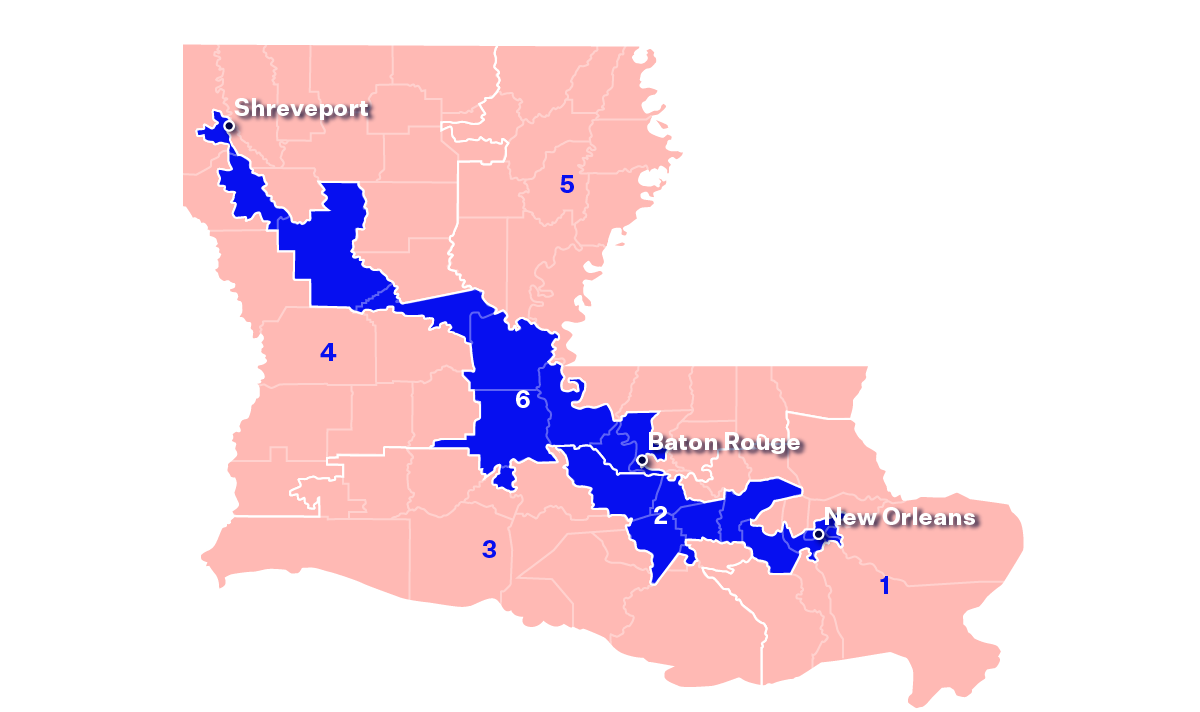
This time, a group of non-Black voters brought a challenge, arguing that they were discriminated against by the new map’s explicit use of race. They said this was a violation of the Reconstruction-era 14th and 15th Amendments prohibiting discrimination on the basis of race (the same amendments the VRA had been passed to effectuate). That question — whether election maps can take race into account, even to prevent discrimination against minority voters, without running afoul of the Reconstruction-era Amendments’ prohibitions against race-based voting laws — is at the center of Callais.
What the decision said
The court split 6-3, along ideological lines, with Justice Samuel Alito writing for the conservative majority. There was speculation ahead of the ruling that the court might overturn Section 2 of the VRA entirely, finding that it required states to illegally incoprorate race in contravention of the 14th and 15th Amendments.
But Alito said they weren’t going that far. Instead, the court struck down just the Louisiana map, finding that its creation of a second majority-Black district was unconstitutional. The court didn’t overturn Gingles, the reigning precedent, but it instead updated the Gingles test, ruling that majority-minority districts should only be set up where “voters engage in racial bloc voting that cannot be explained by partisan affiliation” and to combat “present-day intentional racial discrimination regarding voting.”
The ruling can only be understood in the context of Rucho v. Common Cause, a 2019 case where the Supreme Court said that partisan gerrymandering is a non-justiciable question — in other words, that the court does not get involved in deciding what is or isn’t a partisan gerrymander. Therefore, Alito said, for the court to get involved in a racial gerrymandering case, voters challenging a map will have to “disentangle race from politics in proving their case.” Challengers will have to prove a state is engaging in racial gerrymandering (which is illegal), not simply partisan gerrymandering (which the Supreme Court said it will not intervene against). Were Louisiana Republicans trying to slice up voters because of their race, or because of their party?
In her dissent, Justice Elena Kagan (writing for the court’s liberal wing) argued that this ruling would render Section 2 “all but a dead letter,” writing that as long as a state has “left behind no smoking-gun evidence of a race-based motive,” it can simply limit minority voting power by claiming to implement a partisan gerrymander.
In a concurrence, Justice Clarence Thomas (joined by Justice Neil Gorsuch) echoed Alito, but said that he would go even further, arguing that Section 2 of the VRA doesn’t cover redistricting claims at all, because it only prohibits states from imposing a race-based “voting qualification,” “prerequisite to voting,” or “standard, practice, or procedure.” Thomas said that none of those categories describe redistricting.
What’s next
This is what I really dug into with Zachary Donnini and, friends, there’s a lot we still don’t know.


