


One of my favorite “what-if” moments in recent political history is from January 2021.
No, not Trump’s second impeachment trial — though that is a fascinating one. It’s from the days surrounding Trump’s lonely departure from Washington after Joe Biden’s inauguration, when he was reportedly giving serious thought to starting a new political party called the “Patriot Party.”
Unlike other people who have thought about starting a third party, like Andrew Yang, Tucker Carlson, or Elon Musk, Trump — even in his weakened, post-January 6th state — might have had enough electoral clout to throw an interesting wrench into our calcified political system. It would have been a fascinating experiment to watch.
Then again, if Trump was running his own operation intent on destroying the Republican Party, what would he be doing differently right now?
He has endorsed primary candidates, like Ken Paxton in Texas, who were opposed by the party’s leadership and have made it more difficult for the GOP to maintain control of the Senate. He has focused on priorities, like 2020 election denialism or the “Anti-Weaponization Fund” or the White House ballroom, that are broadly unpopular and wholly specific to his interests and desires.
He has basically set up a rival national party committee — his super PAC, MAGA Inc. — that has more cash on hand ($400 million) than the actual Republican National Committee ($129 million). The MAGA Inc. purse strings are controlled purely by Trump’s political team, and so far, he doesn’t seem to be in a rush to disburse any cash to Republican candidates. According to FEC filings, the super PAC has only boosted two candidates this year, and they’ve both been competing against other Republicans: $17,900 for Clay Fuller, Trump’s chosen candidate to succeed Marjorie Taylor Greene, in the first round of a special election in Georgia, and $560,000 for a group backing a primary challenge against Thomas Massie in Kentucky.
Meanwhile, MAGA Inc. has paid Trump properties six different times (for a total of more than $38,000) to rent them out for fundraisers. Republicans are reportedly starting to panic about how much money the super PAC is sitting on, with fewer than four months to go until the midterm elections.
On policy, polls show that this will be a cost-of-living election (although, really, what election isn’t?)
Trump has made Republicans more vulnerable on nearly every cost-of-living issue Americans care about. According to a Reuters/Ipsos poll, 26% of voters say that health care is the most important cost on their mind. (Trump’s Big Beautiful Bill slashed Medicaid spending, and Trump let the enhanced Obamacare subsidies lapse.) 21% answered housing. (Trump canceled a signing ceremony for a major bipartisan housing bill, calling it “unimportant” and a “big yawn.”) 17% said food. (Trump’s tariffs have raised the cost of groceries.) And 14% said gas. (Trump’s war in Iran has raised the price of gas.)
In fairness to the president, he was aligned with Republican Party leadership on Medicaid cuts and the Obamacare subsidies. But on the other three issues, he has damaged the Republican Party’s political standing entirely by himself. Many White House advisers and GOP lawmakers urged Trump not to blow up the housing bill, or impose his tariffs, or go to war in Iran. He ignored them; in November, rank-and-file Republicans are likely to be the ones to pay the price.
This morning, I want to give an update on the last two issues: tariffs and Iran, both of which are surging back into the news this week. The Iran war has very obviously started heating up again; less attention-grabbing has been the fact that Trump’s trade wars are about to re-escalate. Neither is particularly welcome news for Republican candidates.
I’ll break down where things stand in the Middle East, and also give you a glimpse at the new tariff developments to watch out for. When we last discussed Trump’s trade war, the Supreme Court had dealt a fatal blow to his worldwide “reciprocal” tariffs. The president is now experimenting with new legal authorities to impose replacement tariffs, right in time for the midterms. Let’s dive in.
If you appreciate my work analyzing the political environment and looking ahead to issues other outlets aren’t talking about, please consider subscribing to support Wake Up To Politics. You’ll receive access to special bonus features, like Q&A editions and exclusive analysis columns.
Iran
I’ve written before that voters way overestimate how much the president (any president) can do to impact the economy. It’s not as if there’s a big “MAKE ECONOMY BETTER” button on the Resolute Desk that the president can smash.
Except, in Trump’s case, there kind of is?
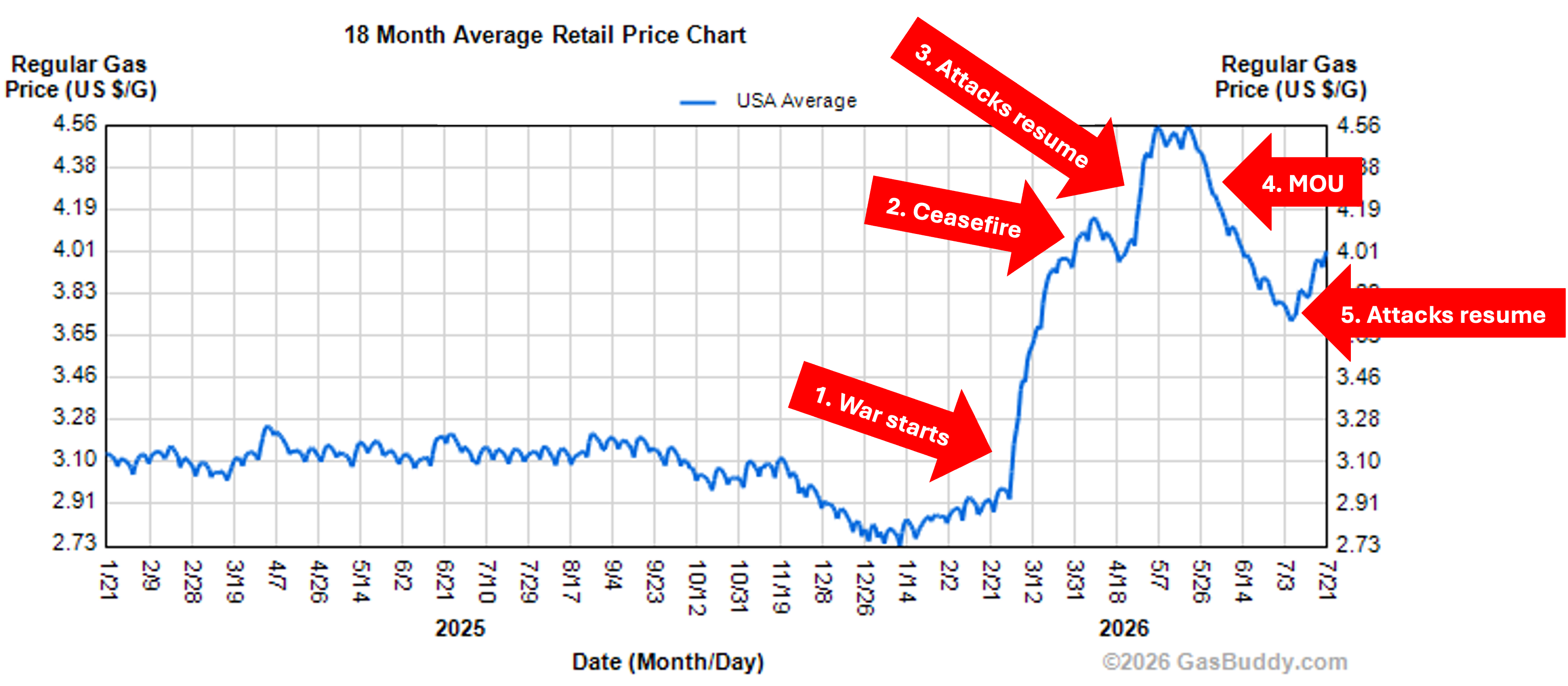
Here is GasBuddy’s chart of average U.S. gas prices over the last 18 months. It almost perfectly correlates with the state of the war in Iran. You can see prices chug along at the $3/gallon level (or even lower) for most of Trump’s first year in office. Then, they shoot up in March 2026 when the war starts. They drop slightly after a ceasefire was inked in early April, before spiking up again as negotiations stalled and attacks resumed. Prices then drop again as talks pick up and eventually produce a memorandum of understanding in June.
Finally, after attacks resumed in the last few weeks, gas prices started ticking up again. On Monday, the average price of gas in the U.S. went back up above $4/gallon for the first time since mid-June.
Trump’s approval rating moves according to the exact same pattern. When the war started, his net approval rating (per Nate Silver’s average) was about -12%. By mid-May, the peak of the gas price increase, Trump’s popularity had slid to a low of -20%. It started picking up a bit as attacks slowed, going back up to -16%. Now, with fighting back on, he is back down to -18%.
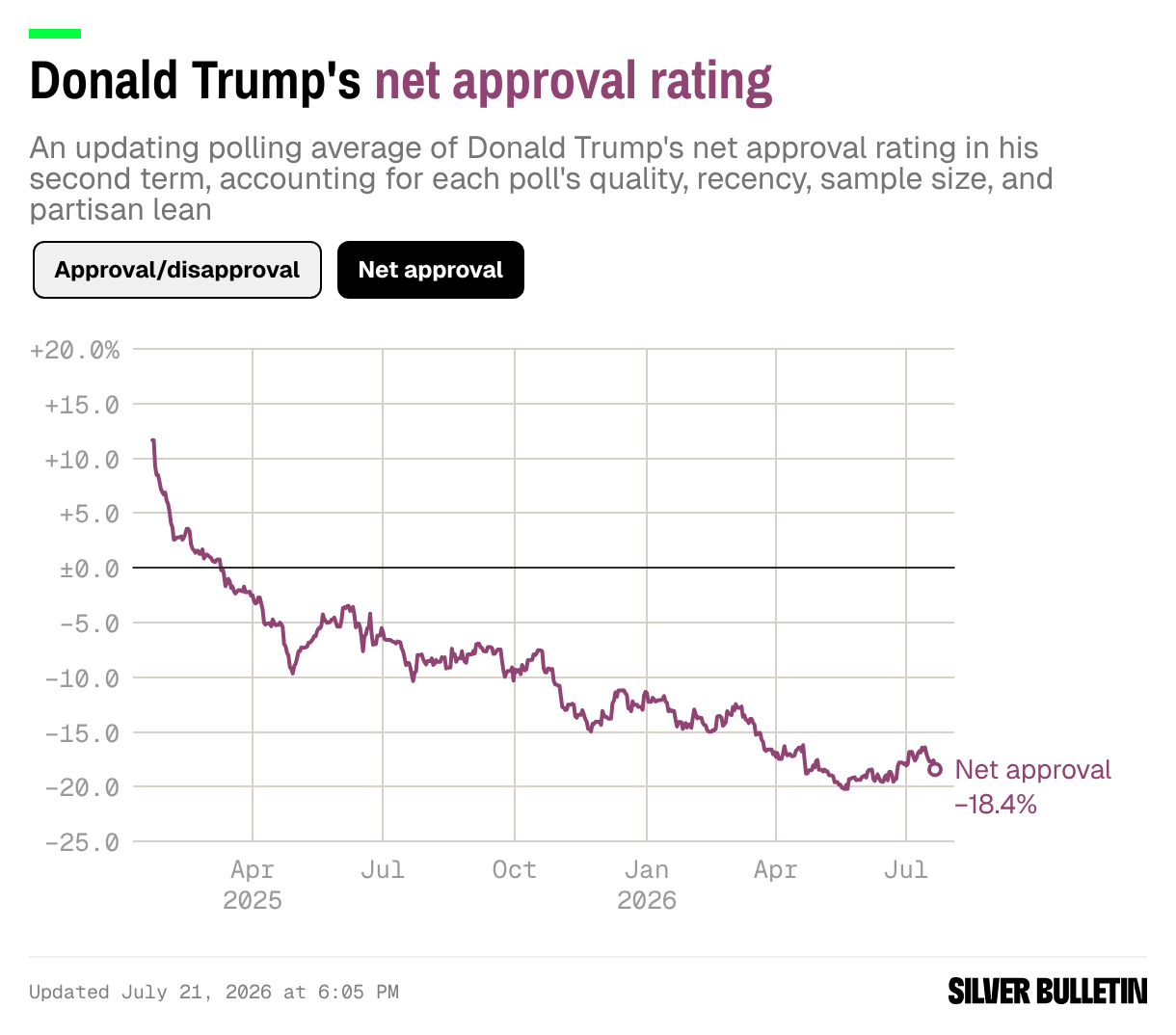
Every new round of attacks appears to drive gas prices ever so slightly up, and Trump’s approval rating ever so slightly down. Trump may not have it in his power to suddenly reverse the direction of the economy — but it does appear possible to make it at least a little bit better, which could be good for at least a few more House seats saved for Republicans. All he has to do is keep things quiet on the Middle Eastern front.
Unfortunately, now that Trump has opened this particular Pandora’s box, it is proving difficult to find a scenario under which a) the U.S. and Iran are not attacking each other; b) the Strait of Hormuz remains open and toll-free; and c) Iran makes enough nuclear concessions that Trump can credibly say the whole thing wasn’t a waste of time.
Trump is confident that he has leverage over Iran because of his ability to pummel the country with superior military might. Iran is confident that it has leverage over Trump because of its ability to shut down the Strait of Hormuz. And, for those reasons, neither is in any rush to make significant concessions, which places us in a stalemate with no clear end.
With the short-lived memorandum of understanding now officially ditched by both sides, and casualties mounting as fighting picks back up — three American service members have been killed and almost 100 have been wounded in the last two weeks — the next few days will present a critical crossroads to either return to a ceasefire or all-out war.
According to Axios, a group of regional mediators (Qatar, Egypt, Pakistan) have presented the U.S. and Iran with yet another 10-day ceasefire/open-the-Strait proposal. Trump is reportedly considering this, although the Wall Street Journal reported last week that he is leaning towards expanding military operations instead. He said Tuesday that he would be bombing the Pickaxe Mountain site, where Iran is believed to be hiding thousands of uranium-enrichment centrifuges, “pretty soon and very heavily.” The Journal said that Trump was also considering deploying ground troops to Iran’s Kharg Island, which would be a major escalation.
“From this point forward, any time the Islamic Republic of Iran shoots at a ship in the Strait of Hormuz, whether it be by Missile, Rocket, Drone, or any other device or weapon, the United States will bomb and destroy ONE BRIDGE OR POWER PLANT, including those located next to, or in, the Capital City of Tehran,” Trump threatened this morning on Truth Social.
According to the Washington Post, U.S. intelligence agencies have assessed that Iran is unlikely to change its negotiating position based on additional American attacks. Trump is in a trap of his own making, with no easy escape route. And Republicans, whose political fortunes are tied to gas prices, are stuck with him.
Tariffs
When the Supreme Court ruled in February that the International Emergency Economic Powers Act (IEEPA) did not empower the president to impose tariffs, it removed the most powerful weapon (purported to be) in Trump’s tariff arsenal. There are many statutes in which Congress delegates tariff power to the president, but they all come with a catch: either a limit on how high the tariffs can go, or how long the tariff can last, or certain steps that an administration must take before imposing them.
IEEPA had none of that (except for requiring a national emergency declaration, which just means the president has to sign his name on a dotted line). Unfortunately for Trump, the Supreme Court said that the law didn’t apply to tariffs at all, so that statute was crossed off the list.
Plan B was Section 122 of the Trade Act of 1974, which was appealing because it plainly allowed the president to impose tariffs and there were no steps that had to be taken before imposing them. The downside was that the tariffs could only go up to 15% and they could only last for 150 days.
On the day of the Supreme Court ruling, Trump used Section 122 to impose 10% tariffs on every country in the world. The one detail I didn’t mention: Section 122 tariffs can only be used to address a balance-of-payments deficit, a type of currency crisis that most experts agree the U.S. is not in the throes of. Several Democratic-led states sued on these grounds; a lower court ruled in May that the new tariffs were illegal, though an appeals court paused the ruling in June and allowed the tariffs to remain in effect during litigation.
The appeals court has yet to actually rule on the merits of the Section 122 tariffs, but the slow-moving nature of the legal system is about to be lapped by reality: the 150-day clock runs out on Friday, which means the tariffs expire anyway.
After that, Trump’s advisers have reportedly urged him to go easy on the tariffs, worried about the economic implications for November. Trump has overruled them.
The next tool up will be Section 301 of the 1974 Trade Act, which has no limit on tariff rates and allows tariffs to be imposed for four whole years. They can only be imposed after an investigation by the U.S. Trade Representative (USTR) into whether countries are engaging in practices like forced labor. Sure enough, the USTR completed such an investigation last month, recommending 10% tariffs on trading partners including Canada, Mexico and the European Union, and 12.5% tariffs on countries including China, India, Japan and South Korea. In total, the USTR said 59 countries (plus the 27-nation EU) would be impacted, covering 99% of U.S. trade.
Trump already moved last week to impose 25% tariffs on Brazil under Section 301, which will impact products including farm machinery, wood products, ethanol, and apparel, per Reuters. More Section 301 tariffs are likely to come soon, once the Section 122 tariffs lapse.
In addition, Trump also announced Monday that he was imposing 50% tariffs on Canada, using yet another legal tool: Section 338 of the Tariff Act of 1930 (better known as the Smoot-Hawley Act), which allows tariffs of up to 50% for any amount of time and without any prior investigative steps needed, in order to retaliate against trade actions by other countries. Products including wine, hockey sticks, cement, and dairy products will be impacted.
These new tariffs will likely trigger new legal battles questioning whether Trump is using these statutes correctly. But whatever the result of those court fights, tariffs are about to be showing back up in headlines (and in consumer prices) after a period of relative quiet — which is more bad news for Republican candidates. Politico already has a report up about the troubles the new Canada tariffs could cause for the Maine economy, and thus for Sen. Susan Collins (R-ME), the GOP’s most embattled Senate incumbent.
“A lot of our blueberries, our potatoes, our lobster, our lumber are harvested in Maine, processed in Canada and then come back. I don’t want to see the tariffs on the books,” Collins told Politico, a sign of how these new duties complicate her political standing.
By writing about all this, I’m not actually suggesting that Trump wants Republicans to lose the 2026 midterms. Rather, it seems, he just doesn’t care. In the past, Trump has called it a “great compliment” that Republicans perform poorly when he’s not on the ballot. I don’t think he’ll mind running up that score, nor does he mind having his adversaries elevated: Trump is never stronger politically than when he has has an enemy to play off of. (There’s nothing he’d love more than another impeachment.) He is never weaker than when the spotlight, and the responsibility of governing, is all on him.
Trump does not seem especially attached to the idea of Republicans remaining in control of Congress, especially since he believes (rightly or wrongly) that his best path to getting things done runs through the White House. Republicans are likely to lose the House in November no matter what, but their ability to stave off deep losses there (and to keep control of the Senate) could hinge on Trump keeping his two wars — trade and Iran — in a holding pattern. He seems to be leaning towards the exact opposite.
A few thoughts.
I do not need to be in the head of the real estate mob boss posing as President to know that he does not care. His actions and words are that of a pathological lying, malignant narcissist. He didn’t care then, he doesn’t care now and he won’t care in the future.
He can’t care. His pathology does not allow it. Therefore, phrases like “to be fair to the president” are unnecessary. He is no better than a broken clock that is right twice a day. He deserves none of our concerns about fairness.
It’s shear, dumb luck when he stumbles onto something that makes sense or seems right. He and his sycophantic self-empretzeling administration go out of their way to be cruel, capricious, careless and corrupt. The result of this chaos in our most basic institutions causes real harm and death. The damage of all the senseless wrongs continue to pile up and the most vulnerable continue to suffer.
I say this “to be fair to the president”. Seriously.
Just hope that if the Democrats do win control of congress in November they start enacting legislation that addresses the country’s needs and they do not get lured by the siren song of another attempt at Trump impeachment.