


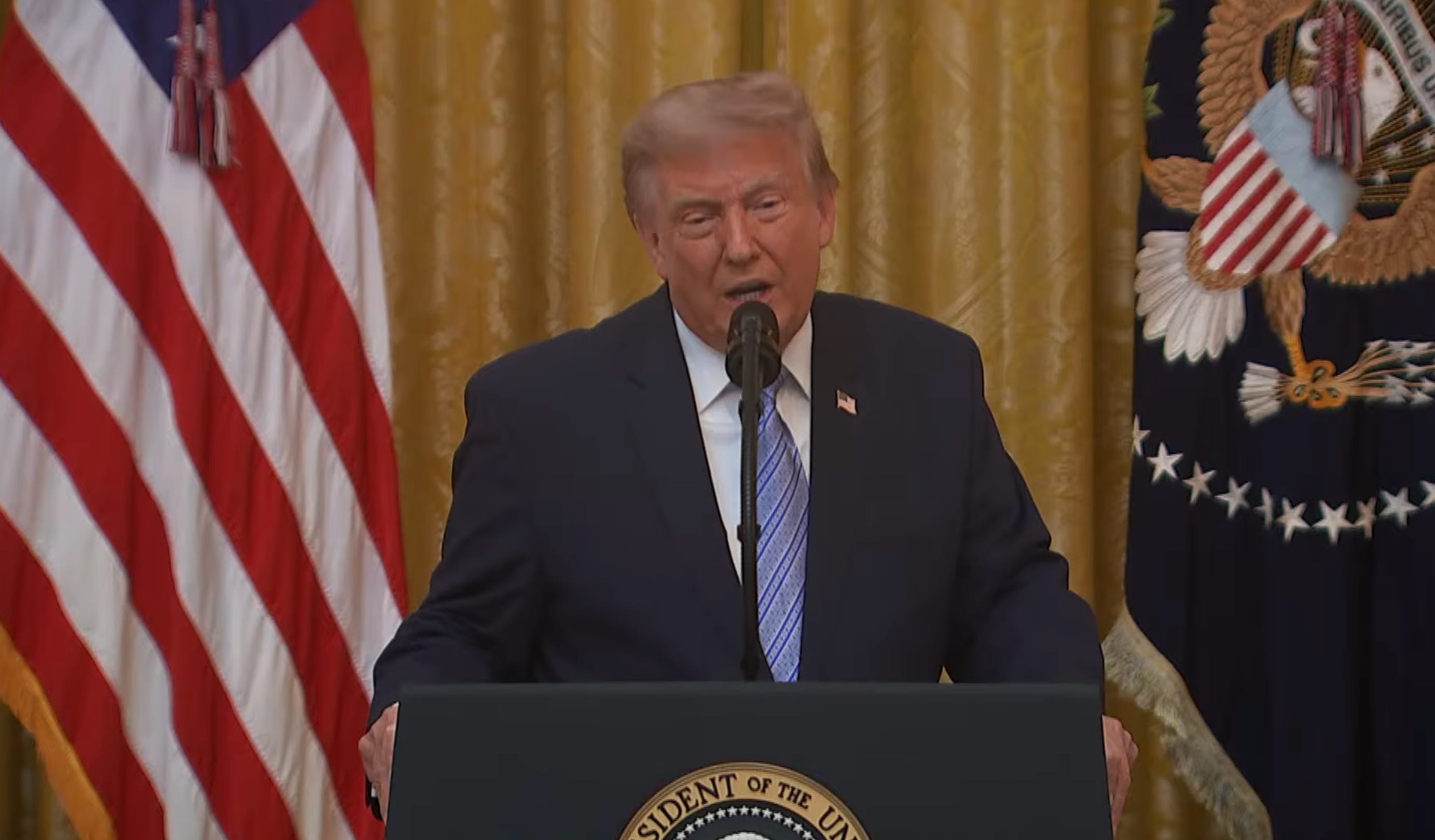
President Trump addressed the nation in primetime last night, a format that previous presidents have used to discuss terrorist attacks and peace plans.
Trump’s topic was an election that he lost six years ago. The president declassified reams of documents to support his declaration that the U.S. election system is “worse than any third world country.” The documents are available for download at whitehouse.gov/election-integrity, and if you have some time today, I recommend you spend some time checking them out.
Once you do, you will see that few of Trump’s claims stand up to scrutiny:
The president alleged that China acquired 220 million U.S. voter files during the 2020 election cycle and following years. But the documents do not show that China hacked its way to any of this information. In many states, voter files are freely available; the documents explicitly show that at least some of the data was in China’s possession simply because it downloaded it from public websites.
The president alleged that China “fought like hell” to prevent him from winning in 2020. But the documents show that the intelligence community was divided on the extent to which China attempted to influence the 2020 election. The consensus view was that “Beijing has not deployed influence efforts intended to change the outcome of the US Presidential election.” There was also a minority view among intelligence agencies that China had taken some steps to stage a social media campaign to harm Trump’s re-election prospects, though these officials also agreed that there was “no reporting to suggest that China” was “trying to compromise voting infrastructure or interfere with mail-in ballots.”
The president alleged that “China’s activities even included an attempt to manufacture illegal ballots for Joe Biden.” But the documents show that this allegation came from a source who claimed they were told it by a source who claimed they were told it by unidentified Chinese officials. The claim was never corroborated, and in any event, there was never any indication that China followed through with this scheme (if such a scheme even existed).
The president alleged that the “CIA obtained reporting of a specific plot” by the Maduro regime in Venezuela to “digitally rig their own country’s elections in 2020.” The documents do show attempts by the Venezuelan government to meddle in their own elections, though it is not clear if the attempts were successful. To the extent Trump was mentioning this to try to imply that the U.S. is vulnerable to similar attempts — his allies have frequently noted that Smartmatic, the same voting machine company used in Venezuela, is also used in Los Angeles County — the CIA also concluded that the Venezuelan government’s efforts “rest in part on its ability to control every stage of the electronic voting process,” a level of control that it would lack “during an electoral process outside Venezuela.”
The president alleged that the FBI was contacted about “alleged fraud by a large-scale voter registration operation in Michigan.” It is true that 8,000-10,000 fraudulent voter registration forms were delivered to a county clerk in Michigan in 2020, but this has been known about for years, and the applicants were never added to the state’s voter rolls because the scheme was caught before Election Day.
The president alleged that a federal review had “identified approximately 278,000 non-citizens who are registered to vote in federal elections.” But the documents do not show evidence to support that claim, which was developed through a database that is known to produce false positives. He also did not allege that any of the alleged non-citizen registrants had successfully cast ballots.
There is also information in the documents that Trump did not see fit to mention in his speech, including intelligence assessments that Russia staged influence operations to hurt the Biden campaign in 2020 — though, as with China, there is no evidence that either country actually interfered with voting infrastructure or manipulated a single vote.
In sum, Trump’s speech serves as a convenient metaphor for his second term as I’ve described it over the last year and a half: a lot of hype and build-up — Sen. Bernie Moreno (R-OH) said it would be the “most important Oval Office address since the Cuban Missile Crisis” — but little in the way of substantive policy change.
No new election policy or executive order was announced. Many of the executive actions Trump has previously taken in this area have been blocked by a judge, while the piece of legislation the speech was aimed around promoting (the SAVE America Act) remains stalled by the Senate filibuster.
In 2018, Special Counsel Robert Mueller produced a detailed indictment of the Russian nationals he alleged had meddled in the 2016 election. The Trump administration has, so far, released nothing about interference in the 2020 election that could be tested in a court of law. If they have information that could lead to a criminal conviction, they should put it in an indictment. Otherwise, Trump is simply speaking into the void.
While the focus of last night’s speech was election security, Trump also gave himself a brief progress report for his presidency (“we are the hottest country anywhere in the world”). In that spirit, I wanted to take this opportunity to give myself a progress report on covering his presidency. The events of the last few days — the speech, but also the latest developments in Iran and elsewhere — fit fairly neatly into the broader view of Trump’s presidency that I’ve been articulating. I want to hold that view up to scrutiny, looking at where I’ve been right about Trump 2.0, and where I’ve missed the mark: