


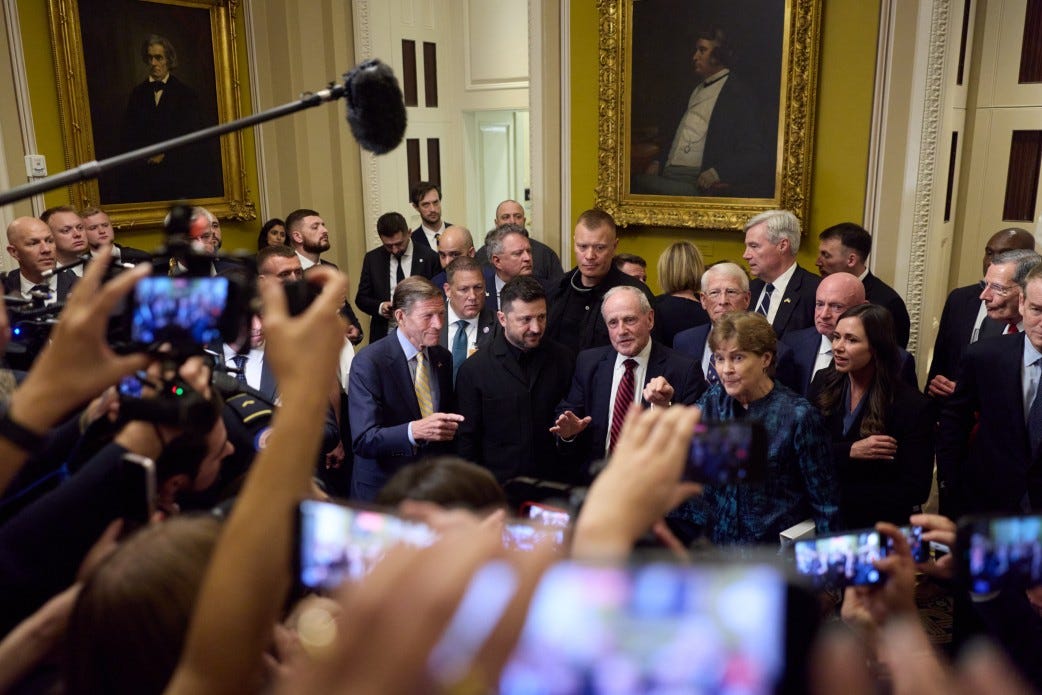
The late Sen. Lindsey Graham (R-SC) received three tributes in Washington on Tuesday.
The first was a memorial in the Capitol Rotunda, where Vice President JD Vance, Senate Majority Leader John Thune (R-SD), and other dignitaries saluted Graham’s career in public service. The second was a funeral at the National Cathedral, where President Donald Trump was among the eulogists. The third, fittingly, came from Graham’s home of 23 years: the Senate floor.
In a whopping 86-12 vote, the Senate voted to advance the bill now known as the Lindsey O. Graham Sanctioning Russia and Iran Act, which the South Carolina senator was working on right up until he died.
The measure was notable for several reasons: in relation to Graham’s legacy; because of the effect it will have on the wars currently being fought in Ukraine and Iran; and because it represents the first time in Trump’s presidency — after more than a year of tariffs being at the forefront of conversation — that Congress is poised to actually authorize new tariffs.
That’s right: a bill just advanced in the Senate to expand Trump’s tariff powers … and 77% of Senate Democrats voted for it. That seems like a bill worth digging into.
The latest version of the legislation is 61 pages long, but I can give you the quick-and-dirty. If enacted, the bill would:
Impose sanctions on Russian President Vladimir Putin and other Russian leaders, oligarchs, companies, banks, and energy projects, as well as any other foreign individuals aiding the war against Ukraine.
Extend a slew of sanctions on Iran (which are currently set to expire in December) for five more years.
Prohibit Americans from investing in Russia.
Impose tariffs of up to 500% on Russian goods.
Impose tariffs of up to 100% on goods imported from countries that purchase oil or gas from Russia going forward, or were among the top five buyers of Russian oil or gas in the past year (a list that includes China, India, Japan, South Korea, and the European Union).
The bill offers a significant amount of leeway to President Trump. He is required to impose the sanctions and tariffs detailed in the legislation, but can terminate those levied on individuals or countries outside of Russia if he certifies in writing to Congress that he has “received reliable assurances” that they will no longer engage in the behavior they were being punished for. (Lifting the sanctions on Russians themselves will require the president to certify that Russia has signed a peace deal with Ukraine or “ceased all military hostilities” there.)
At several points, the measure also gives the president authority to decide exactly who to target: he is able to sanction any foreigners who “undermine the peace, security, political stability, or territorial integrity of Ukraine,” which is a pretty broad category. Determining which countries fit the bar for tariffs described by the bill is largely left to the president, as is setting the tariff rate anywhere between 0% and 100% (or between 0% and 500%, in the case of Russia itself).
However, Congress would still reserve some say in the process. The language of the bill says that the president “shall” impose the various sanctions and tariffs (not that he “may”), which means the default will be that the president must follow Congress’ will, unless he gives a specific reason to ease off. If the president does decide to lift the penalties, Congress would be able to override him by passing a joint resolution of disapproval within 30 days. Such a joint resolution would be subject to a presidential veto, but it would not be subject to the Senate filibuster.
In other words, the measure represents something closer to the normal push-and-pull between the legislative and executive branches.
The legislative process is hard, and this bill has been no exception. Graham and a bipartisan group of colleagues worked on it for more than a year. The bill went through multiple drafts and iterations. When I first wrote about this measure last year (calling it the “Senate’s most popular bill,” since it had 80+ co-sponsors, almost unheard-of for a non-ceremonial piece of legislation), the tariffs on countries that buy oil and gas from Russia were able to go up to 500%. That has since been reduced to 100%, giving the president less room to punish other countries at his discretion.
The language about a joint resolution of disapproval has also been added in to assuage Trump’s critics, as well as an expiration date (five years after enactment, meaning this won’t be a permanent weapon handed from the legislative branch to the executive. If a future president wants to use these powers, Congress will have to re-up the law.) Trump had his demands too: to win him over, the bill was amended to include sanctions on Iran.
This was a long and jagged road, with many changes along the way. Ultimately, the bill’s advancement may have only been made possible by Graham’s death, and — less morbidly — a last-minute lobbying effort by Ukrainian President Volodymyr Zelensky, who met with Senate Democrats skeptical about giving Trump new tariff powers and convinced several of them that the bill would be necessary for him to win his war with Russia.
The revision process may not be done. The Senate vote yesterday was procedural; several more will be required for the chamber to pass the legislation. Somewhat unusually, that may include amendment votes: per Politico, Sens. Rand Paul (R-KY) and Ron Wyden (R-OR) are working on a proposal to rein in the tariff powers in the bill.1
Even if the measure passes the Senate, complications await in the House as well. As we know, there are two ways for a bill to pass in the House: 1) under a “rule,” which typically requires the majority party to be able to advance the bill on its own, with a simple majority, or 2) through “suspension of the rules,” which requires support from two-thirds of the chamber.
It’s not clear whether isolationist Republicans in the House would allow the measure to come to a vote through the first path, or whether enough House Democrats support the bill for it to pass through the second path. The top Democrat on the House Foreign Affairs Committee has come out against the measure, calling it a “massive backdoor authority for President Trump to impose more tariffs, including on our European allies, that hurt American families.”
And so, the legislative process will continue, without clarity, at this point, as to how it will end. And that’s good! Tariffs are no small thing: it should take a long, drawn-out process to impose them, with input from Democrats and Republicans (and multiple factions within both parties) and a series of changes and revisions. If this bill does become law, it means that majorities of both chambers of Congress — representing a cross-section of the American people, with all their various differences and idiosyncrasies — will have debated the proposal and deemed it necessary.
Which happens to be exactly what the Founding Fathers had in mind when they wrote in the Constitution that “the Congress shall have Power To lay and collect Taxes, Duties, Imposts and Excises.” (“Duties” and “imposts” are what we now know as tariffs.)
The winding process behind the Lindsey O. Graham Sanctioning Russia and Iran Act stands in stark contrast to the processes responsible for all of the other tariffs imposed during Trump’s second administration, which have been handed down without congressional input.
As a result, many of the tariffs have rested on shaky legal ground. Trump’s most ambitious tariff project, claiming the power to impose unlimited tariffs under the International Emergency Economic Powers Act (IEEPA), was struck down by the Supreme Court. A lower court then found his back-up plan for global tariffs illegal. Last week, as I previewed a few days before, Trump moved on to Plan C: a law that allows tariffs on countries that engage in practices like forced labor. A group of small businesses have already sued, arguing that the tariffs were not brought in response to forced labor, but merely as a guise to replace the Plan B tariffs, which expired.
Trump surely did not help his legal case when he told Fox News yesterday that the new tariffs represented “other ways of doing the same thing” as the previous ones.
If the Graham Act becomes law, and Trump imposes tariffs as a result, they will not be vulnerable to these sorts of legal challenges. Long and tedious as working with lawmakers may be, no one can question whether your actions comport with the will of Congress if you’ve gone through Congress first. There’s a lesson there for Trump and future presidents.
Paul was the only Republican to vote against the Graham Act advancing on Tuesday. Wyden was one of 11 members of the Democratic caucus in opposition, along with Sens. Lisa Blunt Rochester (D-DE), Maggie Hassan (D-NH), Mazie Hirono (D-HI), Andy Kim (D-NJ), Ed Markey (D-MA), Jon Ossoff (D-GA), Alex Padilla (D-CA), Bernie Sanders (I-VT), Elizabeth Warren (D-MA), and Peter Welch (D-VT).
If you ask me, this vote is possibly the clearest signal yet that Ossoff plans to run for president in 2028. This is largely a list of the 11 most progressive members of the Senate … plus Ossoff, who is otherwise out of place on the list as a more moderate Democrat. If I had to guess, Ossoff has no interest in facing attacks ads in a 2028 Democratic primary accusing him of “voting for Trump’s tariffs,” which would be somewhat misleading — these aren’t the tariffs most viewers of such an ad will be thinking of — but technically true.
Lots of “if”s here. I am not as sanguine as you about what this means. But I respect your enthusiasm for any indication of normal processes in an increasingly irrational administration.
Thanks for the well written, informative and timely post!
Sad to think that political 'attack ads' guide voting behaviors of our leaders.