



Oh, to be a safe-seat senator.
Out of the last 100 Senate elections, only 16 were decided by five percentage points or fewer. Races in states like Michigan or North Carolina are closely contested battles that grip national attention. Meanwhile, away from the spotlight, the other 84 senators more or less glide to victory without a problem. (Did you even know that there are Senate races this year in, say, Idaho or Rhode Island?)
These senators have pretty much won a life-long sinecure: a golden contract that they can keep renewing, without much obstacle, every six years until they die or retire. In exchange, it isn’t expected that they do anything in particular — we all know that legislative output has significantly shrunk — so much as that they not do anything. Because of the composition of their state’s electorate, they have more to fear from a primary challenge than the general election, so the key is mostly not to step out of line.
As long as one of these senators doesn’t rock the boat too much, they can continue to rattle around the Capitol, flashing their member’s pin and voting “yea” or “nay” when told.
At least, that’s the path of least resistance. Sen. Lindsey Graham (R-SC) chose another path.
In a Senate that encourages conformity and rewards anonymity, Graham — who unexpectedly died Saturday night from a tear in his aorta, two days after his 71st birthday — unapologetically planted himself at the center of the action. He was the rare modern senator who used the chamber to build a national (indeed, international) platform, well-known by viewers of the Sunday talk shows and in capitals around the globe.
Graham’s influence ranged widely, leaving an imprint on many of the most important issues of our time. As chairman of the Judiciary Committee in President Trump’s first term, Graham helped remake the federal bench. As chairman of the Budget Committee in this term, he shepherded Trump’s two biggest legislative achievements (the One Big Beautiful Bill Act and the Secure America Act) through the budget reconciliation process. He was a throwback to a time when Congress sought a coequal role in world affairs, going on countless CODELs (“congressional delegations”) and acting as one of the key advisers pushing Trump towards a more internationalist and hawkish foreign policy. And Graham participated in several rounds of (unsuccessful) bipartisan immigration talks.
“Lindsey Graham was invoked in nearly every piece of legislation that moved in the Senate,” former Sen. Jeff Flake (R-AZ) wrote on X. “Part of every gang, involved in virtually every discussion.”
True to form, Graham died just one day after returning from his 10th visit to Kyiv, Ukraine, where he announced that he had inked a deal to secure White House support for a Russian sanctions bill (backed by a bipartisan coalition of 84 senators) that he had spent a year trying to get Trump’s blessing on. He was due to discuss the measure on “Meet the Press” on Sunday, what would have been his 64th appearance on the program.
As that last legislative effort shows, Graham played a crucial bridge role in the Senate, between factions of the GOP (as I noted last year, there aren’t many people who could get away with golfing with Trump and attending his critic Dick Cheney’s funeral in a single week) and between Democrats and Republicans. The Venn diagram overlap of people who counted Donald Trump, Volodymyr Zelensky, Elizabeth Warren, and Benjamin Netanyahu as friends is probably pretty tiny.
That is not the type of thing that primary voters appreciate anymore, and Graham’s decision to actually legislate did come at a cost. Even before Trump came on the scene, Graham was facing primary challengers from the right and critics who called him “Lindsey Grahamnesty” and “Lindsey Gomez” for his controversial (in conservative circles) work on immigration reform. According to the political scientist Seth Masket, Graham holds the record for the most censures of any Republican by local Republican organizations.
To be clear, Graham was not above making the grubby political sacrifices required for survival. The most notable was his embrace of Trump, whom Graham called a “race-baiting, xenophobic, religious bigot” while briefly running against him for the 2016 Republican presidential nomination, before becoming one of the president’s closest allies (and golf buddies) in the Senate.
In recent years, Graham went through the same 180 a second time. “Trump and I, we’ve had a hell of a journey,” Graham said on the Senate floor after the January 6, 2021, Capitol riot. “I hate it to end this way. Oh my God, I hate it.” But, he added: “All I can say is count me out. Enough is enough.” The journey wasn’t over: two years later, in January 2023, Graham became one of the first senators to endorse Trump’s 2024 presidential comeback bid.
Graham was also careful to attenuate his bipartisan legislating when primary season rolled around. In fact, although he is often remembered as the sidekick to John McCain, this was a game they played together, effectively trading spots as the foremost dealmaker depending on who was facing primary voters next. When McCain was trying to avoid a Tea Party primary challenge in 2010, it was Graham who took the lead on working with John Kerry on a climate bill and with the Obama White House on a potential deal to close the Guantanamo Bay prison. (Notably, neither deal came to fruition. Perhaps Graham did need his Arizona mentor.)
“John’s got a primary. He’s got to focus on getting re-elected. I don’t want my friend to get beat,” Graham told the New York Times in 2010, explaining why he was suddenly at the center of so many bipartisan negotiations while McCain was staying silent. Asked if he would be working so closely with Democrats if he were the one on the ballot that year, Graham acknowledged, “The answer’s probably no.”
Indeed, this weekend, Sen. Cory Booker (D-NJ) recalled going up to Graham during the 2014 cycle and seeing whether he wanted to work together to address mass incarceration. “Cory, do you understand?” Graham replied, according to Booker. “I’m in a primary right now, and I’m running against a guy who is batshit crazy. I can’t even so much as talk to you right now. Get out of here, man. Come back to me after my primary.”
But Booker did go back to Graham after the primary, and the result was the First Step Act of 2018, the most significant criminal justice reform bill in a generation.
Graham was a member of the Bush-era Gang of 14, which saved (for the time being) the filibuster for judicial nominations, and the Obama-era Gang of 8, which ushered a bipartisan deal to strengthen border security and offer a path to citizenship for unauthorized immigrants through the Senate (though it failed in the House).
In the 1990s, as a congressman, he helped lead the Bill Clinton impeachment effort — though he also voted against one of the four proposed charges, the only Republican impeachment manager to do so. In 2003, he joined members on both sides of the aisle to ink a “ceasefire” on Social Security, jointly pledging that they would not attack any congressional candidate (Democrat or Republican) who took unpopular political stances in the name of protecting Social Security for the long term.
A former Air Force lawyer, Graham crossed swords with George W. Bush on post-9/11 treatment of terrorist suspects. He worked with Booker on a bill to protect Special Counsel Robert Mueller during the first Trump administration. During the Biden interregnum, he was among the minority of Republicans to vote for the bipartisan infrastructure and gun control bills (the latter would not have passed without his support, its Democratic sponsor said this morning) and also sponsored the most significant bill to come out of the #MeToo era.
Graham was also the last senator to uphold the tradition of voting for judicial nominees, no matter their ideology, as long as they were qualified for the role. He was one of nine Republicans to vote to confirm Sonia Sotomayor to the Supreme Court, and one of five to support Elena Kagan. (Graham did vote against Ketanji Brown Jackson, after urging Biden to nominate a different liberal judge, one from South Carolina.)
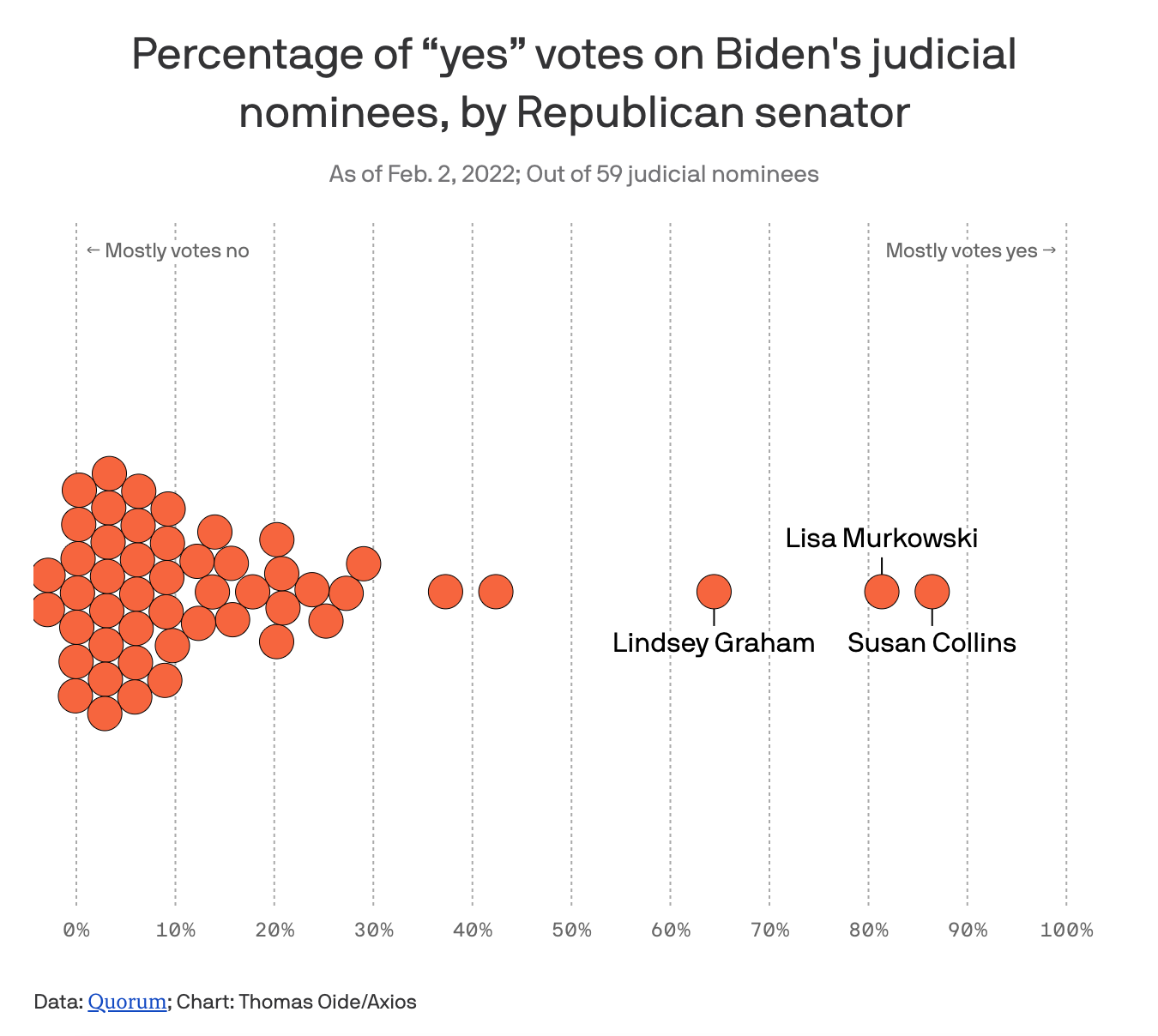
This Axios chart from 2022, recapping the first year of Biden judicial nominees, tells the story: almost all Republican senators blobbed around voting for none or almost none of their confirmations; only Susan Collins, Lisa Murkowksi, and Graham stick out.
Over the years, after McCain died and Graham’s alliance with Trump grew thicker, there were a lot of articles asking, What happened to Lindsey Graham?, to which he would invariably offer a simple answer.
“Well, OK, from my point of view, if you know anything about me, it’d be odd not to do this,” he told Mark Leibovich for a 2019 profile. What’s “this?” Leibovich asked. “‘This’ is to try to be relevant,” Graham responded.
It’s an answer that’s easy to mock: a senator who would do anything to try to seem important, to try to get another hit on “Meet the Press.” But, really, in an age when most senators blob together with their party, forgettable yes-men-and-women, is striving for relevance really so bad? There are surely toxic ways to achieve relevance in politics, in the way that Matt Gaetz or George Santos were once “relevant,” but hardly for productive reasons. But if, to Graham, “relevant” meant breaking with his party and working with the other side long after it became unfashionable, trying to achieve outcomes towards his preferred policy ends, maybe it wouldn’t be the worst thing in the world if more senators had that as their goal.
While many senators act as though they’re in a perma-primary, sitting like potted plants for six years — too scared (or lazy) to inch out of line — Graham wasn’t afraid to frustrate his more extreme constituents every once in a while. He always knew when to retreat, which stoves not to touch (he did not participate in the 2024 border security negotiations, for example, and also dropped his longtime support for the DREAM Act last year). But his record will reflect that he stuck his neck out more than most, playing a central role in legislative accomplishments on a striking range of issues. Unfortunately, the place that sort of record is most likely to be found nowadays is an obituary.
Graham could be a partisan knife-fighter (perhaps most famously with his impassioned speech in defense of Brett Kavanaugh in 2018), and a bipartisan dealmaker the next day, a dual role that many of the now-departed giants of the Senate played with gusto. “He had a unique ability,” President Trump said yesterday. “He was able to deal with Democrats and Republicans. If I had a problem — a real problem, I wouldn’t often ask — but if I had a problem with a Democrat, he could work it out.”
Graham’s rise to the Senate was unlikely, having grown up in the back of a bar, to two parents who died by the time he was 21, leaving him to take care of his little sister. (He would later attribute his passion for maintaining Social Security to his and his sister’s reliance on the program’s survivor benefits.) Perhaps that is why he opted to milk the role for all it was worth. “What’s the point in having the job if you don’t do something with it?” Graham would often ask, according to his former campaign manager.
In an age when many lawmakers prefer to take a backseat, we would do well with a few more senators trying to be relevant.
I am surprised at the one-sidedness of your analysis. I've been reading WUTP since you started (now as a subscriber). I've always appreciated your ability to look at all sides. In this article, however, you don't stay true to your practice. Yes, Senator Graham had many laudable moments. You did not include any of the issues that have created misery for so many (LGBTQ+, immigrants, women). I grew up with the notion of not speaking ill of the departed, but let's show some balance. And by the way, in Trump world, he played it very safe.
Gabe, I too usually read and like your balance but I think you are obit-washing a non-deserving quisling sycophant who so desperately wanted to remain in the Trump Club at all costs that he sold his JAG soul; tolerated to his everlasting shame the abject denigration of his lifelong friend and war hero John McCain by a cowardly draft-dodger, and flip-flopped so many times it appears his aorta finally gave way. What does this say about not just an attempt to just be "relevant" but to so desperately need to fill his life with the only thing he had going for himself, the pomp, trappings and TV acclaim of a senator, that he made a fool of himself, dancing for a would-be traitor. The one thing he stood for and on behalf of was Ukraine but that is not sufficient. He followed Trump down so many ratholes and he finally did what cannot be forgiven. He MAGA-washed the impeachment and the insurrection. We have a right to look squarely at who Graham really was. Some might say he was complex, but that does not cut it. Read what beaten and severely injured Capital policeman Michael Fanone wrote When no one was looking and when he could be himself and no one other than Fanone would know, he failed the greatest test of all, being genuinely committed to honoring his oath of office. He failed that 100%.