


Sen. Mike Lee (R-UT) is upset that the Senate has gone on recess while the Department of Homeland Security shutdown stretches into its 45th day. That makes two of us.
The DHS is the country’s third-largest Cabinet department, with more than 240,000 employees. It’s the agency that protects the border, swears in new citizens, prepares for natural disasters, keeps airports secure, guards the president, and fends off cyberattacks. The Coast Guard, the Secret Service, FEMA, TSA, ICE, and Customs and Border Protection are just some of its component agencies.
It has already been shut down longer than any federal agency in history — and now both chambers of Congress have skipped town, virtually ensuring that the shutdown drags on in their absence for two more weeks, at least. Numerous federal employees are working without a paycheck, but lawmakers aren’t even trying to come to a compromise; instead, they’re giving up and going home. (And yes, senators and representatives will still be paid in the meantime.)
“Reconvene the Senate Now,” Lee wrote on X. “The Senate must reconvene. This is crazy,” he added in another post. Somewhat confusingly, he also posted in Japanese, in a message that translates to, “The House of Councillors must be convened and conduct its business.”
I agree completely with Lee (at least with the English-language messages I’m able to understand). It is crazy that DHS employees are working without pay, while the exact people who could fix the problem are being paid without working. But there’s a difference between Lee complaining about it, and me complaining about it: he actually had the power to stop it.
And I don’t mean in an abstract, “You’re a member of Congress! Just DO SOMETHING!!!!” way. Oftentimes, there is only so much a single member of Congress can do to shape events. But this is not one of those times. At about 2:30 a.m. on Friday morning, Majority Leader John Thune (R-SD) came before the Senate to ask unanimous consent that the chamber leave town for the next two weeks, meeting only for a handful of pro forma sessions (when no business is conducted) in the meantime.
At that moment, any of the other 99 senators could have stood up, and said “I object,” preventing the chamber from going on recess (or at least forcing a vote on it, which would have meant that senators would have had to go on record on whether they wanted to recess in the middle of a shutdown). However, according to Andrew Desiderio of Punchbowl News, only five senators were on the floor shortly before Thune made his 2:30 a.m. request. None of them objected. Lee was not one of the senators present.
Video of the moment is below, via Friend of the Newsletter Kacper Surdy:

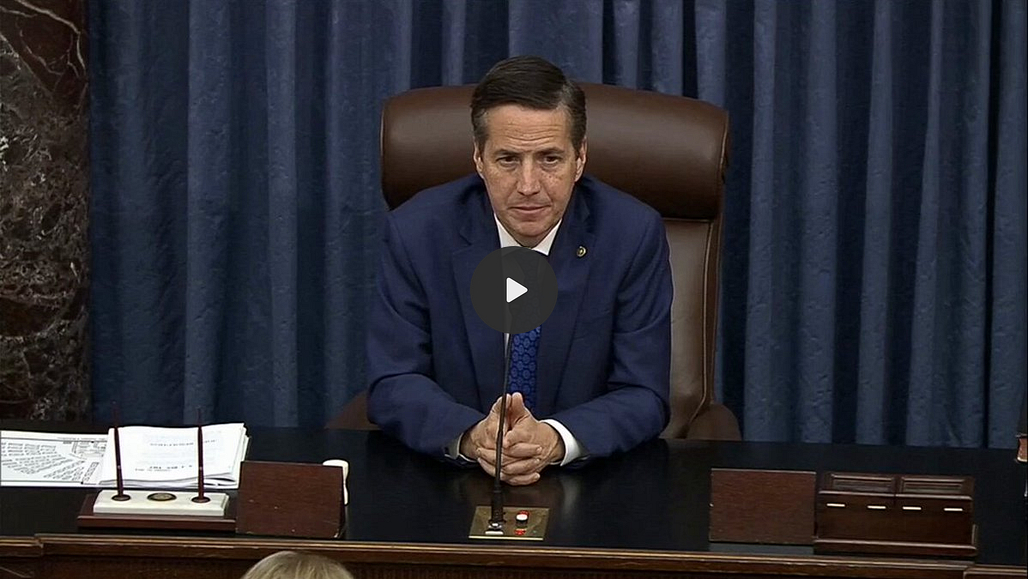

Lee is complaining about legislative absenteeism, but at the crucial moment when all 100 senators had equal power to block (or at least forestall) the Senate from going on recess, he himself was absent. The DHS shutdown has officially become the perfect metaphor for the modern-day Congress.
To explain why, let’s review what’s going on in greater detail.
The perfect metaphor
The Department of Homeland Security was initially supposed to be funded by September 30, exactly six months ago. It wasn’t, along with the rest of the government, leading to a record-breaking, 43-day shutdown in the fall. Since then, all the other agencies have been funded by bipartisan agreements, but DHS continued to operate off of stopgap funding bills (except for another, four-day shutdown in February). When the most recent stopgap expired on February 14, Democrats said they would not accept another one unless it included reforms to ICE, sparking the new shutdown.
Negotiations have continued off and on since then, with Democrats and the Trump administration trading offers back and forth. Eventually, on Thursday, the two sides basically agreed to disagree. Democratic and Republican senators settled on a compromise to fund all of DHS except for ICE and part of Customs and Border Protection, both of which would be able to continue due to funding from the One Big Beautiful Bill. No new ICE reforms were included, but neither was any new ICE funding. Senators on both sides of the aisle were satisfied.
In the wee hours of Friday morning, Thune asked for unanimous consent to pass the bill. With five senators present and none objecting, the bill passed. (All 100 senators were aware in advance that Thune was going to make this request, and any of them could have gotten to the Hill in time if they wanted to stop it.) Then, Thune asked for unanimous consent to go on recess.
House Speaker Mike Johnson (R-LA) did not take kindly to this compromise, and refused to put it up for a vote in the House. Instead, he held a vote on a bill to fund DHS — all of it — through May 22, which passed 213-203, with three Democrats joining all the present Republicans. (Eight Democrats and eight Republicans didn’t show up for the vote.) Then, the House left for recess, too.
President Trump promptly signed a memorandum ordering TSA employees to be paid, by moving money around from the One Big Beautiful Bill. Record numbers of TSA employees had been calling in sick, instead of showing up for work without pay, leading to long wait times at airports across the country. At this point, Congress had deserted Washington, closing off any path to a legislative compromise, leading the president to step in and offer a fix by executive action, thereby alleviating the main source of pressure that still existed for lawmakers to come to a deal.
Almost everything wrong with the present-day Congress can be detected in this string of events.
First, the Senate approved a major piece of legislation by unanimous consent, without any semblance of debate, at 2:30 a.m., with five senators present. Rather than risk taking a tough vote, senators opted to just put the bill up by unanimous consent and then not show up to object. Some senators now say they were against the legislation: “I opposed this bill,” Sen. Rick Scott (R-FL) wrote on X after it passed. But this is empty rhetoric; none of them showed up to block it.
Then, the House Speaker refused to put the bipartisan bill up for a vote, even though a majority of his chamber very likely would have supported it. (In fact, per Punchbowl, House GOP leadership aides estimate that more than half of House Republicans would have backed the Senate bill if it were put up for a vote.) But majority party members, even when they support a bill, usually don’t rock the boat and step in to prevent their leadership from deciding what does or doesn’t get a vote. So a bill that is thought to be backed by a majority of House members withered because one person, the Speaker, opposed it.
And in the final act: the legislative branch abandoned its post, and allowed the president to step in to fix the problem, preferring to fork their “power of the purse” to the executive branch and let the president handle things rather than stay in session and do the hard work of legislative negotiation.
Bills passed without any semblance of deliberation. Members posturing on social media rather than actually showing up to take tough votes or exerting their power to stop bills they claim to oppose. Leaders singlehandedly blocking votes on bipartisan bills that otherwise could pass. And lawmakers skipping town so the executive branch can sweep up their messes, allowing the president to expand his power at the expense of their own. All while breaking the record for longest-ever government shutdown, which they set just a few months ago. Welcome to the United States Congress in 2026.
The end of shutdowns?
We’ll return to our wayward legislative branch soon, but I want to pause for a moment on Trump’s move to pay TSA officers.
Regular readers won’t be surprised by the idea that government shutdowns aggrandize the power of the executive branch. In fact, as I’ve written repeatedly, shutdowns are an executive branch creation: the whole reason they exist is that Jimmy Carter’s attorney general changed the existing interpretation of an 1870 law to say that when a government agency runs out of money, it has to halt non-essential activities instead of continuing to operate at its current funding level. (Read more here and here.)
Anything that was created by the executive branch can be ended by it too. At any time, a new president or attorney general could put the interpretation that reigned from 1870 to 1980 back in place, and shutdowns would be no more. So it’s no surprise to me that a memo from the president could end shutdowns. But this isn’t exactly the type of memo I had in mind:
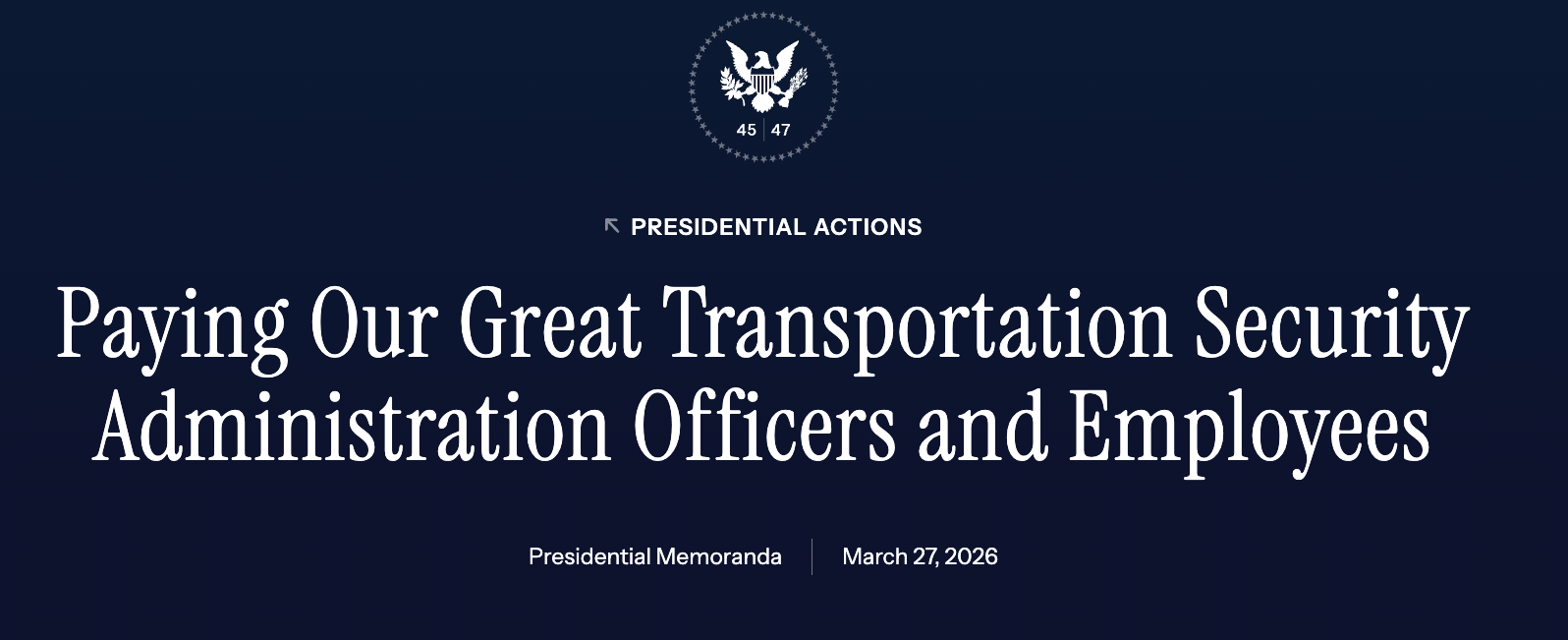
That’s the header for Trump’s memo ordering that TSA officers be paid, and I don’t think enough attention is being paid to the fact that this move effectively neuters the whole concept of a government shutdown going forward.
Shutdowns happen when members of Congress have some otherwise-hard-to-achieve political priority in mind, and want to use the pain of a shutdown as leverage to make it happen. The success rate of this strategy is basically zero, but it’s proved seductive for both parties at various points anyways.
Whether or not the strategy works, though, the only reason to try it is because you hope that the party in power will be so cowed by the pain a shutdown causes, that they’ll give you what you’re demanding.
With the fall 2025 shutdown and now this one, Trump has basically killed this strategy. In the last shutdown, Trump moved money around to pay the troops and to pay (some) SNAP benefits, when those emerged as the shutdown’s largest pain points. This time, the TSA has proven to be the shutdown’s biggest pain point; now, Trump is paying them, too.
If presidents follow this precedent over time, it will become harder and harder for minority parties to even try to enact legislative change via shutdown, because the executive branch will simply step in and alleviate any shutdown-related pain, knowing that no one will want to challenge them in court and sue to stop, say, troops from being paid.
In no small part, this is also possible because of the expansion of the reconciliation process, which allows majority parties to pass certain pieces of legislation without worrying about the Senate filibuster. The reconciliation process has evolved over time to include parties funding line items that used to have to go through the normal appropriations process, which comes with the 60-vote filibuster threshold.
Democrats did this with the Inflation Reduction Act. Then, Republicans did this with the One Big Beautiful Bill, which is how they had enough money in the defense and DHS budgets to pay the troops and ICE agents and, now, TSA officers. Republicans might now move forward with a new reconciliation bill to fund DHS, cutting the minority party out of the funding process entirely if Democrats don’t drop their demand for ICE reforms.
As time goes on, as reconciliation bills grow larger — and vaguer, giving the president more and more leeway over how to spend the money — shutdown threats might not carry much weight soon. When controversial issues come up in appropriations negotiations, the majority party will simply be able to fund what they want through reconciliation and let the president fill in the rest. If parties do this during a period of united government, they can even be sure that their priorities will be funded for the rest of a president’s term, even if the opposing party eventually wins a foothold in Congress. (Or, of course, the legislative filibuster might just get scrapped entirely, mooting this whole thing.)
Over time, shutdown threats will lose their luster, possibly giving rise to more Zombie Shutdowns that drag on for weeks, since the biggest-ticket items get funded by a combination of reconciliation bills and executive actions, erasing any impetus that lawmakers might have had to act.
Queen of the hill
However this might look down the line, however, the fact remains that right now, there are still federal employees working without pay. The most attention-grabbing examples, like TSA officers, have now been taken care of — but that leaves out all sorts of employees across DHS, including support staff at many agencies, to whom the One Big Beautiful Bill funding doesn’t extend.
None of this is about taking either the Democratic or Republican position in these negotiations. The Democratic Party has valid reasons to be calling for ICE and CBP to be reformed, in the wake of the two American citizens killed by those agencies in Minneapolis. And the Republican Party has valid reasons to resist those reforms, and to resist them being attached to appropriations negotiations: majority parties, including Democrats in the past, have long said that they will not negotiate on policy while government funding is being held hostage.
The outrage here is that America’s legislators aren’t even trying to bridge that gap by legislation. Instead, they’ve all gone home.
The way I see it, there are three proposals on the table:
The Senate-passed bill to fund all of DHS but ICE (not reforming the agency but also not giving it new funding), which has not received a vote in the House.
The House-passed bill to fund all of DHS through May, which has not received a vote in the Senate.
A bipartisan bill proposed by the House Problem Solvers Caucus — funding all of DHS, including some ICE reforms (requiring officers wear body cameras and identification; banning them from wearing masks; requiring warrants for enforcement activities at sensitive locations; mandating independent investigations of ICE agent-involved shootings), as well as a GOP priority (setting enhanced penalties for doxxing law enforcement officers) — which hasn’t received a vote in either chamber.
In the House, there is a procedure that is sometimes used called the “queen of the hill” rule. In a “queen of the hill” process, multiple pieces of legislation on the same topic are put up for consecutive votes; the bill that receives the most votes is the one that is considered to have passed the chamber.
In my perfect world, the House and Senate would vote on all three of the above proposals under this process. I believe that at least one of them would receive majority support in both chambers, and potentially two of them. All three would end the shutdown.
But this can’t be tested — the Senate-passed bill can’t get a vote in the House, the House-passed bill can’t get a vote in the Senate, and the Problem Solvers bill can’t get a vote anywhere — if both chambers of Congress are on recess. And even if they were here in Washington, it couldn’t be tested, because rank-and-file members largely allow their party leaders to control the floor and block bills from being considered even when they might fetch majority support.
In the House, the only way around this is the discharge petition, which can force a vote on legislation if a majority of House members sign on. Incidentally, another bipartisan discharge petition notched the necessary 218 signatures this week, on a bill extending temporary deportation protections for Haitian migrants that the Trump administration has tried to end. It will be the fifth discharge petition to force a vote this Congress, more than in any Congress since 1934.
The Problem Solvers Caucus has indicated that they might try this route for their DHS bill. The record-breaking run of discharge petitions is one small sign that rank-and-file members of Congress are pushing back. But mostly they play dead, content to tweet from the sidelines while allowing their chambers to recess as their leaders shield them from tough votes and the president steps in with a quick fix.
This morning, the Senate quickly gaveled in for a pro forma session, without conducting any business. “No attempt was made to pass DHS funding by unanimous consent,” Mike Lee fumed on X.
Only two senators were present. Mike Lee wasn’t one of them.
How to stop this shutdown madness: all politicians don’t get paid until an agreement is made. Simple and right.
"...and the Problem Solvers bill can’t get a vote anywhere" Yeah, I know this phrase was followed by the note that it's because Congress went home, but isn't this also a more general description of the problem nowadays? The Problem Solvers are trying to come up with--gasp!--compromises. But the will to compromise nowadays is in such short supply that they can't get anywhere. It's insane. A pox on all their houses. Not only should Congress not get paid when something like this happens, they shouldn't get back pay when they solve it, either. It would seem only real pain would make them do the right thing.