


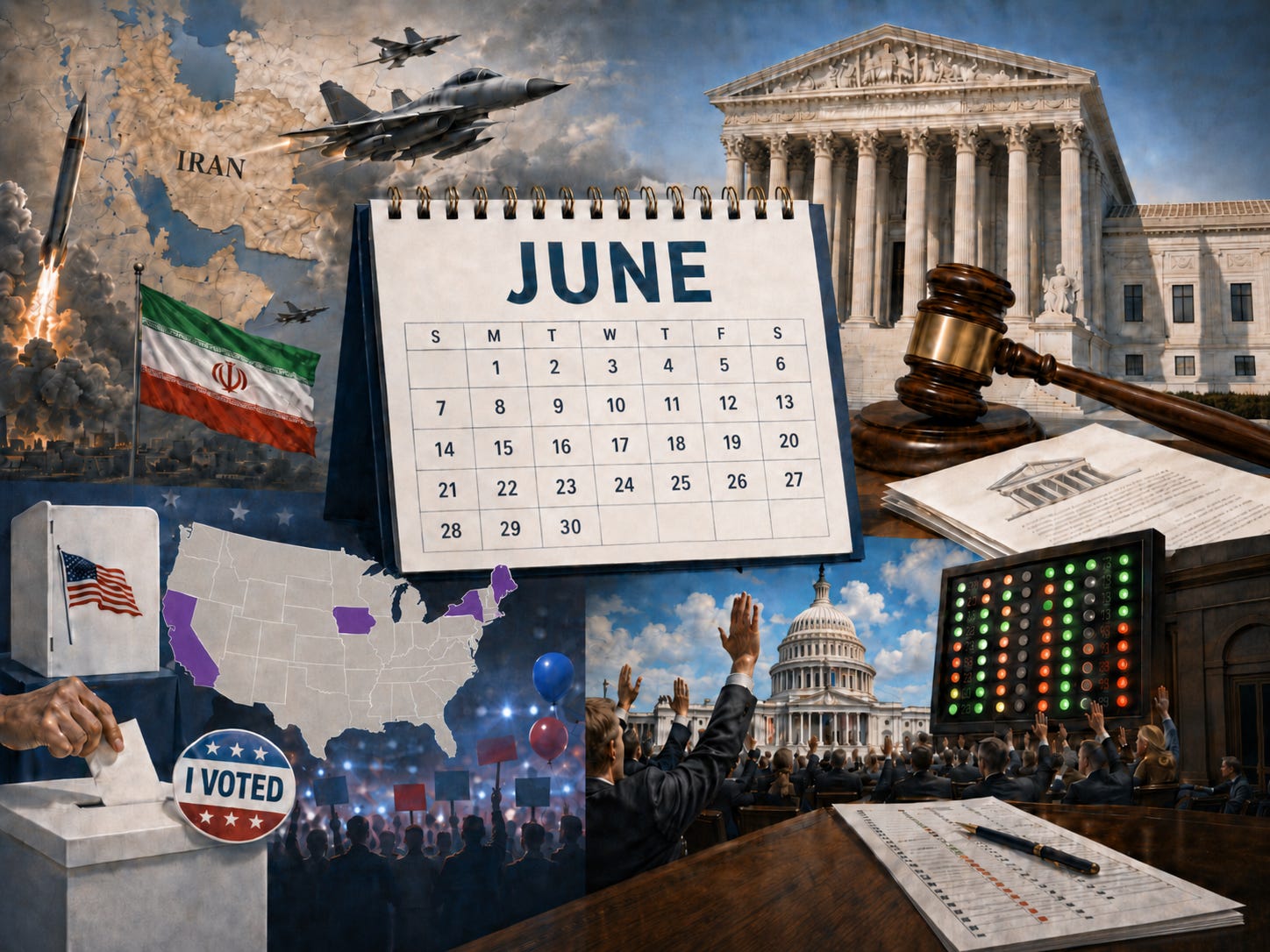
Good morning and happy Monday! June is officially here. The year is a bit more than 40% over. The 2026 midterms are 155 days away.
At the beginning of a new month, I thought it would be a good time to take a step back and take stock of some of the storylines I’m tracking, to give a sense of what to watch in June:
Waiting for a peace deal
The Iran war has been in a state of ceasefire for longer (56 days) than it was in an active state of fighting (38 days), though a formal peace deal has yet to be inked, leaving the conflict in suspended animation.
Axios reported on Thursday that the two sides were nearing agreement on a “memorandum of understanding,” which would extend the ceasefire for 60 days — and call for “unrestricted” shipping through the Strait of Hormuz — while broader negotiations begin on Iran’s nuclear program. President Trump discussed the deal with his advisers in the Situation Room on Friday, and reportedly requested several edits, which have now been sent to Tehran.
The exact contents of the deal remain uncertain, as do Trump’s requested changes. Because of the leadership vacuum in Iran, it often takes some time for negotiating points to make their way through the government’s upper levels, which means it could be several days before the U.S. receives a response to Trump’s new offer, though officials say the talks are in their closing stages.
However, there still seem to be several sticking points just with the MOU, including over billions of dollars in Iranian funds that Tehran wants unfrozen and whether the deal would include a ceasefire between Israel and Hezbollah in Lebanon. (Israel has continued advancing in its deepest incursion into Lebanon in decades.) And that’s just the MOU. Discussions over the bigger questions about the future of Iran’s nuclear program, and of its existing stockpile of highly enriched uranium, haven’t even started yet.
The shaky state of ceasefire — both in the sense that a full peace deal appears to be ways off, and in that the ceasefire itself has been repeatedly violated, including in an exchange of fire over the weekend — ensures that the war will continue to hang over the Republican Party’s political prospects, especially if the Strait of Hormuz does not immediately reopen and it takes some time for gas prices to go down.
Trump’s approval rating has, for the moment, seemed to stabilize at just above 38%, around the record low from Trump’s first term and from Joe Biden’s term, as if there is an iron law that presidential approval ratings can dip to 38% but will never go below that mark. For now, at least, the bleeding seems to have stopped and the rating seems to be stagnating rather than declining — though, of course, that could always change, and 38% isn’t exactly an ideal level of support to be stuck at.
Congress is back!
The Senate returns to Washington today and the House returns tomorrow after a Memorial “Day” recess that suspiciously seems to have lasted more than a week.
Close readers will recall that lawmakers left town a bit dramatically, with Senate Republicans declining to advance Trump’s ICE funding bill because of concerns over his $1.776 billion “Anti-Weaponization Fund.” While Congress has been out of town, the fund has been paused by a federal judge, while another judge reopened the Trump/IRS suit it originated from (a move that could also potentially imperil the fund). However, these moves will likely not be enough to satisfy Senate Republicans, especially those in the “YOLO Caucus” who have called for legislatively imposed limits on the money.
It will be left to Senate Majority Leader John Thune (R-SD) to pick up the pieces in the days ahead, laboring to find a compromise that his conference can agree to, in order to both advance funding for immigration enforcement and rein in the anti-weaponization plan.
Another big deadline facing Congress is June 12, when a key government surveillance authority is set to expire, sparking internal tensions over an extension within the GOP. Lawmakers are also attempting to move forward with a housing bill, an aviation bill, and the farm bill — plus the House still has to vote on another resolution ending the Iran war, a vote that was postponed before recess because it appeared it had the votes to pass.
Primary season
Another big slate of primaries is set to take place tomorrow, including the closely watched California gubernatorial race and the Iowa Senate primary.
In California, a slew of heavy hitters like former Vice President Kamala Harris and Sen. Alex Padilla declined to run for governor, leaving behind a wide-open field that for a time was led by then-Rep. Eric Swalwell, until he was forced to flee the race as well. Under the state’s election system, the two top vote-getters — regardless of party — will advance to the general election in November. Polls currently show that those two contenders are most likely to be Democrat Xavier Becerra, the former congressman, Biden-era Secretary of Health and Human Services, and state attorney general, and Republican Steve Hilton, the former British political operative turned Fox News host.
A slew of other Democrats are in the next polling tier, including billionaire Tom Steyer and former Rep. Katie Porter, as is Republican sheriff Chad Bianco, all hoping to claw their way to one of the two tickets for advancement.
Meanwhile, in Iowa, Republican Sen. Joni Ernst is retiring and Rep. Ashley Hinson is on a glide path for the GOP nomination to succeed her. The Democratic primary has become a brawl between state Rep. Josh Turek (a moderate and champion Paralympic basketball player who is favored by Senate Minority Leader Chuck Schumer) and state Sen. Zach Wahls (a fierce Schumer critic who has become the favorite of Elizabeth Warren and other progressives). The race has become a test of Democratic sentiment toward their party leaders nationwide.
Also coming up later this month: New York’s congressional primaries on June 23. In the state’s 10th congressional district, Democratic Rep. Dan Goldman is facing a primary challenge from former New York City comptroller Brad Lander in a contest that has been dominated by disputes over Israel. In the 12th district, state Reps. Micah Lasher and Alex Bores, Kennedy scion Jack Schlossberg, and Trump ally-turned-critic George Conway are squaring off in the Democratic primary to succeed longtime Rep. Jerry Nadler. In the 13th district, Congressional Hispanic Caucus chair Adriano Espaillat is in the fight of his political life against a democratic socialist 38 years his junior who’s backed by New York City Mayor Zohran Mamdani.
Finally, on June 9, Democrats will hold a consequential primary where the outcome is pre-ordained — though members of the party wish it wasn’t — as the party is poised to nominate oysterman Graham Platner to take on Republican Sen. Susan Collins. Platner had been plagued by a trail of scandals already when news broke this weekend that he had exchanged sexual messages with multiple other women not long after marrying his wife, creating yet another controversy for the upstart candidate.
SCOTUS watch
If it’s June, it means the Supreme Court is about to become the center of the political world.
The justices typically release their biggest opinions of the term this month before adjourning for the summer. This year, we are waiting on rulings on President Trump’s birthright citizenship order and his ability to fire a Fed governor and other independent agency heads, as well as decisions on transgender sports bans, mail-in ballots, and laws that prohibit illegal drug users from possessing firearms.
So far, the justices are scheduled to release opinions every Thursday of the month, though additional opinion releases could be scheduled.
Will the justices rule on whether Trump can add his name to the Kennedy Center? That will have to wait ’till next term.
You write,
"...then-Rep. Eric Swalwell, until he was forced to flee the race as well. "
I had just sent an email to you lauding you for generally remaining non-partisan in your newsletters, and in coming here to update my payment method for my subscription, that's a bit of snark in your use of the word "flee" - more neutrally but factually you could have just stated that "he was forced to withdraw from the race" or even include, "due to revelations (or accusations) of ongoing long-term sexual harassment."
Fwiw he was my representative for many years and projected a wholesome family man image, so you can imagine how bitterly disappointing it was to discover his true nature and that these accusations had been previously suppressed over the years. If not for his behavior, if he had truly been authentic, he could have been the next governor of California. Now the Dems have no better options except to choose between Becerra (a "typical" politician supported by oil interests) or Steyer (a billionaire viewed with skepticism despite his environmental and personal leanings).
https://www.meditationsinanemergency.com/the-case-for-climate-champion-tom-steyer-in-the-california-governors-race/
I can't wait to read your coverage later this week of tomorrow's primaries! The primaries so far this cycle have shown a worrying trend of fringe candidates either winning outright (Ken Paxton), or doing surprisingly well (Maureen Galindo, and to a lesser extent, Lucia Simonelli).
Tomorrow should help reveal if these were flukes, or part of a larger pattern of both parties losing the ability to reject weak candidates.