


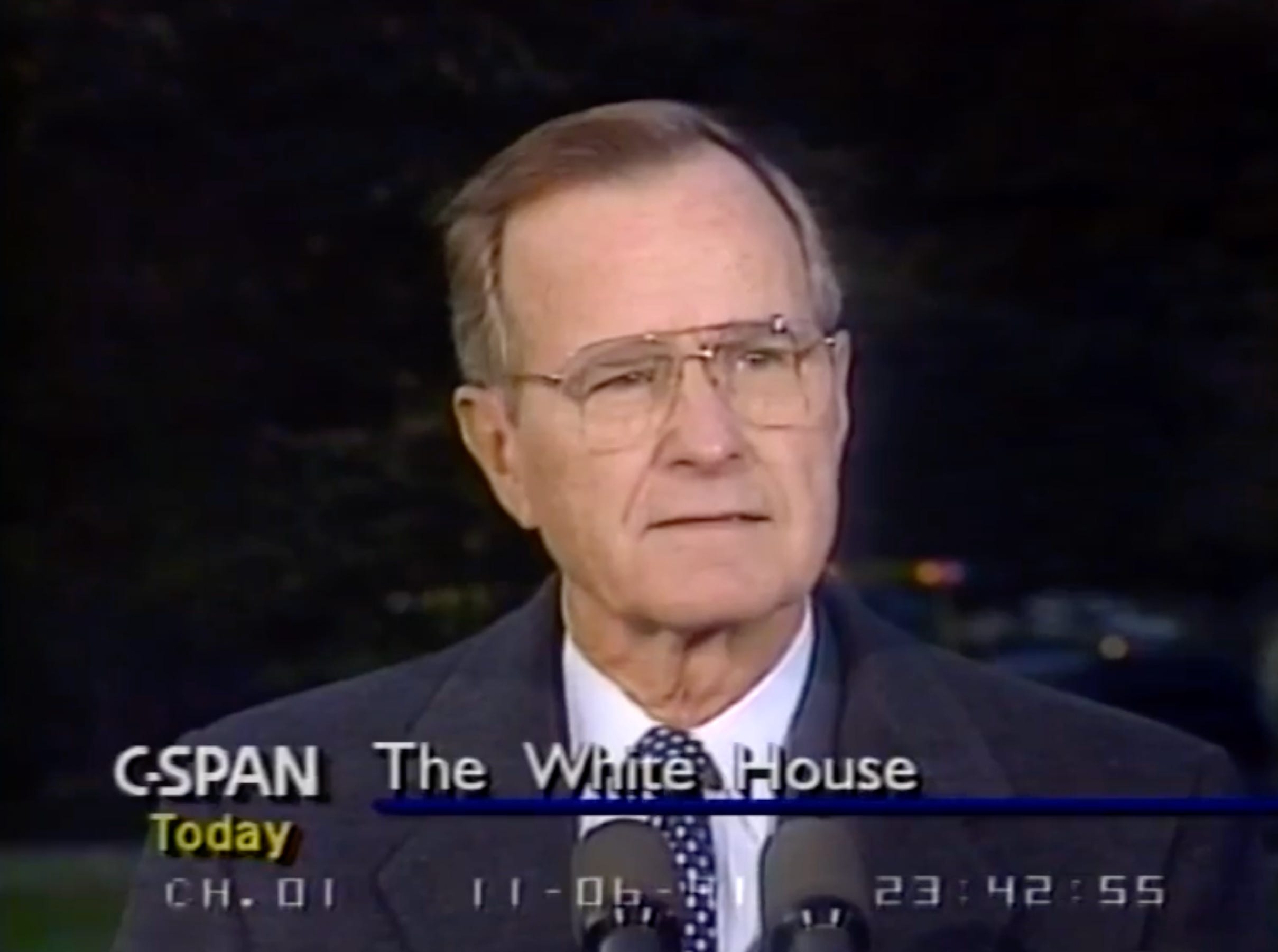
On November 6, 1991, President George H.W. Bush did something deeply patriotic.
Voters in Louisiana had gone to the polls a few weeks before, as part of the state’s unique election system, in which gubernatorial candidates of both parties compete against each other in a first-round election in October and then — if nobody fetches a majority — the top two vote-getters advance to a runoff in November.
Bush had been a strong supporter of the incumbent governor, Republican Buddy Roemer. But Roemer had been eliminated after the October round, when he finished third. Now, the runoff was looming and reporters wanted to know who had Bush’s support: the lead Democrat in the race, Edwin Edwards, or the remaining Republican.
Of course, Bush himself was a Republican, so you might not think it was much of a decision. But I haven’t yet told you who the Republican candidate who advanced to the runoff was. It was David Duke.
Yes, that David Duke: the former Grand Wizard of the Ku Klux Klan, who denied the Holocaust, had previously described himself as a Nazi, and called for Jews to be exterminated and for African-Americans to be returned to Africa. Now you see the issue.
Bush was about to leave on a trip for Rome when he was asked by a reporter if he would urge Louisianans to vote against Duke, his own party’s candidate. “Yes, strongly,” Bush responded.
He left no ambiguity about where he stood. “When someone asserts that the Holocaust never took place, then I don’t believe that person ever deserves one iota of public trust,” Bush said. “And when someone has so recently endorsed Nazism, it is inconceivable that such a person can legitimately aspire to a leadership role in a free society. And when someone has a long record, an ugly record, of racism and of bigotry, that record simply cannot be erased by the glib rhetoric of a political campaign.”
“So, I believe that David Duke is an insincere charlatan,” he concluded. “I believe he is attempting to hoodwink the voters of Louisiana, and I believe that he should be rejected for what he is and what he stands for.”
After boarding Air Force One, Bush went back to talk with journalists some more. A different reporter put the question to him even more directly: if he were a Louisianan, how would he vote? “Well, I would do what Buddy Roemer said,” the president replied. “Which was that he would end up voting for Edwards.”
Indeed, Roemer — the Republican incumbent — had said after being defeated in the first round that he would be casting his runoff ballot for Edwards, the Democrat, and encouraged his 412,000 voters to do the same. Edwards and Duke had drawn 34% and 31% of the first-round vote, respectively, so Roemer’s 27% had the power to decide the race.
When Edwards ultimately beat Duke in the runoff, 61% to 39%, Roemer’s support for Edwards was credited for helping push the Democrat over the finish line. Exit polls showed that 75% of Roemer voters heeded the governor’s urging and backed Edwards in the runoff; surveys also showed that this critical slice of voters were largely Bush devotees as well, which means the president’s harsh condemnation of Duke likely played a role. It was the definition of putting country before party.
I’m bringing all of this up because of this week’s Texas Senate primary runoff, in which the indicted-and-impeached state attorney general Ken Paxton defeated incumbent Sen. John Cornyn for the Republican nomination.
My aim here isn’t to equate Paxton with Duke. The two men are very different, as are their (alleged or confirmed) misdeeds. But Bush’s 1991 statements are an impressive example of a party leader clearly drawing a line of acceptable conduct and placing a member of his own party outside of it, even if it meant sacrificing political power for his party. I’m not here to express an opinion on whether Paxton belongs outside of that line as well. But you know who does have an opinion on that? John Cornyn. Or, at least, he did.