


Presidential approval ratings used to swing wildly.
Take the two Presidents Bush, for example. They each reached incredible approval highs, during the first Gulf War for Bush I (87%) and after 9/11 for Bush II (88%). And they also sunk to astonishing lows, as the economy slumped in 1992 for the father (28%) and in 2008 for the son (24%).
That wasn’t so long ago, but that sort of range is unthinkable for a president today, now that partisanship has hardened enough that much of the president’s party will always approve of him and much of the opposition will always disapprove. That limits us to a pretty narrow band of movement in the numbers.
With that reality in mind, Donald Trump is basically as unpopular as it’s been possible for a president to get now.
Below, I’ve charted the approval and disapproval ratings for every president since Obama, using the average calculated by Nate Silver. I’ve drawn two lines, one at the lowest approval rating recorded in that time period (36.8%, by Trump in August 2017) and at the highest disapproval rating (58.3%, by Biden in July 2024).
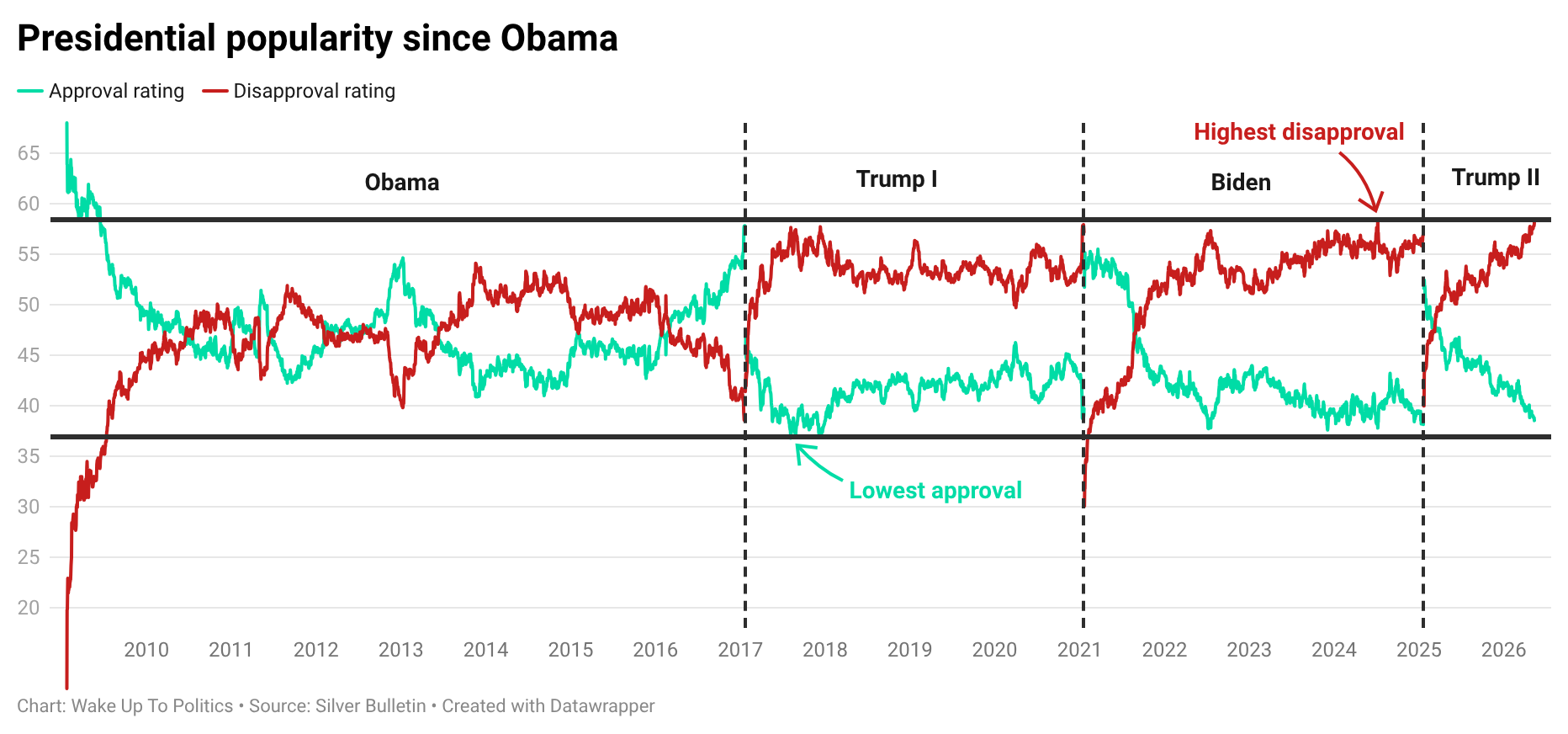
As you can see, Trump is quickly approaching both benchmarks. His approval rating, according to Silver’s average, is currently at 38.5%, about two points above the record in the polarized era. His disapproval rating is already at 58.1%, statistically indistinguishable from the recent high.
This puts Trump’s current poll numbers in league with some of the most unpopular moments in recent presidential history:
Trump in August 2017, one of the most chaotic months of his first administration, as the Obamacare repeal effort failed; Reince Priebus, Anthony Scaramucci, and Steve Bannon all resigned in quick succession; and Trump traded nuclear threats with North Korea and referred to “very fine people” in Charlottesville. (36.8% approval, 57.6% disapproval)
Trump in December 2017, as the Russia investigation intensified; Trump endorsed Senate candidate Roy Moore, an alleged child sex abuser; and the unpopular tax cut bill passed. (37% approval, 57.5% disapproval)
Trump in January 2021, in the wake of January 6th. (38.7% approval, 57.4% disapproval)
Biden in July 2022, during the peak of the inflation spike. (37.7% approval, 56% disapproval)
Biden in July 2024, after his disastrous debate performance but before he dropped out of the presidential race. (37.8% approval, 58.3% disapproval.)
“Very fine people.” January 6th. Biden’s debate. That is not good company for a president to be in, and it’s where Trump is right now, basically tied with Biden’s worst poll numbers and his own from his first term. (Obama never reached these low-approval or high-disapproval marks.) When things look bad for a president nowadays, this is what they look like.
In all of the moments above, the polling pattern takes the same shape: the president approaches ~37% approval and ~58% disapproval, hovers there for a few days, and then recovers. None of the most recent presidents have sunk any lower: for example, none of them have reached 60% disapproval, a line not crossed since George W. Bush as the Iraq War sputtered in 2006 and then again during the 2007-08 financial crisis.
Will Trump keep sinking, until he reaches territory (literally) uncharted in the last three presidencies?
It’s very possible. Trump’s disapproval rating has breached the 60% mark in several individual polls, including a particularly bruising CNN poll released yesterday that showed him at 36% approval, 63% disapproval.
In that same survey, 77% of Americans — including 55% of Republicans! — said that Trump’s policies have increased the cost of living in their community. 65% said that Trump’s tariffs have had a negative impact on their financial situation; 75% said the same about the war in Iran.
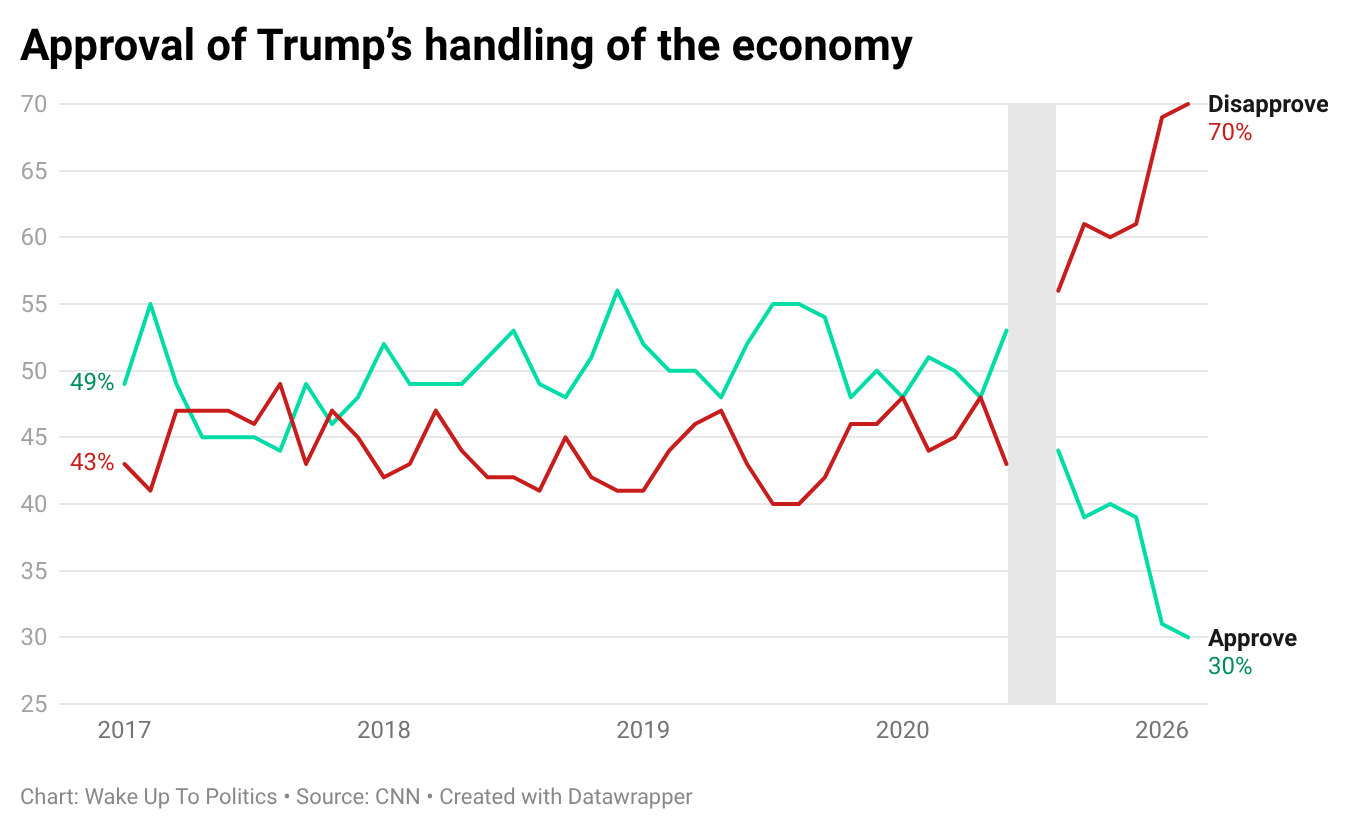
Overall, a remarkable 70% of the country said they disapprove of Trump’s handling of the economy, which a majority also named as their top issue. As seen in the chart below, which uses CNN polls dating back to 2017, the economy used to be a relative strong suit for Trump: even when he was unpopular in his first term (and even during the Covid-induced recession), his handling of the economy generally stayed above-water. For his economic disapproval not only to now outrun approval, but to the tune of 70%-30%, represents an astounding and bipartisan rejection of the president.
There is no sign that the cost of living will ease any time soon.
Yesterday, the Labor Department released its monthly inflation report: it showed that prices rose 3.8% in April compared to a year earlier, the highest annual inflation rate since May 2023.
The increase was largely driven by energy prices, which were up 3.8% compared to last month and 17.9% compared to last year. In turn, of course, that surge was driven by the war in Iran, which has sent average gas prices above $4.50/gallon and average diesel fuel prices above $5.60/gallon, approaching a record high.
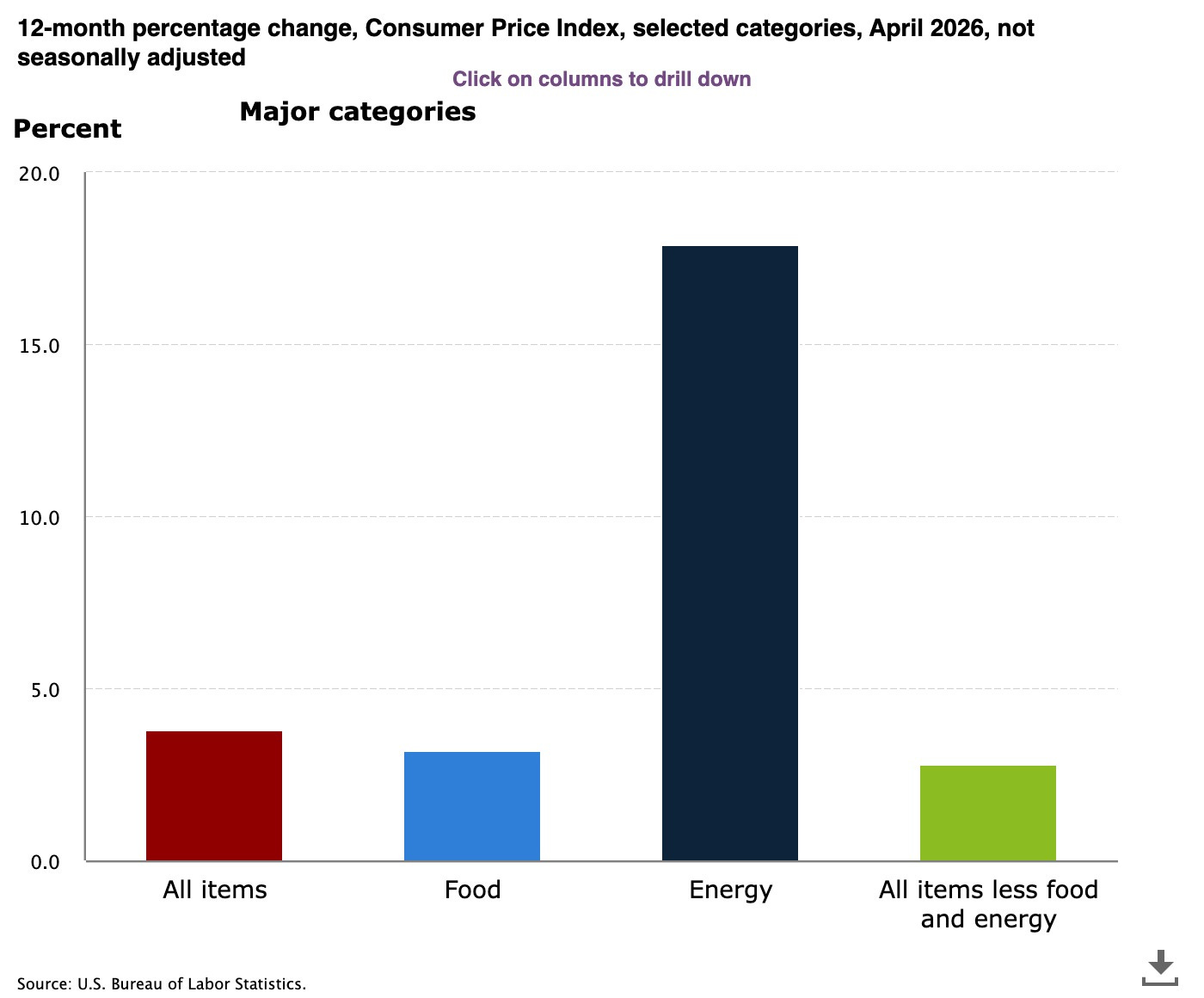
Food prices were up 2.9% annually, and they are likely to keep climbing. As the Associated Press notes, diesel fuel is what powers the trucks, trains, tractors, and ships that transport food to the United States. Higher costs throughout this supply chain can take several months to translate into higher prices on the shelves at grocery stores, which means the prices that were recorded in April — already on an incline — mostly represent increases from before the Iran war. Once the increased price of diesel due to the war starts to factor in, food prices are set to rise even more.
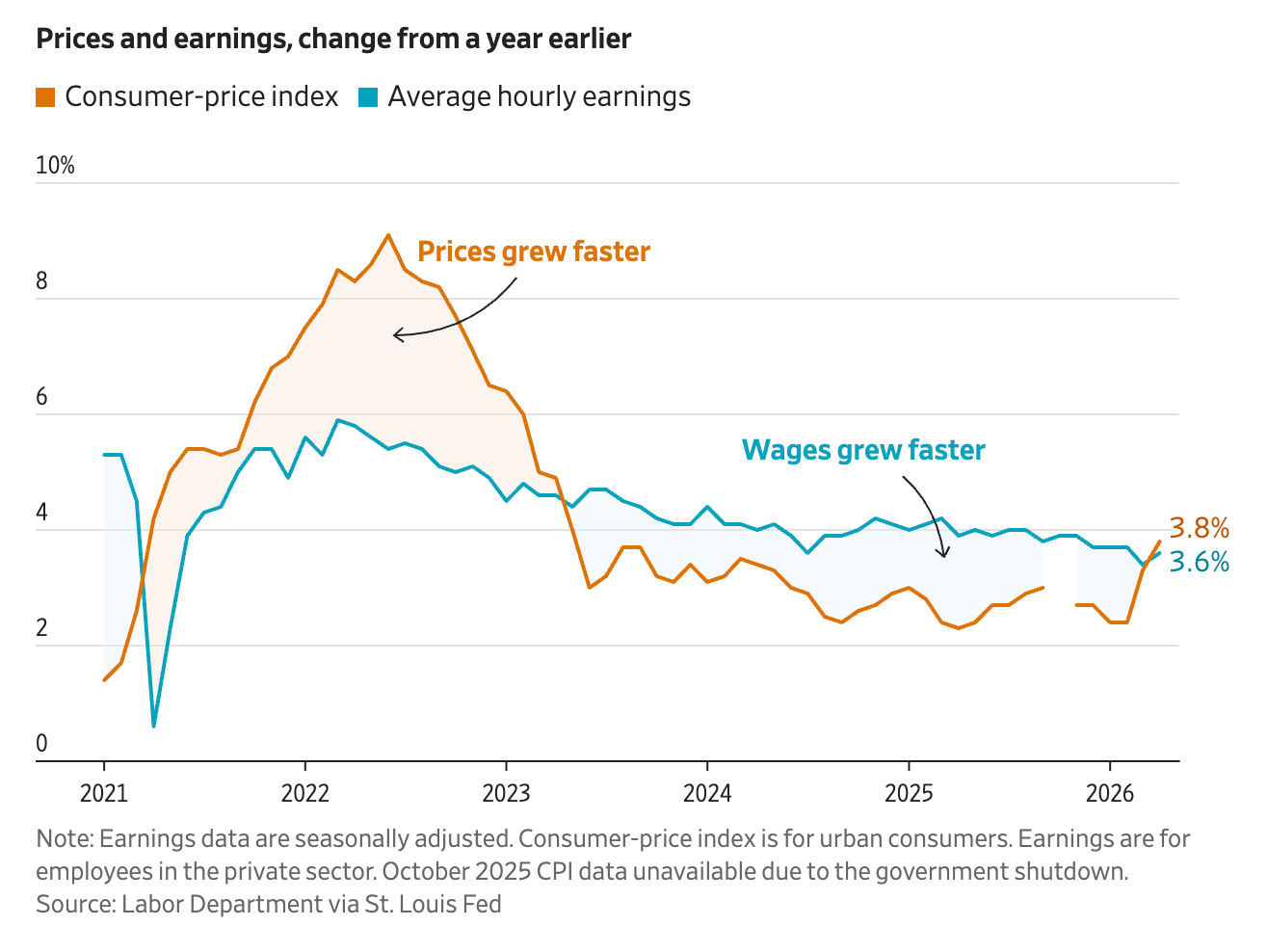
For the last three years, even as prices have increased, wages have grown even faster, giving Americans a measure of relief when faced with eye-popping costs. In an ominous sign for Trump, that was no longer true in April: growth in prices outstripped growth in Americans’ paychecks for the first time since 2023.
If the war goes on, and prices keep rising in response, it is easy to imagine Trump’s disapproval rating crossing the 60% threshold.
This is probably why the war hasn’t restarted (at least not yet), and instead settled into a bizarre state of ceasefire limbo. The U.S. and Iran entered into a two-week ceasefire on April 7; when it was about to expire on April 21, Trump announced that he was extending it indefinitely to allow for peace talks to continue. That was three weeks ago, which means the two-week ceasefire has now been going for five weeks, even though diplomatic negotiations don’t appear to be making much progress.
Trump rejected Tehran’s most recent proposal and said this week that the truce is on “life support,” though he hasn’t ended it yet, perhaps a sign that he doesn’t want to, and is looking for any way he can avoid reigniting a conflict that has been unpopular with Americans and hurt their pocketbooks. (In the meantime, Trump has achieved few of his wartime objectives: Iran’s nuclear program has been unharmed by the war, Tehran maintains substantial missile capabilities, and the Strait of Hormuz largely remains closed.)
Asked yesterday whether Americans’ financial situations are a factor in his wartime decisionmaking, Trump said: “Not even a little bit. The only thing that matters when I’m talking about Iran: they can’t have a nuclear weapon. I don’t think about Americans’ financial situation. I don’t think about anybody. I think about one thing: we cannot let Iran have a nuclear weapon.”
While that may be the responsible answer for a commander-in-chief, it could not be more tone-deaf politically. Expect to see this clip in plenty of Democratic ads this fall:
Interestingly, Trump seems to have settled on an unusual (for him) answer to his problems: Congress.
After spending several weeks ignoring a thicket of legislative headaches on the Hill, despite Republican warnings that the party would be punished if it doesn’t have more to show for its two years of united control in Washington, Trump has suddenly turned his focus back to the other side of Pennsylvania Avenue.
Trump called on lawmakers to suspend the federal gas tax on Monday morning, as a way to lower costs at the pump. He then followed that up on Monday night with a call for the House to approve the 21st Century ROAD to Housing Act, the bipartisan housing package that passed the Senate in an 89-10 vote in March.
This is a notable change of strategy for Trump: implicitly acknowledging that the economy is struggling, by throwing his weight behind legislative packages aimed at offering Americans relief — and implicitly acknowledging that he can’t fix it alone. For most of his presidency, Trump has prioritized executive orders over legislation, trying to signal that he doesn’t need Congress to fix the country’s ills. But there is only so much a president can do to juice the economy. More than 15 months into his presidency, Trump seems to be changing tack.
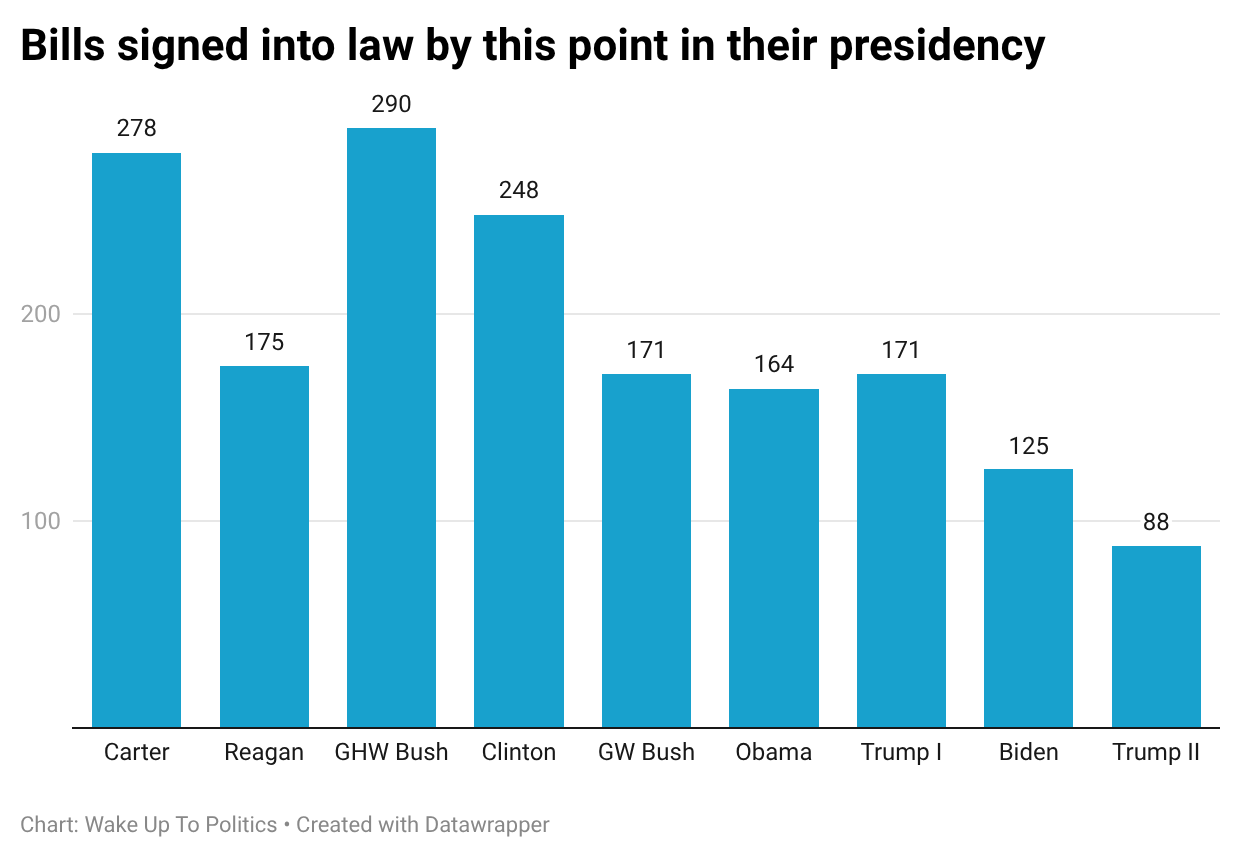
It’s less clear whether congressional Republicans will heed his calls. Senate Majority Leader John Thune (R-SD) was one of several GOP lawmakers who didn’t seem thrilled with the idea of a gas tax holiday. Meanwhile, House Republicans appear to be pushing ahead with their own housing bill, despite Trump’s insistence that they pass the Senate version and send it to his desk. “I am not focused on the president’s Truth Socials on this,” Rep. Bill Huizenga (R-MI) told Punchbowl News.
Other tests of Trump’s influence on Capitol Hill loom as well: Republicans are currently moving forward with a party-line package to fund immigration enforcement, which is also set to include $1 billion for White House security upgrades, including for Trump’s new ballroom. (Republicans say only about $220 million will go towards security for the ballroom itself.)
Many House and Senate Republicans have expressed concerns about the optics of funding the ballroom — and it’s not hard to see why. Already, it’s easy to imagine this new legislative package going over poorly with the American people (Trump’s poll numbers on immigration are not what they used to be: there’s a reason the White House has told Republicans to stop talking about mass deportations). Add in spending on the ballroom while the cost of living rises, and you’ve given Democrats an easy talking point with which to tag the package.
It wouldn’t be the first megabill defined in the public image by its most unpopular qualities: remember Obamacare and death panels? Senate Minority Leader Chuck Schumer (D-NY) referred to the GOP as “Ballroom Republicans” at a recent press conference. I’ll be interested to see whether Trump agrees to remove the funding from the package, or whether he make the GOP walk the plank for his pet project.
In recent presidential history, Biden in the summer of 2022 seems like the best comparison point: an aging president faced with rising inflation (partially due to a war), who tried to convince Congress to suspend the gas tax and muscled through a party-line legislative package that he thought would help. Biden would go on to lose control of the House that fall.
Trump’s political situation is likely even worse, since the war in question wasn’t started by Vladimir Putin: it was his own doing, as were the tariffs that have also contributed to rising prices. That means, as tied to price increases as Biden was in the popular imagination (“Bidenflation,” anyone?), Trump will likely be associated with them even more, creating a political crisis that not even redistricting gains will be able to protect him from.
While Biden’s approval rating in 2022 bottomed out around where Trump’s is now, and then recovered slightly, if the war in Iran continues long enough, Trump’s polling floor could end up being even lower than any of his recent predecessors.
I have noticed since the moon landing denials, starting in 70s, that there is a 30-40% bottom, who will deny or believe anything. Its not always the same people as it depends upon subject. I cant see trump getting much lower than this range of stupid.
This war was put together on a cocktail napkin in a strip club, by men who think their 'package' is a lot bigger than it is....