


Reminder: If you have questions for this week’s all-subscriber mailbag edition, send them here.
President Donald Trump seems pleased about the outcome of last night’s Texas Republican Senate runoff.
“Congratulations to Ken Paxton on such a tremendous win, and to John Cornyn for having run a strong and powerful race but, more importantly, having had a truly great career,” Trump wrote on Truth Social. “John will remain my friend for a long time to come, as we both watch Ken become a fantastic, common sense Senator, one who is respected by all.”
Cornyn was a 24-year incumbent who once served as the second-highest-ranking Senate Republican and, just last year, came within five votes of becoming Senate Majority Leader, one of the most powerful positions in Washington. As recently as 2020, he won the GOP primary for his seat by 64 percentage points.
But in the last six years, Cornyn helped negotiate the bipartisan 2022 gun control package following the Uvalde shooting in his state (earning a rebuke from the Texas GOP) and cast doubt on Trump’s ability to win the 2024 election. “I think President Trump’s time has passed him by,” Cornyn told reporters in 2023, adding: “I don’t think President Trump understands that when you run in a general election, you have to appeal to voters beyond your base.”
That was enough to fuel a primary challenge by Paxton, the Texas state attorney general with much stronger MAGA bona fides (while Cornyn was voting to certify the 2020 election, Paxton was bringing a case to the Supreme Court attempting to challenge the results). Senate Republicans spent months furiously lobbying Trump to endorse Cornyn, and the president reportedly had a Truth Social post drafted and ready to go lending the senator his support. But then a last-minute gambit by Paxton crusading for Trump’s signature election bill led Trump to give Paxton his “Complete and Total Endorsement” last week.
Paxton ended up trouncing Cornyn, 64% to 36%, in last night’s runoff.
It’s not hard to see why Trump feels strengthened by the result. It represents yet another Republican incumbent he has picked off, completing a revenge tour that has unseated five Indiana state senators, Louisiana Sen. Bill Cassidy, and Kentucky Rep. Thomas Massie.
And that’s just in the last three weeks. With Cornyn’s ouster, of the 52 Republicans who were in the Senate when Trump took office in 2017, only 22 are sure to be there still next year. John McCain died. Bob Corker, Jeff Flake, Richard Burr, and others retired. Cory Gardner was ousted in a general election. Cassidy and Cornyn were ousted in primaries. Trump will have succeeded in changing the face of the Senate GOP. The president is already eyeing incumbents to potentially challenge in primaries in 2028. (Watch out, Rand Paul.)
But there are two reasons to think that Trump’s feeling of triumph may be short-sighted.
Blexas?
If you created a dream Democratic opponent in a lab, it would be hard to do worse than Ken Paxton.
Indicted on securities fraud charges in 2015. Impeached for alleged bribery by his own party in 2023. His wife filed for divorce “on biblical grounds” (read: she says that he cheated on her) in 2025. Election denier and all-out MAGA acolyte.
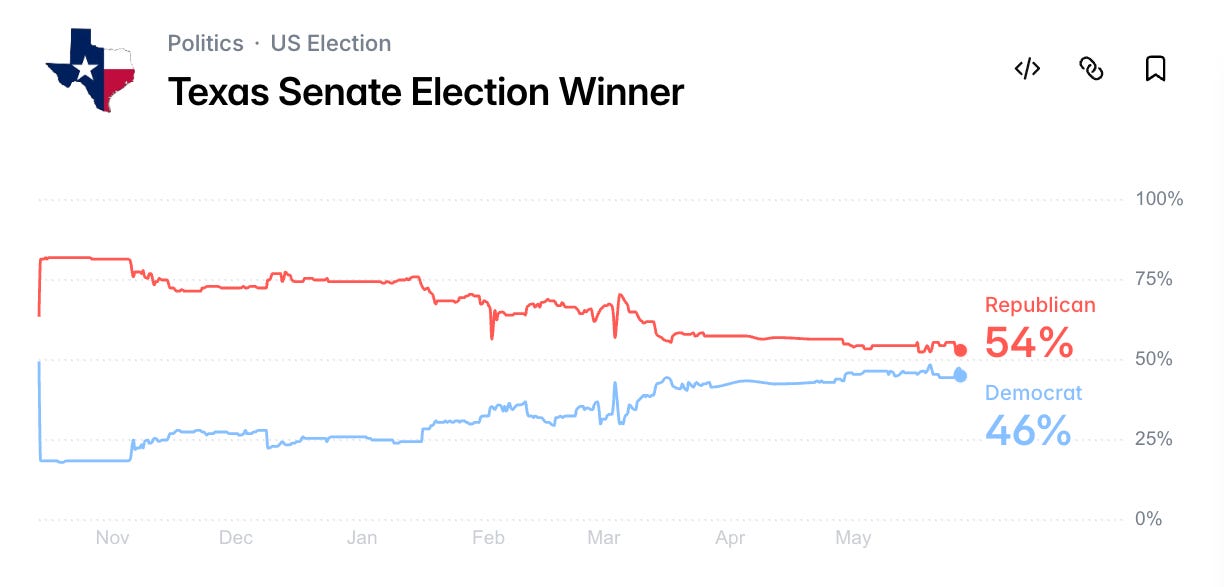
At the beginning of this year, gamblers on Polymarket gave Republicans 75% odds of winning the Texas Senate race. Now, it’s plunged to 54%.
On the other side of the coin, Democratic nominee James Talarico isn’t exactly an ideal candidate either.
A pastor and state legislator who has sought to cloak Democratic stances in the language of Christianity, Talarico suffers from what one might call a Kamala Harris Problem: having made statements during the Peak Woke era of the early 2020s that he is trying to steer away from now, but which are still captured on video and in screenshots.
“God is non-binary” (which Talarico wrote on X in 2021) will be to the 2026 Texas Senate race what Harris’ support for sex-change surgery for transgender prisoners (the subject of one of Trump’s most effective ads) was to the 2024 presidential race. In the same time period, Talarico also said that “radicalized white men are the greatest domestic terror threat in our country” and boasted about having the first office in the Texas Capitol to “add pronouns to our official business cards.”
The National Republican Senatorial Committee, which fought bitterly against Paxton in the primary, is already signaling its strategy for November: ignoring their own nominee and going negative on Talarico. In a statement last night, the Senate GOP campaign arm blasted Talarico as a “radical leftist.” Talarico will surely use the mirror language to attack Paxton.
Moderate Republicans who backed Cornyn in the primary but are skeptical of Paxton may well decide the race; Talarico has already begun reaching out to them. “To Senator Cornyn’s supporters: you have a place in our campaign,” he wrote last night. That shows that he has learned, however belatedly, a valuable lesson from the senior senator from Texas: “When you run in a general election, you have to appeal to voters beyond your base.” We’ll see if Paxton internalizes the same.
I’m not here to tell you who will ultimately win the race. Democrats, of course, are running against history in Texas, which is the state out of all 50 that has gone the longest (32 years) without electing a Democrat statewide.
If Paxton loses to Talarico, especially when there was a much less vulnerable nominee on offer in Cornyn, that will obviously be a reason for Trump to rue the primary result he’s crowing about now. But even if Paxton falls short, his nomination could still be a drag on the GOP in less obvious ways as well.
Just the fact that the Texas seat is now competitive — even if Republicans ultimately win it — is a pain the party might not be able to afford in a potential “blue wave” year. Running campaigns in Texas, a state with almost 32 million residents, is expensive. Almost $130 million was spent in the Cornyn-Paxton contest, making it the most expensive Senate primary on record.1 And that was just the primary. If Republicans have to expend a similar sum to hold onto the seat in November, that means precious dollars will have to be diverted away from states like Maine, North Carolina, Ohio, and Alaska.
Paxton could theoretically still win his seat and lose the Senate for the GOP, if his campaign is costly enough that it drains resources from those other four states and helps tip them towards the Democrats. There are also several downballot House races in Texas where having Paxton at the top of the ticket could depress much-needed Republican turnout.
The worst-case scenario for Republicans is Paxton loses. But the best-case scenario, that he wins after a hard-fought race that makes life difficult for other candidates, isn’t exactly helpful either.
Cornyn unleashed
A new “YOLO caucus” is emerging on Capitol Hill of Republicans who are leaving town in January, either because they’re retiring or because Trump ousted them in primaries, and no longer feel compelled to do the president’s bidding for their last few months in office.
Cassidy, for example, voted to advance a resolution to end the Iran war last week, after previously voting against seven similar measures. It’s interesting how the same war can look different to the same senator before and after Primary Day, isn’t it?
I wouldn’t necessarily expect Cornyn, who is more moderate than Paxton but not as moderate as Cassidy, to flip-flop on the war the next time it comes up for a vote. But Trump has a slew of policy priorities before the Senate that are much more about Trump personally than they are about conservative policy — his ballroom and “anti-weaponization fund” come to mind — and here you could expect Cornyn to join the growing club of Republicans throwing up roadblocks. (Again, this will make for an awkward transition for a senator who was proposing to name a highway for Trump just this month, but what can Texas voters do? Vote against him?)
It’s also worth remembering that the Trump Cabinet currently has three vacancies: Attorney General, Labor Secretary, Director of National Intelligence. Any successors will need to be confirmed by the Senate, which means Trump is now partially reliant on people whose careers he’s put an end to. That will be enough to confirm the Marco Rubios of the world, but perhaps not the Tulsi Gabbards.
In both chambers, these dynamics leave Trump without much of a working majority: in the Senate, Trump loses any party-line vote on which he’s lost four Republicans. The ousted Cornyn and Cassidy, the retiring Thom Tillis and Mitch McConnell, the moderates Susan Collins and Lisa Murkowski, and the dissident Rand Paul create seven possible defectors.
In the House, Trump currently loses any party-line vote with three Republican dissenters, in a chamber that includes the ousted Massie, retiring Don Bacon, and vulnerable members like Brian Fitzpatrick, Tom Barrett, and Kevin Kiley.
Ironically, this high watermark for second-term GOP dissent also comes at the same time as Trump is actually asking Congress to do things for once, including passing a reconciliation bill to fund ICE and CBP that is now stalled due to concerns over Trump’s plan to disburse $1.776 billion to his allies.
Trump doesn’t seem to care much about either one of these potential worries.
He doesn’t seem to mind that he’s possibly alienating lawmakers whose votes he needs: last week, for example, he bashed Fitzpatrick (to the congressman’s wife, a Fox News correspondent), who later that same day vowed to “kill” the anti-weaponization fund.
And he doesn’t seem consumed with an animating need to keep control of Congress: the jury is still out on whether he will apply the same focus to the November midterms that he has to unseating Republican incumbents.
This is short-sighted on his part. Trump has pointed to a possible Democratic impeachment effort as one of the few reasons why he cares about Republicans keeping control of the House — although, if anything, Democrats impeaching Trump could help him politically, based on previous experience.
But there are things Trump should fear much more than another going-nowhere impeachment push. A Democratic House majority means non-stop investigations of the president: of Trump and Iran, Trump and Venezuela, Trump and ICE, Trump and corruption, Trump and the January 6th pardons, Trump and DOGE, and every other scandal you can think of. His presidency will be consumed under an investigative cloud of hearings and subpoenas.
Add in a potential Democratic Senate majority — which Trump may have helped create by ensuring Cornyn’s defeat — and Trump can kiss goodbye any hopes of new Cabinet secretaries, or new federal judges, or new Supreme Court justices if any vacancies emerge in his last two years in office. Already, he may struggle with contentious Senate confirmation votes for the rest of this year after unleashing so many YOLO senators.
The victories that Trump is celebrating today could be planting the seeds for nightmares down the road.
Massie’s race broke the House record last week, which means the most expensive House and Senate primaries on record were both contests to unseat GOP incumbents in May 2026.
I think that you and other political observers overestimate the importance of money in political campaigns. It is too easy to look at fundraising numbers and use that to declare the current leader in the horse race. It is true that a candidate with $100K running against an opponent with $10M is at a significant disadvantage. I am not sure that the same can be said once ad buys have reached a certain level of saturation. At some point, an extra dollar does not translate into more votes.
I'd like to point out some wording in this piece I find questionable. On its surface the language comes off as benign, but I can't help but feel an overall hard bias against Talarico throughout.
- Talarico has been encouraging and welcoming Trump supporters and especially Republicans to join his coalition since day one. The claim that he learned this "belatedly" feels disingenuous.
- It was painful it was to read the problems with Paxton (bribery, election interference) vs. the "problems" with Talarico (vanilla statements mixed with objective truth, the domestic threat comment is objective truth) in this post, written in a way as to suggest these issues are in any way comparable.
- Suggesting Talarico "cloaks" his Democratic views in Christianity. Many Democratic views fit in really well with biblical views- particularly the views of Jesus. Cloak means to conceal or hide - which isn't a fair description of how he's discussed religion and how it aligns with his politics.