


Happy Friday! I’ve got a jam-packed mailbag edition for you this morning, looking at questions like:
The future of the Supreme Court and the possibility of legislative action related to the court
Whether there might be better ways to run congressional hearings, in light of Eric Schmitt’s faceplant
How often midterm elections predict the next presidential election, and what 2026 will (and won’t) tell us about 2028
But first: I’ll give you a bit of a lay of the land for how I’m looking at the midterm elections right now, featuring some data on polling error in recent Senate elections and whether polls might currently be overestimating Democrats.
If you want access to the full Q&A edition, I hope you’ll consider joining as a paid subscriber. This week, I covered two stories that I believe were relatively under-covered by other news outlets: about an obscure tool Trump is using to yank the power of the purse from Congress and a court hearing on what happens when the president defies a judge.
These are the exact kinds of stories I try to cover in Wake Up To Politics, shining a light on parts of the political process that are important but not always fully understood. If you want to support that work, the best thing you can do is become a paid subscriber. I am so grateful for your help.
For now: let’s talk midterms.
My take on where things stand
Q: The “mainstream” media I digest daily (NYT, NPR etc) is filled with polls about how unpopular Trump is and how many races are neck and neck and the Democrats have the edge in the midterms. It honestly feels like Lucy and the football and that, by stolen election, Trump voters under polled or whatever else, we are going to wake up the week after the election with Republicans still in control of both houses. What say you?
First of all, since I get a lot of questions about this: The president has very little power over elections, which are run by the states, and there is currently no evidence that President Trump is trying (or would be able) to “steal” the 2026 midterms. If that changes, I’ll let you know, but those are the facts right now.
If Democrats perform poorly in the 2026 elections, it will almost certainly be for the same reason Republicans performed poorly in the 2020 elections: because they received fewer votes. Sometimes it can be difficult for parties to grasp this disappointing reality (in the case of 2020, Trump has still not grasped it), but it’s important to state up-front.
That said, the questioner also raises another scenario that is much more viable: Could the polls be overrating Democrats?
Because Democrats are polling really well right now.
According to the Silver Bulletin average, Democrats currently have an 8.9-point advantage when pollsters ask voters which party’s congressional candidate they plan to support. That’s a larger advantage than either party has had on that question at this point in an election cycle since 2008, when Democrats went on to win supermajorities in the House and Senate.
Some of the race-by-race numbers are even crazier. According to the Senate polling averages tabulated by the website Race to the White House, polls currently show Democrats leading in Ohio by 4.3 points (a state Trump won by 11 points in 2024), in Texas by 3.1 points (Trump won by 14), Alaska by 2.5 points (Trump by 13), in Iowa by 1.4 points (Trump by 13).
And not just that, the polling averages show Republicans trailing by 0.1 percentage points in the Senate race in Kansas (a state Trump won by 16 points) and by 0.8 points in the Senate race in Nebraska (a state Trump won by 20).
If these numbers are true, they would add up to a genuine political earthquake: not just a blue wave, but a blue tsunami.
These polls are fueling high confidence for Democrats among the modelers who try to forecast political outcomes. Here’s what the most prominent models currently show:
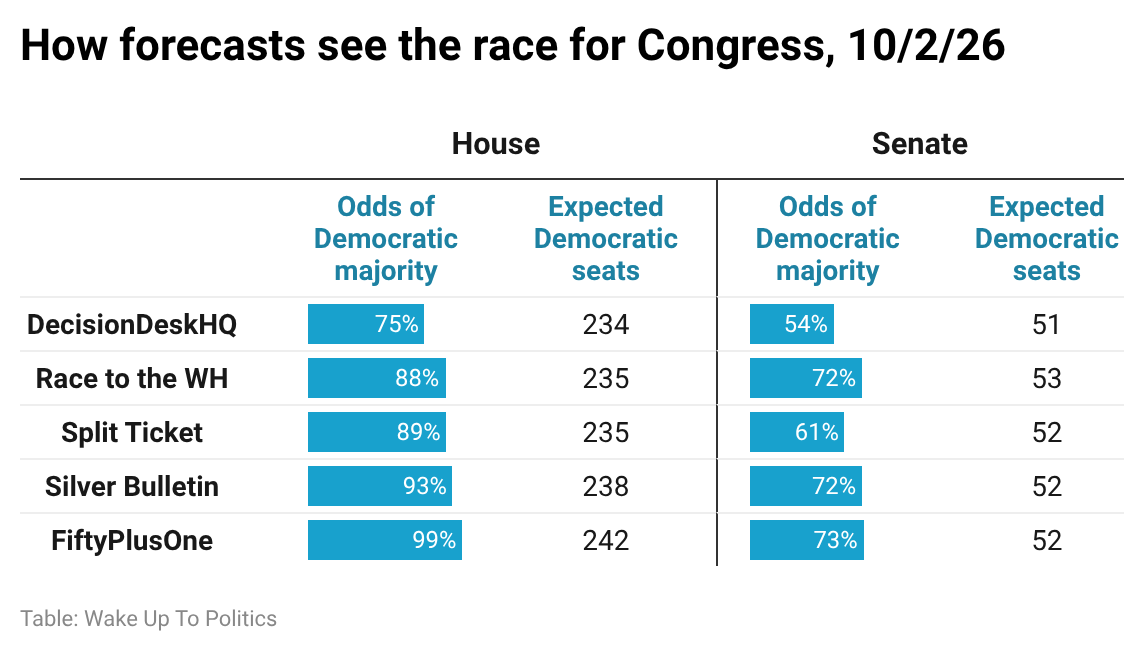
If you want to know what I’m thinking right now, I’m completely sold on the House numbers. In the last eight midterm elections, the president’s party has managed to win a House majority exactly once (in 2002). The average number of House seats gained by the opposition party in midterms over that timespan has been 21, which would place Democrats at 235 House seats come January, right around where most of the models expect the party to land.
235 is also the number of House seats that Democrats won in 2018, the last midterm election during a Trump presidency. This seems to me like a perfectly reasonable expectation.
What about the Senate?