


Have you ever been intensely interested in something, only to find out that not everyone else feels the same way?
That was my experience on Tuesday, except it wasn’t about a niche TV show or a trend that’s all over my TikTok feed but apparently no one else’s. It was a hearing on whether advisers to the president of the United States should be held in contempt of court.
You might remember the broad strokes of this case, which began back in March of 2025: President Trump invoked the Alien Enemies Act (AEA), a 1798 law that he claimed would allow him to deport certain migrants without due process; the government began putting these migrants on planes; U.S. District Judge James Boasberg ordered the planes to turn around; they kept flying, eventually depositing the migrants in the Salvadoran mega-prison known as CECOT, where they were subjected to brutal conditions.
This 18-month-old case has largely fallen out of the news cycle and been overtaken by events. Boasberg’s order was eventually overturned by the Supreme Court, which ruled that the case had been brought in the wrong venue — though the justices also shot down Trump’s interpretation of the AEA, ruling that the law still accorded migrants some due process. Trump has not tried to deport anyone under the statute since then. After about four months, the migrants against whom the law had been invoked were released from CECOT and returned to their native Venezuela.
But there’s still one more nagging mystery: Why didn’t the planes turn around when a federal judge told them to?
Judge Boasberg has been trying to answer this question for more than a year now, launching an inquiry into whether to hold the Trump administration in criminal contempt, which the administration has repeatedly tried to stop. In Tuesday’s hearing, the D.C. Circuit federal appeals court heard arguments on whether Boasberg can continue probing the administration’s alleged defiance of his orders.
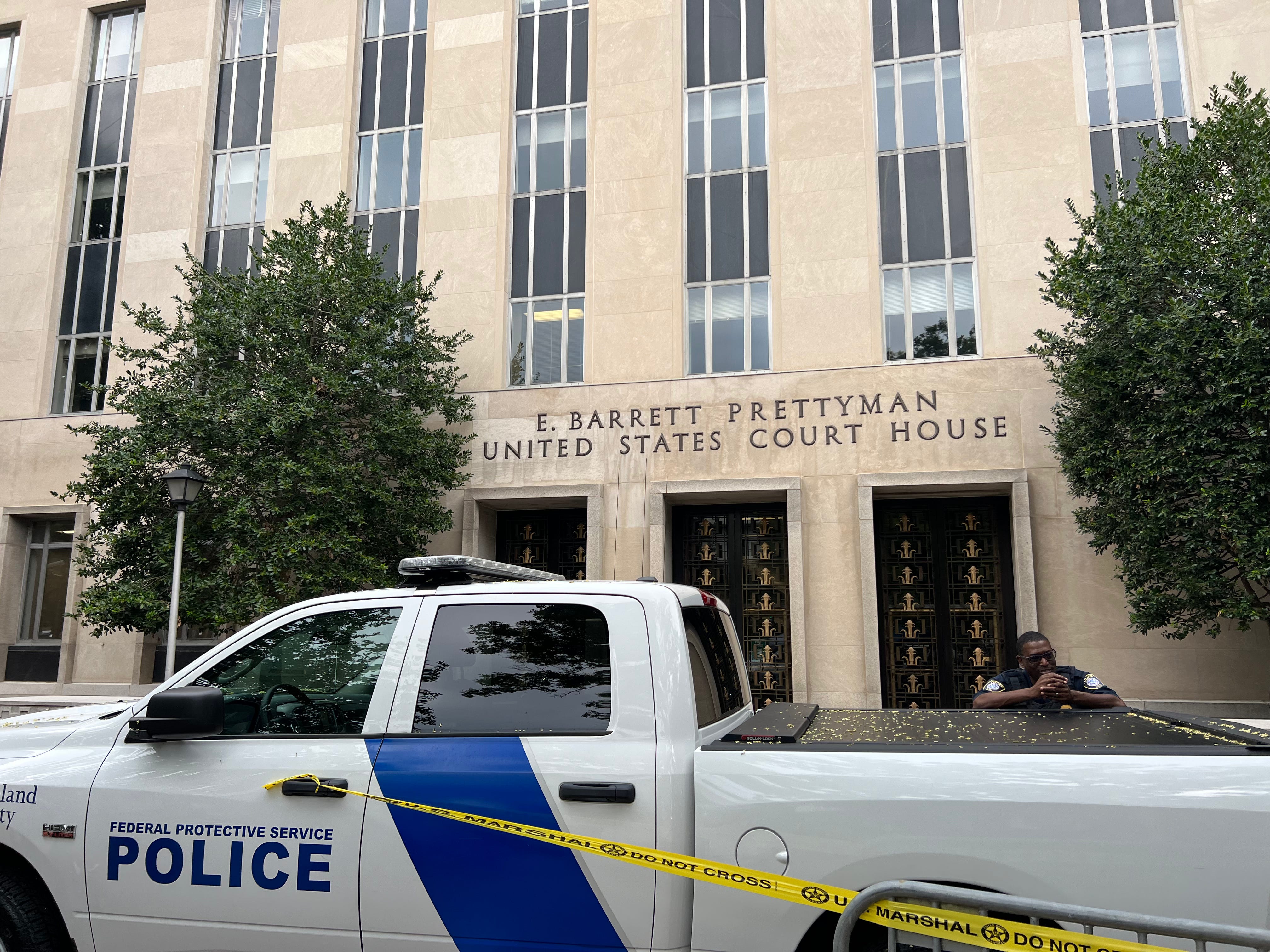
Having covered federal court hearings where it’s been necessary to arrive well before the proceedings start, I got to the D.C. Circuit courthouse an hour early yesterday. With the gravity of the case in mind, I was worried that I was already too late to get a seat. Instead, I arrived to find that not a single reporter was standing in the press line. Eventually, a few did trickle in, but once the clock struck 9:30 and we were told to rise, the press section was hardly full.
“I guess this is only interesting if your thing is rule of law,” one of the other reporters said to me. I guess. The events that were discussed at the hearing may have long stopped making headlines, but the underlying question — when can a judge investigate whether the executive branch has violated a court order — is a critical one, not just for this case, but potentially in setting precedents for the future as well. Let’s discuss.
There is certainly a compelling case to be made that the Trump administration defied Judge Boasberg’s order.
It all went down on March 15, 2025. At 4:20 p.m., the administration publicly posted Trump’s proclamation invoking the Alien Enemies Act against members of the Venezuelan gang Tren de Aragua (which the president had signed in secret the day before). Officials immediately began rounding up migrants to deport under the statute, without giving them any opportunity to challenge their designations as gang members. (For many, the evidence would turn out to be quite flimsy.) Judge Boasberg hastily convened a 5 p.m. Zoom hearing in response to a challenge from the American Civil Liberties Union (ACLU).
When pressed, the administration’s lawyer couldn’t give many details on when the migrants would be removed from the U.S. At around 5:20, Boasberg recessed the hearing for 40 minutes to give the lawyer time to collect answers. It was during that break in the proceedings that two flights took off carrying the migrants, at 5:26 and 5:45 p.m.
When the hearing resumed at 6 p.m., the Trump lawyer still said little; if he was aware that the planes had taken off, he didn’t say so. The ACLU’s lawyer learned separately, however, and informed the judge. At 6:47 p.m., Boasberg orally ordered the Trump lawyer to inform his higher-ups “immediately” that the planes “need to be returned to the United States.” Boasberg followed that up at 7:26 p.m. with a written order stating that the administration was temporarily “enjoined” — prohibited — “from removing” migrants under the AEA.
A Justice Department whistleblower, Erez Reuveni, would later testify that as soon as Boasberg issued his oral order, Reuveni — who was listening into the hearing — sent multiple emails to the Department of Homeland Security (DHS) telling them not to let any of the migrants off the planes in El Salvador, since they would need to be returned to the U.S. “We need to address this asap to avoid contempt,” Reuveni wrote.
Reuveni received no responses to his emails. The migrants were let off the plane and into CECOT. The Trump administration would later argue that, because the migrants had already left U.S. airspace by the time Boasberg issued his order, the government wasn’t bound by it. “Oopsie… Too late,” the president of El Salvador gloated on X, sharing a headline about Boasberg’s order. Secretary of State Marco Rubio reposted the message.
DHS was apparently getting its legal advice from then-Principal Assistant Deputy Attorney General Emil Bove. According to Reuveni, on March 14, Bove had said at a meeting that the administration would need to consider telling the courts “fuck you” and ignoring any order preventing the AEA from being invoked.
All that said, there are also a few complicating factors. At the March 15 hearing, Boasberg did tell the Trump lawyer, referring to his oral order, that “you don’t have to race to write it down,” since he would soon be issuing a written order, raising at least some questions about the formality of the oral order (although Boasberg also told the lawyer to “immediately” transmit the information to his bosses).
The written order was also a bit more vague than the oral order, saying nothing about the planes needing to be turned around and only preventing the administration from “removing” migrants under the AEA. (The administration thus argues that it didn’t cover migrants who were already out of the country. The ACLU retorts that a “removal,” under immigration law, is only complete when a migrant leaves U.S. custody, which these migrants didn’t until they left the planes. Still, the written order was certainly vague as to how it applied to ongoing removals.)
There’s also the fact that the Supreme Court later struck down Boasberg’s order. Can the administration be held in contempt for violating an order that has since been voided?
A majority of D.C. Circuit judges seemed to think the answer to that question is “yes” — or, at least, that they were willing to let Boasberg’s contempt inquiry proceed for now and leave that question for later.
The Trump administration is seeking to end the contempt inquiry under the exacting “mandamus” standard, which requires them to have a “clear and indisputable” right to the relief they are seeking. The D.C. Circuit judges seemed unconvinced that the administration had satisfied this high bar.
Based on Tuesday’s hearing, the appeals court appeared poised to rule along ideological lines; Democratic-appointed judges outnumber Republican-appointed judges on the court, 7-4.
The Democratic-appointed majority spent much of the three-hour hearing hammering the Justice Department lawyer, Brett Shumate, often with raised voices.
“I’m asking you whether contempt of court could be committed…[by] an attorney who advised somebody to ‘f expletive’ the court, and the court’s order, and go ahead and disembark people?” Judge Patricia Millett, an Obama appointee, asked Shumate sharply, implicitly invoking Reuveni’s account. “Would that potentially be contempt of court in the view of the United States?”
“I think it depends on the facts, Your Honor,” Shumate replied.
“Well, then I think like the district court needs to ask some more questions,” Millett concluded, sounding satisfied with herself.
Much of the proceedings turned on how much of an investigation Boasberg would be able to run. Under Rule 42 of the Federal Rules of Criminal Procedure, a judge must alert a potential “contemnor” — that, I learned on Tuesday, is the word for someone who has committed contempt of court — that the judge has reason to believe they committed criminal contempt, in a notice that lays out the “essential facts” of the allegation.
The judge then has to refer the matter to the Justice Department, which can decide whether or not to prosecute. If the government decides against it, the judge is charged with appointing an independent attorney who can prosecute the contempt on the judge’s behalf.
The Trump administration argued that this means there is nothing more for Boasberg to do at this point. The administration has already told Boasberg who made the decision to let the migrants off the planes (then-DHS Secretary Kristi Noem), Shumate said. Therefore, the only thing Boasberg can do now is either refer the matter to the DOJ or not, “because to investigate a crime is a role of a prosecutor rather than a judge,” Shumate pointed out.
However, the D.C. Circuit’s liberal majority seemed unconvinced that just because the administration had named Noem as the person responsible, Boasberg couldn’t at least examine the matter a little further, to ensure that there isn’t anyone else who might need to be referred.
“You are continuing to suggest, ‘Here, district court, just take my word at it, that this is the person.’ That’s also unfair to that alleged contemner, who might be a sacrificial lamb,” said Judge Michelle Childs, a Biden appointee, suggesting that the administration might simply be putting Noem forward as the responsible official while hiding others who may have given her legal advice and committed the real contempt.
The D.C. Circuit is often considered the second-most important court in the country, a stepping-stone to the Supreme Court. Four of the nine current justices came to the Supreme Court from the D.C. Circuit; several of the judges at Tuesday’s hearing have been short-listed for vacancies in the past. Judge Millett, as well as Chief Judge Sri Srinivasan, were considered for Supreme Court appointments during the Obama administration. Judge Childs was considered for an appointment during the Biden era.
Judge Neomi Rao, a Trump appointee, is seen as a potential Republican Supreme Court appointee down the line; she was the D.C. Circuit judge who most vocally came to the Trump administration’s defense during Tuesday’s hearing. She almost seemed to be auditioning for the role, as did Biden-appointed Judge Florence Pan, who is seen as a possible future Democratic pick. The two repeatedly cut each other off, both seeming exasperated with the other.
Because of some of the odd circumstances surrounding Boasberg’s order(s), it is hard to know where this exact contempt investigation will end up. But the D.C. Circuit ruling will be important regardless, as it will likely set out some guidance for what a judge’s role looks like in a contempt inquiry. Does a judge simply have to accept an administration’s accounting as fact, and then pass it off to the DOJ? Or can they dig a little deeper to try to figure out the “essential facts” of what took place?
At times, the very health of the judiciary seemed to be at issue in the case.
Shumate argued that the separation of powers prevented Boasberg from carrying out any further inquiry, but “the separation of powers is going to run two ways here,” Judge Millett noted. “It’s not a one-way street in favor of the executive branch.”
“The separation of powers respects the separate and co-equal authority of the different branches,” Judge Nina Pillard, also an Obama appointee, said. “If Article III judges’ orders are optional with the United States as a litigant, and they can disregard the orders with impunity, that’s obviously a diminution of the authority of the Article III courts.”
“Really, at bottom, what this case is about is whether Article III courts are at the mercy of the executive,” both in their orders being followed and then in that compliance being investigated, Pillard added. “I’m looking for you to respond to that concern, and help me feel more comfortable that my sort of more grim portrayal of the position of the courts under your theory is somehow—that I shouldn’t be concerned.”
“You should not be grim,” Shumate replied. “I can assure you, the government…is always complying, always advising our clients to comply with court orders.”
In some ways, I think this gets to my own question of why the D.C. Circuit hearing received relatively little coverage.
Thinking about the Alien Enemies Act case is like boarding a time machine to a distant era (18 months ago), when Donald Trump was at the peak of his powers and it seemed highly possible that the new administration might get into a habit of defying court orders. “He who saves his Country does not violate any Law,” Trump posted around this time. The president appeared like he might be untouchable.
But before long, it all came crashing down to earth. Trump’s popularity, then higher than it had ever been, started on its long demise. It is now commonplace for Trump to lose court battles; when he does, he no longer flirts with defiance. The Supreme Court strikes down his tariffs, or his birthright citizenship order, or tells him to remove the National Guard — and Trump does so. Trump stared down the justice system, and the justice system won.
The news outlet The Independent recently ran a headline, “Trump’s media ban shows steady slide of his regime into outright dictatorship.” In fact, that experience showed the opposite. There are certain reporters Trump doesn’t want in the White House; a judge ordered him to allow them; now they are back in the president’s house. That’s not quite how things work in an “outright dictatorship.” Notwithstanding the governmental system Trump may want, the one he is still leading is not a dictatorship, as judges retain the power to rule against him — and their rulings continued to be followed.
Put this way, the Boasberg contempt inquiry is about patching up the final hole from another time, back when Trump seemed much surer of himself and genuinely seemed to think he had the popular support sufficient to buck court orders with impunity. That didn’t last long.
Courts have “no influence over either the sword or the purse,” as Alexander Hamilton memorably wrote. Instead, it is with words alone that they have succeeded in blocking the president — even one who has flirted with defiance — from carrying out some of the initiatives most important to him. What a remarkable statement of our constitutional system’s enduring power.
But also its fragility. None of this means that Trump’s compliance will last forever, particularly as he heads into his lame-duck era — or that future (more popular) presidents won’t try to pick up where he left off in March 2025, and try to defy orders handed down by judges. If they do, it will be important to know what system is in place, if any, for judges to protect their powers. How do we balance the separation of powers on one hand by ensuring that judges don’t cosplay prosecutors, but also on the other hand by ensuring that judicial orders aren’t optional?
The influential D.C. Circuit is about to take a first swing at that question. I, for one, will be watching.
Well done Gabe! You've tied together many of the ongoing concerns in this thoughtful post
One of the best things you do, Gabe, is to post news that the rest of the press either ignores or describes with insufficient depth.