


Shocks to the American constitutional order don’t always announce themselves by press release.
But this one did, on Friday.
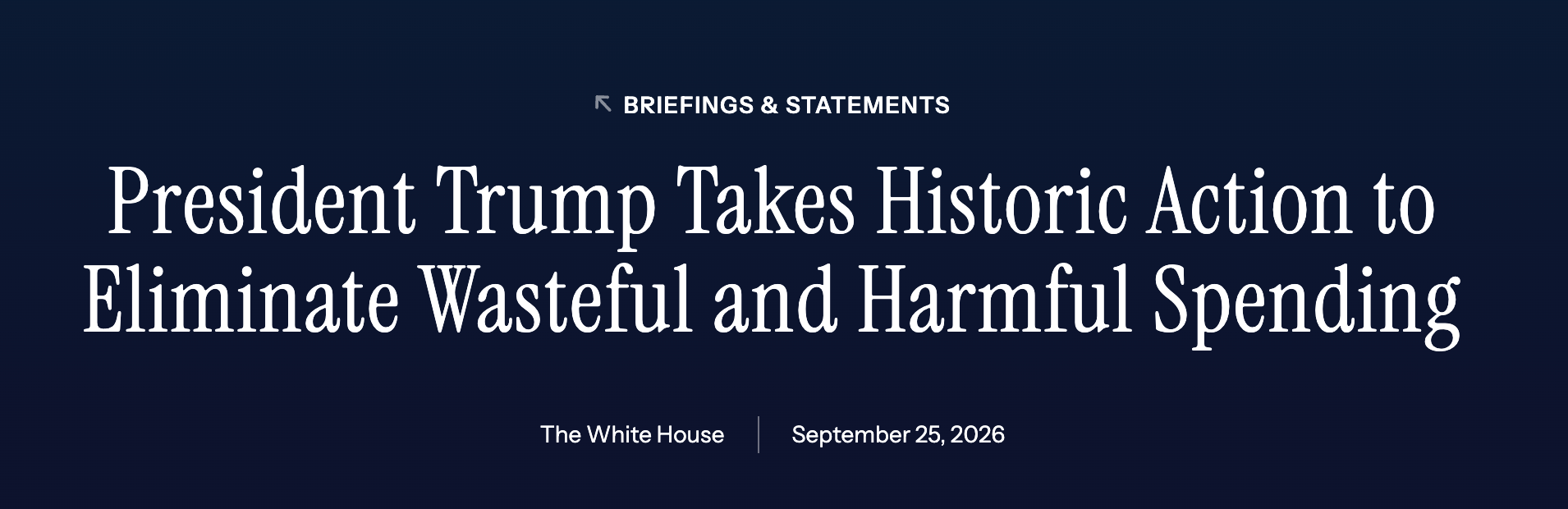
“President Trump Takes Historic Action to Eliminate Wasteful and Harmful Spending,” read the headline of the White House statement, blasted out on Friday night, right as the weekend was about to start.
Trump was unilaterally canceling about $810 million in federal funds, the White House said.
How? We should back up a bit.
Congress famously holds the “power of the purse” — the authority to decide how the federal government spends its money — but presidents and lawmakers have long clashed about exactly what that means.
We know, courtesy of the Constitution, that “No Money shall be drawn from the Treasury, but in Consequence of Appropriations made by Law.” But when Congress passes an appropriations law directing a certain amount of money to a certain priority, does that mean the executive branch can spend that money, or must spend that money? Can the president pick and choose which appropriations laws to follow?
A long line of presidents, unsurprisingly, have argued that the answer to that question is “yes.” But no president argued it as forcefully as Richard Nixon, who is estimated to have refused to spend about $18 billion appropriated by Congress, including for housing programs, disaster assistance, and enforcing the Clean Water Act.
When a president declines to spend congressionally appropriated funds, it’s known as an impoundment. In 1974, fed up with Nixon’s antics, Congress passed the Impoundment Control Act. The goal was to set up an actual process for when the president objected to a certain funding provision, beyond just “Nah, I don’t really feel like spending that.” The result was the rescissions process, which starts when the president sends Congress a letter detailing the money he doesn’t want to spend.
That triggers a 45-day waiting period, during which the funds don’t have to be spent. But after 45 days, if Congress has not approved the president’s rescissions request, the president has to spend the money. Last year, Trump followed this process, requesting to rescind about $8 billion in foreign aid funding and $1 billion in funding for the Corporation for Public Broadcasting (CPB). Congress approved his request. (Notably, a rescissions request is not subject to the Senate filibuster, which means an appropriations bill needs 60 votes to pass, but undoing part of an appropriations bill needs only 51.)
But here’s where things get a little trickier.
What if the president requests to rescind funds fewer than 45 legislative days before the end of the fiscal year (September 30), when most appropriated funds expire? Can the president wait all year to spend the money, then send over a request at the last minute, thereby freezing the funds—and then, oops!, the fiscal year is over while the waiting period is still in place, so the funds expire without the president having had to spend them as Congress intended?
Such a gambit is known as a pocket rescission, though it’s effectively a backdoor impoundment: the president using legalistic tactics to refuse to spend congressionally appropriated funds. And it’s exactly what Trump tried to do on Friday night.
I get that this all sounds a bit wonky. But it’s important.
Congress holding the federal pursestrings is crucial to our constitutional system. James Madison considered it the “most complete and effectual weapon with which any constitution can arm the immediate representatives of the people.”
Appropriations law might seem boring, but if you think about it, it’s really what undergirds every other area of law you might care about. Few things can happen in government without funding, so appropriations bills are really health care bills, and defense bills, and infrastructure bills, and border security bills. The appropriations process is how Congress decides how much money to put towards each of these priorities — in essence, showing which priorities it actually prioritizes.
As Joe Biden liked to say (in a line he would attribute his father): “Don’t tell me what you value. Show me your budget, and I’ll tell you what you value.”
Taken to its logical extension, pocket rescissions could topple this whole system. Congress could create a new program to combat climate change, and without persuading legislators to undo it, a Republican president could simply refuse to spend the money appropriated for it: in effect, singlehandedly repealing the law. A Democratic president could look at the budgets for ICE or the Pentagon, and decide they are no longer interested in sending quite so much money to either agency. The president’s powers would massively expand; Congress would be shoved into the backseat. All spending decisions would run through the Oval Office.
In his Friday letter to Congress, Trump framed the roughly $800 million in new funding cuts as “proposed rescissions.” But, of course, he only transmitted the “request” to Congress five days before the end of the fiscal year — and the House is already on recess anyways. There is no way Congress can approve or reject the request before the fiscal year ends, and the funds go up in smoke. Hence the triumphal tone of the White House press release; unless the courts step in, this isn’t so much a proposal as an order.
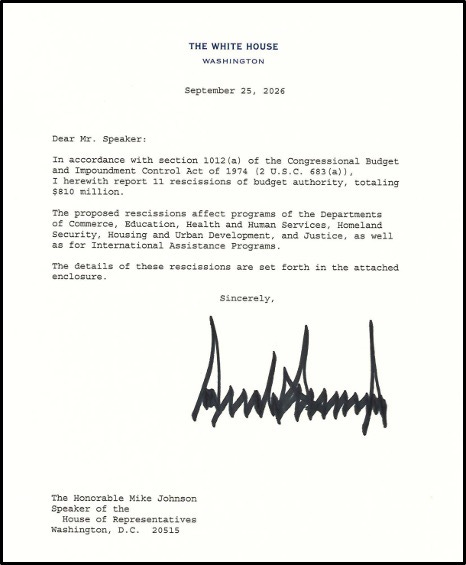
The largest pot of money that Trump is trying to wiggle out of spending is $567 million for the Department of Health and Human Services’ (HHS) Office of Refugee Resettlement, which helps refugees and asylum recipients relocate and assimilate in the U.S.
The pocket rescissions request would also claw back:
$70 million in grants and fellowships that bring foreign students and faculty to the U.S.
$56 million in grants for organizations that provide Americans with housing counseling.
$28 million from the Agency for Healthcare Research and Quality, which studies ways to improve health care quality.
$25 million from a program that offers educational assistance to the children of migrant workers.
$15 million from the Justice Department’s Community Relations Service, which aims to mediate local racial and ethnic tensions.
$15 million from a program that provides mental health and legal services to immigrants and asylum recipients.
$10 million from the Minority Business Development Agency, which supports minority-owned businesses.
$10 million in grants that offer assistance for immigrants trying to navigate the citizenship process.
$9 million from a program that provides debt forgiveness to foreign countries that make climate change-related investments for coral reefs and tropical forests.
$5 million from the HHS’ Office of Minority Health, which aims to eliminate health disparities between racial and ethnic groups.
In Trump’s letter, he refers to several of these programs as “unnecessary and wasteful.” Some of the programs have been ineffective, he alleges. Others are redundant. Still more are not in the best interest of American taxpayers. And a few that preference certain racial groups, he says are outright illegal.
Trump may be right on all these counts, and may have excellent policy arguments for ending or defunding these programs. But the time to make such arguments is when lawmakers are writing their appropriations bills, not almost a year later. Congress is supposed to be the forum for these sorts of arguments.
This is now the second year in a row that Trump has attempted a pocket rescission. Last year, he used the tool to get out of spending about $5 billion in foreign aid funds. The move immediately sparked a legal dispute, which went all the way to the Supreme Court.
Four days before the end of last fiscal year, the court paused a lower court ruling blocking the pocket rescission. However, the justices said that their ruling was only because the plaintiffs in that case likely didn’t have standing to sue, and made clear that their order “should not be read as a final determination on the merits.”
In theory, this means the legality of pocket rescissions remains an open question: the Supreme Court wasn’t even taking a final view on the standing question, much less on the underlying legality of pocket rescissions (on which it didn’t weigh in at all). It was merely pausing the lower court order as the case continued to make its way through the federal courts.
In this case, however, it’s a bit more complicated, since it’s now been more than a year since the funds in question expired. This is the twisted genius of pocket rescissions: not only does it not give Congress any time to stop you; potentially, it might be difficult for the courts to as well, since the case comes so late in the fiscal year that it’s impossible to resolve it before the funds expire, arguably mooting the whole dispute. It’s a great example of the president’s ability to run laps around the court system.
That said, last year’s pocket rescissions case is still technically ongoing. The Trump administration tried to have it dismissed in January, making this exact argument, that the fight was moot because the funds had expired, so it was too late to order Trump to spend them.
But just last week, after many months of consideration, U.S. District Judge Amir Ali shot down the administration’s motion. Ali cited Supreme Court precedent on cases that are “capable of repetition, yet evading review”: disputes that are only applicable for a short period of time, giving one party the ability to quickly make a mootness claim — but that are also liable to keep happening again and again. In these cases, the Supreme Court has said, judges are able to reject the mootness argument and tackle the issue before getting caught in an endless loop.
“This is the quintessential example of a case that is capable of repetition but would otherwise evade review,” Ali wrote. “There is little question that claims challenging an agency’s decision not to spend appropriated funds will generally—indeed, nearly always—take longer to litigate than the window to spend the funds.”
And, he added: “The challenged action here—an agency decision to not spend appropriated funds by Congress’s deadline—is also ‘reasonably likely to recur.’” Ali’s prediction was quickly proven correct, when Trump tried once again to implement a pocket rescission as this fiscal year neared its end on Friday. So, in one vein, Trump has lapped the justice system: moving onto his second pocket rescission, while the courts are still considering his first. But, viewed another way, the courts are fighting back, refusing to let last year’s case die even as the next fiscal year is almost over.
Even if last year’s case is able to continue, it is still unclear how the dispute will be resolved.
Trump has argued that only the head of the Government Accountability Office (GAO) can sue over failures to comply with appropriations law. The Supreme Court seemed sympathetic to this argument, but the justices never made a final decision on that standing question and — contrary to how some news outlets have framed the ruling — never commented on whether pocket rescissions themselves were legal.
The GAO itself has argued that pocket rescissions are illegal (though it has never brought a lawsuit to this effect). The agency has said that presidential refusal to spend funds violates the Constitution’s requirement that he “take Care that the Laws be faithfully executed,” since appropriations laws are laws too. It has also noted that the intention of the Impoundment Control Act was to shut off presidential discretion over appropriations, not to expand it — though Trump retorts that the text of the law, whatever its intention, does not seal off the pocket-rescission backdoor.
Another factor worth noting here is that the Supreme Court said last year that it was preliminarily siding with Trump in the pocket rescissions dispute partially because the funding in that case was related to foreign policy, over which the courts typically give presidents significant discretion. The justices could potentially be less sympathetic to this year’s pocket rescission, if a lawsuit over them is filed, since some of the funding implicates priorities that are entirely domestic in nature.
No matter what happens in the courts, the pocket-rescission loophole offers an easy starting place for reform if lawmakers ever become interested in reining in executive power. There is already bipartisan frustration towards the tool: Senate Appropriations Committee chair Susan Collins (R-ME) called pocket rescissions “illegal” in an X post on Friday.
To address this issue, Congress could simply mandate that rescissions requests have to be made a certain amount of time before the end of a fiscal year, to ensure that there is always time for legislators to consider the request and for the money to be spent in the event the request is not approved.
While in power, one party or the other might enjoy pocket rescissions — but as soon as the shoe is on the other foot, with Republicans already canceling refugee programs or Democrats potentially canceling ICE funding, the tool will no longer seem so nifty. Far from being of concern only to budget wonks, pocket rescissions — if their use continues to expand — could fully snatch the power of the purse away from Congress and unravel one of the most important checks and balances put in place by our Founding Fathers.
Editor’s note: Processes like this one are cloaked in legalese, requiring you to understand words like “impoundment” and “rescission.” But once you sort through all this complicated language, I hope you can see that this is an important issue with big implications for our political system.
Many news outlets have gotten the facts of the pocket rescissions cases wrong. And not a single one has reported on Judge Ali’s ruling last week keeping last year’s pocket rescissions case alive.
If you want to support my work offering civics education that’s tied to the day’s news — so that everyone can understand their government and how it works — I hope you’ll consider joining as a paid subscriber:
I really appreciate the explanation! I made it through and understand a lot more of the rescissions process (a sentence I never thought I would say 😂)
Snatching power? If you’re interested in the subject, the local level is where all the action happens. From Jed Shugarman (MSNBC legal analyst):
“In the United States, almost 90 percent of state judges have to run in popular elections to remain on the bench. In the past decade, this peculiarly American institution has produced vicious multi-million-dollar political election campaigns and high-profile allegations of judicial bias and misconduct. The People's Courts traces the history of judicial elections and Americans' quest for an independent judiciary--one that would ensure fairness for all before the law--from the colonial era to the present.
“In the aftermath of economic disaster, nineteenth-century reformers embraced popular elections as a way to make politically appointed judges less susceptible to partisan patronage and more independent of the legislative and executive branches of government. This effort to reinforce the separation of powers and limit government succeeded in many ways, but it created new threats to judicial independence and provoked further calls for reform. Merit selection emerged as the most promising means of reducing partisan and financial influence from judicial selection. It too, however, proved vulnerable to pressure from party politics and special interest groups.
“Yet, as Shugerman concludes, it still has more potential for protecting judicial independence than either political appointment or popular election.
“The People's Courts shows how Americans have been deeply committed to judicial independence, but that commitment has also been manipulated by special interests. By understanding our history of judicial selection, we can better protect and preserve the independence of judges from political and partisan influence.”