


Here’s a hypothetical for you.
Let’s say a congressman is about to vote on a bill mandating universal background checks for guns. The congressman’s voters oppose the bill. The congressman himself does too, so this isn’t a case where his own conscience conflicts with the views of his district. In your opinion, how should the congressman vote?
Seems simple, right? Maybe not.
A trio of political scientists from Brigham Young University recently polled a representative sample of Americans on this question — and also asked for their opinion on background checks — and they emerged with a striking finding: respondents tended to think the congressman should simply vote according to whatever position the respondent already held, no matter what the legislator or their voters thought.
Professors Michael Barber, Ryan Davis, and Adam Michael Dynes asked the question several different ways, involving immigration, abortion, health care, and tax policy. They randomized whether a respondent was told the congressman’s personally agreed with his voters, or disagreed with them.
Across the different questions, they found that Americans said that a congressman should vote his conscience, including when it conflicted with the views of his district and with the respondent themselves, 52% of the time. They said that a congressman should vote with his district, including when it conflicted with his conscience and their own, 60% of the time. But the respondents were most likely to say that the congressman should vote with them: 66% of the time, a respondent’s answer of what a legislator should do aligned with their own personal opinion, even in cases when they they knew they formed a minority of one, out of step with both the lawmaker and his district.
If the congressman supported a policy but his district opposed it — and the respondent opposed it too — respondents only said that the legislator should vote for the policy 25% of the time. But the simple fact of the respondent supporting the policy got that to shoot up to 60%, even when the legislator’s district was still in opposition.
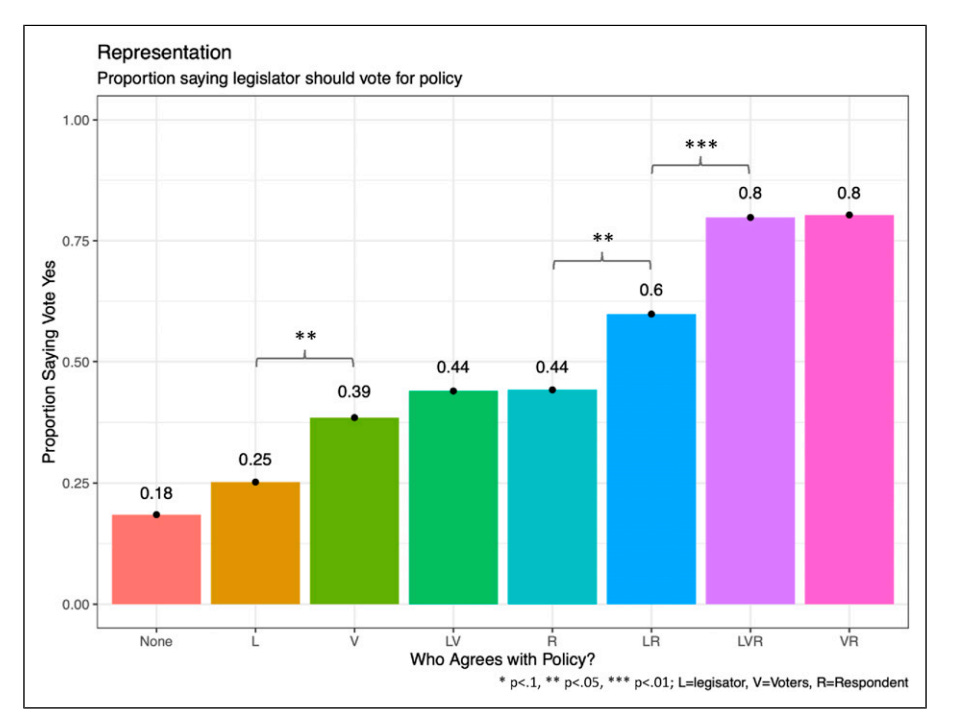
In political science, the idea that a congressman should vote in accordance with his district is known as the Delegate Model of Representation. The idea that a congressman should vote in accordance with his conscience is the Trustee Model of Representation. Barber, Davis, and Dynes proposed that a third model exists, which is actually more influential than either side of that long-accepted binary.
They called this Personal Representation — or, more darkly, Dictatorial Representation — the idea that “many citizens want representatives to prioritize their own preferences, even when both the representative and the majority of constituents disagree.”
“Unlike a preference for delegate versus trustee representation,” the trio wrote, “a preference for personal representation is directly about whether citizens accept the legitimacy of being outvoted in ordinary political life.”
I was thinking about this political science finding yesterday when watching the Senate confirmation hearing for Kevin Warsh, President Trump’s nominee to lead the Federal Reserve. About 35 minutes into the hearing, Sen. Elizabeth Warren (D-MA) asked Warsh a question that has now become commonplace at confirmation hearings for Trump nominees.
“Mr. Warsh, did Donald Trump lose the 2020 election?” Warren asked.
As has also become commonplace, Warsh dodged the question. “Um, uh, we try to keep politics, if I’m confirmed, out of the Federal Reserve,” he said.
Warren prodded him; he bobbed and weaved again. “Senator, I believe that this body certified that election many years ago,” Warsh pointed out. She tried a third time; Warsh pivoted to a criticism of the Fed’s handling of monetary policy in 2020.
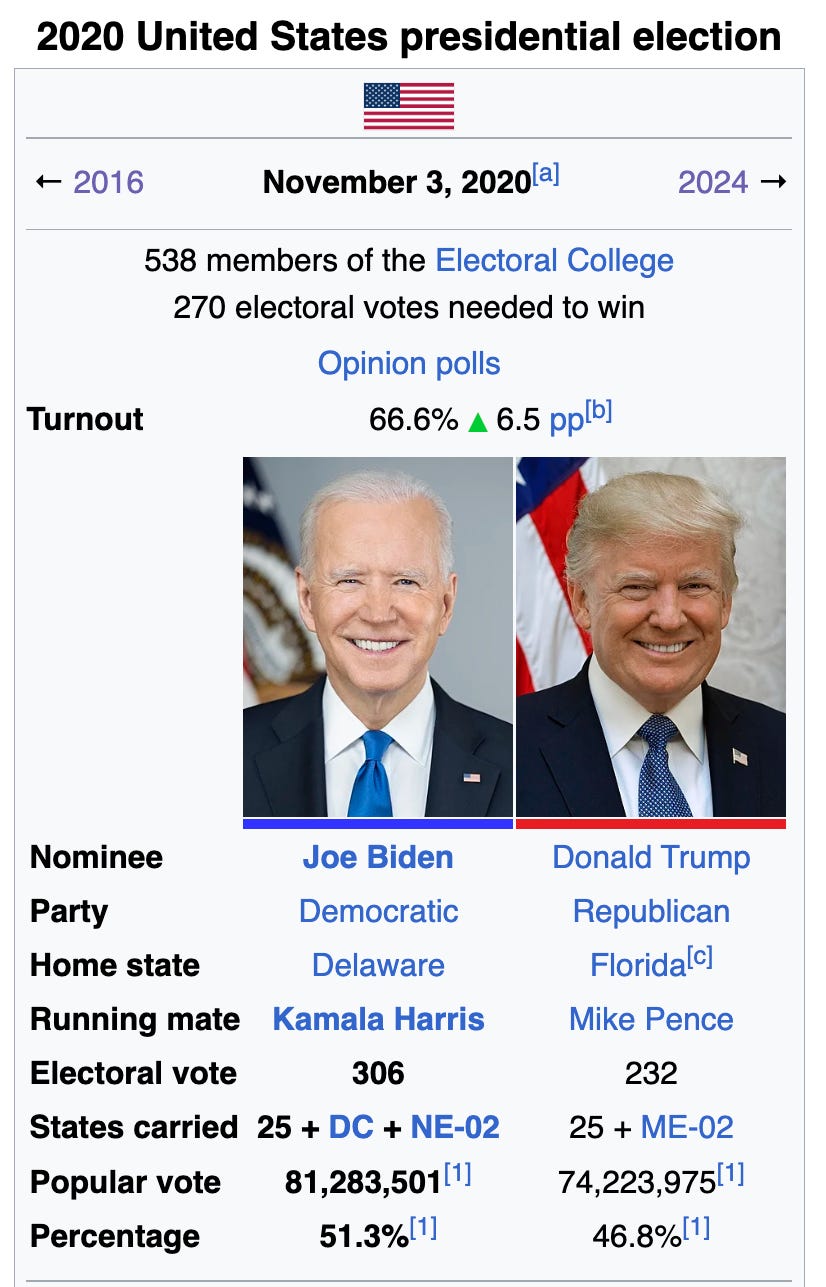
At this point, that simple factual question has been asked of dozens of Trump’s nominees to serve as judges, all of whom have dodged in a similar manner as Warsh. Joe Biden was certified as the winner of the 2020 election, they say. Or Joe Biden served as president. But none have been willing to say what we can glean from simple math, and what was upheld in more than 60 court cases: Joe Biden won more votes in the 2020 election than Donald Trump.
Two plus two equals four. 81 million is greater than 74 million.
Remember what the BYU professors told us, that a preference for personal representation — which many Americans seem to share — is “directly about whether citizens accept the legitimacy of being outvoted in ordinary political life.”
If you feel one way, but the majority of your neighbors feel another, do you accept that the outcome should align with the majority’s opinion, not with yours? When you think about it, this is what all of democracy is about, really.
“Democracy is belief in the ability of human experience to generate the aims and methods by which further experience will grow in ordered richness,” the philosopher John Dewey once said. ‘“Every other form of moral and social faith rests upon the idea that experience must be subjected at some point or other to some form of external control; to some ‘authority’ alleged to exist outside the processes of experience. Democracy is the faith that the process of experience is more important than any special result attained, so that special results achieved are of ultimate value only as they are used to enrich and order the ongoing process.”
It is a belief in process over outcomes, and a faith not that you will usually be right, or that a higher power will be, but that a majority of the population will get to the right answer a majority of the time.
If belief in this idea is the test of whether a citizenry embraces democracy, then we are failing that test, according to the BYU study, in which voters consistently prioritized their own preferences above the preferences of the majority. And is that any surprise, when faith in that democratic ideal is being modeled for us so poorly by our leaders, including those hoping to serve in apolitical positions, like judges and as Fed chairman?
The president of the United States repeatedly insists that he won an election that he lost, and his nominees routinely appear before the Congress and refuse to say otherwise, presumably out of fear of contradicting him.
There are no comparably high-profile figures denying the results of a presidential election on the Democratic side — though, notably, many Democratic voters seem to have gotten there on their own.
In a January poll by YouGov, 67% of Republicans said that Joe Biden did not legitimately win the 2020 election. 51% of Democrats said that Donald Trump did not legitimately win in 2024. (There is, to be clear, equally no evidence for these two claims.) Those two numbers are not equal, but the topline takeaway is stark: majorities of both American political parties are unable to accept it when they’ve lost.
One interesting facet of this to me is that, in the immediate aftermath of the 2024 election, YouGov asked this question and found 35% of Democrats believed that Trump did not legitimately win, still distressingly high but noticeably lower. They asked again in June 2025, and the number crept up to 38%. By January of this year, it had reached 51%.
As Trump’s term has gone on, and as Democrats have grown unhappier with the election result, more and more have come to view it as illegitimate. Not only do Americans reject the legitimacy of an outcome they dislike, some are rejecting the legitimacy of an outcome they once accepted the more that the outcome has upset them. It is hard to think of a better illustration of Americans’ support for the democratic process being conditional on their opinion of the outcome that it yields.
Many of us, it seems, would rather live in our own personal dictatorship, where presidential elections always go our way and congressman always vote exactly how we want, than come to terms with what it means to live in a democracy, with all the hard persuasive work and frequent disappointments that entails.
2020 was not the first controversial election in our history. In fact, there have been several occasions in which presidential losers had much more serious grounds to believe that they were the rightful winner. In 1876, Republican election commissioners in several states threw out votes for Democrat Samuel Tilden, calling Republican Rutherford B. Hayes’ victory into question. In 1960, Democrat John F. Kennedy’s win was tainted by credible allegations of election fraud in Illinois and Texas, which might have kept Republican Richard Nixon from the White House. Finally, after the 2000 race, a post-election study found that if all disputed ballots across the state had been counted according to consistent standards, Democrat Al Gore would have won Florida, and the presidency. (The study also found that if the limited recount that Gore actually requested had continued, instead of being stopped by the Supreme Court, Republican George W. Bush still would have won.)
These three men all had actually credible cases to mount that they should have been elected president. But all three stepped aside, believing that preserving the American process over the long-run was more important than securing a specific outcome in the short-term.
“I can retire to private life with the consciousness that I shall receive from posterity the credit of having been elected to the highest position in the gift of the people, without any of the cares and responsibilities of the office,” Tilden joked.
Here’s Nixon:
I could think of no worse example for nations abroad, who for the first time were trying to put free electoral procedures into effect, than that of the United States wrangling over the results of our presidential election, and even suggesting that the presidency itself could be stolen by thievery at the ballot box.
And here’s Gore:
Now the U.S. Supreme Court has spoken. Let there be no doubt, while I strongly disagree with the court's decision, I accept it. I accept the finality of this outcome which will be ratified next Monday in the Electoral College. And tonight, for the sake of our unity of the people and the strength of our democracy, I offer my concession.
Contrast those statements of magnanimity not only with Trump’s repeated insistence that he won the 2020 election, but the refusal of his nominees, including Warsh on Tuesday, to acknowledge this reality as well. America kinda just got lucky, at three important points in history, by having the right losers. Now, the next chairman of the Federal Reserve cannot even look a U.S. senator (and the American people) in the eye and recite a simple civic fact, because the president finds it personally upsetting.
In his beautiful book “American Covenant,” the American Enterprise Institute’s Yuval Levin writes about a “republican ethic” that undergirds America, which counsels patience in politics: winning with humility and losing with grace. The American system contains so many obstacles preventing majorities from implementing their will, in order to push Americans who disagree to work with one another.
When we win, we are supposed to recognize that we might lose tomorrow, so we should treat the losers justly and work with them cooperatively. When we lose, we know we might win tomorrow, so we should recognize our competitor’s victories so that they will recognize ours, and use defeat as an opportunity to learn and modify our programs in the ways the electorate has asked. Levin writes:
Sustaining that framework means sometimes valuing the processes by which our system acts above the outcomes we desire. This requires a kind of commitment to the Constitution and veneration of the law that do not come naturally but can be achieved by the experience of living under a system of government we respect… This kind of formation of the citizen’s soul cannot be achieved by merely teaching civics in the abstract. But it can be achieved by a combination of rhetoric and experience, by teaching constitutionalism, and by living it.
It is a two-way street, Levin adds, which leaders must model to their citizens, and which citizens must model back. We are failing this equation in almost all directions. When parties win, they immediately try to grab maximum amounts of power, and are being cheerleaded by their voters in doing so. When parties lose, leaders on the Republican side, and voters on both sides, are denyig it.
The next generation is noticing.
More in Common, the nonprofit group whose work I cited Monday, has polled this question:
“With regards to the Constitution, how do you think President Trump should govern?”
Option 1: “He should always follow the Constitution, even if it means he sometimes can’t get things done.”
Option 2: “He should follow his plan to Make America Great Again, even if it means sometimes ignoring the Constitution.”
Older Trump voters (Gen X, Baby Boomers, and Silent Generation) say 74%-15% that Trump should follow the Constitution, even if it provides obstacles. But younger Trump voters (Millennials and Gen Z) are noticeably more divided on that question, 60%-32%, doubling the proportion of voters who say Trump should plow past the Constitution if its process inconveniences his desired outcomes.
On other side of the aisle, in the YouGov polling, 18- to- 29-year-olds are the cohort most likely to say that Trump did not legitimately win the 2024 election.
A democracy is all about admitting that you might be wrong: otherwise, you would prefer to live in an autocracy structured around your specific viewpoint, where your policy stance would always win. We acknowledge our potential wrongness by agreeing to potentially be defeated in elections, yielding power if a majority disagrees with us, and accepting roadblocks to implementing our agendas even when we win, knowing that the best outcomes will be achieved not by our viewpoint becoming law by fiat, but by a process of checks and balances that improve our policies.
When you have leaders no longer willing to embrace this ethic — or to model it in White House speeches or Senate confirmation hearings — you will end up with a citizenry that stops desiring it.
This is a really smart analysis. I have just one quibble, which is that I think there are very logical circumstances where a person might think someone else's Congressional representative ahould vote in keeping with that person's own views, in spite of the personal beliefs of that representative or the desires of their constituents. And I think it ties back to the heart of the point that is being made overall. That is: if I think that my view is better aligned with the rule of law, then of course that's the way I think the representative should vote.
For example, say a rep sponsors a "Citizen Justice" bill at the urging of their constituents, permitting a group of 12 or more adults to form an ad hoc investigation of an alleged crime, reach a conclusion about what they deem is in the immediate interests of justice, and meet out such punishment they hold to be appropriate to the crime. Proponents say this will reduce crime and make for more efficient enforcement of the law. Detractors say this is an attempt to legalize lynching. I would want that rep to recognize that the proposed law is very likely to be found unconstitutional and unenforceable, and that it's potentially harmful to minority communities not well represented by the majority of that rep's constituents. I might be saying that I want their vote to align with my preference rather than their own inclination or that of their constituents -- but in this case I have more of a reason then merely taking my own side, because the bill in question implicates deeper issues than mere policy preference.
Majority rule is not the same thing as the rule of law, for this very reason. We don't want governance be based on the whims of a majority that says "rules for thee but not for me." Lawmakers should first be held to the standard of honoring the Constitution and the foundations of the law, and then may consider policy preferences of themselves and their constituents. Which, again, really gets back to the main point of this piece.
Well done Gabe. I am a boomer and have reaped the benefits of a generation before me that believed in self-sacrifice, compromise and teamwork. I'm distraught over the direction of our politics and society but am encouraged that someone of your generation sees what is going on and is speaking out about it.