


A little more than a month ago, I wrote that there was no MAGA split on Iran, citing polling data to show that Republicans who identified as members of the MAGA movement were overwhelmingly supportive of the president’s war effort, even if there were some loud outliers (Tucker Carlson, Marjorie Taylor Greene, etc.) who were making it seem otherwise.
The piece was shared on social media by a number of high-profile Trump allies, including by White House Press Secretary Karoline Leavitt and the White House itself. I’m not sure they read until the end. While the topline takeaway on MAGA voters was favorable to Trump, the piece also contained warning signs for the White House, noting that opposition to the war among Trump’s strongest supporters may have been overhyped — but that didn’t mean his more loosely committed voters (frankly, a more politically important group) didn’t have concerns.
“To the degree there are drifters in Trump’s coalition, the ones to watch are probably not MAGA diehards who are Trumpier than Trump,” I wrote. “They are likely young men who experimented with Trumpism in 2024 but now, unlike most MAGA Republicans, actually are concerned with the state of the economy and have misgivings about Trump’s handling of the war and other issues.”
One problem, I told another journalist at the time, was that there wasn’t a good name for this group of Rogan-listening, isolationist-leaning, open-to-Trump-but-not-committed-to-him voters. They often got falsely lumped in with MAGA, allowing Trump allies to (accurately) point to polls showing that MAGA voters were sticking with Trump on Iran, which refuted the categorization but not the more important point: that the war was hurting the GOP’s ability to retain this key group of swing voters they had won over in 2024, whatever you want to call them.
So, let’s give them a name — and check in on how these voters are feeling about the war in Iran now.
More in Common is a non-profit, non-partisan organization that publishes research aiming to give a more nuanced look at the American electorate. Earlier this year, they released a report, “Beyond MAGA,” which argued that Trump voters are often grouped under one umbrella of red-hat-wearing, rally-going, would-vote-for-Trump-if-he-shot-someone-on-5th-Avenue voters. But 77 million Americans cast ballots for Trump in 2024. That easy caricature elides many of the important differences among these voters. Trump had built a “coalition, not a cult,” the report argued.
To correct this misperception, More in Common fielded a series of polls of Trump voters asking about their ideologies (“God saved President Trump from assassination so that he can make America great again: agree or disagree”; “The left is an existential threat to America: agree or disagree”; “How important is MAGA to your identity?”), plus questions about how they would describe Trump and whether they had attended his rallies, donated to his campaigns, put up a yard sign, or merely voted for him.
Their conclusion was that Trump’s 2024 voters fit into four types:
30% of Trump voters were Mainline Republicans, who More in Common described as “middle-of-the-road conservatives who play by the rules and expect others to do the same,” “do not follow politics closely,” and like that Trump “advances familiar conservative priorities: securing the border, keeping the economy strong, and preserving a sense of cultural stability.”
29% of Trump voters were MAGA Hardliners, who they called “the fiery core of Trump’s base. They are fiercely loyal, deeply religious, and animated by a sense that America is in an existential struggle between good and evil, with God firmly on their side.”
21% of Trump voters were Anti-Woke Conservatives, who are “relatively well-off, politically engaged, and deeply frustrated by the perceived takeover of schools, culture, and institutions by the progressive left.”
And the final 20% of Trump voters were the Reluctant Right, “the most ambivalent cohort of Trump’s coalition, and the group most likely to have voted for Trump transactionally,” viewing him as “the businessman who was ‘less bad’ than the alternative. Many feel disconnected from national politics and believe politicians do not share their priorities.”
Last week, More in Common released an update to their initial report, applying the “Beyond MAGA” typology to see how each segment of the Trump coalition was feeling about the Iran war.
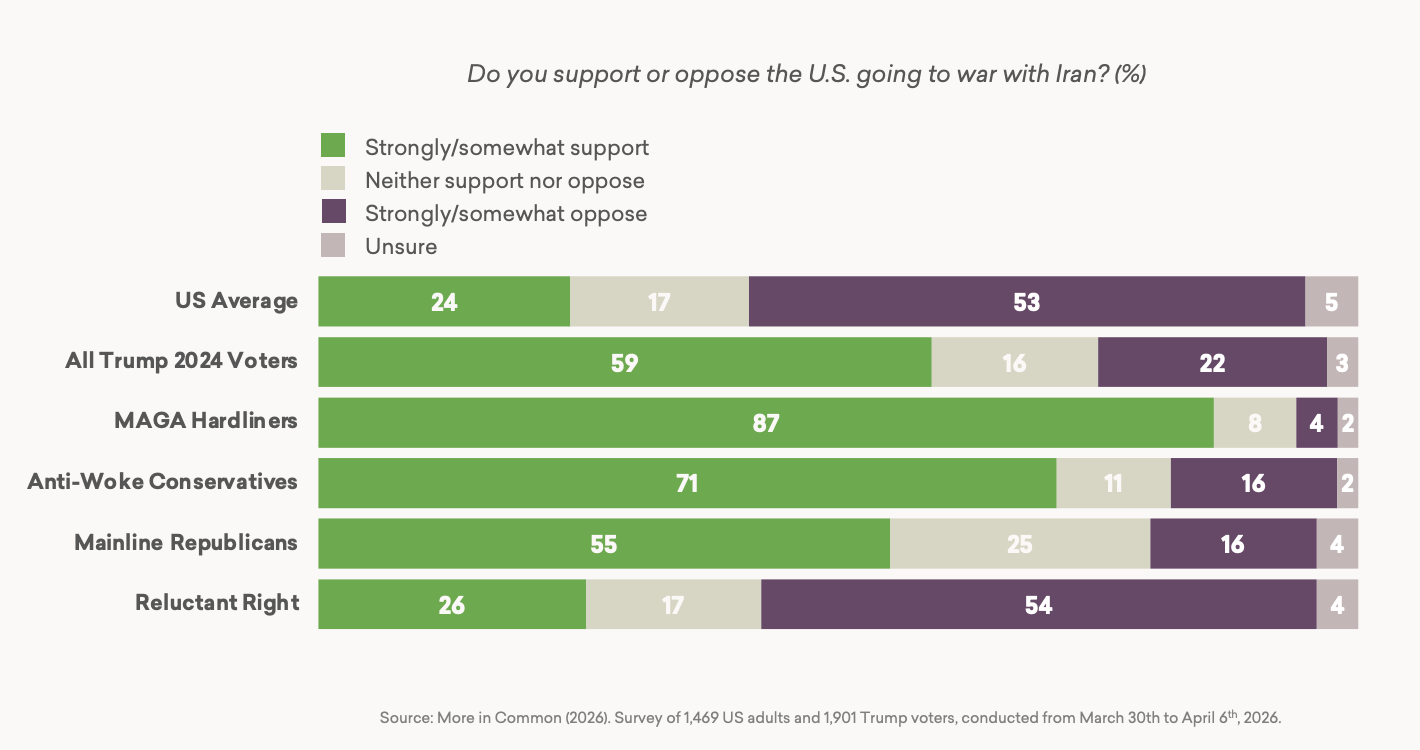
One takeaway: there is still no MAGA split on Iran. An extraordinary 87% of “MAGA Hardliners” support the war. More in Common found slightly lower, but still very strong, support for the war among the “Anti-Woke Conservatives” (71%).
But these factions account for only 50% of the Trump coalition, and there is a stark difference between the two halves. Only 55% of “Mainline Republicans” support the war, although their opposition to the conflict is no higher (16%) than the Anti-Woke Conservatives; the Mainline Republicans are just more ambivalent, with a higher proportion saying they’re “Unsure.”
The real danger for Trump comes from the “Reluctant Right,” of whom only 26% support the war, while 54% said they were against it. “A majority of the Reluctant Right being actively opposed to the war was shocking to me,” Stephen Hawkins, the director of research at More in Common and lead author of the “Beyond MAGA” report, told me in an interview.
The differences are equally stark on other questions, showing how broad of a spectrum Trump voters span — Trump voters do not think with one mind, and anyone making a blanket statement that “Trump voters feel X or Y” is eliding huge differences in opinion — and how much the war is risking Trump’s support with swing voters.
85% of MAGA Hardliners have “a lot” of confidence that Trump will “make the right decisions regarding the U.S. war with Iran.” Only 5% of the Reluctant Right say the same. (In fact, 54% of the Reluctant Right say they have either “not much” or “no confidence” in his war decisionmaking.) 83% of MAGA Hardliners say Trump started the war “to protect American interests.” 55% of the Reluctant Right say Trump went to war at least partially “to protect himself and his reputation.” (On top of that, 43% of the Reluctant Right — remember, these are Trump’s own voters — say he went to war to “distract attention from the Epstein Files.”)
Perhaps most alarming for Trump, an enormous mismatch has opened up between the priorities of his voters and the priorities they perceive the president to have.
60% of Trump voters said that inflation was one of their top three priorities. But only 22% said it was one of the top three issues Trump is focusing on. 60% said Trump was prioritizing immigration, which is now only a priority for 31% of Trump voters. (To the annoyance of many presidents, voters often don’t reward presidents for their successes. Now that the border is secure, many Trump voters likely care less about the border. What have you done for me lately?)
Even more damning: 44% of Trump voters think the Iran war is a top priority for Trump. Only 11% say it is a top priority of theirs.
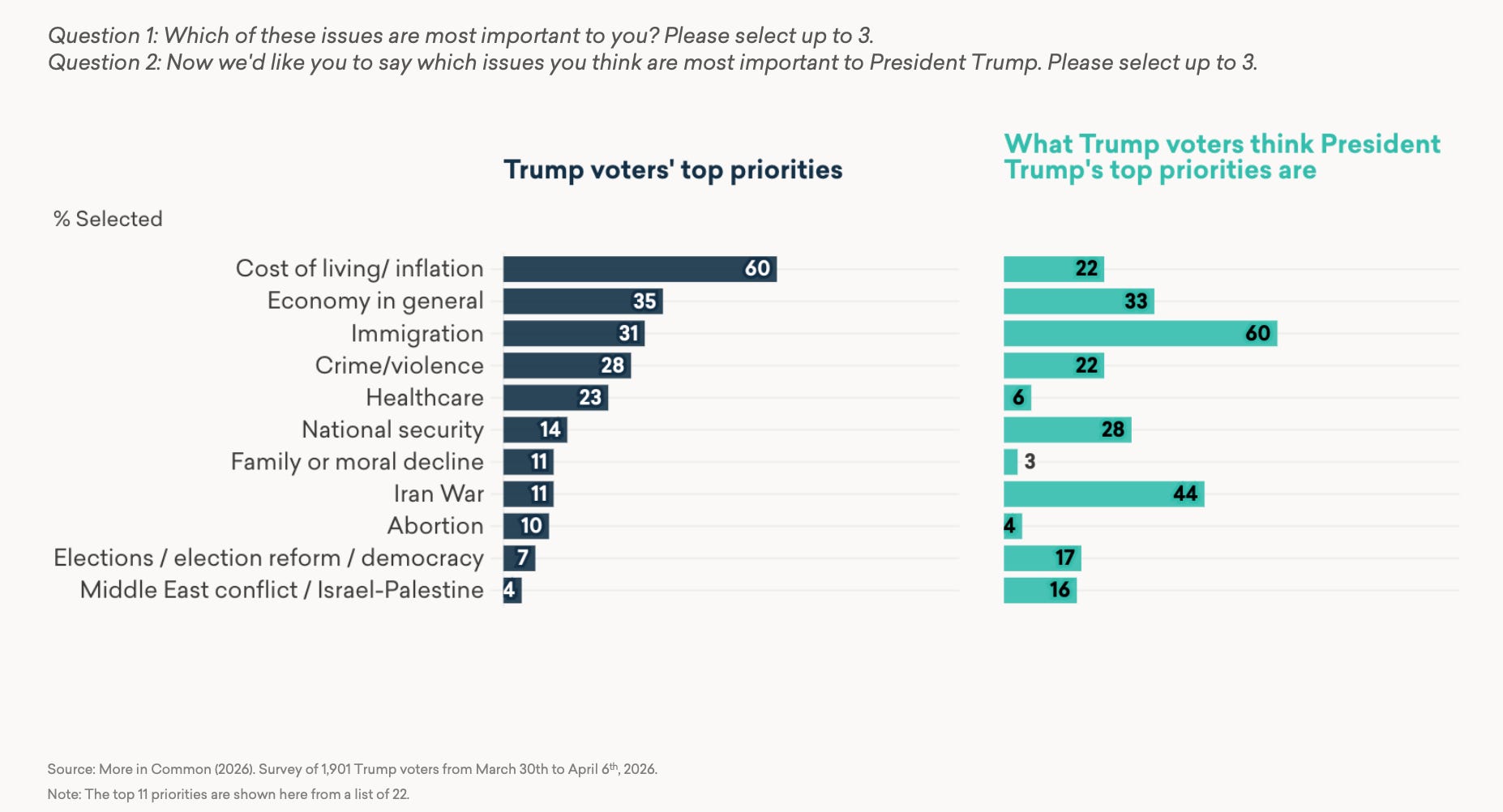
“For Trump voters, who are paying attention only indirectly, only sort of measuring President Trump through their day-to-day lives, I think they might be underwhelmed by economic changes,” Hawkins said, “or even feeling a little bit betrayed by the lack of attention to economics,” considering the war in Iran (something they barely prioritize) has actively increased inflation (the issue they prioritize above all others).
“His promise in the final stretch of the 2024 election was, ‘She is for they/them. He is for you,’” Hawkins noted. “And that sense of commitment to the everyday working American is what people aren’t feeling.”
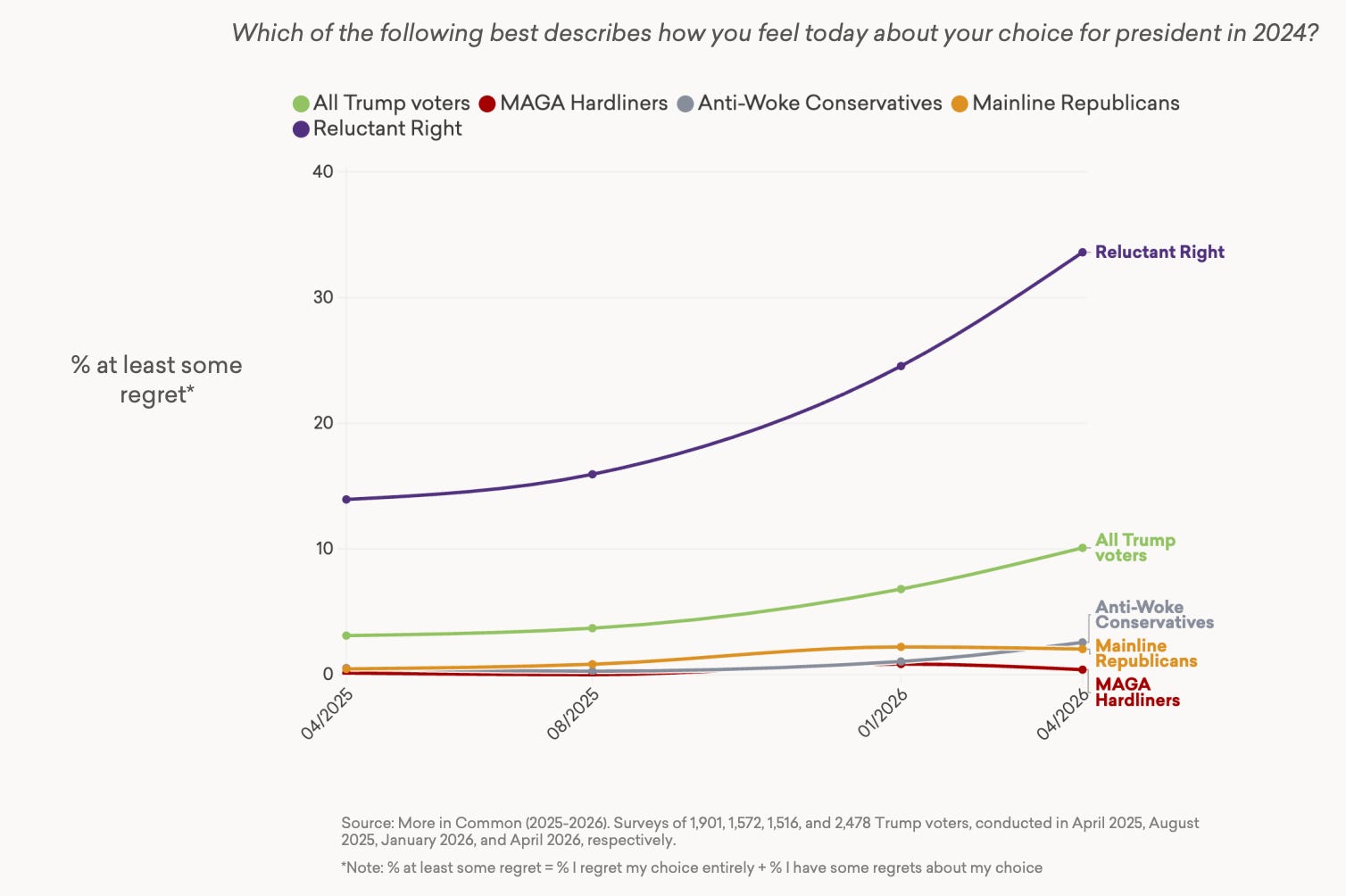
Asked if they feel at least some regret about their 2024 vote, nearly all MAGA Hardliners, Anti-Woke Conservatives, and Mainline Republicans stand by their choice. Once again, the Reluctant Right stands out: about one-third of the group express regret, a number that has increased significantly since the outbreak of the war.
More in Common found a similar trend among Gen Z Trump voters, 20% of whom say they regret their vote, a markedly higher level of second-guessing than expressed by older generations.
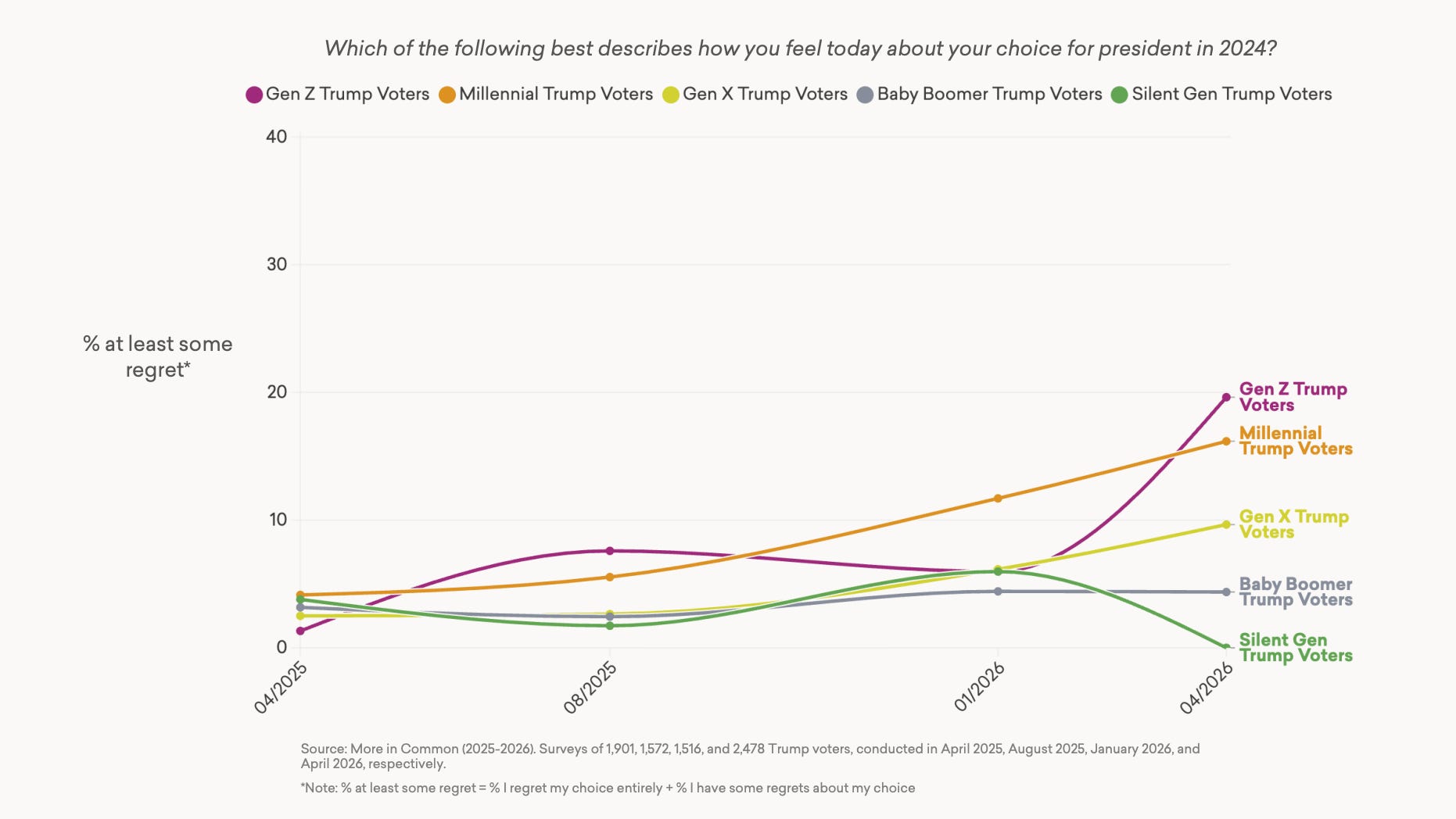
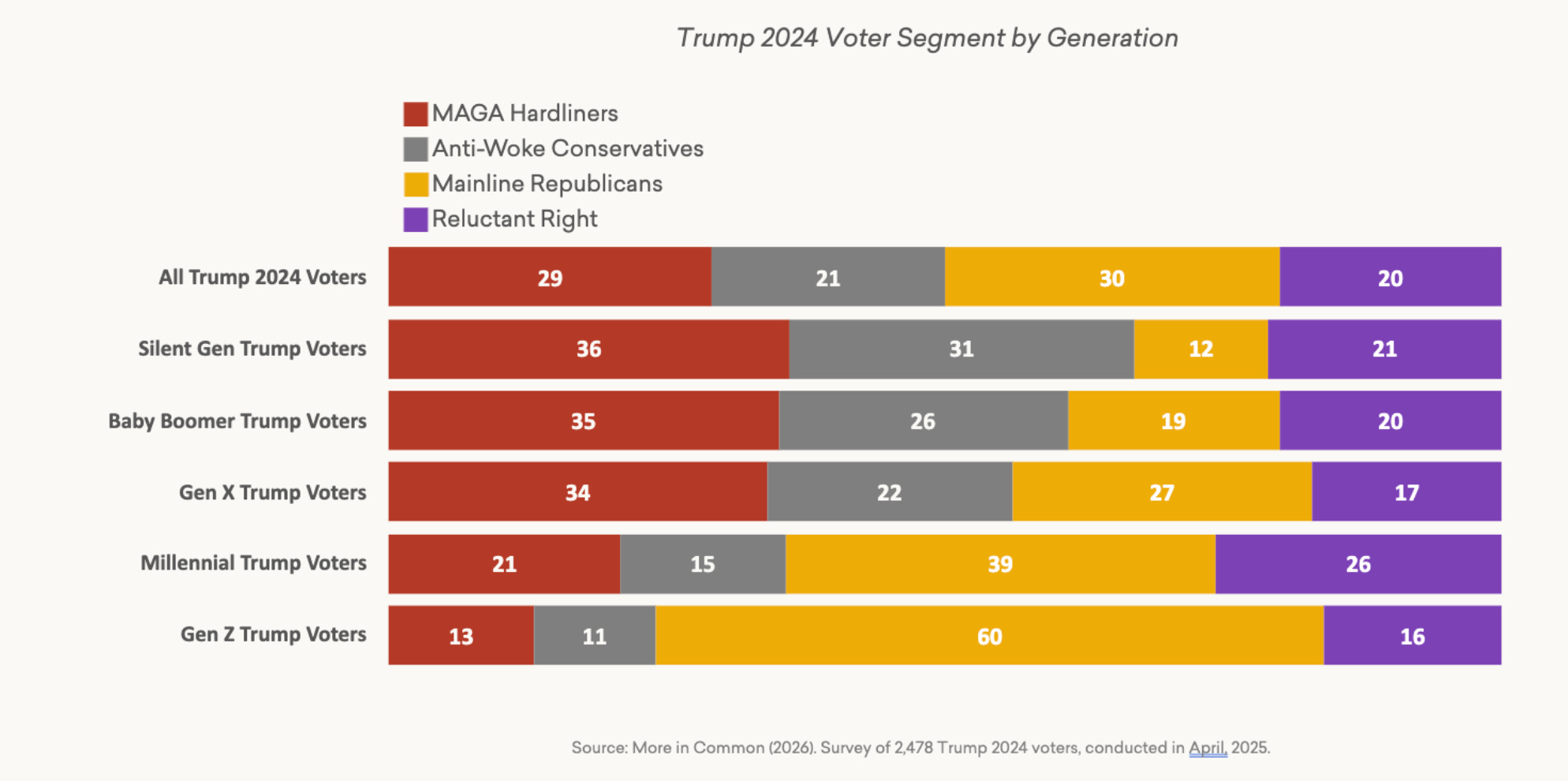
The Gen Z numbers cut against stereotype as well. Contrary to the image in some circles of Gen Z Trump supporters as hard-right conservatives, they are actually the group least likely to code as MAGA Hardliners.
MAGA is mainly a movement made up of Trump’s own generational peers in the Silent and Baby Boomer Generations. Fully 60% of Gen Z Trump voters — more than any other generation — code as Mainline Republicans, even though that group’s ideology reads as a throwback to a previous generation of conservatives that many have judged extinct.
The generation second-most likely to be Mainline Republicans? Millennials, who complement that by being the generation with the largest proportion of Reluctant Rightists. Trump’s changes to the Republican Party might not prove as lasting as you think if MAGA adherents are in their 60s and older, while younger Trump voters, somewhat paradoxically, seem to subscribe to an earlier form of conservatism.
Only 34% of Gen Z Trump supporters back the war in Iran, the lowest number of any generation, while 53% of Gen Z Trump supporters said they agree with the statement “Israel has too much influence on American politics.” For no other generation does that sentiment breach a majority.
This lines up with other findings that Gen Z is more isolationist, and more skeptical of Israel in particular, than older generations. A Pew poll released earlier this month found that 60% of Americans have an unfavorable opinion of Israel, making it a politically dangerous country to partner on a war with, as Trump has done. 57% of Republicans aged 18 to 49 expressed an unfavorable opinion of Israel in that poll, compared to just 24% of Republicans over 50. (Another More in Common poll found that 5% of young Trump voters express coldness towards Jews, higher than other generations — but hardly enough for antisemitism to explain the 53% who have developed skepticism of Israel in the aftermath of the Gaza war.)
“Younger generations have only known a period of conflict of wars [waged by] the United States that have basically been unsuccessful, or at least underwhelming in terms of their outcomes,” Hawkins said. “If you’re 20 years old in this country, you were born into the Afghanistan war, and it only ended in the last presidency. And so I think there’s just a very different geopolitical context in which the generations are thinking about America’s role in the world.”
“For those who lived in the Cold War, so Baby Boomers and to some extent Gen X, they’re remembering a period where the United States had a moral leadership role that was advancing through its foreign policy and through its military decision making. They remember Ronald Reagan. A huge number of these would be Ronald Reagan supporters or voters, as somebody who was defining a role for the United States that stood up against evil,” he continued. “And, by contrast, younger generations have only known the post-September 11th era, which has been one of disappointment and costly ongoing wars.”
Hawkins did note that some of the negative trends could improve for Trump if the war were to wrap up soon, and gas prices declined accordingly. However, whether that is likely seems to shift by the day.
Iran announced on Friday that it had reopened the Strait of Hormuz after Israel and Lebanon agreed to a ceasefire. 24 ships crossed the strait on Saturday, more than at any point since the war began. However, after Trump said the U.S. blockade on Iran’s ports would continue, Tehran reversed itself and announced that the strait would be closed again. Only one ship crossed the strait on Sunday; Iranian gunboats fired at other tankers that tried to cross, while the U.S. Navy seized an Iranian-flagged ship that attempted to get past the American blockade.
The current ceasefire — such as it is — is set to expire on Wednesday. Vice President JD Vance is on his way to Pakistan for a second round of peace talks, although Iran has not yet publicly committed to participating.
At times, Trump seems attuned to the sort of political problems revealed by the More in Common report: this morning, he insisted in a Truth Social post that “Israel never talked me into the war with Iran”; last week, he hosted Joe Rogan (an influential voice among young Trump voters, More in Common has found) at the White House for an announcement on psychedelic drugs, attempting to keep Rogan in the tent despite the podcaster’s wartime criticisms.
This attention to swing voters rarely lasts long, however. In a post yesterday, Trump returned to threatening to “knock out every single Power Plant, and every single Bridge, in Iran” if the country doesn’t quickly agree to the U.S. peace offer. A recent Washington Post analysis also found that Trump has mentioned the White House ballroom on roughly one-third of the days of 2026 so far. It’s unlikely that’s the sort of issue his voters would rather he prioritize when they say Trump is focusing too much on Iran.
Making matters worse, Energy Secretary Chris Wright said on Sunday that gas prices might not return to normal until 2027, a nightmare scenario for the White House.
The word that stuck out to me most from the More in Common report was “transactional,” which is how the organization described the Reluctant Right voters.
If there’s one thing Trump should understand, it’s a transactional relationship. These voters gave Trump their support in exchange for a promise that he would lower prices; now, many of them don’t think he’s living up to his end of the bargain.
I obtained data from More in Common that isn’t in their report, on how the different segments of Trump voters plan to vote in the 2026 midterms, from their poll conducted earlier this month.
No surprise: 97% of MAGA Hardliners plan to vote Republican, no matter what Tucker or MTG might tell you. 0% say they plan to vote for a Democrat. These splits go down, ever so slightly, to 88%-0% and 82%-2% for Anti-Woke Conservatives and Mainline Republicans, respectively.
And then the numbers absolutely take a nosedive for the Reluctant Right: only 50% of these Trump 2024 swing voters say they plan to vote for a Republican in 2026. 12% say they plan to vote for a Democrat. The other 39% say either that they’re undecided, plan to vote third party, or don’t plan to vote at all.
Great analysis, thank you! Incredible that Repubs aren't getting the meal they ordered but still insist on still eating every meal there....
Trump voters think he lost his focus? Many voters think he has lost his mind.....