


Happy Friday! We have four pieces of business to discuss before we get to our main course:
First, President Trump’s Wednesday night address on Iran. Despite the hype, not much new was announced. Trump said that America’s “core strategic objectives” in the war — “systematically dismantling the regime’s ability to threaten America or project power outside of their borders” — are “nearing completion,” though the U.S. is going to “hit them extremely hard over the next two to three weeks” before the conflict wraps up. He did not lay out any plans to reopen the all-important Strait of Hormuz, which he said would “just open up naturally” when the war ends. “We have all the cards,” Trump said. “They have none.”
Second, Attorney General Pam Bondi has been fired. Trump was reportedly frustrated with Bondi’s handling of the Epstein Files, as well as her failure to prosecute more of his political rivals. Her ouster comes just a few weeks after Homeland Security Secretary Kristi Noem was dismissed as well; per Politico, Trump is weighing a broader Cabinet shakeup, with Commerce Secretary Howard Lutnick and Labor Secretary Lori Chavez-DeRemer also potentially on the chopping block. Deputy Attorney General Todd Blanche will serve as acting AG after Bondi officially steps down later this month; successors being floated include EPA Administrator Lee Zeldin.
Third, the Department of Homeland Security shutdown — the longest in American history — is maybe inching closer to a resolution. House Speaker Mike Johnson and Senate Majority Leader John Thune announced that they have agreed on a plan to fund DHS, minus ICE and CBP, for now and then deal with those two agencies in a party-line reconciliation bill. (Yes, this is the same deal that Johnson rejected a week ago.) Now, many House Republicans are fuming about the plan, which might not be approved until mid-April. In the meantime, the president has said he will sign an order to pay all DHS employees for the duration of the shutdown. As I said on Monday, the days of shutdowns as a meaningful political tool are over.
Fourth, the March jobs numbers came out this morning, and the U.S. economy added 178,000 jobs last month, well above what economists were expecting. The unemployment rate dropped down a tick, from 4.4% to 4.3%. Nothing will be more important for the midterm elections than the economy, so this is an important indicator to be watching.
And now, our top story this morning, my report from inside the room as the Supreme Court considered a landmark case on birthright citizenship on Wednesday, another behind-the-scenes special for paid subscribers:
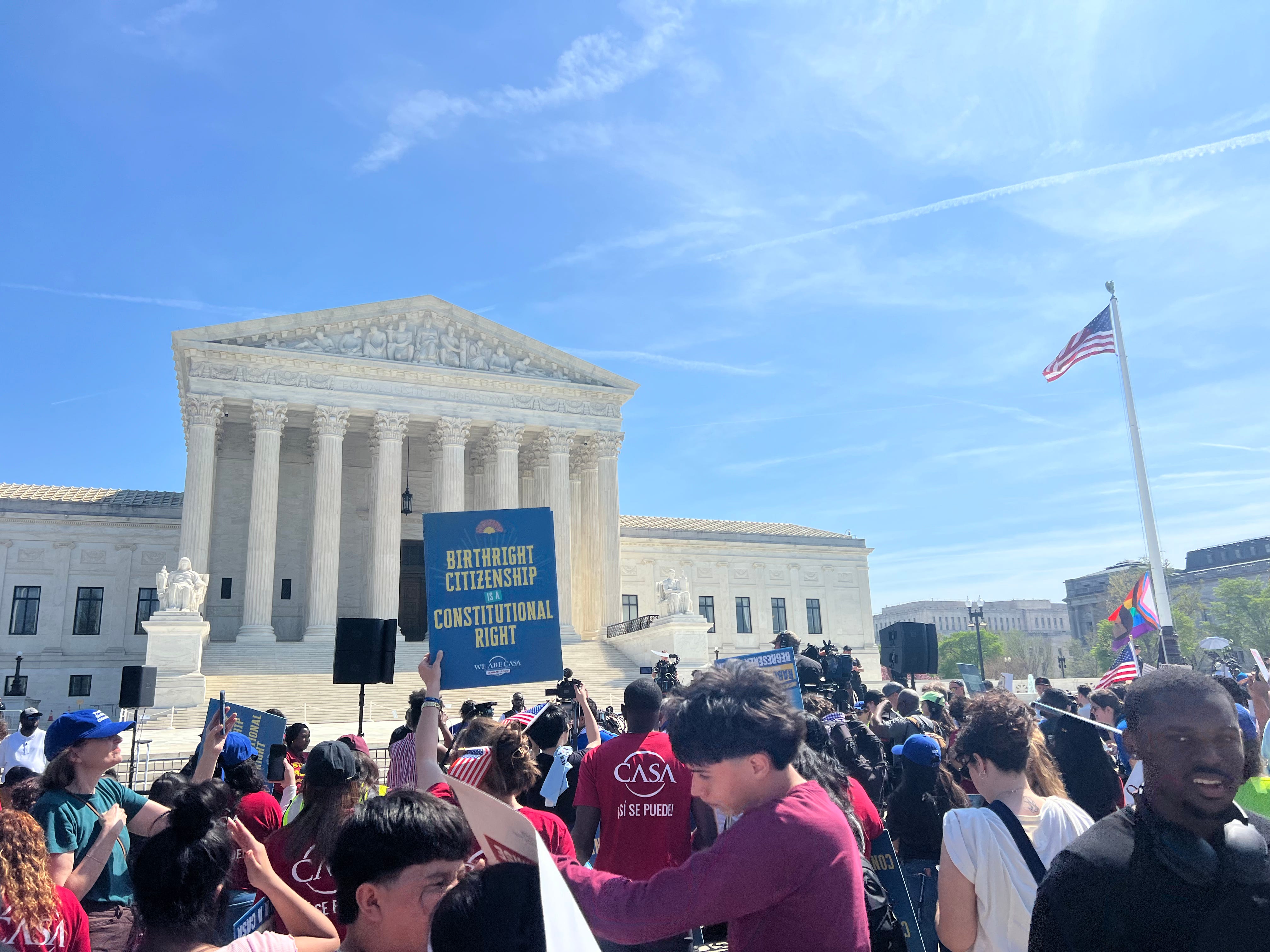
Let’s deal with the elephant in the room first. Yes, President Trump was in attendance as the Supreme Court considered his executive order on birthright citizenship on Wednesday. No, no sitting president has ever attended Supreme Court oral arguments before.
There are many commentators who have cast Trump’s presence as an attempt to bully or intimidate the Supreme Court, or even as a threat to the separation of powers. Inside the room, however, the move came off a little differently.
When Trump walked in, it caused a stir in the press gallery, but seemed to have little impact on the rest of the courtroom. Trump’s entrance wasn’t announced. Nobody stood up; “Hail to the Chief” wasn’t played. (There is also not, despite what some Trump officials claimed, a special chair set aside for the president during Supreme Court oral arguments. This was made abundantly clear since Trump actually changed seats with Commerce Secretary Howard Lutnick, moving closer to the center, a few minutes after sitting down. Did he want the better view? To move away from Pam Bondi, whom he had just fired? It’s impossible to say.)
By contrast, as always, when the justices grandly strode out from behind their velvet curtain, their presence was announced (“Oyez! Oyez! Oyez! All persons having business before the Honorable, the Supreme Court of the United States, are admonished to draw near and give their attention…”) Everybody stood, including Trump.
For the next hour and 20 minutes — when Trump left shortly after his lawyer was done speaking, and right as the lawyer challenging his executive order began — all nine of the justices were given a turn to grill the president’s attorney. Trump sat silently and watched.
Whatever Trump’s intent, the impact of his attendance wasn’t to aggrandize the appearance of his power versus the court’s; it was the opposite. While the justices presided from their imposing bench, Trump sat in the front row of the public gallery. He quietly walked in and quietly walked out, without any pomp or circumstance. This was a testament to the separation of powers, not a threat to it. The president was treated like any other litigant; he was welcome to attend, but that didn’t mean he would receive any acknowledgement or special treatment.
It was a powerful reinforcement that the court is its own branch of government — he was walking into their house — and its procedures aren’t altered one iota if the sitting president is a party to the case, or sitting in the room. The court marches on regardless.
Nor did the justices seem particularly intimidated. I was wondering, ahead of time, if Trump was expecting something akin to a congressional hearing: big, partisan fireworks, with two sides fighting over the policy implications of his birthright citizenship order. (He has likely seen many House and Senate hearings on television over the years, including the confirmation hearings for the three justices he nominated. The court has been livestreaming audio of its hearings since 2020 — and they make for scintillating listening! — but I would be surprised if Trump has ever clicked over to supremecourt.gov to listen in.)
Indeed, Trump’s only comment after leaving the court was strictly policy-related. “We are the only Country in the World STUPID enough to allow ‘Birthright’ Citizenship,” Trump wrote on Truth Social just after leaving the court. That isn’t strictly true (there are 32 other countries that offer citizenship automatically to anyone born on their soil), but more to the point, it wasn’t relevant to the proceedings Trump had witnessed.
If Trump wants to have a policy argument, he should go to Congress (and, potentially, depending on how the court rules, state legislatures as well to advocate for a constitutional amendment). The Supreme Court’s is not to decide good policy for the country. It is to interpret what the law says.
This point was actually made by Justice Brett Kavanaugh, while the president who appointed him was still sitting a few rows away.
“You’ve mentioned several times the practices of other countries, and that, obviously, as a policy matter supports what you’re arguing here,” Kavanaugh said to Solicitor General John Sauer, who was representing the Trump administration. “But, obviously, we try to interpret American law with American precedent based on American history. That’s certainly what I try to do and I think you try to do.”
“And so why should we be thinking about, even though as a policy matter I get the point, thinking about, ‘Gee, European countries don’t have this or most other countries, many other countries in the world don’t have this?’” Kavanaugh continued. “Doesn’t that—I guess I’m not seeing the relevance as a legal, constitutional, interpretive matter necessarily, although I understand it’s a very good point as a policy matter.”
Based on his Truth Social post, Trump doesn’t seem to have internalized this distinction, or grasped the sort of legal — not policy — arguments that are most likely to impress the justices.
So let’s turn now to those legal arguments.
On Wednesday, Sen. Alex Padilla (D-CA) posted pictures of himself outside the Supreme Court, with a message about birthright citizenship. Padilla wrote: “The 14th Amendment is CRYSTAL CLEAR: All persons born or naturalized in the United States… are citizens of the United States.”


That is perhaps the hardest-working ellipses in Washington: nearly all of Wednesday’s arguments turned on the six words that Padilla omitted.