


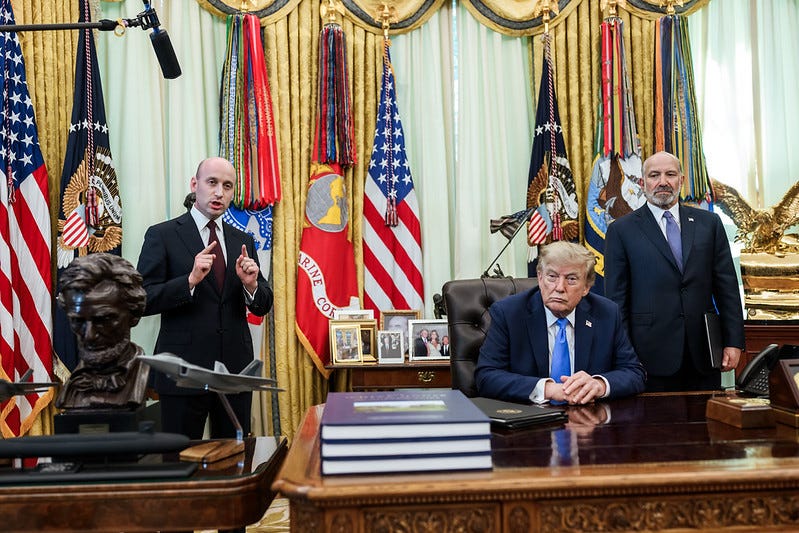
The new Congress won’t be sworn in until January 3, but there will be no such lame-duck period for the changing of the guard playing out inside the West Wing. Today will mark Stephen Miller’s first day as White House chief of staff.
Fresh off a historic midterm drubbing, President Trump announced in a Truth Social post on Friday that Miller would be taking over as his top aide, replacing Susie Wiles, his longest-serving chief of staff and the first woman to hold the post in history.
According to the New York Times, Trump berated Wiles in front of several people at an Election Night watch party in the White House last Tuesday, blaming her for the GOP’s decisive losses. By the end of the week, she had been ousted, signaling a new era in Trump’s administration. “I wanted to make a change… Sometimes in life, you have to make moves,” Trump told reporters. (Wiles reportedly wanted to stay on for a longer transition period, through the end of the year, but was rebuffed.)
While Wiles is a longtime Republican operative who cut her teeth working for more moderate pols like Jon Huntsman, Miller is a Trump original and a true believer. He got his start in Washington working for a string of Trump-before-Trump right-wing populists, first arriving in D.C. as Michele Bachmann’s press secretary and eventually becoming communications director for the top immigration hardliner in Congress, then-Sen. Jeff Sessions.
Miller joined the Trump campaign early in 2016, connecting to the future president through Steve Bannon (who had originally attempted to persuade Sessions to mount a White House run that year). When Trump won, Sessions became attorney general and Miller became a White House senior adviser; the duo finally had an opportunity to implement the hawkish immigration agenda they had spent years pushing from the fringes. Sessions and Trump quickly fell out, but Miller far outlasted his former mentor in Trump’s orbit: he is one of the few aides to have served through all four years of Trump’s first term and (so far) through all of his second.
Wiles has long been a voice in Trump’s circle urging caution, having advised him to scale back some of the most controversial decisions of his presidency, including the January 6th pardons, the “Liberation Day” tariffs, and the Iran war. Clearly, her advice has frequently fallen on deaf ears. But we are likely about to find out just how often she was able to restrain Trump from his most aggressive impulses.
According to the book “Regime Change,” by the Times reporters Jonathan Swan and Maggie Haberman, last year Miller urged Trump both to invoke the Insurrection Act (which allows the president to deploy the U.S. military domestically) and to suspend habeas corpus (which would make it harder for arrestees to challenge their imprisonments). Both times, he was overruled; as chief of staff (and without Wiles in the conversation), Miller will have an easier time advancing his policy ambitions.
The Atlantic has similarly reported that Trump has lately been pushing the Justice Department to be more forceful in carrying out leak investigations, including by potentially arresting journalists in order to induce them to give up their sources. Wiles has reportedly been pushing back on that idea behind the scenes. Miller was all for it. Only one of them will now remain.
Miller’s ascension is an unmistakable signal that Trump intends to spend his last two years doubling down on his aggressive, often unpopular, uses of executive power, rather than pivoting to working across the aisle with a Democratic Congress in light of last week’s rejection of his agenda.
Trump may have told Ross Douthat on “60 Minutes” this weekend that his mass deportation campaign was “too tough,” but it is unlikely to be curbed now that its chief architect is the White House chief of staff. Miller has also been a key voice encouraging Trump’s imperialist ambitions, urging the president to strike alleged drug boats in the Caribbean and defending the right of the U.S. to take foreign territories like Greenland by force.
“We live in a world in which you can talk all you want about international niceties and everything else,” Miller explained on CNN earlier this year. “But we live in a world, in the real world … that is governed by strength, that is governed by force, that is governed by power.”
Although it is easy to imagine this hardened philosophy producing an endgame to Trump’s presidency unlike any that has come before it, at least directionally, Trump joins a long tradition of second-term presidents doubling down in the face of midterm losses. Those decisions don’t tend to work out well for the president’s party, a warning for Republicans in 2028.
After Miller was tapped as chief of staff, several commentators contrasted it with George W. Bush’s decision to fire then-Defense Secretary Donald Rumsfeld after his party also went through a major midterm “thumping” amid a Middle Eastern war, in 2006.
“A bit as though Bush had made Rumsfeld chief of staff right after the ‘06 midterms,” Semafor editor-in-chief Ben Smith wrote on X of the Miller choice. “Trump just gave Donald Rumsfeld a promotion,” Politico columnist Jonathan Martin echoed.
As far as the PR consequences go, this is a genuine contrast: Bush ousted Rumsfeld, the face of the Iraq war; Trump promoted Miller, the face of so much of his agenda (and, at least so far, is keeping Defense Secretary Pete Hegseth, the face of the Iran war). But in terms of the actual policy consequences, the two decisions are more similar than it might seem.
Back in 2006, Rumsfeld had been urging Bush to “go minimalist” in Iraq, advising the president to consider withdrawing U.S. troops, just as Democrats had been calling for in that year’s midterms. Ousting Rumsfeld was Bush’s way of moving in a different direction: towards sending more troops to Iraq as part of an escalation that became known as “the surge.”
In his memoir “Decision Points,” Bush recalls that Republican lawmakers like then-Senate GOP Whip Mitch McConnell were urging him to withdraw troops, a chorus that only grew after Democrats retook both chambers of Congress in the midterms. Instead, in firing Rumsfeld, as the Times would later put it, Bush “removed some of the institutional resistance at the Pentagon to the ‘surge.’” In Bush’s own words, this was not a pivot away from the policies that voters had rejected at the ballot box. “This is it,” he said in an Oval Office meeting, according to the memoir. “We’re doubling down.”
When the surge was announced in January 2007, just two months after the midterms, it was opposed by 61% of the country, according to a Gallup poll. The public would only continue souring on the Iraq war in the final two years of Bush’s presidency. Bush later described the surge as the “toughest and most unpopular decision” of his presidency, though one he defended as ultimately reducing violence in Iraq.
A similar pattern would play out in the next administration, too. No one benefited more from Bush’s surge politically than Barack Obama, as Democrats expanded their 2006 midterm victories into a 2008 presidential win (though, of course, the financial crash, not just the Iraq war, also contributed). However, Obama mounted a similar response to his losses in the 2014 midterms, which also preceded his party losing the White House two years later.
Republicans came out of the 2014 midterms not too unlike how Democrats are exiting 2026: the GOP flipped nine Senate seats, leaving them with 54, while also expanding their House majority to a mammoth 247. Republicans flipped Senate seats in Iowa and North Carolina, and held onto governorships in Michigan, Wisconsin, Florida, and Ohio, all states that Obama won in 2008 and (except for North Carolina) 2012 but which Trump would go on to win in 2016. As the journalist John Judis noted at the time, Democrats sustained significant losses among white working- and middle-class voters, which would also presage Trump’s victory two years later.
How did Obama respond? He blamed his party’s messaging, just like Trump has, and spent his final two years doubling down on ideologically driven executive actions, just as Trump appears poised to do with Miller at his side. Two weeks after the 2014 midterms, Obama signed a sweeping executive order offering legal status to millions of unauthorized immigrants. Throughout 2015 and 2016, he would also join the Paris climate agreement, unveil major climate regulations, normalize U.S. relations with Cuba, and sign an order to toughen background checks on guns — all unilaterally.
Come 2016, many of these progressive actions would form the backbone of Trump’s critique of the Obama era, ultimately catapulting him to the White House.
None of this means that second-term presidents doubling down after midterm losses are why their parties tend to lose the White House: perhaps, voters simply tire of a political party after eight years, and would have voted the incumbent party out of office regardless of what Bush or Obama did in their final stretch. (It is very rare for the party of second-term presidents to keep the White House; Reagan passing the baton to George H.W. Bush in 1988 is the rare modern exception.) If the turnover is more because of an eight-year cycle than specific policy decisions, then maybe Trump’s second term being served non-consecutively means his party will be treated more kindly in 2028 than Republicans in 2008 or Democrats in 2016.
Still, it’s worth taking note of the patterns we have, even if the sample sizes are small and the future is never fully predictable. Maybe second-term presidents enter YOLO mode because they think their parties are doomed no matter what; maybe they just don’t care, because they will never again be on the ballot. Either way, presidents rarely seem to learn from midterm shellackings. They generally make noises about a pivot, but they usually double down in the end. Their parties are the ones that pay the price.
Gabe, please address what congress can do to check Trump and Miller’s efforts during the coming two years.
I'll be surprised if Miller lasts six months in the job. Suspending habeas corpus to jail journalists or legislators is probably the best (only) way Trump will get impeached and convicted.