


Twenty eight years. Thirty eight years. Ninety four years.
That’s how long it had been since Democratic senators were elected from South Carolina, Texas, and Kansas, respectively — until last night, when each of those streaks was broken as part of a historic night for Democrats and a stunning collapse for the Republican Party across the map.
Not only have Democrats been declared the winners in both the House and Senate, but they are on the verge of capturing majorities in each chamber that few in the party dreamed possible, a sweeping rejection of President Donald Trump and the previous two years of Republican control in Washington.
Democrats have already notched 54 seats in the Senate, flipping seven Republican-held seats, nearly all in ruby-red territory like South Carolina (which Trump won by 18 percentage points in 2024), Kansas (Trump won by 16), Texas (by 14), Iowa (by 13), and Ohio (by 11), while also toppling five-term Republican Sen. Susan Collins in Maine and scoring a win in the tossup state of North Carolina. The party is likely to reach 55 Senate seats after the votes are counted in Alaska (which Trump won by 13 points) — and even a 56-seat majority is on the table, with Democrat Scott Colom currently leading Republican Sen. Cindy Hyde-Smith by a mere 43 votes (out of 945,000 cast) in Mississippi.
As with South Carolina, few thought that Mississippi (which Trump won by 23 points in 2024 and which hasn’t elected a Democratic senator in 44 years) would be competitive this (or any) cycle, another sign of the blue tsunami that Democrats delivered.
In the House, Democrats have been declared the winners in 228 seats, but that sorely underestimates the scale of the majority they are likely to win. Both NBC News and the New York Times currently estimate that the Democrats will end the cycle with 258 House seats, 40 more than the 218 needed for a majority. That would be the biggest House majority since the 1992 elections, larger than anything either party has won in the narrowly divided 21st century.
The Times projects that Democrats will win the national House popular vote by 13 percentage points, which would be the largest such margin in 50 years, since the Democratic victories of 1976. Even the Democratic waves of 2006 and 2008 pale in comparison.
On the state level, Democrats are expected to win trifectas (control of the governorship and both chambers of the state legislature) in Wisconsin for the first time in 18 years and in Pennsylvania for the first time in 34 years. Every statewide office in the Republican stronghold of Texas has turned blue — governor, lieutenant governor, attorney general, all the way down the list — as has the state House, for the first time in 26 years.
All told, Democrats are expected to have gained somewhere between 600 and 800 state legislative seats across the country. Anyone looking for good news for Republicans will be looking for quite a while.
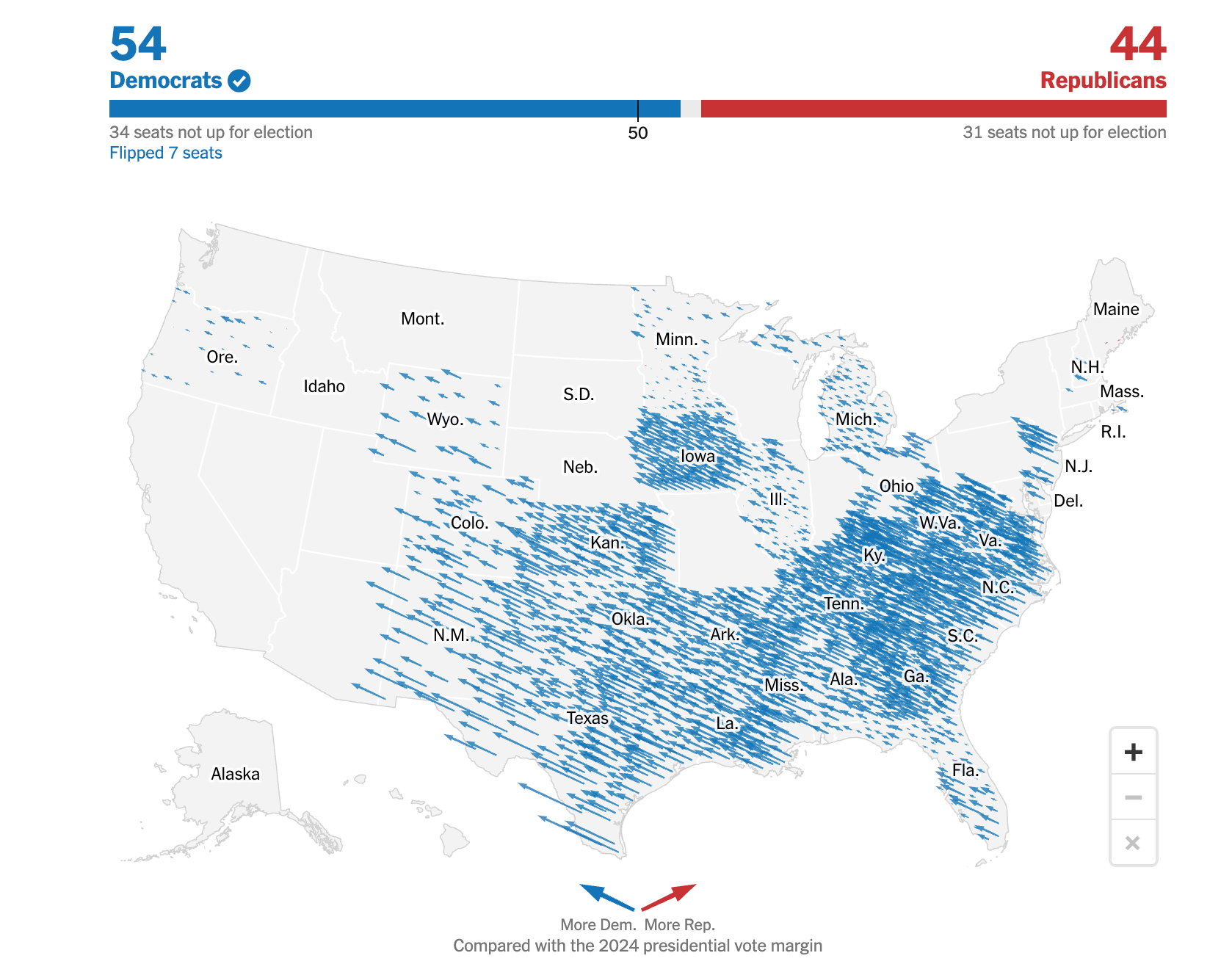
Few presidents have entered office with as much swagger or bravado as Trump, who viewed his 2024 comeback (historic and improbable in its own right) as confirmation that he boasted a sweeping mandate of support from the American people and as license to pursue an aggressive agenda of executive action.
In reality, his victory was narrow (a mere 1.5 percentage points in the popular vote), though its message was fairly clear: a wide array of demographic groups were attracted to Trump’s promises to bring prices down, secure the border, and end foreign wars.
Trump quickly went far beyond that mandate, taking a chainsaw to the federal government with DOGE, carrying out a mass deportation program that ended in multiple deaths across the country, enriching himself and his allies, and running roughshod over Congress to put his imprint on federal spending, trade policy, foreign policy, social policy — and buildings across Washington, D.C. Many of Trump’s moves were not only deeply unpopular, but in direct contradiction with his 2024 promises, most notably his decision to launch a war with Iran, which caused a spike in gas prices to which much of last night’s Republican shellacking can be attributed. His sweeping tariff program had already raised prices, despite his 2024 pledge to curb inflation; Trump plowed ahead regardless.
The president then compounded these politically toxic moves by forcing on Republicans a slew of low-quality candidates, including the scandal-plagued Ken Paxton in Texas and the inexperienced Darline Graham, sister of the late Lindsey Graham, in South Carolina. Both were elevated as Republican Senate nominees largely because of Trump’s intervention. For either to lose by any margin, considering the states in which they were running, would have been shocking, but neither race was even particularly razor-thin: Graham is set to lose by four percentage points, while Paxton is currently down by 12, an unthinkable margin for a Republican in Texas.
At times, Trump did not even seem to be trying to maintain control of Congress; his closing message consisted of a rambling speech in front of the Lincoln Memorial Reflecting Pool, one of his construction projects, hardly an issue close to many voters’ minds at a time when 75% of the electorate believed the condition of the economy was “not good” or “poor” (according to CNN’s exit polls). Trump forced Republicans to defend toxically unpopular policies, and then gave them an irrelevant closing message and subpar messengers to carry it out.
In response, the impressively diverse coalition he stitched together just two years ago completely fell apart. In the 2024 presidential election, Democrats only slimly carried Latino voters (51%-46%) and 18-to-29-year-old voters (54%-43%), two traditional cornerstones of their coalition. This year, per CNN’s exit polling, those groups split 62%-35% and 72%-25%, respectively, in Democrats’ favor, a stark reversal from 2024.
Washington will now be infused with a new generation of Democratic talent, including a pastor and a seminary student in Senators-elect Adam Hamilton (Kansas) and James Talarico (Texas), respectively, and a pair of doctors in Senators-elect Abdul El-Sayed (Michigan) and Annie Andrews (South Carolina). When he takes office, El-Sayed will be the first Muslim senator in U.S. history. Democratic Sen. Jon Ossoff of Georgia was also returned to office in a resounding victory (he currently leads by 18 percentage points), as was Gov. Josh Shapiro of Pennsylvania (who leads by 22). Both will immediately rocket to the top of many 2028 short-lists; it is possible that Talarico and El-Sayed, despite only just taking office, will join them there.
Meanwhile, an entire generation of Republican lawmakers has been turned out of office. At least one Republican committee chair (Bryan Steil of Wisconsin) was defeated; another (Virginia Foxx of North Carolina) is currently trailing. In perhaps the ultimate metaphor, the very man who was charged with defending the House Republican majority (National Republican Congressional Committee chairman Richard Hudson, the House GOP campaign chief) lost his own seat in North Carolina. The Democratic gains reached deep into Republican territory, flipping several seats that Trump had won by double digits in 2024. Perhaps the only thing Trump did to really try to help congressional Republicans was promote a flurry of mid-decade redistricting efforts — and even that didn’t work, as shown by GOP losses in Florida and North Carolina.
Between retirements and defeats, the Senate will swear in 16 new members in January, the most since the 1950s. There will likely be more than 100 new members of the House, a high-water mark not reached since the 1990s. New blood is surging into Washington.
It was possible to imagine a scenario, before Tuesday night, in which Hakeem Jeffries (who is now poised to become the first Black speaker of the House in U.S. history) spent the next two years white-knuckling his post. He might have had difficulty winning the speakership; he might have had to trade away significant concessions to get there; he might have spent his time sweating out procedural votes on the bills he hoped to place on the floor; he might have seen his rank-and-file buck his floor control by using discharge petitions. After all, these were all hallmarks of the Republican House majority of the last four years.
However, none of that is now likely to come true, since Jeffries is expected to command a majority (around 258 seats) that swamps the GOP majorities won in 2022 and 2024 (222 and 220 seats, respectively). Whereas Mike Johnson was working with a two-vote cushion for the last two years (and often fewer due to vacancies or absences), Jeffries will have about 40 votes to spare on any contentious legislation.
Senate Democratic Leader Chuck Schumer will similarly be able to lose four or five Democratic votes on any bills he places on the floor, a luxury neither party has enjoyed in the Senate in quite some time. Whether Democrats use this cushion to its full effect remains to be seen: they could now pass progressive bills that Talarico, Hamilton, Andrews, and other more moderate members of their Senate majority might oppose, though going too far in this regard could risk repeating Trump’s same mistake of going beyond a specific (in this case, anti-Trump and pro-affordability) mandate.
But the future of the Republican Party, after its unquestioned leader and so much of its rank-and-file were so decisively rejected, is what is now currently in question most.
In the hours since election results started pouring in, some Republican voices have started calling for a pivot away from Trump — but still only the voices that already didn’t like him. Moderate Sen. John Curtis (R-UT) called for Republicans to return to the “conservative principles that once defined us,” while former Trump ally Marjorie Taylor Greene said that the GOP would “have to kick Donald Trump out of the party” if it “wants any chance in the future.”
However, there is still no evidence that Republicans who were not already critical of Trump are ready to publicly break with the president, even as he now heads into his last two years in office severely weakened by the sheer breadth of Democratic gains. It is still possible that a version of Trumpism — one that remains true to the populist and isolationist rhetoric that he has since abandoned — remains the best path forward for the party, but how much course-correction will Trump allow Republicans to do while he remains in office? If he continues to betray his mandate (political consequences be damned) for two more years, what will the state of the party’s support be come 2028?
For his part, Trump appears to have internalized the scale of the losses, at least a little.
In an interview over the weekend, Trump said that he would become “Mr. Veto” if Democrats won control of Congress. But he told Politico last night that he doesn’t want to “be just sitting there for two years vetoing everything,” a change in tone. While he has not accepted responsibility for the Republican defeats (“I wasn’t on the Ballot and if I was, we would have won IN A LANDSLIDE!” he insisted on Truth Social), Trump has started to express openness to making deals with Democrats in this new era of divided government.
“We’ll, you know, look forward to working with them,” he told the New York Times last night. “We’ll probably work something out.” Trump, however, has sounded notes of bipartisan cooperation before, only to pull back; we’ll see how long it lasts.
There are already some Republicans worrying about being locked out of power in Washington for years to come: “Looking at the Senate map and considering such a massive House margin, it is very unlikely Republicans will recapture the Congress in 2028,” Gov. Ron DeSantis (R-FL) wrote on X. “Might not have a shot at Senate control until 2032.”
It is true that the commanding Democratic victories will make winning back Congress a steeper climb for Republicans — and, notably, the longer Democrats control the Senate, the longer they retain power over any Supreme Court vacancies, which could end up being the longest-term effect of Tuesday’s midterms — but in this rhetoric from some Republicans, it is hard not to hear echoes of their rivals, many of whom believed not so long ago that they were going to be locked out of the Senate majority until 2032.
But then, last night, Democrats flipped the Senate, which many in the political world believed just a few months ago would be impossible — and they did it with ample room to spare, winning in states that no one thought they could compete in. Here is the Senate map as judged by the widely respected forecasters at Sabato’s Crystal Ball at the beginning of this year:
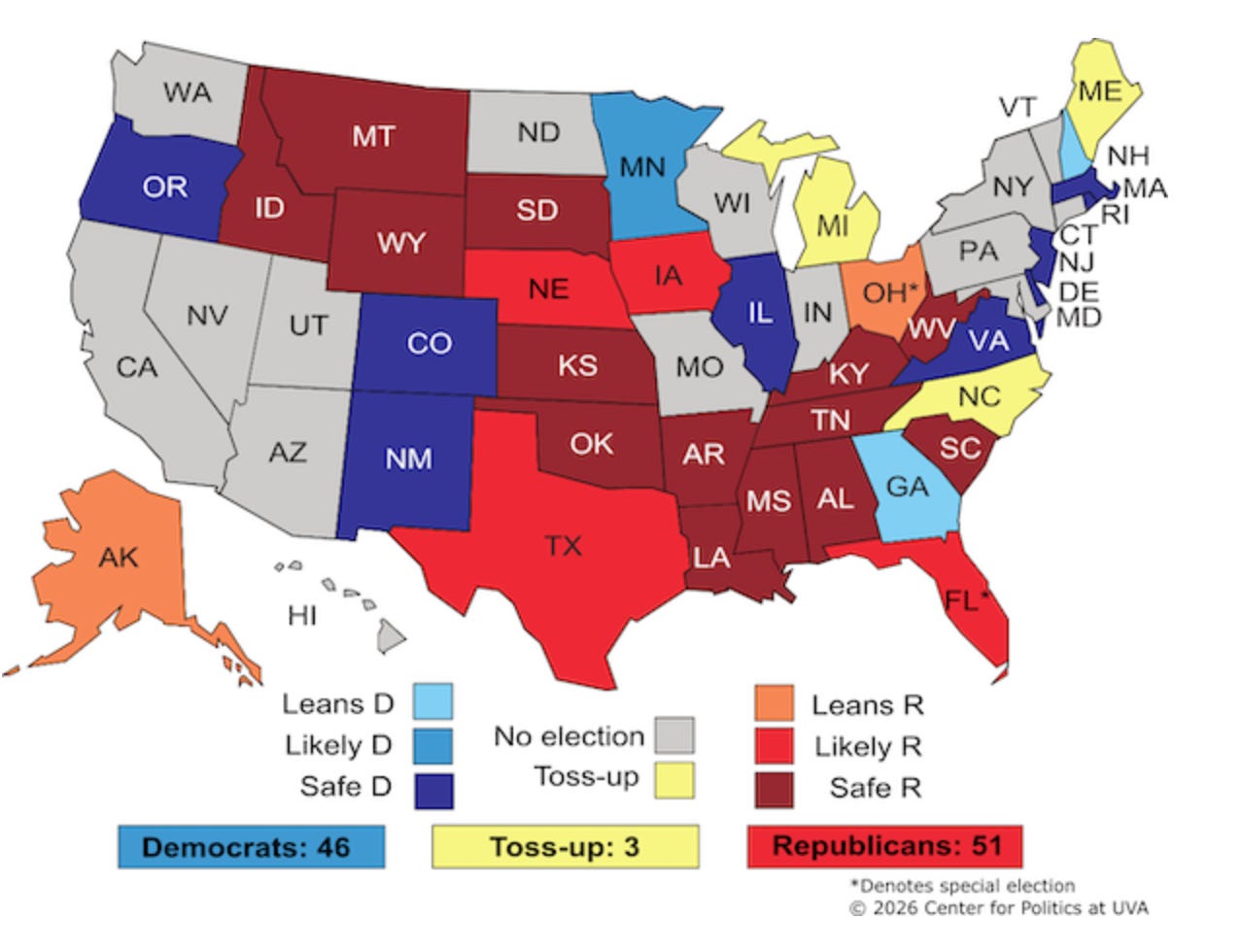
Kansas and South Carolina were “Safe Republican.” Iowa and Texas were “Likely Republican.” Ohio and Alaska were “Lean Republican.” Democrats just won them all. Louisiana, also deemed as “Safe Republican” at the beginning of the year, was indeed won by a Republican, Julia Letlow — but Letlow currently leads by only 1.8 percentage points, with nearly all the votes reporting.
We have spent the last several years living in an age of stark polarization and division, of slim majorities, of a shrinking electoral map, of difficult-to-persuade voters stuck in one political tent or the other, and a game of inches between two parties that, when they won, did so by only picking up the narrowest of ground.
All of those trends were bucked on Tuesday night, leading to outcomes that were difficult to foresee even a few months in advance — in no small part because events changed (primarily the outbreak of a war), leading political opinions to change with them. People’s minds are still changed by the (often-difficult-to-predict) things that happen in the world around them, even in a time when so many states and voters were thought to be immovable.
Perhaps, as a result, political observers should stop talking in terms of impossibilities and confident long-term predictions. If last night reminded us of anything, it’s that.
Couldn’t be happier!
Does Trump's immunity extend to illegal acts unrelated to his official capacity?
Does the VP have the same immunity?
Thanks