


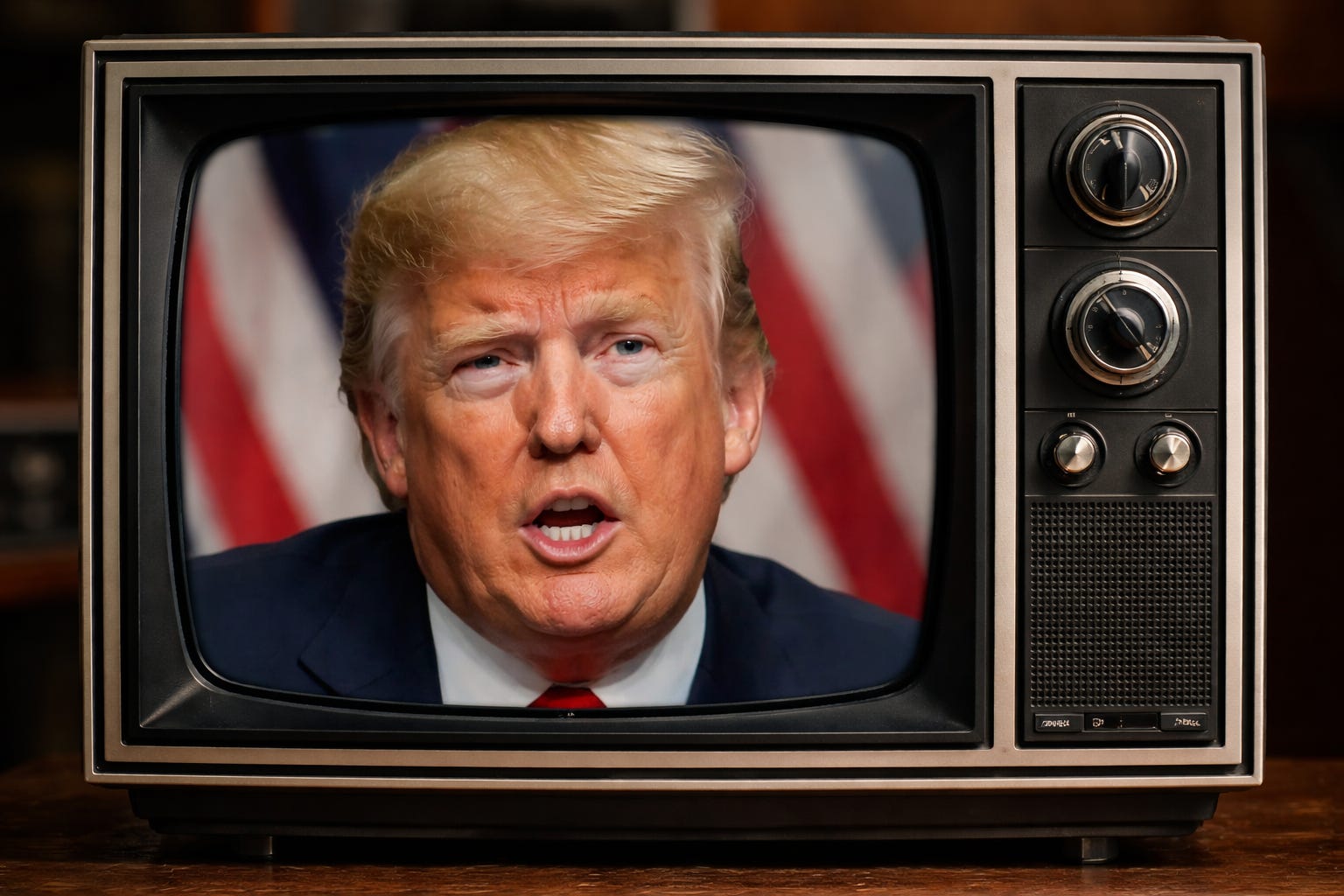
Here are a few things we’ve learned (or, rather, re-learned) in the last 72 hours:
1. TV is (still) the president. During Donald Trump’s first term, it was not uncommon for ideas to go from the curvy couch on “Fox and Friends” to the presidential Twitter feed in a matter of minutes. Trump allies and critics alike would take out ads during the show to get his attention (and, oftentimes, it worked).
The Trump/“Friends” feedback loop seems to be alive and well. As CNN’s Brian Stelter notes, at around 6:15 a.m. yesterday morning, “Fox and Friends” co-host Brian Kilmeade offered Trump a suggestion on the show. “What I would do is just bring Tom Homan in,” Kilmeade said, urging the president to send the White House border czar (and former Fox commentator) to Minneapolis to calm tensions.
Kilmeade reiterated the proposal at 7:15 a.m. and once more at 8:10 a.m. By 8:31 a.m., Trump had posted: “I am sending Tom Homan to Minnesota tonight.” Huh, I wonder where he got that idea?
Television’s influence on the president’s response to Minnesota has also gone deeper than Homan’s deployment. While Homan is headed for the state today, the Border Patrol’s Greg Bovino — who had been the initial public face of the Trump administration’s reaction to the death of Alex Pretti — is leaving. In fact, according to the Atlantic, Bovino has been stripped of his lofty title (“commander-at-large”) and demoted back to his previous role within the agency; per CNN, Bovino’s access to his social media accounts has been suspended by his higher-ups after he spent the weekend picking fights online.
Trump also moved to ratchet down his administration’s position in other ways, using more conciliatory rhetoric towards Tim Walz and ordering at least some of the Border Patrol agents in Minneapolis to leave with Bovino. Asked on Monday if Trump agreed with his advisers who had called Pretti a domestic terrorist planning to harm federal agents, White House press secretary Karoline Leavitt notably left officials like Homeland Security Secretary Kristi Noem and White House deputy chief of staff Stephen Miller in the dust, distancing the president from their harder-edged remarks. “I have not heard the president characterize Mr. Pretti in that way,” Leavitt said.
These reversals reportedly came directly from Trump watching cable news and growing unsatisfied with what he was seeing from his administration. Per the Washington Post, Trump was particularly sensitive to comments from conservative media figures like Fox News host Maria Bartiromo, who criticized Noem and Miller’s rhetoric, leading Trump to make a shift.
Trump, of course, is a former TV host himself and this string of events is another reminder that he is obsessed with television and how things (and people) play on TV. One moment I always go back to is from early in Trump’s first term, when his administration had indicated opposition to intervening in Syria, but then Trump said his mind was changed by seeing images on television of children who had been attacked by chemical weapons. He quickly moved forward with an airstrike. Similarly, Trump appeared to be affected by watching video of George Floyd’s death in 2020 and also by the images of Alex Pretti being shot this weekend. “I don’t like any shooting,” he told the Wall Street Journal.
Beyond the direct policy implications of TV’s influence on Trump, there is also an apt metaphor here. TV is, by nature, moderate. Not just anything can go on television; content tends to stay within the 40-yard lines of acceptability. “Will it play in Peoria?” TV execs of another age were known to ask.
Trump is undoubtedly surrounded by extremist voices and can be quite extremist himself sometimes as well. But one thing holding him back from the unbounded presidency that both his supporters and critics imagine is his instinct, often, to pull back and return to the inner bounds of acceptability — returning, in other words, to what he knows will play on television without scaring off too much of the audience.
Ultimately, this desire for widespread support and mainstream acceptance means that Trump can never be the fully unleashed, autocratic leader that some imagine him to be. He still cares too much about, and is too sensitive to, public opinion, often represented by what will rate on TV. Perhaps if, say, Stephen Miller or another right-wing nationalist were elected president, this dynamic would look different and their current term would imitate the one that MAGA firebrands want and Resistance types fear. Perhaps that president would be plunging even deeper into a situation like the one in Minnesota right now, public opinion be damned, unlike Trump who opted to pull back. But, then again, that person likely never would have been elected president in the first place, without Trump’s sensitivity to how things will be received by a mainstream audience, which causes him to sometimes skate towards a full-on extremist presidency but then also frequently to reverse himself when he senses (often from TV) he’s gone too far.
2. Trump is (still) highly amenable to the last person he spoke to. This is another Trump-specific trait that holds him back from a full, unbounded presidency. Trump is sometimes branded by his critics as a fascist, including because of his rhetoric towards his enemies, which is often incredibly bombastic and even dehumanizing.
But, as always, Trump is both more simple and more nuanced than that, and those claims are at least complicated by the fact that Trump also has a streak of rapidly changing his rhetoric about someone after he speaks with them. For example, Trump has spent the last several months railing against Minnesota governor Tim Walz, who he’s called “corrupt” and “grossly incompetent,” and who his Justice Department launched an investigation into just last week.
Then, Trump and Walz spoke on the phone yesterday. Here is how Trump described the call:
Governor Tim Walz called me with the request to work together with respect to Minnesota. It was a very good call, and we, actually, seemed to be on a similar wavelength. I told Governor Walz that I would have Tom Homan call him, and that what we are looking for are any and all Criminals that they have in their possession. The Governor, very respectfully, understood that, and I will be speaking to him in the near future. He was happy that Tom Homan was going to Minnesota, and so am I! We have had such tremendous SUCCESS in Washington, D.C., Memphis, Tennessee, and New Orleans, Louisiana, and virtually every other place that we have “touched” and, even in Minnesota, Crime is way down, but both Governor Walz and I want to make it better! PRESIDENT DONALD J. TRUMP
It is not a typical fascist tactic to take a break from bashing your opponents to say that you and they are on “a similar wavelength” and that you both “want to make” a given situation “better.” Which isn’t to say that Trump’s rhetoric doesn’t frequently veer into alarming territory — but just that he’s more complicated than an easy label can suggest, including because of his desire to charm people, even rivals, once he’s in a room or on the phone with them, and his proclivity to agree with what they say and adopt the position of whoever he’s spoken to last. We saw this, perhaps most famously, with Zohran Mamdani last year; it also happened with Gavin Newsom a few times during Trump’s first term.1
In addition to Walz, Trump also announced yesterday that he’d had a “very good telephone conversation” with Minneapolis Mayor Jacob Frey, who he similary had previously criticized. The Walz and Frey calls were quickly followed by the news that Bovino and at least some Border Patrol agents were leaving Minneapolis, suggesting that Trump’s wariness of how his stance was playing on TV and his positive conversations with Democratic officials both contributed to his eventual reversal.
3. Trump’s power (still) often only extends as far as conservative orthodoxy allows. My plan is to write more about this piece of the Pretti shooting tomorrow, but contrary to the idea that Donald Trump has molded Republican Party orthodoxy like putty in his hands, there’s a running theme of his administration running up against core tenets of GOP thought — and losing.
We’ve seen this in the various tariff debacles, where Republican willingness to sanction import taxes has certainly grown since Trump has arrived on the scene — it’s not like we’ve seen Congress reject any of his tariffs — but not nearly to the extent of the unbounded tariff regime he desires. When Trump has pushed too far, such as during “Liberation Day,” Republican lawmakers have pushed back and secured major concessions from him. The same is true of Trump’s recent threats to NATO around Greenland, which sparked GOP pushback, and perhaps most notably after the assassination of Charlie Kirk, when Ted Cruz and other conservatives managed to stop the Trump administration’s plans of policing speech in its tracks.
None of this is to say that the Republican Party c. 2026 is not different than the party Trump ambled into 11 years ago, but when he has tried to change its views on issues like free trade, NATO, and governmental censorship, it doesn’t exactly seem like he’s succeeded.
Similarly, this last weekend, Trump’s immigration crackdown collided (fatally) with long-held Republican Party orthodoxies about the Second Amendment, after Trump officials tried to defend Pretti’s killing by noting that Pretti was carrying a gun. “You cannot bring a firearm, loaded, with multiple magazines to any sort of protest that you want,” FBI Director Kash Patel said in one interview, exactly the sort of comment that Republicans have been decrying for years.
As with other times the Trump administration has tried to subjugate conservative orthodoxy to serve its own ends, it doesn’t seem to be working out. Gun rights groups, normally supportive of Trump, have exploded in anger, and several Republican lawmakers have pushed back against the Trump team’s framing of the Second Amendment. Republicans give Trump a great amount of leeway to accomplish his objectives but, repeatedly, when doing so means quelling key tenets of conservative thought, GOP lawmakers have signaled that they won’t let Trump push quite so far.
4. The Trump administration is (still) a viper’s nest, and personnel is (still) policy. Trump’s first presidency was marked by clashes between various factions of White House officials: Priebus vs. Bannon vs. Kushner and so on. That has been less of a theme of his second term — but much of the same sniping (which Trump reportedly encourages) has still been present quietly, behind the scenes. And these aren’t just petty squabbles: oftentimes the warring officials have competing policy visions, and it matters who is winning, because that can tell us which policies to expect next.
Here, for example, Homeland Security Secretary Kristi Noem and her top adviser Corey Lewandowski (a longtime fixture of Trumpworld, as the president’s original 2016 campaign manager) have been engaged in a months-long battle with White House border czar Tom Homan. According to the Wall Street Journal, Homan has “emphasized the importance of focusing ICE’s efforts on hunting down serious criminals living illegally in the U.S.,” while Noem “has favored the flashier approach that has seen agents making indiscriminate arrests–and deploying military tactics against protesters.”
As the Journal notes (and as we’ve all seen for ourselves), “over the last six months, top administration officials have preferred Noem’s strategy” of confrontations with protesters and flashy arrests (even if their targets lack a criminal record), while Homan’s influence has “waned.”
Now, with the news that he’s being sent to Minneapolis, it seems like Homan is on top again, while Noem and Lewandowski (who were advocates of Bovino, who Homan is effectively replacing on the ground) are seeing their stock sink. Again, this isn’t just idle gossip; it potentially suggests a policy pivot away from the Noem way of doing things, and towards Homan’s favored approach of targeting illegal immigrants with a criminal record (which is also much more popular with voters).
According to the Washington Examiner, Noem and Lewandowski have similarly sparred with Customs and Border Protection (CBP) commmissioner Rodney Scott, whose agency oversees the Border Patrol and who has reportedly pushed back against Noem’s deportation strategy as well. Noem reportedly was hoping to install Bovino in Scott’s place, and had even blocked Scott from traveling to Minneapolis. Well, things are shifting quickly. Bovino has now been relieved of his duties, and Scott’s travel block has been lifted.
5. Officials can (still) lose their jobs in Trumpworld — but it’s (still) difficult. This is a side-takeaway from #4, but it’s genuinely notable that Trump is demoting Bovino, considering how resistant the president has been to fire any high-profile administration officials this term.
Bovino’s demotion shows that it’s still possible to lose your job in Trumpworld, although the bar for being shown the door is clearly very, very high. And, of course, Bovino is not a Cabinet-level official; the real test would be if Trump were to fire Noem. Reportedly, he’s been displeased with her performance, but doesn’t plan to dismiss her, for the usual reasons of not wanting to give his critics a victory.
So, personnel changes under pressure very much remain abnormal in Trump 2.0, but we’ve learned from this controversy that they aren’t quite impossible.
6. Judges (still) don’t like to be bullied. Trump’s immigration crackdown in Minnesota hasn’t just played out on the streets — it’s also been a legal battle, fought inside courtrooms. And judges appointed by presidents of both parties do not seem to be appreciating the Trump administration’s tactics.
Politico’s Kyle Cheney has done invaluable work on this, reporting on the tensions running high in Minnesota’s judicial chambers as cases stemming from Trump’s crackdown pile up. (The workload is so much that some cases have even been assigned to visiting judges from other districts.) In one case, U.S. District Judge Michael Davis, a Bill Clinton appointee, pushed back strongly against the administration’s contention that judges in Minnesota weren’t giving “serious consideration” to the administration’s positions. “Since November 2025,” Davis wrote, “the courts of this District have thought of little else.”
In another case, the administration took the unusual step of demanding that a district judge overturn a magistrate judge’s refusal to charge former CNN host Don Lemon for actions related to the Minnesota protests, and then going straight to an appeals court when the district judge didn’t move fast enough. Patrick Schiltz, the George W. Bush-appointed district judge, appeared enraged by the administration’s antics, which he called “unprecedented” and “frivolous.” The appeals court ended up rejecting the administration’s bid.
Now, Schiltz has ordered acting ICE director Todd Lyons to personally appear in his court on Friday and explain why Schiltz shouldn’t hold Lyons in contempt for ICE allegedly violating court orders. “The Court’s patience is at an end,” Schiltz wrote. Judges do not like to be pushed around or stonewalled.
7. Congress (still) exists — maybe. This is the one I’m most uncertain about, and curious to see how it plays out in the coming days.
Democrats of all stripes have undergone a striking shift in rhetoric in the last few days: Senate leaders, like Chuck Schumer, who recently rejected the idea of another shutdown now seem to be driving towards one; immigration hardliners, like Tom Suozzi, who voted for DHS funding in the House are now apologizing for it; moderates, like John Fetterman, who voted to confirm Kristi Noem are now calling for her to be fired.
And we’ve also seen statements from a slew of Republican lawmakers who normally keep their Trump criticisms quiet, but are now calling for investigations into the Pretti shooting. Most notably, we’ve seen Congress move to resurrect their oversight role, with the Republican chairs of both the House and Senate Homeland Security committees summoning Trump’s top immigration officials for hearings in the wake of Pretti’s death.
Congressional Republicans have held very few oversight hearings in response to the many scandals of Trump’s second term, so this bicameral move is notable, and a sign that GOP lawmakers view this as perhaps the most serious Trump II controversy to date.
All that said, I’ll be most curious to see whether these bipartisan frustrations actually turn into legislative policy, which is, of course, Congress’ main function (at least in theory). Democrats are reportedly saying they’ll oppose the DHS funding bill unless it includes language requiring ICE and CBP officers to wear body cameras, among other demands.
According to Punchbowl News, bipartisan negotiations are taking place and Republicans have floated some potential offers but, revealingly, GOP lawmakers are hoping to contain the concessions to actions that Trump could take “outside of” the legislative process — in other words, actions that wouldn’t be codified by law. With a potential government shutdown looming, we’ll see if bipartisan fury is enough to secure actual legislative changes, or whether Republicans are willing to hold oversight hearings and pressure Trump to make administrative changes, but not to take that extra step of actually writing things into law.
During the Mamdani meeting, he explicitly rejected some of the rhetoric his allies have thrown out about socialists, once again complicating narratives about how Trump uses language like a fascist to demonize his rivals, since his rhetoric often grows checkered and more affectionate after actually talking to someone — and also, once again, leaving some of his own advisers in the lurch, another common Trump trait, and one we’ve seen in the last few days as Trump aides took to TV spreading the message they assumed the boss would want, only to find out belatedly, after he threw them under the bus, that he had decided on a different tack without informing them.
I might suggest that T only cares about one TV network and that’s Fox. I refuse to call them a news station. Not sure the others exist in his shallow mind - except to sue and bully.
Just a question from an old hermit, why do you call Trump and his MEGA crowd "conservative?" Trump doesn't believe in a balance budget, he is neither pro-choice or pro- life (He is which ever will get him the most votes), his foreign policy is all over the place. his tax policy is a joke, as are his economic policies. Don't mean to upset anyone, just asking.