


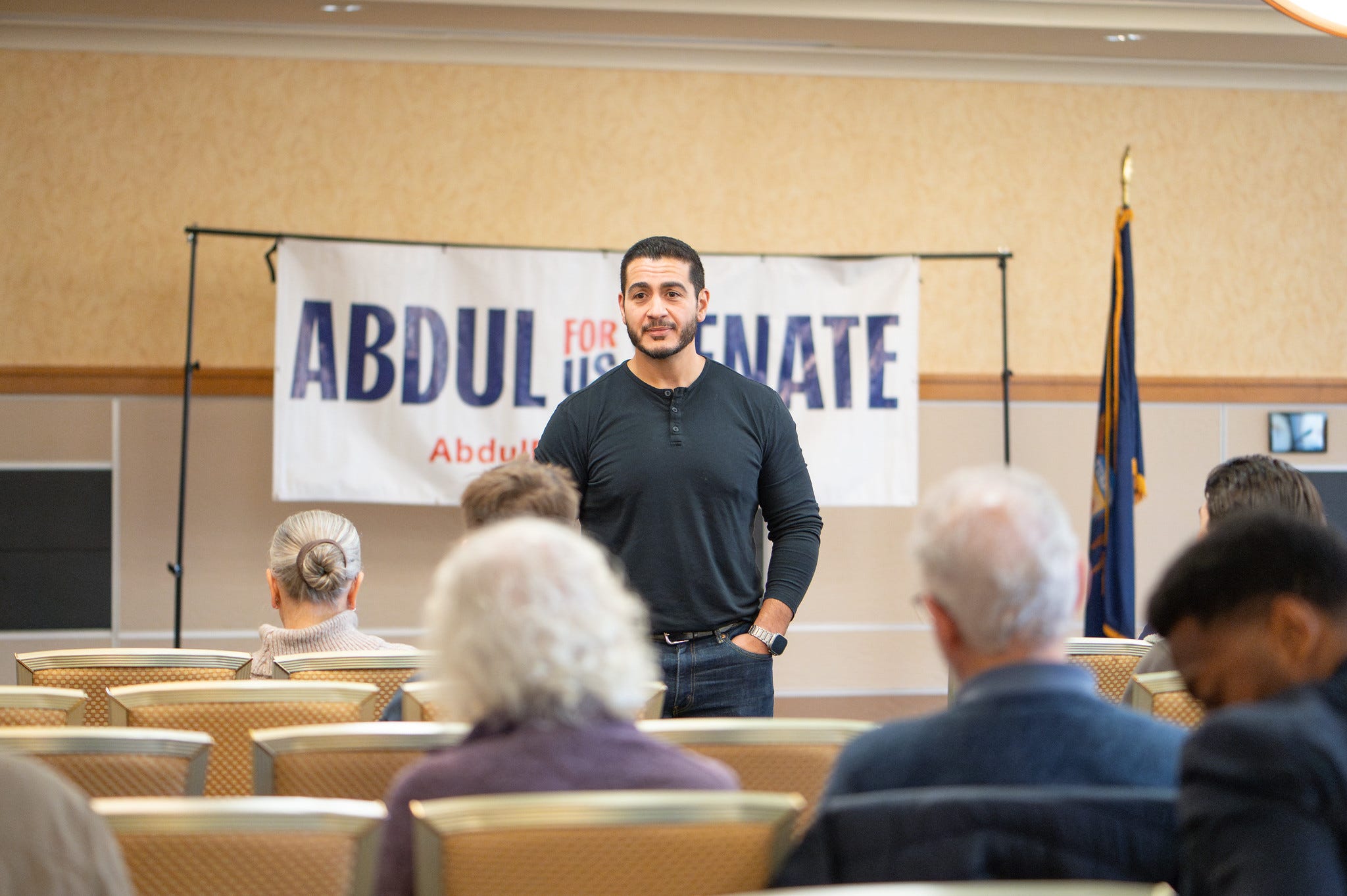
As I’m writing this, former public health official Abdul El-Sayed was just declared the winner of last night’s Michigan Democratic Senate primary by the Associated Press. With more than 95% of precincts reporting, El-Sayed currently has 48.48% of the vote, while his rival, moderate Rep. Haley Stevens, has 47.51%, giving the progressive favorite an edge of just under one percentage point.1
There are already two takes forming:
Someone named Abdulrahman Mohamed El-Sayed just won a primary for the U.S. Senate, overcoming opposition from the Democratic Party establishment on both the state and national level (Senate Minority Leader Chuck Schumer was privately steering support to Stevens, while Michigan’s sitting governor and outgoing senator publicly endorsed her) and a massive spending disadvantage (Stevens and her allies poured $65 million into advertising in the race, compared to just $7 million in ad spending by El-Sayed). This is a landmark victory for Bernie Sanders and Alexandria Ocasio-Cortez, who backed El-Sayed, and their broader left-wing political movement attempting to remake the Democratic Party.
Or…
Polling averages showed El-Sayed with a mammoth 13-point lead ahead of the primary, a benchmark he is poised to underperform by about 12 points. No matter your opinion on prediction markets as an oracle for the future, they are great vehicles for assessing conventional wisdom; 24 hours ago, the favored outcome on Polymarket was that El-Sayed would win by 15-20 percentage points, followed by him winning by 10-15 percentage points. Now, it is El-Sayed winning by fewer than five percentage points, which was deemed a remote possibility yesterday. After expressing a confidence that “can border on cockiness,” progressives badly underperformed expectations in this race.
Most pundits, depending on their factional loyalties, will spend most of the day trumpeting one of these two narratives. But here at Wake Up To Politics, we have no factional loyalties, so we can be honest: There is truth in both.
Considered on its own terms, El-Sayed’s apparent victory is deeply impressive: with all the party elites (and outside money) stacked against him, he could now become the first Muslim senator in U.S. history.2 But considered within the context of the renewed civil war that has been brewing within the Democratic Party all year — ever since Zohran Mamdani beat Andrew Cuomo in the New York City mayoral primary last June — the outcome is more of a draw. In a race that was decided by about 20,000 votes out of more than 1.5 million cast, it can’t exactly be said that either side of the Democratic Party ran away with a victory.
Instead, when considering the results from Michigan and other primary races across the country, a picture of two Democratic Parties — roughly evenly matched — comes into view.
El-Sayed trounced Stevens in Kent County (home to Grand Rapids), 61% to 35%, and Washtenaw County (home to Ann Arbor), 61% to 36%. Both counties are overwhelmingly white (70% and 67%, respectively). Washtenaw County, home to the University of Michigan, is disproportionately young and college-educated: 20% of the county is in their 20s (compared to 13% of Michiganders overall), while 60% have a bachelor’s degree or higher (compared to 33% statewide). Though not by as much, Kent County also punches above its weight in terms of education (42% of residents have at least a college degree). Both counties have higher median household incomes compared to Michigan overall.
Stevens, meanwhile, came out ahead in Wayne County (home to Detroit), which has a significantly smaller white population (48%) and significantly larger Black population (37%). Its educational attainment (28% have a bachelor’s degree) and median household income ($59,000) are both below the figures for the state overall. Stevens is winning there, 52% to 45%.
Statewide, according to the New York Times, Stevens is winning in rural counties, Detroit, and its suburbs. El-Sayed is winning in other suburbs and mid-size cities. In counties with more young residents, El-Sayed is winning by 21 points. In counties with more old residents, Stevens is winning by two.
These patterns would be striking if they didn’t align so perfectly with the results we have seen across the country this year. In June, the democratic socialist Darializa Avila Chevalier unseated Rep. Adriano Espaillat in New York’s 13th congressional district (covering upper Manhattan and parts of the Bronx). According to the Times, Avila Chevalier romped to victory in the younger, more college-educated, higher-income precincts. Espaillat won in lower-income areas. Avila Chevalier overperformed in the majority Black precincts in the district, while Espaillat overperformed in the majority Hispanic precincts. The same age and income trends held true in New York’s 7th district (covering parts of Brooklyn and Queens), though there left-wing candidate Claire Valdez overperformed in the majority Hispanic precincts while moderate Antonio Reynoso performed well in areas that were majority Black.
Yesterday, at the same time as El-Sayed eked out a victory in Michigan, his fellow left-wing candidate Cori Bush fell flat in Missouri’s 1st district (my home district, comprising St. Louis) against moderate Rep. Wesley Bell. The district is 43% Black (compared to 12% nationwide), with a median household income of $60,000 (compared to $81,000 nationwide). Bell beat Bush by 22 percentage points.
One of the two Democratic Parties is younger, whiter, more college-educated, and higher-income. This one is generally trying to tug the broader party to the left. The other is older, less white, less college-educated, and more working-class. This one is trying to keep the Democratic platform where it is, or move it to the center.
Despite what either faction might tell you, neither of these smaller parties has a clear advantage, which shouldn’t be surprising when considering the demographics of the Democratic Party as a whole. According to Pew Research Center, 56% of voters who lean Democratic are white. 44% are not. 47% are 18 to 49 years old. 53% are 50 or older. 45% have at least a college degree. 55% do not. The party is evenly split on all of its most salient demographic lines.
As a result, the party is split as to its direction. When a CNN poll last week asked Democrats whether they wanted their party to move to the left on policy issues, 54% said “yes” and 45% said “no.” When the poll then asked whether the party should move to the center, 54% said yes and 46% said “no.” (Yes, this means some Democrats answered “yes” to both.) There is no clear winner in the Democratic Party’s factional battle, only temporary victories based largely on the demographics of a given contest, which is how moderate Reps. Wesley Bell (in Missouri) and Marie Gluesenkamp Perez (in Washington state) can fend off left-wing primary challenges on the same day that progressives Abdul El-Sayed (in the Michigan Senate race) and Donavan McKinney (challenging incumbent Michigan Rep. Shri Thanedar) eked out narrow victories.3
All this said, it’s important to remember that the two Democratic Parties differ directionally, on the question of whether the broader party should inch left or right. But it really is a game of inches, with divides smaller than some make them seem.
Ahead of the Michigan primary, the journalist Astead Herndon (reliably a thoughtful observer of Democratic Party politics) penned an explanation of why the democratic-socialist faction of the party was on an “upward march.” (Remember, this was back when polls were saying El-Sayed would dominate.) “The left has a vision,” Herndon wrote. “Do moderates?”
Last week, I watched the final debate between Stevens and El-Sayed — their last opportunity to differentiate themselves before the primary — and I certainly did not come away with the sense that Stevens had a stirring vision for the future of the Democratic Party. But nor did it seem to me like El-Sayed had a clear policy agenda that was all that much different than the party’s existing platform.
For El-Sayed, nearly every question came back to campaign finance (and the $65 million barrage that was being dumped on him, about half of it from the American Israel Public Affairs Committee, or AIPAC), just as for Stevens, nearly every question came back to electability (and the polls that showed her running ever-so-slightly better against Republican nominee Mike Rogers in the general election). These are both interesting political questions, deeply relevant in the heart of a campaign. But neither offers much of an indication of the broader policy agenda either candidate would push.
The very first question El-Sayed received was about what he would do differently than the politicians in Washington right now to address affordability, a pitch-perfect opportunity to speak to the No. 1 concern for voters in Michigan and across the country. “For me, it’s I don’t take money from the corporations who are jacking up your prices in the first place,” El-Sayed began his answer, before launching into an explanation of the companies that had contributed to Stevens and not him. But when he got around to the actual economic policy differences that he believed would stem from those differing campaign finance stances, his vision frankly didn’t seem that distinct from the broader Democratic Party that he largely framed his campaign around running against.
The three economic policies El-Sayed named were antitrust enforcement, taxing billionaires, and ending aid to Israel. The first two are pretty standard fare within the Democratic Party (Stevens supports both); the third is a notable foreign policy difference, but hardly as meaningful an economic point as El-Sayed made it out to be. Because he is not backed by AIPAC, El-Sayed said, “I can do things like make sure that rather than sending your money somewhere else to drop bombs on other people and their kids, we can keep that money here at home.”
But, as Bill Scher of the Washington Monthly noted: “For the last 15 years, the U.S. has spent about $4 to 5 billion a year on military aid to Israel, except for a one-year spike to $12.5 billion in Fiscal Year 2024 following the October 7 attacks. Annual federal spending on education between 2021 and 2024 roughly ranged from $170 to $180 billion. For health care, the range is $1.8 to $2.1 trillion.” Whatever your opinion on the morality of sending aid to Israel, its existence is not much of a budgetary barrier. Ending it would not unlock much fiscal space to fund a brand-new, progressive economic vision.
None of this is meant as a defense of Stevens or of the Democratic Party’s moderate faction, neither of which (to Herndon’s point) have articulated much of a vision for the last 10 years beyond opposing Donald Trump. Rather, I mean to question just how meaningfully either faction differs from that same, familiar party line.
El-Sayed, to his credit, has a detailed platform on his campaign website.4 But if you read it, the vast majority of the points either align with the Democratic Party or are vague as to how they differ. There are points about protecting “the rights of all Americans,” regardless of “how—or if—they pray, their sexual orientation, gender identity, how old they are, or how much money they make,” which all Democrats would agree with. There is support for a “muscular Federal Trade Commission that enforces anti-monopoly laws” and empowering Medicare to negotiate prescription drug prices, which were both signature Biden administration policies.
Unsurprisingly, much attention is paid to campaign finance, though his prescriptions (overturning Citizens United, banning super PACs, and public financing for elections) are broadly shared within the Democratic Party. Stevens certainly had a different policy than El-Sayed about accepting contributions to her individual campaign, but she is a co-sponsor of a constitutional amendment to overturn Citizens United and (like 219 other House Democrats) voted for the party’s H.R. 1, which would have imposed stricter campaign spending limits and expanded public financing.
Perhaps the three key points where El-Sayed differs from the party are: supporting Medicare for All, wanting to abolish ICE, and pushing for a change to U.S. policy in the Middle East. But none of the three points are as cut-and-dried as the sloganeering can make them seem.
Medicare for All is one of the key planks of El-Sayed’s campaign, but even he acknowledged, in an interview with the Bulwark, that “we’ve got to take a pathway there,” adding that he would support anything that “reduces the power of the health care corporations, expands health care, and does so publicly.” That doesn’t sound too distinct from Stevens’ preferred path to universal health care, a public option (where government-run health insurance is an option for all Americans, but not required, competing with instead of replacing private plans).
On ICE, El-Sayed’s platform calls for ending ICE, but maintaining “a safe, secure border and immigration enforcement” program, without making clear how the two would differ from each other. In the debate, he called for an agency that would enforce immigration policy, but in accordance with the Constitution, hardly something any sitting Democrats would disagree with (whether they would call that agency “ICE” or something else).
Finally, on the Middle East, El-Sayed has called for an end to Israel aid but left unclear his broader vision for the region. In the debate, he said he supported “self-determination for Palestinians and Jewish Israelis alike.” Does that mean he supports a two-state solution? A single, binational entity? El-Sayed has repeatedly refused to say.
He has also frequently called for taxpayer funds to stop flowing overseas and instead be spent domestically. “I believe that in an era where our schools are crumbling and healthcare is unaffordable, we should be spending our taxpayer dollars here at home,” his campaign website says. How far does that extend? In the same section, he refers to “supporting Ukraine against Russian invasion” as being on “the right side of justice.” So, is he opposed to foreign aid, or are there some taxpayer dollars that should be spent on bombs abroad, depending on the circumstance? It’s never quite made clear.
On two of these policy issues — health care and Israel — El-Sayed clearly aligns with the Democratic base, and has used his obvious communications abilities to accentuate cleavages between Democratic leaders and their voters. In a recent New York Times poll, 50% of Democrats said they wanted the party to move to the left on health care and 60% said they sympathized more with the Palestinians than with Israel.
I don’t mean to minimize the split on Israel, which is obviously incredibly salient within the party. One common strand among American voters of all ideological stripes is that they hate being told how to feel and resent a conventional wisdom being forced down their throats. This explains much of the backlash to the “wokeness” phenomenon c. 2020. It also helps explain why the divide over Israel has become so motivating to so many Democratic voters, as they break away from a pro-Israel consensus that has dominated American politics for so long, creating an easy litmus test to separate those politicians who are still hewing to old ways and those who are updating their thinking after a deadly war.
But a meaningful difference on one foreign policy issue does not equal an entirely new political vision. On almost everything else, for all the sturm und drang about running against his party and remaking the Democratic platform, El-Sayed falls into the same rhythms as the rest of the party, but just with superior communications skills. Like Stevens and many other Democrats in both the mainstream and progressive factions, El-Sayed shies away from expressing positions on social issues. According to the same Times poll, pluralities of Democrats want the party to move to the center on immigration, crime, and transgender issues. Here, El-Sayed and Stevens both offer the same, familiar moves to the left.
During the debate, El-Sayed was asked, “What is the No. 1 thing Senate Democrats are failing to do right now that you would do differently?” His answer — that he would eliminate the Senate filibuster — was downright bizarre, for two reasons. The first is that almost all Senate Democrats already support eliminating the filibuster, at least when they are in power. But the second is that the question was about “right now,” which suggests that El-Sayed wants to end the filibuster now that Republicans are in the majority and Trump is in the White House. El-Sayed has repeatedly suggested that Democrats are not doing enough to counter Trump, but the filibuster is the Senate Democrats’ only real tool to do so, the tool that progressive activists have called on them to use again and again, to stop everything from government funding bills to the SAVE Act.
So if El-Sayed was in the Senate right now, his answer would be to fight Trump … less?
Surely this was a slip of the tongue, but it gets at a broader sidestepping about where exactly this big new vision differentiates itself. Here’s the question I would ask: If Abdul El-Sayed was Senate Minority Leader right now, not Chuck Schumer, what would currently be different?
A few weeks ago, Politico leaked audio of El-Sayed, which mostly drew attention for him referring to an “ogre on a pike” (which Stevens took to mean her, but which he said was referring to John Fetterman). But, to me, the more interesting part was El-Sayed’s description of his job for the next two years, if elected to the Senate: “throwing as much sand in the gear of the Trump administration as I can and using them to posterize them,” by which he meant conducting investigations to “tell the story about the corruption” within the administration. Democrats are going to investigate Trump with or without El-Sayed in the Senate. The real difference, then, is about messaging. It’s stylistic, not substantive.
El-Sayed is no doubt a superior communicator to Chuck Schumer. But I’ve yet to hear the specifics of what he would be doing differently to counter Trump5 or reach voters who are turned off by the Democratic Party’s existing social or economic policies — or, for that matter, to cobble together the three-fourths majority in state legislatures needed to overturn Citizens United, as he calls for.
The Democratic Party is split between two camps, which have some differences at the margins on where the party should go, but largely are offering the same policy prescriptions that Democrats have been selling for years, with mixed success. The great promise of El-Sayed’s candidacy, according to a sympathetic profile at its outset, was his ability to attract “working- and lower-middle-class Americans who pulled twice for Obama before switching to Trump over the past decade.”
El-Sayed will now have the opportunity to test that theory in November. So far, like other left-wing candidates, he has appeared no more adept at winning working-class voters than the existing Democratic ruling class, who does well with the segment of this constituency who votes in Democratic primaries but often struggles among the remainder who participate in general elections. The fact that polls showed both El-Sayed and Stevens running about even with Rogers, in a state with two Democratic senators and a Democratic governor, in a year where a Republican president is historically unpopular, is a warning in of itself. Michigan is to the left of about half the country, friendlier territory than many of the states required for Democrats to win the Senate.
There may be two Democratic Parties, but neither appears to have much of a vision for winning a lasting majority or making the changes needed to win over voters beyond their base.
A third candidate, State Sen. Mallory McMorrow — who exited the race on July 5 — has 4.01% of the vote. Absentee voting began in Michigan on June 25, so some of McMorrow’s 61,000 voters likely cast their ballots without knowing that she would drop out. At least some of them probably voted for her knowing she had left the race. Either way, I wonder what they are thinking now that their votes could have been determinative in a race that was decided by about 15,000 votes.
He is not, however, the first Muslim Senate nominee from a major party. That title goes to Dr. Mehmet Oz, the television personality who was the 2022 GOP Senate nominee in Pennsylvania.
Progressives also scored a victory in Michigan’s 7th district, a key battleground for the fall, with the nomination of Sunrise Movement co-founder William Lawrence. But this one came with an asterisk: Lawrence took 43.7% of the vote. Two centrist contenders, Bridget Brink and Matt Maasdam, split the moderate vote, but combined to take 56.4% of the vote. Another near 50-50 split.
Stevens’ website featured only a vague “MI Hope Agenda,” which has seven brief points and then a note at the end describing it as a “love letter to our Black and brown communities in Michigan,” which comes off as somewhat strange since it is the only platform on her site and nothing else about it seems to be specific to those communities, rather than something aimed at all Michigan voters, though it makes sense when you remember the constituencies targeted by the different Democratic factions.
Especially without the filibuster!
Very much appreciated the percentages that divide the party almost in half.
Very good analysis and well written. Thank you.
I think what you are missing is that the establishment wing of the party has been espousing these ideas for years but don’t deliver. Voters want someone they perceive as a fighter. The fact that Stevens was supported by millions in PAC support fed the perception that she would not truly rock the boat, whereas El-Sayed seems as if he would. Medicare for All is a big deal and if the Democrats had eliminated the filibuster under Obama we could have it now.