


The Nebraska Senate race has everything: A billionaire incumbent. A populist mechanic. Alleged double agents. A legal battle. And intrigue with a pro-marijuana party.
The seat is currently held by Sen. Pete Ricketts (R-NE), the former governor whose family owns the Chicago Cubs. Ricketts is running for his first full term, after being appointed in 2023 to succeed former Sen. Ben Sasse (R-NE), who resigned to become a college president.
To oppose him, Democrats are fielding … nobody?
The Nebraska Democratic Party announced almost a year ago that they planned to stay out of the race and instead endorsed Dan Osborn, a third-party candidate who previously ran as an Independent for the state’s other Senate seat. Osborn, a mechanic and former union leader with a heterodox mix of views — he is pro-border wall, pro-gun rights, pro-legalizing marijuana, and pro-raising the minimum wage — lost his 2024 race by seven points in a state Kamala Harris lost by 20.
“We believe a coalition of Dems, Indys and Republicans can beat Ricketts and break up the one-party rule,” Jane Kleeb, the Democratic state party chair, wrote on X last year. “We like the odds of a mechanic vs a billionaire.” It’s a strategy Democrats are also pursuing elsewhere, in hopes of taking on Republicans without the Democratic Party label hanging around their necks.
The Nebraska state party couldn’t stop candidates from running in the Democratic primary, however, and soon a 79-year-old anti-abortion, Trump-supporting pastor named William Forbes threw his hat in the ring. Democrats accused Forbes of being a Republican plant, running at Ricketts’ behest to take votes away from Osborn. (“The Nebraska Democratic Party made a deliberate, principled decision not to field a candidate in the U.S. Senate race,” Kleeb said in a March statement, accusing Forbes of “running to trick voters.”) Forbes denied the allegations.
A pharmacy technician named Cindy Burbank quickly jumped in the race as well, with the explicit promise that she would drop out and make way for Osborn if she won the Democratic primary. This launched a brief legal battle, when Nebraska’s Republican secretary of state removed Burbank from the ballot, arguing that she was not a “good-faith candidate” since she was only running to drop out. The Nebraska Supreme Court ultimately ruled in Burbank’s favor.
Meanwhile, the primary for a pro-weed third party was also gripped by drama. It has been revealed that Burbank paid the filing fee for Mike Marvin, who was running as a candidate of the Legal Marijuana NOW Party. Other leaders of the party have accused Marvin of being a plant as well, alleging that he, too, plans to drop out in Osborn’s favor, which Marvin denies.
The primaries were finally held last week in the race CNN has dubbed the “craziest election in the country,” and the results yielded the best-case scenario for Osborn: both Burbank and Marvin won their primaries. That gives Osborn his best shot at a one-on-one race against Ricketts.
It will still be an uphill battle for the Democratic-backed Independent; the last time Nebraska elected a non-Republican to statewide office was 2006. (Ironically, Ricketts — then a businessman — was the Republican nominee who came up short that year, losing to Democratic Sen. Ben Nelson.) On Polymarket, Osborn’s odds of winning the race are pegged at 39%, which still makes him an underdog, of course, but is nothing to sneeze at in such a deep-red state. Strange things can happen in years when the incumbent president is polling at such a dismal low.
Those sort of odds mean it is not ridiculous to start thinking through what it might look like to have an Independent in the Senate, a body where the two-party system is so ingrained that your party membership dictates everything from where you sit to where you eat lunch, with only two options for each.
And not an Independent like Bernie Sanders or Angus King, both of whom caucus with the Democrats and operate as party members in everything but name. (Sanders is even a member of the Democratic leadership team.) Unlike them, Osborn claims he would not caucus with either party. I recently received a reader question about how exactly this would work:
Q: Dan Osborn, an Independent, is claiming that if he wins in Nebraska he will not caucus with either party. Has that ever happened? I realize his chances are slim but I am curious. Do you think he would cave and choose a side, in order to get committee assignments, etc?
As this questioner guessed, it is very unusual to have a senator who is not a member of either party caucus.
The last five Senate independents — former Sens. Joe Lieberman (CT), Kyrsten Sinema (AZ), and Joe Manchin (WV), and then Sens. Sanders (VT) and King (ME) now — all caucused with a party (interestingly, all sided with the Democrats).
The last time there was a senator who didn’t caucus with either party, it was Sen. Dean Barkley (MN), but that was a bit of a special case, since he was appointed by Gov. Jesse Ventura — a member of the Reform Party — to briefly fill a seat during a lame-duck session, when a vacancy was created by a death. Barkley only served for two months, never joined a party, and apparently the issue of committees never came up, presumably since Congress was on winter break for most of the time he was in office.
Keep marching back in time, and you get Sens. Jim Jeffords (VT) and Harry F. Byrd Jr. (VA), who caucused with the Democrats; James Buckley (NY), brother of William F., who caucused with Republicans; and Bob Smith (NH), who ran for president on the Taxpayers’ Party line and briefly became an Independent but who appears to have kept his Republican committee assignments for the handful of months during which he left the GOP.
To find a senator who didn’t caucus with either party from the beginning of a Congress — when committee assignments are handed out — as Osborn would be doing, you have to go all the way back to 1953. And, friends, it did not go well.
The senator in question was Wayne Morse of Oregon. Like Osborn, he was a populist. He was also an iconoclast and a curmudgeon and, frankly, a bit of a crank. Morse was a Republican, but he left the party after Dwight Eisenhower took office in 1953, feeling that the GOP had moved too far to the right. Morse was then in his second Senate term. He didn’t like that Eisenhower had tapped the conservative Richard Nixon as his VP. He didn’t like that the GOP platform called for repealing the New Deal. And he didn’t like that Eisenhower hadn’t condemned McCarthyism, which Morse ardently opposed.
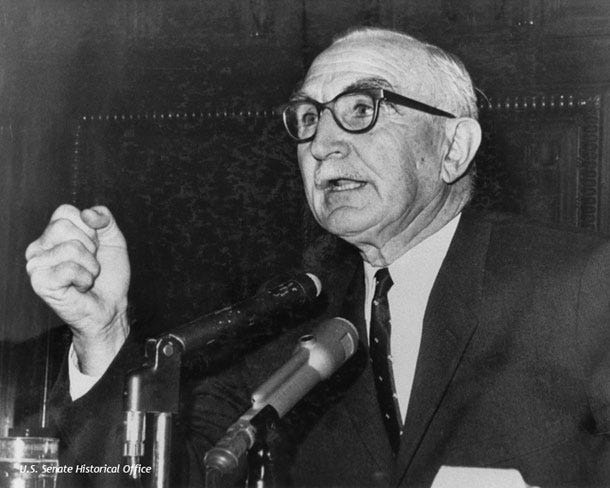
That meant the Senate on January 3, 1953 had 48 Republicans, 47 Democrats, and one Morse. On the first day of the new Congress, he marched into the chamber with a folding chair, which he planned to set up in the aisle, right in between the Democratic and Republican sides of the chamber. “Since I haven’t been given any seat in the new Senate, I decided to bring my own,” he told reporters.
When asked how he would receive committee assignments as an Independent senator, Osborn has invoked a Senate rule that requires every senator to sit on two committees. The rule technically doesn’t mention anything about parties, even though they are how the assignments get divvied out now.
Morse invoked the same rule in 1953. He quickly learned, however, that the rule says every senator has to sit on two committees; it doesn’t say they get to choose which two.
At the beginning of that year’s Congress, the Republican and Democratic leaders came forward to submit their lists of proposed committee assignments for Senate approval, which is normally a mere formality. Neither party wanted to give Morse any of their slots. So they merely gave all of their own members the seats they wanted, and then offered to give Morse the two committee spots remaining, the ones nobody had claimed: seats on the Committee on Public Works (which oversaw federal buildings) and the Committee on the District of Columbia (which oversaw the nation’s capital).
Incidentally, today, you could imagine both of those committees being a prime slot for a publicity-hungry senator, since they would offer a platform with which to battle President Trump’s recent D.C. renovation projects. But in 1953, nobody wanted them, and certainly not Morse. He said that they were “garbage can” appointments, and he declined to accept them.
Morse then waged a lonely crusade to get himself more favorable assignments, citing a different Senate rule that allows for committee assignments to be made one by one — with senators filling out ballots listing out everyone they wanted to serve on a given committee. Morse wanted seats on the Armed Services and Labor Committees. For those two panels, he insisted that the Senate vote by ballot.
“The case which the Senate must decide is new,” Morse said in his typically grandiose fashion. “No such combination of facts and law has been before the Senate in precisely the same posture… I stand before the Senate, not as a member of either the Republican Party or the Democratic Party, but as an Independent.”
Every senator filled out their ballots for Morse’s desired committees, starting with Armed Services. The members selected for the panel by the two party leaders all received 80+ votes. Morse received seven. He did not press his motion to vote on the Labor Committee by ballot, agreeing to submit the matter to the Rules Committee to decide.
The process took months, during which Morse would take to the Senate floor every Friday afternoon to give long speeches, which he referred to as conducting “my committee work” out in the open, since he had no actual committees to sit on.
After the folding chair spectacle on the first day, he had agreed to sit on the Republican side of the aisle, but eventually, he decided he wanted his own section: a corner of the Democratic side — which he referred to as the side for the minority parties (plural) — that would be the one-man section of the Independent Party.
Other senators rose to protest; Morse traded barbs with each of them. “If we move the Senator’s seat, as he requests, what assurance do we have that he will not wish to move somewhere else in about 30 days?” Sen. Homer Capehart (R-IN) asked.
“I assure the Senator from Indiana that one great difference, of many differences between the Senator from Oregon and the Senator from Indiana, is that I take pride in my intellectual flexibility,” Morse replied.
Capehart tried another tack. “Does that mean, in the case of the Independent Party which the Senator from Oregon is trying to start, or perhaps has already started, that if I wanted to join the party I would have to wait for perhaps 60 days before joining, because at the end of 60 days the Senator from Oregon might have new facts which would convince him that he should not after all start a new party?” he asked.
Morse was ready with a quick retort. “I am sure my good friend from Indiana is speaking hypothetically,” Morse said. “I cannot imagine the Senator from Indiana ever having the intellectual flexibility which would cause him to want to become a member of an Independent Party and to place in first position an independent judgment on the facts pertaining to issues.”
Mic drop.
Frustrated, Capehart finally said, “My personal opinion is that the able Senator from Oregon thoroughly and completely and 100 percent enjoys being different.”
“I wish to assure the Senator from Indiana that I would not· enjoy being like him,” Morse responded. “I enjoy that kind of difference.”
At that point, the presiding officer interjected to express his “regret” that the Senate had no rule limiting senators to speak only about topics germane to pending business. “It would not be half so much fun,” Morse gleefully replied.
Morse had a sharp tongue, but these quick ripostes hardly helped him win his colleagues over. His effort to change his seat stalled in the Rules Committee, as did his effort to join his desired committees. Morse would continue to be a thorn in the Senate’s side for years, though his colleagues would gain a grudging respect for him. During his days giving those long Friday afternoon speeches, senators called him the “Five O’Clock Shadow”; by the time he retired in 1969, he was admiringly called the “Tiger of the Senate.” He had been one of only two senators to oppose the Gulf of Tonkin Resolution, which authorized U.S. involvement in the Vietnam War, in 1964. The passage of five years had vindicated one of the war’s earliest, most vocal critics.
As for Osborn, Republicans have alleged that the mechanic is merely a Democratic plant — how many plants can one Senate race have? — and that he is only pretending to be non-partisan now, so he can caucus with the Democrats if he wins. Indeed, the Senate Democrats’ main super PAC spent almost $4 million supporting Osborn in 2024; he isn’t exactly the free agent that he claims to be.
After flirting with independence, many third-party senators have ultimately decided to caucus with a major party, often finding it too logistically challenging to make it on their own, once questions like committees come into play. It’s in neither party’s interest to help someone who won’t help them win the majority; conversely, a third-party senator can often win the committee jackpot if they agree to nudge a party over the finish line.
Even the most stubbornly principled senators can fall victim to this grubby horse-trading. Morse eventually accepted his “garbage can” assignments in 1953, acknowledging that no one was in any mood to give him anything else. But when the new Congress started two years later, Senate Democratic Leader Lyndon B. Johnson offered Morse seats on the prestigious Banking and Foreign Relations Committees in exchange for joining the Democratic fold and helping Johnson become Majority Leader.
Morse took the deal. Senators who claim complete independence rarely stay that way.
Great story, well told.
What strikes me is that the Senate was in session on a Friday afternoon. I don't think that happens very often anymore.