


The 119th Congress isn’t just disliked: it’s one of the most unpopular sessions of the legislative branch on record.
A Gallup poll in April, conducted during the longest government shutdown in U.S. history, found that a whopping 86% of Americans disapproved of Congress — the Congress they elected! — while only 10% approved.
The legislature’s numbers have improved a bit since then, but disapproval of the First Branch is still nearly unanimous and strikingly bipartisan.
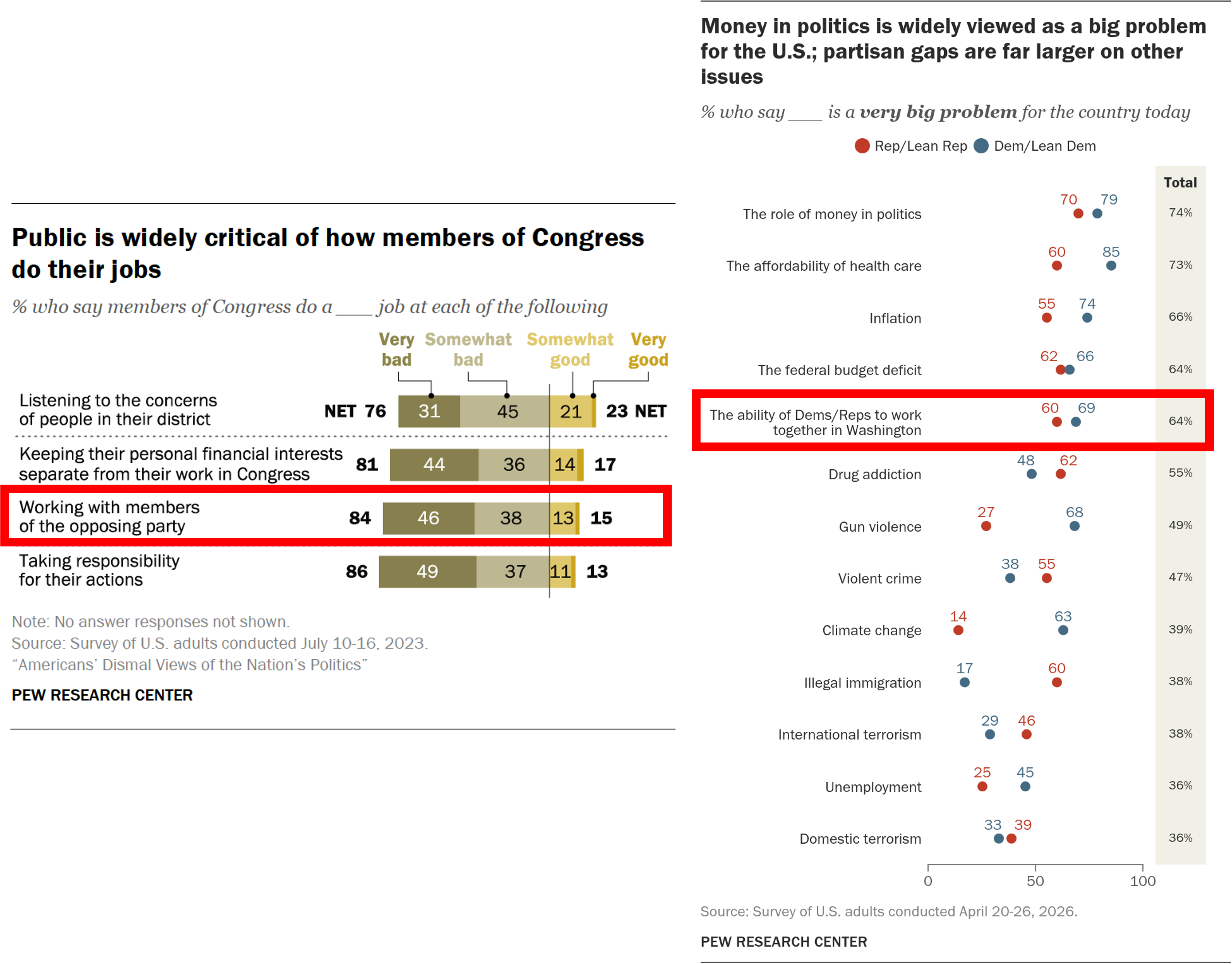
Americans have a long list of complaints about their representatives, ranging from their age to their personal finances, but one recurring gripe is that members of Congress don’t get enough done and don’t work enough across the aisle. A Pew Research poll from 2023 found that 84% of Americans believe lawmakers do a bad job “working with members of the opposing party.”
A Pew poll from May found that 64% of the country believe the “ability of Democrats and Republicans to work together in Washington” is a “very big problem for the country,” outranking drug addiction, violent crime, and unemployment on Americans’ list of concerns.
Ready for a hot take?
Americans are wrong. Members of Congress are working productively with members of the opposite party, just as the voters would want.
Nearly every day, lawmakers announce new bipartisan initiatives aimed at fixing major problems. In fact, so far this month — and keep in mind that September is all of nine days old — members of Congress have introduced bipartisan bills to expand the Child Tax Credit, cap the cost of insulin at $35 a month, prohibit most non-compete agreements, boost rural hospitals, prohibit the use of federal funds to install the controversial Flock cameras, ensure AI systems are used only in a supporting role in health care settings, strip pensions from members of Congress who are expelled, expand the Public Service Loan Forgiveness program, combat mosquito and tick-borne illnesses, strengthen efforts to eliminate tuberculosis, crack down on car insurance fraud, help veterans in job training programs, ban utility companies from selling Americans’ private data, increase federal funding for the suicide hotline, streamline the construction of new power lines, prevent key Education Department offices from being transferred out of the agency, and protect airline crews and passengers from toxic cabin air.
That list comprises efforts uniting Democrats and Republicans on health care, affordability, AI policy, privacy, veterans, education, and air travel — just in the last eight days!
Congress does not suffer from a lack of bipartisan cooperation among rank-and-file members. The problem is that when these members do work together, their party leaders often prevent those compromises from ever getting voted on.
Only about 4% of introduced bills receive a vote in the House or Senate, even though many more than that would likely receive supermajority support in both chambers — if only they were given the chance. As I’ve documented, fewer and fewer uncontroversial bills from one chamber are receiving consideration in the other. But the problem also extends to popular House bills going nowhere in the House, or popular Senate bills going nowhere in the Senate.
For decades now, party leaders have maintained a stranglehold on which measures reach the floor, often refusing to hold votes on measures that might distract from their partisan agendas, or would give a boost to an opposition party member — or would just require them to stay in Washington for more than a few days at a time — even if those bills would sail by with support from both sides of the aisle.
But the last few months have shown signs that the fever might be starting to break: rank-and-file lawmakers, tired of following orders and not getting much done, are increasingly trying to wrest back control from their leaders. Here’s how.
I. Discharge petitions
For more than 100 years, if House members have been frustrated by the Speaker’s failure to put a certain bill up for a vote, they have had a release valve, only to be used in the case of an emergency. The procedural tool known as the discharge petition allows rank-and-file members to go around the Speaker and force a vote on a piece of legislation, as long as 218 of them (a simple majority) sign on.
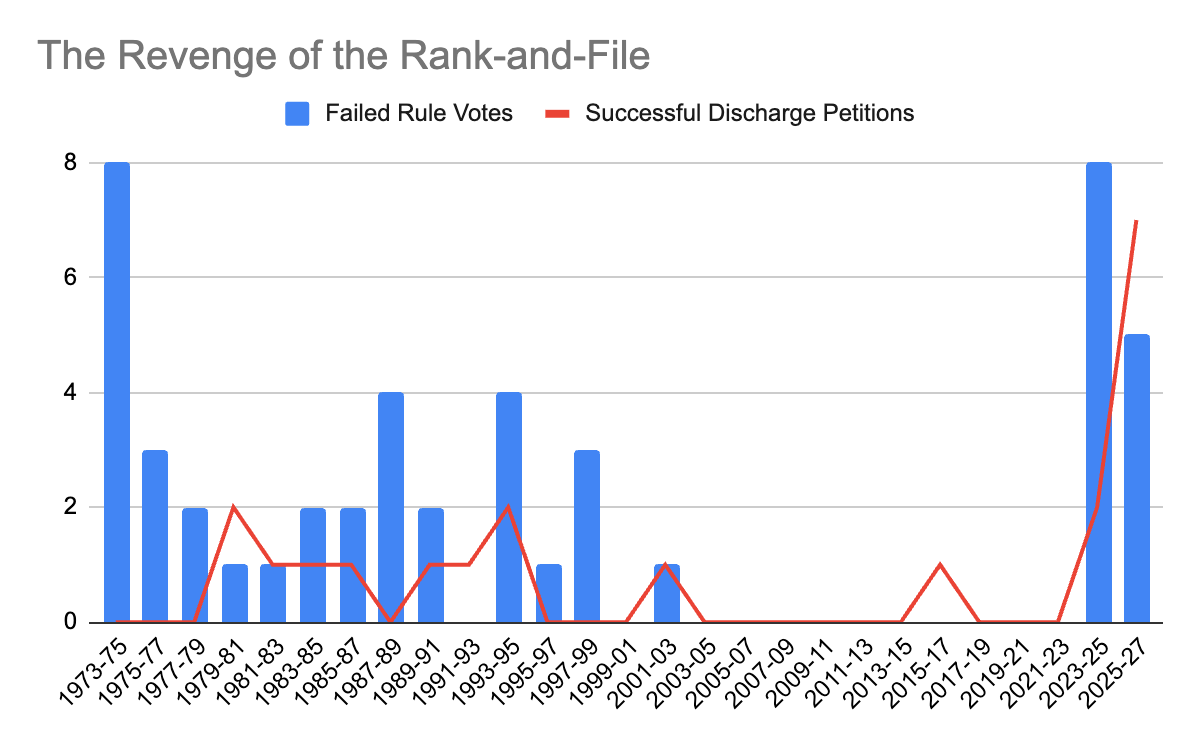
The last time I wrote about discharge petitions — and their history helping everything from the first minimum wage to the McCain-Feingold campaign finance legislation pass — I noted that three such petitions had notched 218 signatures this Congress, the most in 75 years.
Since then, that number has risen to seven, officially breaking the record for the most successful discharge petitions of any two-year Congress in history. (For context, only two discharge petitions reached the required threshold between 2000 and 2023.) The group of seven includes major bills to release the Epstein Files, undo a Trump executive order on federal unions, extend the enhanced Obamacare subsidies, reinstate temporary legal status for about 350,000 Haitian migrants, and boost aid for Ukraine while sanctioning Russia.
Now, discharge petitions for two more pieces of legislation — on expanding veterans benefits and creating a pathway to citizenship for “Dreamers” — are sitting at exactly 217 signatures, each one backer away from forcing yet another House vote unauthorized by leadership.
The veterans bill is particularly instructive for understanding the ways that congressional leaders subvert the will of majorities of the democratically elected members of Congress.
The measure, the Major Richard Star Act, is the most popular bill currently pending before the House or Senate. That’s no exaggeration: it has 338 co-sponsors in the House (203 Democrats and 135 Republicans), more than any other bill, and 80 co-sponsors in the Senate (44 Democrats and 36 Republicans), more than any bill except Lindsey Graham’s Russia sanctions measure, which has already passed the chamber.
It is named for Richard Star, an Army major and combat engineer who served deployments in both Iraq and Afghanistan. He was ultimately forced to medically retire from the military, after contracting stage 4 lung cancer due to toxic burn pit exposure during his deployments.
When veterans retire from the military, they receive retirement benefits from the Defense Department. When veterans become sick or injured in the course of their service, as Star was, they receive disability benefits from the Veterans Affairs Department.
These are separate benefits, serving separate purposes, but a veteran can currently only receive the full amounts of both if they served more than 20 years in the military. If they served less than that, the amount of their DOD retirement pay goes down one dollar for every dollar in VA disability pay they receive. So, for example, if a veteran would otherwise receive $2,000 from each benefit, the $2,000 in disability benefits would cancel out the $2,000 in retirement benefits, and leave the veteran with $2,000 a month (just the amount of the disability benefit) instead of $4,000.
Here’s the thing: Richard Star served nineteen and a half years in the military. He only retired then because he was medically required to: he had no choice. But because he didn’t serve for 20 years, Star — who died of cancer in 2021 — received only a fraction of the retirement pay he was otherwise entitled to.
The popular bill that bears his name would make it so veterans who are medically required to retire before 20 years because of combat-related disabilities receive both their full retirement benefits and their full disability benefits. This is known as addressing the “wounded veteran tax”; it’s an issue faced by about 55,000 veterans who were required to medically retire, who each lose out on an average of about $1,200 a month.
The measure is not without its detractors. According to the Congressional Budget Office, it would cost $78 billion over the next 10 years, which some lawmakers say would be fiscally irresponsible without offsetting the cost. My point today is not to advocate for or against the piece of legislation as a policy matter. But, as a matter of process, if 77% of the House and 80% of the Senate support the bill — whether they’re right or wrong — shouldn’t it at least receive a vote in the two chambers?
In fairness to House GOP leaders, the measure was included in a broader veterans package that was ultimately pulled from the floor in July after splitting veterans groups and Republican lawmakers. (The bill would have paid for the Major Richard Star Act and other expansions in benefits by reducing benefits for veterans with obstructive sleep apnea and tinnitus.) But with that package flailing, the Major Richard Star Act has yet to receive a standalone vote, despite its overwhelming backing.
Hence the discharge petition, which four House Republicans have now broken with Speaker Mike Johnson to support. Notably, the petition is missing the signature of one House Democrat, which would be enough for it to reach the 218-signature threshold.
“I appreciate and support the intent of the Major Richard Star Act, but I remain concerned that the legislation is not paid for with an appropriate offset,” House Armed Services Committee ranking member Adam Smith (D-WA), the lone Democratic holdout, told me in a statement. “Our country is facing a $2 trillion deficit; we can’t keep spending taxpayer dollars and cutting taxes, particularly for the richest Americans, without the risk of financial collapse. And we could easily find an offset for this bill with any number of tax increase options.”
Without Smith on board, the discharge petition’s supporters will need to find a fifth Republican backer. One obvious possibility would be the bill’s original sponsor, Rep. Gus Bilirakis (R-FL), though an aide to Bilirakis signaled to me that he does not plan to sign on.
“While the discharge petition would force a House vote on the legislation, we have been advised that, in its current form, the bill would face the same obstacle it has encountered in the past: as it does not have a viable path through the Senate without an offset,” a Bilirakis spokesperson said. “The Congressman’s goal has never been simply to secure another House vote — or to engage in empty political rhetoric. His goal is to finally get this long-overdue fix across the finish line and signed into law for our combat-injured veterans.”
The spokesperson added that Bilirakis believes the “strongest opportunity to advance the provision through both chambers” remains the broader GOP veterans package, which the congressman expects to receive a House vote “before the end of the year.”
And thus, unless the discharge petition receives one more signature, as long as leadership declines to schedule a vote, a bill with bipartisan, supermajority support is able to remain in purgatory.
II. Rule votes
What are the levers through which House leadership retains so much control over the floor schedule?
Barring a discharge petition, bills can generally only land on the House floor through approval of a “rule” (a procedural measure drafted by the House Rules Committee, which is traditionally dominated by handpicked allies of the Speaker) or by “suspension of the rules” (which is controlled by the Speaker and Majority Leader).
After a “rule” (which structures the terms of debate for a bill on the House floor) is approved by the Rules Committee, it has to be approved by the full House. In recent years, these rule votes have tended to be strictly partisan, with the majority party falling behind their leadership to vote “yea” and the minority party falling behind their leadership to vote “nay” (even if a majority party member opposes the bill in question, or a minority party member supports it).
Rank-and-file House Republicans have increasingly shown a willingness to break this trend, rejecting a total of 13 rules put forward by GOP leadership since Republicans retook the House in 2023, more than were rejected throughout the 1990s, 2000s, and 2010s combined.
Last week, a pair of back-bench House Democrats broke ranks as well, voting to save a rule that was about to fail due to GOP defections. The rule was poised to set up votes on measures denouncing socialism, expediting mining projects, restricting colleges that boycott Israel from receiving federal funding, and delaying regulations protecting the Atlantic large whale.
House Democratic leaders opposed all four measures. But Reps. Jared Golden (D-ME) and Marie Gluesenkamp Perez (D-WA), leaders of the moderate Blue Dog Coalition, supported all four. In fact, Golden had co-authored the whale bill with Rep. Mike Lawler (R-NY) and identified it as his top priority; the regulations in question were going to pose obstacles for the lobstermen in Golden’s district.
This means that Gluesenkamp Perez and Golden were faced with the same fundamental question as signatories of a discharge petition: they supported a bill that their party leaders didn’t want there to be a vote on. Should they blindly side with their party leadership, or with their own judgement on the legislation?
Gluesenkamp Perez and Golden chose the latter, as have Republican signatories of the seven — and, soon, possibly nine — successful discharge petitions, a sign of rising discontent among rank-and-file lawmakers and increasing unwillingness to simply go along with party leaders if it means quashing bipartisan legislative efforts that the member supports.
III. What now?
These acts of apostasy have led party leaders to start thinking about institutional reforms that might whip their members back in line.
On the right, House Rules Committee chair Virginia Foxx (R-NC) has called for contributions from the House GOP’s campaign arm to be revoked from any Republican member who signs a discharge petition. Other Republicans have talked about raising the threshold for the petitions.
On the left, Democrats erupted with anger towards Gluesenkamp Perez and Golden last week. House Minority Leader Hakeem Jeffries (D-NY) said, in a joint statement with his top deputies, that their vote to schedule a vote on bills that they support was a “significant breach of trust” that “necessitates a serious response.” Some Democrats said they should be stripped of their committee assignments.
That’s one direction for Congress to go: enforcing top-down rule and punishing members who break with leadership and follow their own instincts.
Or Congress can move in a more democratic direction, making it easier for bills to move through Congress if a majority of members support them, no matter what the small cartel of leaders would prefer.
Last week, the House Rules Committee held its biennial “Member Day hearing,” where members are invited to offer proposals for the next Congress’ rules package. Several members proposed ways for bipartisan, broadly supported bills to more easily be voted on, even without leadership’s sign-off.
Rep. Chrissy Houlahan (D-PA) proposed that legislation approved by committee with bipartisan support receive an expedited path to consideration on the House floor. “By allowing these non-controversial bipartisan measures before the House, more legislation will be reviewed, adopted, or rejected,” she said. “We will do more work together, and our constituents back home will benefit.”
Similarly, Rep. Hillary Scholten (D-MI) proposed that bills that receive supermajority support in the Senate should receive expedited consideration in the House.
The House has already created a pathway that should — in theory — bring broadly supported bills right to the floor. In 2019, the bipartisan Problem Solvers Caucus successfully pushed for the creation of a “Consensus Calendar,” through which bills co-sponsored by two-thirds of the House (290 members) are supposed to be ushered to the floor.
But the Consensus Calendar can be blocked in multiple ways: a bill is no longer eligible for guaranteed consideration under the calendar if a committee votes on it; in addition, House leaders can (and have) forced through “rules” that block Consensus Calendar bills from receiving a vote. Plus, 25 legislative days have to elapse between a bill reaching 290 co-sponsors and it ripening on the Consensus Calendar — and the calendar stops taking effect after September 30 on election years.
The Major Richard Star Act, for example, reached the necessary 290 cosponsors in the 117th Congress — but only did so in August 2022. By the time 25 legislative days had elapsed, it was late October; because it was an election year, that was too late for the Consensus Calendar. It didn’t receive a vote.
In the 118th Congress, the bill again returned to the Consensus Calendar, this time earlier in the year. But then the measure was acted on in committee, which meant a floor vote could no longer be forced. The measure is currently eligible for the Consensus Calendar in this Congress, but only the sponsor of the bill can place it there; so far, Rep. Bilirakis has not done so.
It is one of four bills currently languishing in House purgatory despite boasting 290+ co-sponsors; the other three are ineligible for Consensus Calendar action because committees have acted on them.
One of those, for example, is the Improving Seniors’ Timely Access to Care Act, which addresses some of the problems surrounding “prior authorization,” the (often lengthy) process by which insurance companies require doctors to get pre-approval before offering medical services to patients. (95% of doctors say prior authorization leads to delayed access to care, with 26% reporting that prior authorization had led to an adverse event for a patient.)
The Improving Seniors’ Timely Access to Care Act successfully received a vote through the Consensus Calendar in the 117th Congress. It passed by voice vote, but then died in the Senate. This year, the measure notched its 290th co-sponsor in June (it’s now up to 302), but the House Energy and Commerce Committee approved it (unanimously) in July, preventing the bill from receiving a full House vote through the Consensus Calendar.
The House could ease passage for bipartisan bills simply by reforming the Consensus Calendar, making it so that these supermajority-backed bills are still guaranteed a floor vote even if committees act on them, and even if it’s the fall of an election year. The rules could also be changed so that any member, not just the sponsor, can place the bill on the calendar.
Frankly, the threshold for the calendar could also be reduced, potentially even to 218 co-sponsors, creating something more akin to an automatic discharge petition that embraces this principle: if a majority of democratically elected House members have signed onto a piece of legislation, it should receive a vote.
This would hardly overwhelm the House with new bills they’d have to vote on — and, even if it did, that problem could be alleviated by spending a bit more time in Washington — and it would create a pathway towards a more democratized Congress. These bills would not be granted automatic passage. But if a majority of members support something, it would at least guarantee that idea an up-or-down vote.
Considering how many supermajority-backed bills return year after year with overwhelming support, it also wouldn’t be a bad idea to allow bills that have previously passed by a supermajority to receive expedited consideration, so these measures can be more quickly sent over to the Senate, allowing the bicameral negotiating process to be jumpstarted without waiting for the House to pass a bill it already approved overwhelmingly two years before.
Contrary to popular belief, members of Congress are working together across party lines, coming up with bipartisan solutions to the nation’s problems. But a select few party leaders prevent these measures from ever seeing the light of day. Members on both sides of the aisle are already tiring of this status quo, beginning to rise up against their leaders through discharge petitions and rule votes. Additional structural reforms would help these majorities work their will on behalf of the American people.
This article seems to shift blame for our lazy congress to the leaders who won't let anything pass. I get the notion, but in truth, the rank and file ELECT their leaders and could oust them at any time. I'm not ready to give the rank-and-file a pass when they still very much hold the power to undo the knots that keep their hands tied.
Interesting article. I have two questions that you might answer: What is the political incentive for leadership to kill widely popular bills? If there is a supermajority, their party can just as easily (if not more so) take credit for this popular initiative. Some examples of why Mike Johnson is holding up these bills would be helpful to understand his motivation, and by extension, what we might expect from Jeffries, should he become Speaker.
The second question is more of a request - can you provide a similar analysis of what prevents the Senate from moving legislation, other than the filibuster? What levers does Thune have to prevent popular, uncontroversial legislation from receiving a vote in his chamber?