


Trey Carlock grew up in Dallas, Texas, and went to a summer camp called Kanakuk Kamps every year in Branson, Missouri.
It was later revealed that Carlock was among dozens of underage boys who were being sexually abused by the camp’s longtime director, Peter Newman. As a young adult, Carlock eventually sued Kanakuk for allowing Newman’s abuse to take place. The two sides reached a settlement, which included Carlock signing a nondisclosure agreement (NDA) preventing him from speaking out about what he experienced.
Carlock struggled with having to stay silent, describing the settlement as “blood money” and hesitating to tell even his family the details of what he went through. In 2019, Carlock died by suicide at the age of 28. “They will always control me, and I’ll never be free,” he had told his therapist.
Carlock’s ordeal has become a catalyst for legislative change, with his family advocating for a bill known as Trey’s Law, which would prohibit the signing of NDAs in cases of child sexual abuse. It would also retroactively make any current such NDAs null and void. The measure aims to shield other child sexual abuse victims from the mental anguish that Carlock’s NDA caused him — and to help bring perpetrators of sexual abuse to justice before they can harm other children. Other campers had similarly reached settlements with Kanakuk Kamps, but no one knew about the extent of Newman’s actions because each victim had signed NDAs pledging them to secrecy.
Due to advocacy by Carlock’s family, versions of Trey’s Law have been passed on the state level in Missouri, Texas, Alabama, Georgia, Louisiana, and Tennessee. (A similar law already existed in California.) Sen. Ted Cruz (R-TX) introduced a federal version in March of this year, with bipartisan co-sponsors including Sen. Kirsten Gillibrand (D-NY). The bill was passed unanimously by the Senate Judiciary Committee in May. Six days later, it was passed unanimously by the full Senate.
The measure has not yet received a vote in the House — not because of any disagreements with the merits of the bill, but because, Cruz says, of a blockade in the House being enforced against any pieces of legislation that arrive from the Senate.
“House leadership has decided to adopt a strategy that is, frankly, indefensible,” Cruz said on the Senate floor last week, calling on the lower chamber to take up Trey’s Law. “It is a strategy where they pass bills that originate in the House; they ignore bills that originate in the Senate, and they let them die.”
A Wake Up To Politics analysis confirmed a stark drop-off in the number of Senate-passed bills that have been approved in the House this Congress, especially compared to previous Congresses where both chambers were controlled by the same party.
Between January 2009 and August 2010 — the equivalent portion of Barack Obama’s presidency — 51% of Senate-passed bills were approved by the House. In the same stretch of Donald Trump’s first term, 40% of Senate-passed bills were approved by the House. Between January 2021 and August 2022, the opening of Joe Biden’s administration, the House greenlit 45% of bills that passed the Senate.
So far this Congress, a mere 36 bills passed by the Republican-led Senate have been approved by the Republican-led House. That is a rate of 21%, the lowest this century. It is just below the percentage of Senate-passed bills that were approved by the House between January 2023 and August 2024, when Democrats controlled the Senate and Republicans controlled the House.1
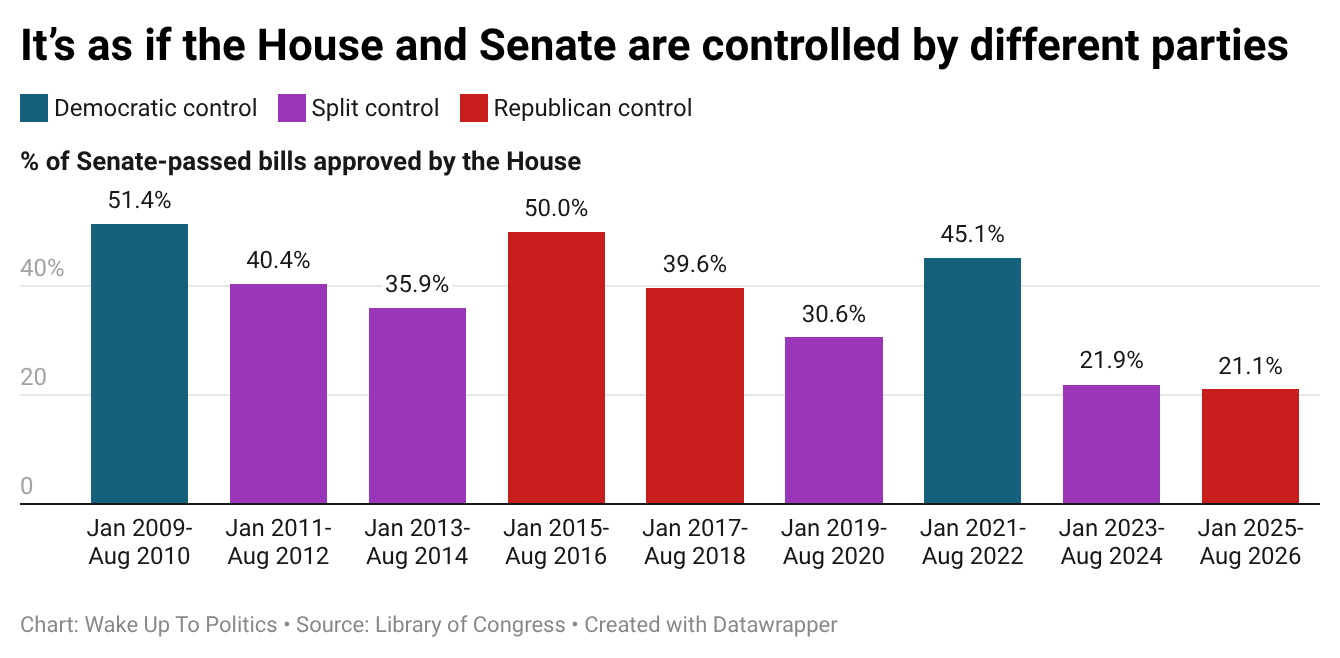
That’s right: House and Senate Republicans are currently on such different pages that it’s as if Congress isn’t being controlled by the same party at all.
Like nearly everything else on Capitol Hill these days, the bicameral tensions seem to come back to the SAVE America Act, President Trump’s top-priority legislation, which would require Americans to provide proof of citizenship before registering to vote and to provide photo ID before casting a ballot. (Trump has also called for the bill to be expanded to end mail-in ballots, prohibit transgender women from participating in women and girl’s sports, and ban gender reassignment surgeries for minors.)
Trump has called on the Senate to end the filibuster, which requires most pieces of legislation to have 60 votes to advance, a level of support that the SAVE America Act currently lacks. Senate Republicans have, so far, refused to do so.
In March, a group of 25 House Republicans penned a letter to Senate Majority Leader John Thune (R-SD) threatening to oppose any Senate-passed bills that came to the House until the Senate approved the House-passed SAVE America Act. “Consider this our filibuster,” they wrote.
Since then, these conservative members have repeatedly shut down the House floor to protest the Senate’s failure to approve the SAVE America Act.
As Trump’s anger towards Thune has risen — “His patience is running out,” White House press secretary Karoline Leavitt recently said — his allies in the House have doubled down.
“Aside from Reconciliation and a fixed version of the NDAA, the Senate will not get any legislation passed in the House because there are Members of Congress in the House that will vote against anything they send over based on the fact that they are refusing to pass the SAVE America Act and Voter ID,” Rep. Anna Paulina Luna (R-FL) wrote on X last week. “No Senate bills until SAVE AMERICA is passed,” she wrote again two days later.
Hanging in the balance are bills like Trey’s Law. “Every day of delay is another day victims of child sexual abuse and trafficking can be legally silenced in America’s civil courts,” Elizabeth Phillips, Trey Carlock’s sister, told me in a statement.
There are other pieces of legislation recently passed by the Senate that are likely to similarly languish in the House:
The Older Americans Act Reauthorization Act, which extends and expands programs to help senior citizens, including Meals on Wheels, the national eldercare locator service, and programs to prevent elder abuse, neglect, and exploitation.
The Tribal Warrant Fairness Act, which would allow the U.S. Marshals Service to help tribal law enforcement track down violent criminals and search for missing children at a tribe’s request, assistance that the Marshals are currently authorized to provide to other law enforcement agencies but not to Native American tribes, despite the high rates of violence many tribes face.
The Officer John Barnes and Chief Michael Ansbro Public Safety Officers’ Benefits Program Expansion Act, which would speed up the process of awarding benefits given to law enforcement officers disabled in the line of duty, or to the families of officers killed in the line of duty. The measure is named for an officer who had to wait for several years to receive his benefits, and another who is still waiting, eight years later.
The Affordable Prescriptions for Patients Act, which would prevent the ability of pharmaceutical companies to set up “patent thickets,” the practice of obtaining several overlapping patents around a single drug, making it impossible for competitors to bring lower-cost generic or biosimilar versions to market.
The Rural Community Hospital Demonstration Program Reauthorization, which would extend a program tinkering with the Medicare reimbursement formula for rural hospitals, in an attempt to keep more of these remote hospitals with fewer than 51 beds afloat.
All of these bills passed the Senate unanimously. None of them are the type of measures that frequently receive national media attention. But, if they became law, they would make a meaningful difference for older Americans who are hungry, or missing Native American children, or police officers hurt in the line of duty, or people who rely on prescription drugs, or patients at rural hospitals — or children who have been sexually abused. Each bill now faces a difficult path in the House, where about 80% of Senate-passed bills are being stalled, seemingly due to partisan anger about an unrelated issue.
This phenomenon does not run in only one direction.
In fact, even fewer House-passed bills are being approved in the Senate than Senate-passed bills being approved in the House: just 7%, according to my analysis.
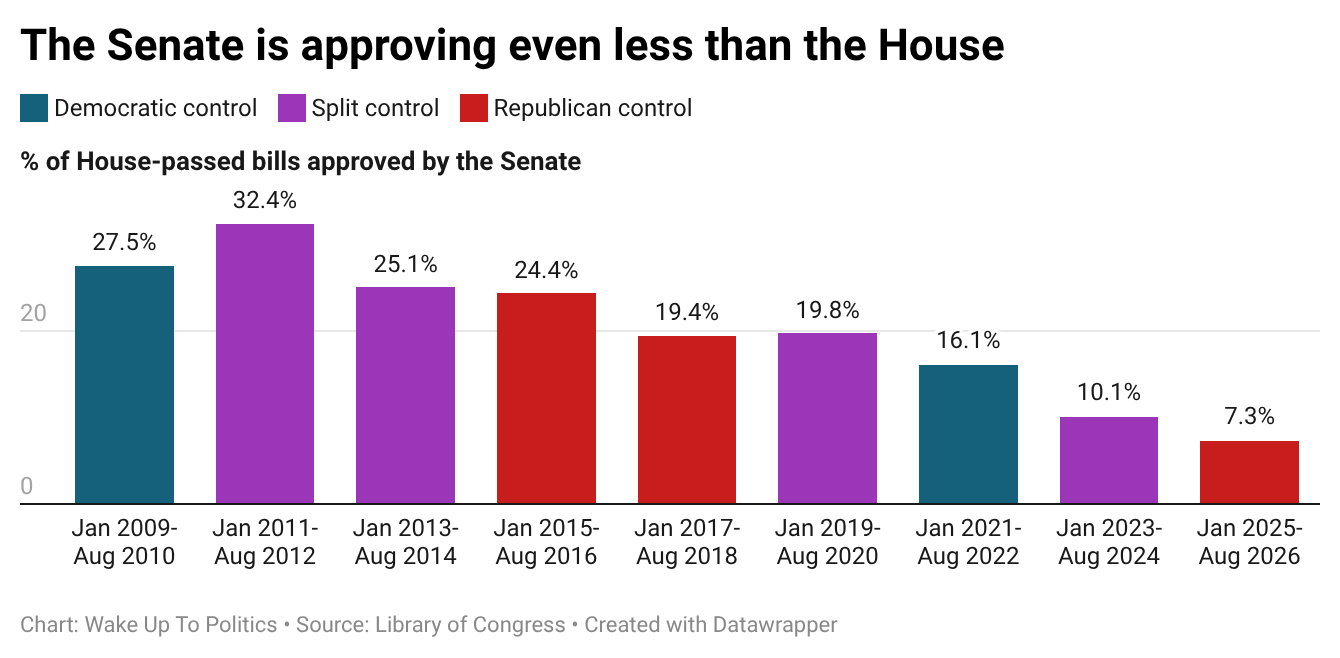
This stands out less because the House and Senate trends are very different: while the House, which tends to reflect the partisan balance of a given moment, generally approves more Senate-passed bills in periods of united control (like we are in now), the Senate has been approving fewer and fewer House-passed bills for more than a decade now, as partisan polarization and the increased use of the filibuster have combined to focus the upper chamber’s time on confirmations instead of legislation.
Still, it is hardly the case that the House is the only chamber that has effectively stopped considering bills — even broadly supported ones — from their colleagues on the other side of the Capitol.
In fact, Cruz has now launched a blockade of his own, rising on the Senate floor last week to block two House-passed bills from receiving unanimous consent: the Stop Secret Spending Act (which would increase transparency requirements for federal spending) and the Improving Social Security’s Service to Victims of Identity Theft Act (which would simplify the currently lengthy process for people to get help when their Social Security numbers are stolen).
Cruz said that he had no policy objections to either measure. Rather, he announced plans to block any House-passed bills from receiving unanimous consent in the Senate until the House started taking up Senate-passed bills like Trey’s Law. “If you want to change the behavior of another chamber, the only way to do so is to exercise leverage,” Cruz said.
Later in the week, just before the Senate left for its summer recess, Cruz dropped his hold on the Stop Secret Spending Act, though his spokesperson told me that a broader breakthrough has yet to be reached.
In essence, the two sides of the Capitol have stopped functioning as a bicameral legislature, prioritizing petty feuds over substantive bills being passed by the other chamber. It is now incredibly rare for the House to pass a Senate bill, and even rarer for the Senate to pass a House bill, despite the fact that both chambers are led by the same party. The president of that party, however, does little to hide the fact that he has essentially no legislative agenda (besides the SAVE America Act, of course), which has allowed Congress to atrophy and spend more time squabbling than legislating.
When initially blocking the House-passed Stop Secret Spending Act, Cruz noted that the Senate had already unanimously passed the legislation before the House passed an identical version of the same bill to send over to the upper chamber. “Now, mind you, that was not because they had any substantive objections to [the Senate version], but, rather, it was because they were refusing to do their job as another chamber in this Congress,” Cruz said.
“I would love to see my name at the top of the bill and it listed as a Senate bill,” Sen. Joni Ernst (R-IA), the measure’s Senate sponsor, responded. “I discussed it with my staff. I am in the last 6 months of my final term in the U.S. Senate. I would love to have more of my legacy items with my name on them, but I told my staff that it is more important that we get these bills done. I don’t care if it is a House bill. I don’t care if this has my name all over it. The important thing is that when we have good pieces of legislation put in front of us and that we worked hard in a bipartisan manner, in a bicameral manner, and it is good for the American people, that we move forward with those bills.” (This argument must have eventually won Cruz over, since he later dropped his hold.)
However, the Senate has been doing the same thing, passing bills identical to measures that were already passed by the House — but using different legislative vehicles, so the bill has to be voted on again by the other chamber to become law, even though the two chambers have already both backed the underlying legislative language. Recent examples include the Youth Poisoning Protection Act (which would ban the sale of a product frequently used to help young people die by suicide) and the DeOndra Dixon INCLUDE Project Act (which boosts funding for Down Syndrome research).
There is really no reason to do this except for credit-taking. It certainly does not help suicidal youth or people with Down Syndrome, for whom identical versions of these bills have now passed both the House and Senate — but cannot be sent to the president’s desk, because lawmakers cannot agree whether the law should say “S. ___” (the designation for a Senate bill) or “H.R. ___” (the designation in the House) at the top.
To be clear: it is not new for tensions to emerge between a House and Senate controlled by the same party. In fact, it happens basically every time, usually for the same reasons: the boisterous House being upset that the lumbering Senate is not moving fast enough to enact their party’s agenda. We saw this with Republicans during the “Contract with America” in the 1990s and with Democrats in the Obama era.
If you really want to see petty, read about the so-called “Battle of the Octogenarians,” when the government nearly ran out of funding in the 1960s because a pair of Democratic House and Senate committee chairs couldn’t agree on things like which side of the Capitol to meet in. The classic line here is about a freshman House Democrat around this time who referred to the other party as “the enemy.” No, a more senior colleague supposedly told him: “House Republicans aren’t the enemy. They’re the opposition. The enemy is the Senate.”
But Trump, as is often the case, has ratcheted tensions to a high, needling his own party’s Senate Majority Leader and egging on House conservatives to block Senate bills as a result. Musing recently about the Democratic Socialists of America’s (DSA) platform, there was one particular plank Trump didn’t sound so averse to. “Sometimes, I’d like to get rid of the Senate too,” he said.
At a time when Americans frequently complain about Congress’ inability to get anything done across party lines, understanding the House-Senate cold war can help provide a glimpse into what is actually going on in Washington.
So far this Congress, the House and Senate have actually passed the same or a higher number of bills originating in their own chamber (655 and 171, respectively) as previous Congresses up to this point. But fewer bills have become law — only 102, compared to 168 at the same point in the Biden presidency — because there has been such a breakdown in each chambers approving bills from the other.
This means the issue is not Democrats and Republicans working together, which they are doing at perfectly normal rates, on issues from child sexual abuse victims to prescription drug prices. Rather than earlier in the process, it is at the last, final step (unfortunately, the very one required for a bill to become a law) that the system isn’t working — bills going from one side of the Capitol to another — largely because of petty squabbles within a party, rather than partisan beef between them.
These figures include all bills passed between January 3 of the year a new Congress started and July 31 of the next year.
A valuable piece. I should think it might have been additionally informative and helpful to highlight more specifically that which of the GOP in the House are presumably responsible for this (in addition to the Speaker). Who are the 25 and are there others? Maybe I missed that in reading the piece too quickly.
But what actually allows a small percentage of the House from holding these popular bills hostage? Is it a procedural tool or is Johnson just worried about his position if he brings them to the floor? Can a discharge position be used?