


President Trump is set to give the nation an update on the Iran war at 9 p.m. Eastern Time tonight.
There are two ways this could go. In his most recent public comments, Trump has been signaling that the war may soon be wrapping up: “It’s coming to an end,” he told NBC News in an interview yesterday. The U.S. and Iran have been engaged in peace negotiations, though we don’t have much insight into how they’ve been going. If the war ends, will the Strait of Hormuz reopen? Trump has suggested that he may be fine with ending the military operation even if the strait stays closed. He wrote on Truth Social that, essentially, other countries will have to handle it: “You’ll have to start learning how to fight for yourself,” he said. “The U.S.A. won’t be there to help you anymore, just like you weren’t there for us.”
Trump being Trump, it is also possible, of course, that he will announce the exact opposite: that the war is expanding. According to the Washington Post, the Pentagon has been drawing up plans for a potential weeks-long ground invasion.
In other news, the Supreme Court is set to hear oral arguments this morning on Trump’s executive order on birthright citizenship. I’ll be there. Trump says he’ll be there, too. I’ll have more for you later this week on that fascinating staredown, and on the president’s address.
I’m going to wait for the speech to make any conclusions about where the war stands militarily. But in the meantime, we can say what it’s meant domestically: the last month of war has been absolutely toxic for Trump’s political fortunes.
This morning, let’s dive into four data points I’m watching, all of which tell a scary story for the GOP:
1. The Iran war is deeply unpopular
As was widely noted when the war in Iran started, however unpopular foreign military interventions often become, they usually start out with majority support. This one didn’t.
As the Iran war continued over the last month, it only became less popular. Below, I’ve charted the percentage of Americans who said they approved of the initial U.S. attacks on Iran when asked by YouGov on March 2 vs. those who said they approved of the war in a YouGov poll conducted from March 27-30.
The military operation started out with 37% support. It has since plunged to 28%. As you can see below, this is due to decreases among every political group. What little support the war initially had among Democrats has basically evaporated, and the roughly one-fourth of Independents who first backed the war has shrunk to roughly one-fifth. And most notably: there has been a 14-point decline in support among Republicans.
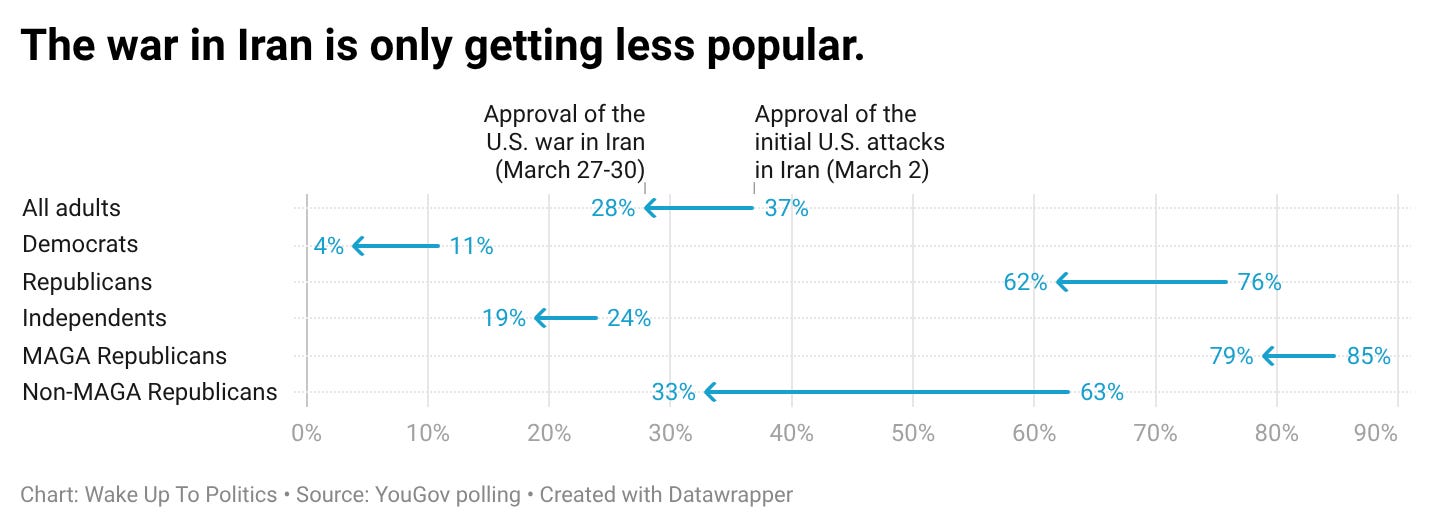
There is still mostly no MAGA split on Iran, although MAGA support did drop from 85% to 79%, a small but noticeable change. Instead, most of the GOP movement comes from an absolute collapse in support from non-MAGA Republicans: 63% of this group backed the war at the beginning of March; only 33% backed the war by the month’s end.
(For those wondering, there has been a decline in the percentage of Republicans who identify as “MAGA Republicans” over the last month. In the March 2 poll, 66% of Republicans said they were a MAGA supporter; 21% said they weren’t. In the March 27-30 poll, 54% of Republicans said they were a MAGA supporter; 29% said they weren’t. I will note, though, that the March 2 number was basically the high watermark of Republicans identifying as MAGA Republicans in YouGov’s polling. The current 54% number is much closer to where the number was for most of 2025. Still, it’s notable that the MAGA number went up in January and February before dropping in March, and it’s a trend worth paying attention to.)
But let’s go back to that topline number for a second: Trump is waging a war with only 28% of the American public behind him. By comparison, 70% of Americans backed the war in Iraq one month in. For a president to be fighting a war, this early in, that only about one-quarter of the country supports is basically unprecedented.
2. Gas prices continue to rise
Historically, Americans don’t pay much attention to foreign policy. One stat I’ve been curious about is whether the ongoing war in Iran would make voters tune in more closely to foreign affairs. So far, it seems like the answer is “a little, but not much.”
According to polling by Strength In Numbers/Verasight, before the war, 2% of Americans said foreign policy was the issue they cared most about. After the war, that number ticked up to 5%: a little bit higher, but still a really small segment of Americans.
From those numbers, we can glean that the simple fact of the war — just by itself — might not have much of a political impact, since American voters continue not to care much about foreign policy. In other words, if the U.S. began attacking Iran but it didn’t lead to many or any reverberations inside the U.S. (sort of like the capture of Nicolás Maduro in Venezuela), you wouldn’t expect it to help President Trump politically (because the war is unpopular), but you also wouldn’t expect it to hurt. Americans may not love the idea of foreign military intervention, but that isn’t a philosophical stance that is so closely held or so important to them that you’d brace for a political impact. (Indeed, the Venezuela operation was unpopular, but didn’t really seem to affect Trump’s approval rating.)
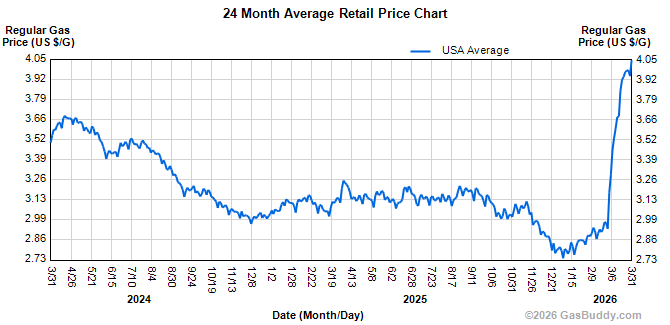
However, the war in Iran has had an impact on Americans’ lived experiences in a way the operation in Venezuela didn’t: it has led to the closure of the Strait of Hormuz, which has caused the global oil supply to plummet, which has caused global oil prices to rise, which has caused gas prices here in the U.S. to increase accordingly.
Per AAA, average U.S. gas prices crossed the $4/gallon threshold on Tuesday for the first time since August 2022. The below chart of gas prices is from the website GasBuddy; it is not hard to tell when the war in Iran began:
1 + 2 = 3. Trump’s approval rating is cratering
Unlike foreign policy, rising prices is an issue that matters to a lot of voters, so it’s no surprise that an unpopular war that has also had a negative economic impact would create a political crisis for a president. 1 + 2 = 3.
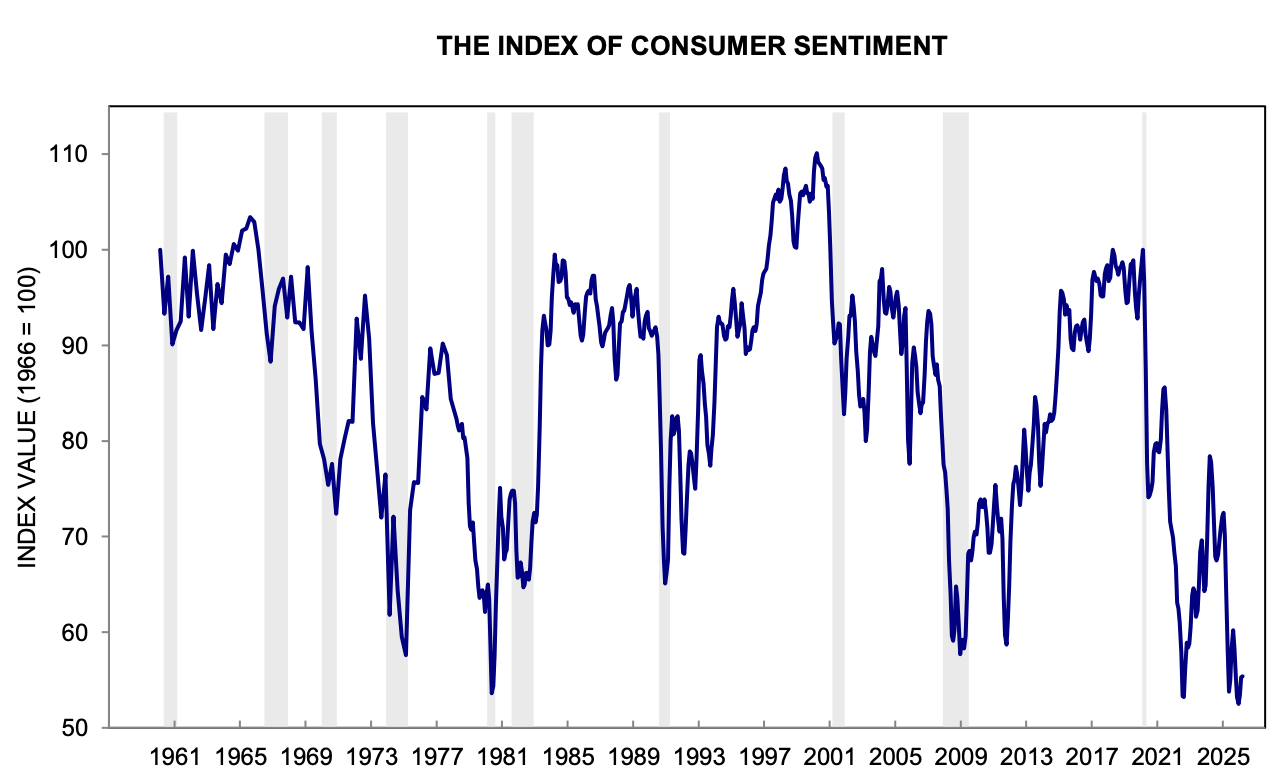
Opinions on the economy — Americans’ No. 1 political issue — were already low. The war in Iran has only made them worse. Below, you can see the results of the University of Michigan’s long-running consumer sentiment survey. Americans currently feel about as badly about the economy as they did during the post-Covid inflation spike, and even worse than they did during the 2008 recession.
Trump’s approval rating has gone down with it. In the last week, several pollsters, including Reuters and YouGov, have recorded lower approval ratings for Trump than they have at any other point in his second term. Some of these polls showed his support dipping into the mid-30s.
Here at Wake Up To Politics, we believe it’s always best to use polling averages, in order to sweep in as many data points from as many different pollsters as possible. This week, Trump’s average approval rating in Nate Silver’s tracker dipped below 40% for the first time in his second term:
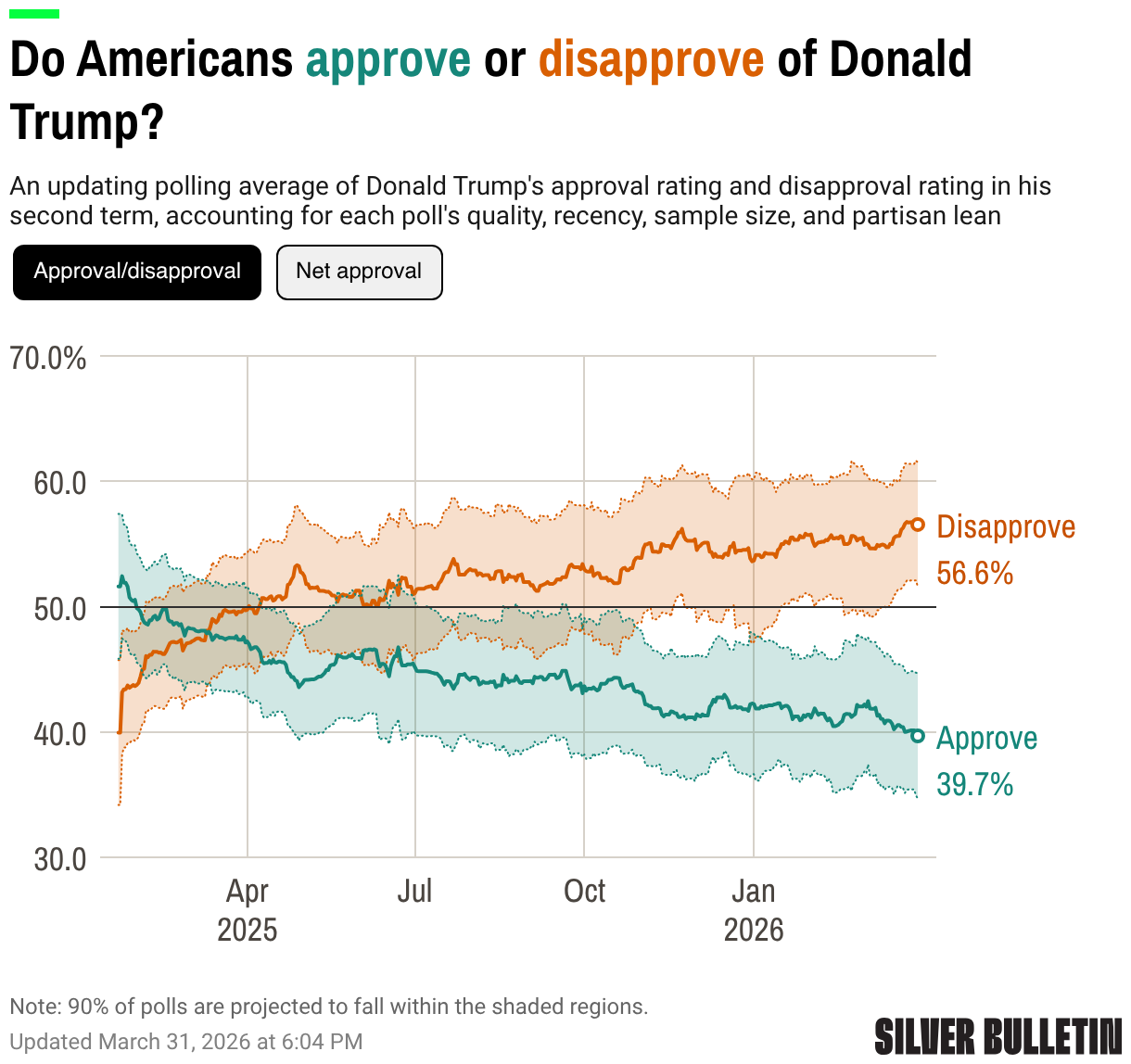
March really did a number on Trump’s approval rating: Trump started the month with an average net approval rating of about -12%, which is basically where he had hovered since December. He ended March with an average net approval rating of about -17%, a five-point drop in four weeks. (Trump’s net approval rating = his approval rating minus his disapproval rating.)
Trump is far from the first president to see his approval rating dip under 40%, but it’s not the best club to be in: Harry Truman during the post-World War II inflation spike and again during the Korean War, LBJ during Vietnam, Nixon during Watergate, Ford after the Nixon pardon, Carter during the Iran hostage crisis and stagflation, Bill Clinton during Hillarycare, George H.W. Bush during a recession, George W. Bush during Iraq and the Great Recession, Trump himself during the Mueller probe and after January 6th, and Joe Biden after the Afghanistan pullout, then again as inflation spiked, and again after his disastrous debate. (You’ll notice a fair amount of foreign wars on this list: we often think of military conflicts as causing a “rally around the flag,” but over the long run, wars usually cause the opposite for a president’s approval rating.)
Trump’s average approval rating — 39.7% — is now exactly where it was on the last day of his first term, meaning Trump is as popular now as he was in the wake of January 6th.
Of particular political importance: Trump’s average approval rating among Independents is now down to 28%, per the Cook Political Report. 66% of Independents disapprove of his presidency, a stunning 38-point gap. (Per CNN’s Harry Enten, no president on record has been as unpopular among Independents at this point in their second term, not even a soon-to-resign Richard Nixon.)
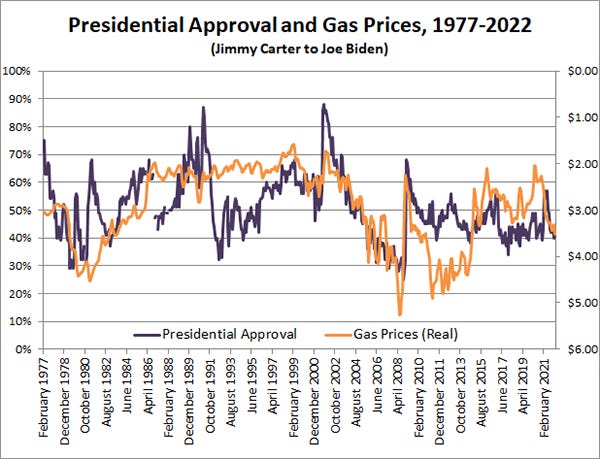
Should we be surprised that a spike in gas prices has sent Trump’s to their lowest level this term? Not at all. As this 2022 chart from Sabato’s Crystal Ball shows, presidential approval ratings and gas prices are highly correlated. This is just one more example of that trend.
Trump’s approval rating on the economy — arguably the issue that got him elected — is even worse than his overall approval: 36.8% approve, 59.3% disapprove, per Nate Silver’s average. Almost 60% of Americans disapproving of the president’s handling of the economy is an obvious political danger zone in an election year.
His approval rating on other matters isn’t much better. In YouGov’s latest poll, I noticed that only 28% of Americans approve of Trump’s White House renovations. On this, there actually is something of a MAGA split: only 69% of self-identified MAGA supporters approve. I don’t think this is an issue costing Trump votes or anything, but it is very rare to see such a low level of support from Trump’s base on anything Trump is doing.
Naturally, then, Trump posted twice about the White House ballroom yesterday, plus three separate posts with photos of the plans. (Construction was blocked by a judge yesterday.) Possibly the least helpful messaging from the president you could imagine if you’re a Republican seeking re-election in a competitive district.
1 + 2 + 3 = 4. Democrats are expanding their generic ballot lead
All of these data points add up to a four-alarm fire for Republicans ahead of the midterms.
One trend that was giving some Republicans hope for much of the last year was that, even as Trump’s approval rating dropped, Democrats weren’t gaining much of an edge in the generic ballot. (“Generic ballot” questions ask poll respondents whether they plan to support a Democrat or Republican the next time they cast a ballot for Congress.)
Back in April 2017, during Trump’s first term, Democrats boasted about a six-point edge on the generic ballot, per RealClearPolitics. By April 2025, Trump was back in office once again, but now Democrats had only about a 1-point edge on the generic ballot. This gap between 2017 and 2025 was a source of concern for many Democrats.
Well, it’s now April 2026, and that gap has disappeared. According to RealClearPolitics, the average generic ballot now shows Democrats with a six-point advantage, much closer to where you would expect based on the president’s poll numbers. Not only is Trump’s approval rating dropping, but it is taking the Republican Party’s midterm prospects with it.
We are also seeing Democratic gains on another question: party identification.
As you can see in the chart below — which uses quarterly party ID data from Gallup — the general trend for the last three decades has been that more people identified as Democrats than Republicans. This underwent a sharp change during the Biden era, when Republicans took their first lead in party identification since the 1990s.
Gallup released its data for the first quarter of 2026 this week, and the Biden-era change has now reversed itself: Democrats are back to claiming an advantage on the party identification question.
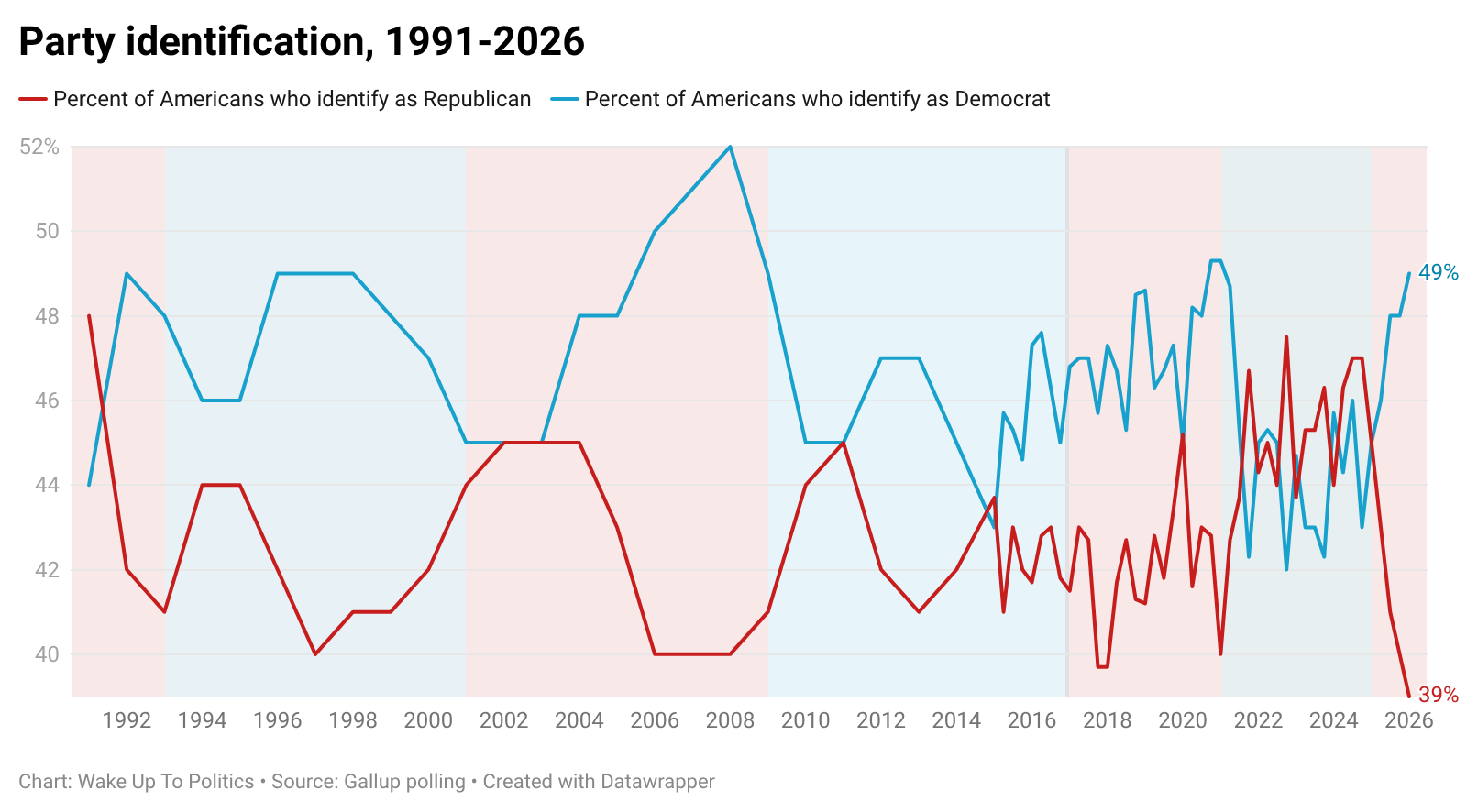
Not only that, but the percentage of Americans identifying as Republicans (39%) is lower than Gallup has recorded at any point in the last 35 years. The Democrats’ 10-point advantage on this question is the largest that it’s been since 2006, when the party flipped 31 House seats and five Senate seats.
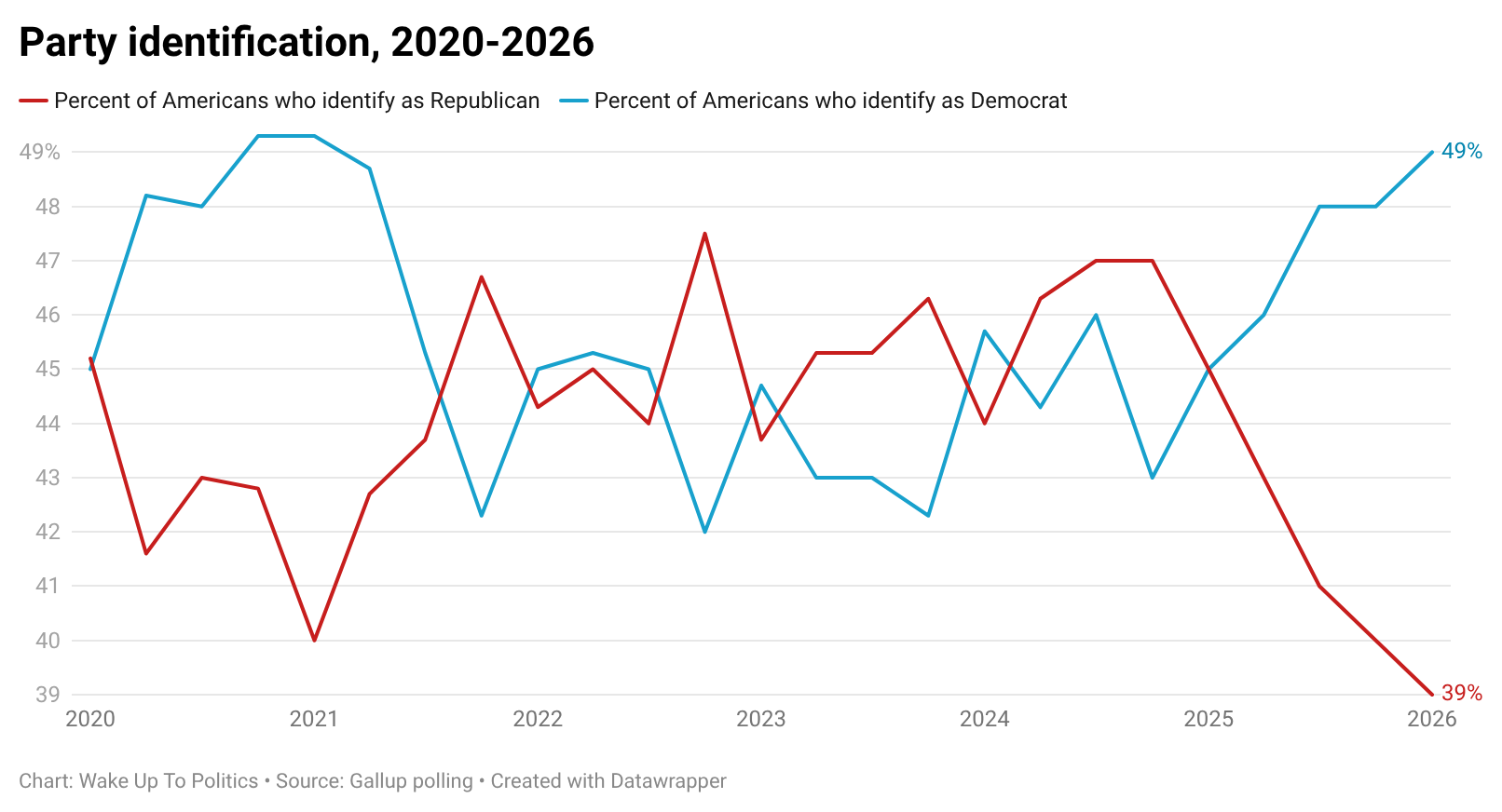
If you zoom in on the above chart, you can really get an appreciation of Republican Party identification has collapsed during Trump’s second term, going from 47% in the last quarter of 2024 to 39% today.
Another ugly trend for the GOP. If it and the others hold, expect to see more congressional Republicans retiring, more House seats sliding into tossup territory, and Democrats starting to daydream about flipping Senate seats in Alaska and Iowa that could catapult them into the majority.
What happens if the war ends tonight?
It’s possible that Trump’s approval rating could recover somewhat. His numbers saw a similarly sharp drop after the “Liberation Day” tariffs, and then bounced back (though only to their previous, subpar level). We also saw Trump’s approval rating decline during last year’s government shutdown; they partially recovered, but never fully made up that ground.
No matter what happens next, this last month has been a political disaster for the president, and one that was entirely self-made. Even if gas prices get back to normal by Election Day, Trump has handed Democrats the gift of two periods in his first two years where Americans thought he was hurting, not helping, the economy — “Liberation Day” and the Iran war — despite his 2024 promise to lower prices. If either one fades from the national memory, there will surely be plenty of Democratic advertising in the next seven months to remind voters. (Of course, if the war continues, voters won’t need reminding. Of particular danger to the GOP could be the legislative package to fund the war that would then become necessary. Per Axios, Republicans are considering offsetting the cost of the war by cutting health care spending, thereby mixing one unpopular policy with another.)
Trump could have spent the last month shoring up his political position, traveling the country in a bid to tell a feel-good story about the economy. Instead, he launched a war that has helped worsen it, and barely tried to sell it, leaving voters with the exact opposite impression. These sorts of impressions can often be hard for presidents to reverse — Joe Biden’s image never recovered after the pullout from Afghanistan — though outside events can sometimes lend a helping hand (for Biden, it was the Supreme Court’s decision on abortion).
The Republican Party’s political prospects were already shaky enough when the Iran war began. For the GOP, the month of March was nothing but one long setback.
A little humor today.
We have a new definition of March Madness!
Hi, Gabe. I'm interested to know if you see signs that Trump is trying to intimidate the Supreme Court justices by his presence in the room.