


There is a typical model for what losing a primary looks like in modern American politics.
During the primary, two (or more) candidates bitterly spar over the direction of their party and who should be its standard-bearer. Then, the voters pick one of them, and everyone else is supposed to put on a brave face, show up at a unity breakfast or two, endorse the nominee, and campaign for them in the general election.
It can be awkward at times — think of Ted Kennedy and Jimmy Carter’s uncomfortable handshake at the 1980 Democratic convention — but it’s just how things are done. Or, at least, it’s how things were done.
Several primary losers this year have been challenging this classic political ritual.
On the Republican side, John Cornyn has said he’ll vote for Ken Paxton (who beat him in this year’s Texas Senate GOP primary), but the two have not campaigned together, despite Paxton reportedly wanting his support. Instead, when Cornyn and George W. Bush co-hosted a fundraiser for Senate Republican candidates last month, the GOP nominee in their shared home state was pointedly left off the list.
Rep. Ralph Norman, who was beaten by Darline Graham in the South Carolina Senate Republican contest, has been even less shy about his feelings towards his onetime rival, who was appointed to the seat after it was vacated by her brother’s death. Here’s what Norman texted a CNN reporter yesterday:
The voters in South Carolina are not buying the argument that everyone has to “settle” for a candidate that has been propped up by special interest groups and a Republican president spending millions of dollars spreading false narratives about why Darline Graham is qualified to be elected to the U.S. Senate for the next six years!!
This election is about attempts to “force” a candidate on the voters of S.C. And regardless of the outcome, it didn’t have to be this way as the great people living in South Carolina deserve “better!” Bottom line!! Elections have consequences!!
Not exactly what you normally hear during the final weeks of the general election, when primary losers tend to unify behind the primary winners and shower the nominee with praise. (Norman’s son has said he is leaning towards voting for Graham’s Democratic opponent, Annie Andrews.)
Bill Cassidy has also declined to endorse Julia Letlow after she beat him in the GOP primary for his Louisiana Senate seat, while physician Sarah Adlakha — who failed to unseat Cindy Hyde-Smith in a Mississippi primary — agreed to star in a general election ad by a left-of-center PAC attacking Hyde-Smith, who has been polling well below the norm for a Republican in Mississippi.
Democrats are facing some similar dynamics.
When Jasmine Crockett’s PAC released a list of candidates it was endorsing last month, many observers couldn’t help but notice that James Talarico (who bested her in the Texas Democratic Senate primary) was nowhere to be seen. (Crockett responded by saying that she will vote for Talarico, but is focusing her energy on backing downballot candidates.) Whether Crockett will campaign for Talarico before Election Day has even been turned into a Kalshi market. (The odds are currently at 34%.)
Or there’s Haley Stevens, who endorsed Abdul El-Sayed after their bruising Michigan Senate primary (she even went to one of those awkward unity breakfasts), but didn’t seem so sure of it in an interview on CNN this weekend.
Here’s that exchange:
Dana Bash: You’re still fully behind Abdul El-Sayed?
Haley Stevens: Look, I’m on the Democratic ticket. I can’t say that I agree with everything that’s gone on. I wish that first debate [between El-Sayed and Republican Mike Rogers] had been more about that rubber-stamp for Trump, because we have got a lot of chaos in Michigan. I don’t want to debate who’s the enemy of the United States. It’s very clear that Iran is.
I didn’t run my campaign on foreign policy issues, but that was litigated in my primary. I’m not looking to be front and center right now. I’m looking to be on the team to support my next governor, Jocelyn Benson, and, frankly, these great Democrats who are working their tails off who are going to make Hakeem Jeffries the first Black speaker of the House.Dana Bash: You didn’t mention Abdul El-Sayed in that last answer.
Haley Stevens: Well, look, I would just say, you had asked me if I’m still on the team. I’m on the team.
That was an example of a centrist Democrat equivocating about her support for a progressive who beat her in a primary. In New Hampshire, we’ve seen the reverse. Progressive Karishma Manzur surprised some observers when she received one-third of the vote in the New Hampshire Senate primary, exceeding expectations in her race against the moderate Chris Pappas.
A local news outlet reported late last month that Manzur was endorsing Pappas. But Manzur (whose absence at a meal the morning after her primary defeat meant the state party had to rename the event from “unity breakfast” to “general election kickoff breakfast”) quickly clarified that the outlet had got it wrong: she was not endorsing Pappas.
Manzur demanded a correction, explaining that she would “only ‘back’ or ‘support’ a federal candidate who, at a minimum, supports Medicare for All to protect the health and well-being of Granite Staters, supports a moratorium on hyperscale AI data centers in New Hampshire and across the country, and rejects money from foreign-aligned lobbies and weapons transfers to foreign entities violating human rights.”
There are two basic ways to understand these moves. One is that these candidates are sore losers. They are bitter that their opponents won their primaries and they didn’t, so now they are taking their ball and going home, withholding their support for petty, personal reasons.
There’s probably some of that going on. But today, I want to probe the second possibility: maybe it means our politics are showing some signs of health?
The automatic post-primary party unification is just one of the expectations we’ve come to hold about our politics lately.
Here are a few others:
Fewer and fewer voters split their tickets: most just vote “D” or “R” down the line.
Fewer and fewer states or districts are competitive: most are safely in a party column for every race.
Fewer and fewer members of Congress break with their parties on key votes.
Some of the stats here are quite striking. From the 1960s to the 1990s, there were always at least 100 House districts (and sometimes closer to 200) that voted for a presidential candidate of one party and a congressional candidate of the other. In 2024, only 16 did so. In the same time period, there were always between 15 and 25 states that were represented by one Democratic senator and one Republican senator. Today, that number is just three. Back then, on votes where majorities of each party were aligned against each other, the average member of Congress could be counted on to vote with their team about 70% of the time. Today, it’s north of 90%.
Basically, what this adds up to is a dearth of independent thinking, on the level of the individual voter (declining ticket-splitting), the district or state (increasingly “safe” territory), the candidate (post-primary unification), and the officeholder (voting along party lines in Congress).
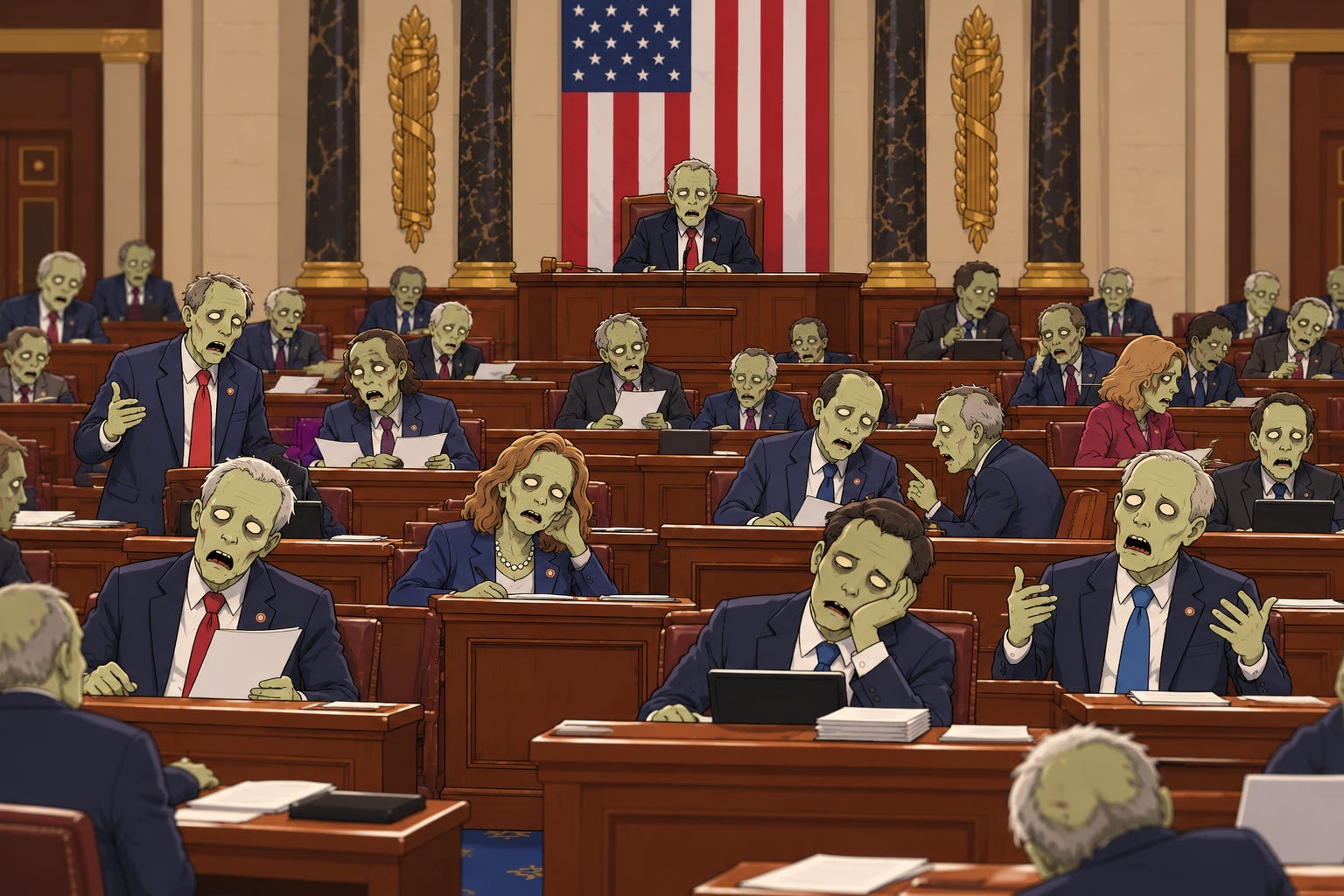
I call the combination of these four trends “zombie politics,” since it basically means voters and politicians alike are acting more and more like partisan zombies.
There are some political scientists who would tell you this is a good thing. Back in the 1950s, the American Political Science Association commissioned a now-infamous report that argued the problem with American politics was that neither party stood for anything, voters couldn’t distinguish between them, and what the country needed was two internally unified, distinct options.
I would argue, however, that these trends have not been great for our body politic. When the parties are this distinct, we become more isolated from — and angrier with — the people in the other tent. We lash out at people with the temerity to question party orthodoxy. We discourage our lawmakers from making compromises, and punish those who do. There is more hatred, and sometimes even violence. Less gets done. Extremists flourish. Fluidity gives way to stasis.
But the worst part about it is, it’s not clear all of this is even being done in service of genuine ideological disagreement. It would be one thing if every Democratic or Republican voter or lawmaker genuinely believed in every candidate or policy proposal they were offering support for. If that were the case, and people were voting their true preferences every time — and these preferences just happened to always align with their political party — the pejorative “zombie” wouldn’t be appropriate. Our politics would still be rigid, but it wouldn’t be because of partisans blindly following their tribe. It would simply be because everyone was honestly following their principles.
However, I’m not sure that’s quite the case. Do we really believe that every Republican who endorsed Donald Trump in 2024, including some who voted to convict him for “incitement of insurrection,” thought he should be president? Or that every Democrat who was prepared to support Joe Biden in 2024, at the age of 81, believed he was fit to hold the office? Does every congressional Republican who votes to uphold Trump’s tariffs truly support the import taxes? Does every congressional Democrat who opposes voter ID truly have an issue with the policy? (Public opinion polls of the parties at large would suggest the answers are “no.”)
It seems as though many voters and lawmakers are making decisions based on hatred or fear of the other side, discomfort over straying from the team, and a lack of examination of the individual candidates or bills up for a vote, beyond checking what their broader party is instructing them. These are all hallmarks of a zombie politics.
Of course, to have a healthy politics, you would also need both parties to be consciously trying to expand their coalitions, to reach out to disaffected voters from the other tent with open arms, so that they are a palatable option when the time comes. Voters are more likely to make cold calculations based on party loyalty if the other party isn’t doing anything to dissuade them.
I wouldn’t say we’re quite at that point yet. But I do have some good news: the land of the undead might be stirring. There’s reason to believe 2026 could mark a shift away from zombie politics.
Let’s revisit our four levels.
First, the candidate level. To be very clear, there is nothing wrong per se with the norm that losing primary candidates endorse the nominees who beat them.
Even in our model of healthy politics, where voters and politicians line up behind the candidates and policies that they genuinely believe would be best for the country, you would normally expect that to lead them to support their party’s nominee. Losing candidates might have had slight disagreements that were aired out in the primary, but these probably pale in comparison with their disagreements with the other party’s candidate.
But you would also expect some occasional exceptions.
To use some of the cases I discussed above, during their primaries, John Cornyn said Ken Paxton was “unfit” for office; Ralph Norman said Darline Graham was “beholden” to the “deep state” and suggested that she knew nothing about foreign policy; Haley Stevens accused Abdul El-Sayed of misogyny and antisemitism; and Karishma Manzur said that Chris Pappas was “very corrupt” and had voted to “fuel a genocide.”
Perhaps these candidates’ refusal to actively support their former opponents is just proof of sour grapes. But some of these statements sound like more than minor disagreements. If these candidates were telling the truth about how they really felt (and not just opportunistically slinging mud during a primary), then you could argue that it’s a healthy sign that none of them are bowing to significant party pressure to merely hop on the bandwagon for nominees they have serious reservations about.
Back in May, I argued that primary candidates should be careful about using words like “unfit,” but when they do, they should stand by them in November. At the time, I bemoaned that Cornyn planned to support Paxton and that Democrats were lining up behind Graham Platner despite a growing list of scandals they surely wouldn’t countenance from a candidate on the other side. But, since then, Cornyn has refused to lend Paxton assistance (asked why, Cornyn replied: “For all the reasons we pointed out in the primary”) and Democrats threw Platner overboard. Principles seem to be overtaking party loyalty in at least some cases.
Second, the level of states and districts. After years of a shrinking electoral map — if polls are to be believed — we could be headed for an expanded political battleground this November.
A number of states that had been competitive before the Trump era, but had seemed to move firmly into the Republican column — especially Midwestern states like Ohio and Iowa — are once again hosting tossup races. States like Texas and Alaska also seem to be coming into play. A New York Times poll out this morning even showed a tied Senate race in South Carolina.
On the House level, too, some districts Republicans took for granted (like the one Lauren Boebert moved to in Colorado) are suddenly up for grabs. In gubernatorial races, as I’ve written, we are also seeing the opposite dynamic: polls suggest that unpopular governance might be leading voters to abandon party loyalties in Democratic-controlled states like Oregon and Minnesota. Once-safe states no longer seem so.
Third, the level of individual voters. None of these states or districts would be competitive without a significant bloc of voters changing their minds: longtime Democratic or Republican supporters who are now planning to cast a ballot for the other side, shaking off any zombie tendencies.
We are also likely to see a fair amount of ticket-splitting this cycle, suggesting that voters are thinking carefully about the individual candidates on the ballot rather than simply voting based on party. Below, I’ve charted the differences in the Silver Bulletin polling averages for Senate and governor in the marquee states with races for each office.
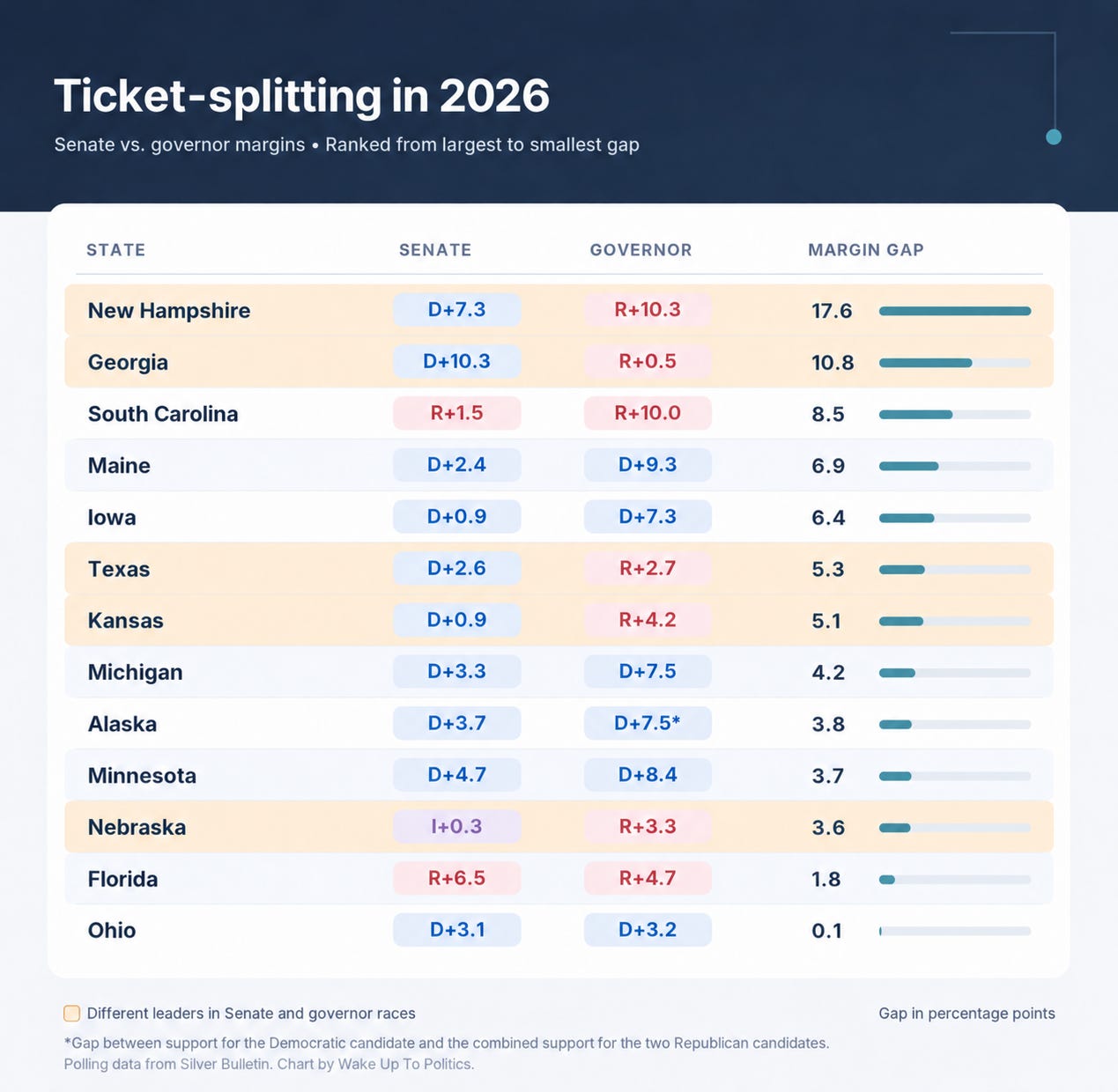
As of now, the polling averages would suggest five split outcomes: lots of Ayotte/Pappas voters in New Hampshire and Abbott/Talarico voters in Texas. There are also several races where the polling leaders might hail from the same party, but there are significant gaps between their advantages, which still suggests a sizable bloc of voters planning to split their tickets.
This includes several high-profile party defectors: Neil Bush, son and brother of a Republican president, who is backing Talarico; Karl Rove, GOP eminence, who is voting for a down-ballot Democrat against a Texas Republican he says has practiced “raw, uncut bigotry”; Lisa Murkowski, a Republican senator who yesterday endorsed a Democrat for Alaska’s governorship; the former chair of Haley Stevens’ Senate bid, who has said he will be voting for Republican Mike Rogers; and Joe Manchin, the former Democratic senator who has thrown his support behind Susan Collins.
Fourth, officeholders. After record-high levels of party loyalty in recent years, I would not be surprised if the 120th Congress, which will convene in January, includes some high-profile examples of lawmakers breaking with their parties.
The rank-and-file in both parties seem to be growing increasingly restless, experimenting in braking with their leadership by defecting on procedural (but important) matters like discharge petitions and rule votes.
In addition, as I’ve noted, many of this year’s crop of candidates have been making high-profile breaks with their parties: Democrats voicing opposition to transgender athletes playing in girls’ sports; Republicans breaking with Trump on the Iran war and the Russia diesel deal. Several of these candidates are winning over unexpected voters in unexpected states by taking unexpected stances: our moribund politics showing signs of life. In several of the competitive races, if the Democratic candidates win, they would likely not be rubber stamps for the party based on the policy stances they’ve espoused on the campaign trail; in fact, that’s why they are running so competitively.
None of this used to be all that novel. Throughout the 20th century, it was not uncommon for large movements to spring up of voters and politicians abandoning their party nominees, from “Bull Moose” Republicans to Reagan Democrats. (In 1980, for example, 22% of voters voted for a different presidential candidate than their party’s nominee. In 2024, that number was 5%.)
Even earlier, in 1884, a faction of reformist Republicans was so disgusted by the corruption of their party’s presidential nominee, James Blaine, that they bolted from the party and likely handed the election to Democrat Grover Cleveland. They were referred to as the “Mugwumps” (politics used to have much better names), which came from an Algonquian term meaning “important person”: a way for their critics to call them holier-than-thou.
They didn’t care. Former Missouri Sen. Carl Schurz, a leading Mugwump, told one audience of Republicans, “As a member of a party I do not cease to be a citizen… When I go as a delegate to a party convention, I consult with others as to what may be best for party action. When as a voter I go to the polls, I consult my own conscience about what is best for the country's welfare. And if I conscientiously find that what the party demands is not for the good of the country, then it is not only my right but my duty as a citizen to vote against it.”
Bemoaning “a new code of political honor” that “forbids us to be honest,” he said that the English principle “Once a subject, always a subject” had been subverted into a new rule: “Once a party member, always a party slave.”
“And what is worse,” he added, “we see men who know that all we say is true, and who but yesterday said it themselves, stifle their consciences and wear the badge of that slavery.” 2026 might be the rare election, like 1884, in which a growing group of voters and politicians drop their badges and side with their consciences.
Good insight and clarity! ...and timely Halloween zombie congress image!
I have found myself going down the D line exclusively - primarily due to the spineless R congress and the crazed president they support. I'll start being more conscious and selective as our politics become more civil. (and "he" fades)
Great combination of a hopeful take for the future rooted in more independent times!