


A lot of people seem to have strong opinions on what the phrase “general election” means in Article XII of the Virginia Constitution lately.
Or they’re pretending to, at least.
That esoteric question is at the heart of the 4-3 decision handed down on Friday by the Virginia Supreme Court invalidating a constitutional amendment that would have redrawn the state’s congressional map in Democrats’ favor. The decision was part of a one-two redistricting gut punch suffered by Democrats in recent weeks at the hands of judges, the other being the U.S. Supreme Court’s decision in Louisiana v. Callais, a landmark ruling on the Voting Rights Act.
Before these two decisions, the conventional wisdom was that this year’s tit-for-tat battle of mid-decade redistricting had mostly come to a wash — and potentially even a Democratic advantage — with Democratic gains in California, Utah, and Virginia (as many as 10 seats) canceling out Republican gains in Texas, North Carolina, Ohio, and Missouri (as many as nine).
But after Callais, Republican legislators in Louisiana, Florida, Tennessee, Alabama, and South Carolina are moving forward with redistricting, potentially netting the party as many as nine additional House seats. Take away the four seats Virginia was supposed to net for Democrats, and suddenly we’re looking at potential GOP gains of 18 seats and Democratic gains of only six. Democrats are still favored to win the House — they only need to flip three seats, after all — but the road now looks tougher and their potential majority looks slimmer.
The sizable consequences the Virginia and Callais decisions will have for the midterms mean that they have unsurprisingly generated a lot of commentary, including scorching Democratic criticism. But in both cases, strikingly little of that commentary seems to be attached to actual discussions of the complex legal issues at hand.
This is even more glaring because of the extreme language many on the left have used to describe the rulings. Several Democratic lawmakers have called the Callais ruling “Jim Crow 2.0,” comparing it to the system of oppression that blocked African-Americans in the South from equal access to employment, education, housing, or the ballot box. In a YouTube headline, Scott MacFarlane — who recently left CBS News to join a major progressive news outlet — asked, “Did the Supreme Court STEAL the NEXT Election??”
On Friday, former House Speaker Nancy Pelosi (D-CA) said that the Virginia Supreme Court had given a “vile assist to MAGA’s plan” to “rig the elections in their favor,” while California Gov. Gavin Newsom (D-CA) said that the decision was evidence that “MAGA has rigged the system.” Obama-era Attorney General Eric Holder, who leads a Democratic redistricting group, referred to “Republican efforts to steal the 2026 midterm election” in his statement after the Virginia ruling.
If you are going to allege to a large audience that a court ruling is evidence of an election being rigged or stolen, then a baseline requirement would probably be not just that you disagree with the court’s reasoning, but that it is so egregiously wrong that it can only be explained as part of a plot to gain partisan advantage.
And yet, none of the Democrats making these claims seem to actually be disagreeing (or even engaging) with the courts’ legal interpretations. They are merely reacting to the topline result of which party will be helped or hurt, and using all-caps and emotive language to rile up their audiences without giving them any of the proper context. If this sounds familiar, that’s because President Donald Trump and right-wing media figures did exactly the same thing after the 2020 election, pretending that various Covid-era changes to state voting laws were akin to an election being stolen. But complicated court rulings parsing vague text, even in ways you don’t agree with, are not the same as a stolen election, just like voting changes passed to address a global pandemic (even ones you don’t agree with!) aren’t either.
It seems to me that it would have been very easy over the past week to read several commentaries on the Callais and Virginia rulings and walk away without any understanding of the legal questions that undergirded them, but still be told that you must have a passionate opinion on why they are great or terrible. The way I see it, the price of admission to having a strong opinion on the Callais and Virginia rulings (whether you are devastated or ecstatic by their consequences) — an opinion on whether they were correctly or or wrongly decided, or even so wrong that they might be part of a plot to steal an election — is having a strong opinion on what “general election” means in Virginia law and what words like “opportunity” and “participate” mean in the Voting Rights Act.
Once you’ve read up enough on those questions, then you can have an opinion on the rulings and cheer or complain all you want, but in the meantime, you might find that it’s more complicated than you initially thought.
In today’s newsletter, let’s take a close look not at the partisan consequences of either ruling, but at the legal reasoning behind them. Then, you can wade back into the political discourse world and responsibly dish out any #hottakes you’d like.
These two rulings have very different contexts, so we’ll look at them separately. But I want to use the same tools when we’re doing so, and then — after applying the same methods — maybe you’ll agree with both, or disagree with both, or agree with one and disagree with the other. (There’s really no reason that how you interpret the phrase “general election” in Virginia law has to correlate with how you interpret the Voting Rights Act, and yet almost every professional pundit and politician seems to either agree with both rulings or disagree with both. How odd!)
In essence, we’re dealing with two cases that each revolve around one vague legal text, and two parties in each case that are offering competing interpretations of the texts that are neither obvious nor ludicrous. If the interpretations were one or the other, these cases would be easy. Anyone who tells you these cases are easy is not telling you the truth.
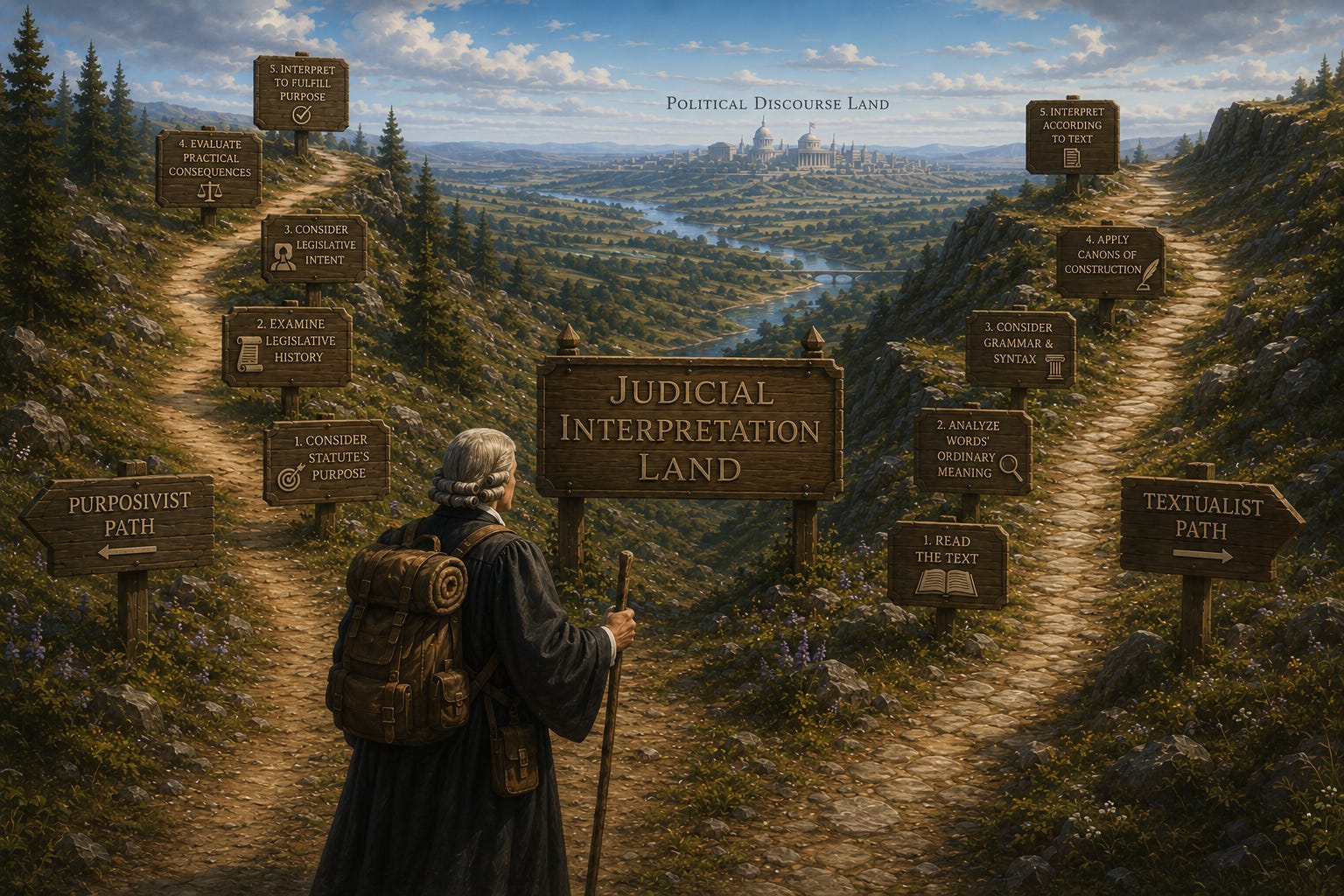
What do you do when lawmakers have written a vague text, and competing parties are offering not-obvious-not-ludicrous interpretations? There are two main schools of thought, each of which have long and respectable histories.
One is called textualism, and it says that a judge in this situation should look at the bare text at hand, consult a dictionary to define each word or phrase, and use that to arrive at their best interpretation of what the statute means, without introducing any extraneous documents besides the parts that have actually been enacted into law.
The other is called purposivism, and it says that a judge should look not only at the text, but also at its authors’ purpose in enacting it. This study of legislative intent, purposivists say, will help judges understand what the law is supposed to say.
Textualism is generally associated with the conservative legal movement, and purposivism with progressives, but you can decide which one makes the most sense to you. In these two cases, I would submit that the two political parties are inconsistently applying their associated legal methods: that the Democrats are using purposivist arguments on the Voting Rights Act but textualist reasoning in Virginia, while Republicans are acting as textualists on the Voting Rights Act and as purposivists in Virginia.
But, as we’ve discussed before, the political parties’ hypocrisies don’t have to be your own. Come along with me, and we’ll look at the law in both cases, and how to interpret them either by looking at text alone or with legislative purpose in mind. Freed from the politician’s need to hypocritically apply legal methods, or the pundit’s focus only on the political consequences of a decision — since we do not want judges to incorporate such thinking in their rulings — but fully equipped with the facts and context, you can play judge for yourself and decide what you think is the legal route that makes the most sense in each dispute.
It’s time for an adventure into Legal Interpretation Land. I hope you have your robes and gavels ready!
The Voting Rights Act case
We’ll start with Louisiana v. Callais, which concerns Section 2 of the Voting Rights Act, as codified at 52 U.S. Code § 10301:
No…standard, practice, or procedure…shall be imposed or applied by any State…in a manner which results in a denial or abridgement of the right of any citizen of the United States to vote on account of race or color, or [membership in a language minority group].
The law then goes on to say that it has been violated if:
Based on the totality of circumstances, it is shown that the political processes leading to nomination or election in the State or political subdivision are not equally open to participation by members of a class of citizens protected by [the above text] in that its members have less opportunity than other members of the electorate to participate in the political process and to elect representatives of their choice.
The extent to which members of a protected class have been elected to office in the State or political subdivision is one circumstance which may be considered: Provided, That nothing in this section establishes a right to have members of a protected class elected in numbers equal to their proportion in the population.
In Louisiana v. Callais, Louisiana had previously been told by a court that compliance with this language required the state to set up a second majority-Black district, in response to a lawsuit by a group of Black voters alleging discrimination. But then a group of non-Black voters sued, alleging that this new map discriminated against them.
Some of the broader questions surrounding Callais were (1) whether the VRA is violated only when a state intentionally discriminates against a racial group, or also when a policy has the effect of giving a group less representation; (2) whether the language about a group being able to elect “representatives of their choice” requires states to set up districts where minority groups form a majority; (3) if so, how do we know in which situations that’s required; and (4) could that requirement then violate the 14th and 15th Amendments, which generally block the government from using race when setting election policy.
The pre-Callais interpretation of the VRA (which Democrats were fighting to preserve) was that the law prohibits policies that are intentionally discriminatory and those that have a discriminatory effect (irrespective of intent), and frequently requires majority-minority districts in response. That isn’t a crazy reading of the text, but it’s also not obvious.
The text does say that no policies should be imposed that “results in a denial or abridgement of the right” to vote, which does sound results-based. (That is, it doesn’t merely prohibit policies that are “intended to” deny the right to vote.) But ensuring that a group’s right to vote won’t be abridged doesn’t necessarily mean they have the right to be a majority in a certain number of congressional districts.
Similarly, the text says that racial groups should not have “less opportunity than other members of the electorate to participate in the political process and to elect representatives of their choice.” Constructing majority-minority districts does sound like a good way to do that. But does the text require it? It doesn’t really say what is meant by a group having the “opportunity…to elect representatives of their choice.” Does that mean they have to form 50%+1 of a district? 40%? 30%? Of how many districts?
This partially depends on who the “other members of the electorate” are that a given racial group is supposed to have the same opportunities as. Does it mean Black Louisianans, writ large, must have the same opportunities to elect “representatives of their choice” as white Louisianans, writ large? Or, since Louisiana is a Republican-controlled state and the Supreme Court has previously declined to block partisan gerrymandering, and Black Louisianans are disproportionately Democratic while white Louisianans are disproportionately Republican, is that an unfair standard? Should the comparator instead be whether Black Louisiana Democrats have the same opportunities as white Louisiana Democrats to elect a congressman (which is to say, little in both cases, but seemingly for partisan, not racial reasons)?1
As for the “how many districts” question, one natural way to ensure members of a racial group in a state have equal opportunity is to look at how many of them there are in that state and ensure there are a roughly equivalent number of districts where they’re able to elect “representatives of their choice.” One in three Louisianans are Black, for example, so you might think that Black voters should be given significant weight (a majority? 🤷♂️) in two out of the state’s six districts.
But that’s the one thing the law tells us it doesn’t require! Remember: “Nothing in this section establishes a right to have members of a protected class elected in numbers equal to their proportion in the population.”
So, I hope you can now see that this is a bit more complicated than it is often portrayed. The Democratic reading of the VRA is by no means ridiculous, but it isn’t necessarily the most natural textualist reading to look only at what the VRA says and walk away thinking that a certain number of majority-minority districts are absolutely required to follow that vaguely written law. And you also have to reckon with another text, that of the 15th Amendment, which says that “the right…to vote shall not be…abridged on account of race.” Does that mean mapmakers can’t even take race into account when carving up districts, in which case our whole majority-minority district project might have to be thrown out?
But that’s just how a textualist might look at things. There’s also a whole world of purposivist arguments that we haven’t discussed yet!
After all, the text of the VRA didn’t just come out of thin air, without any context. In fact, the text above isn’t even from the 1965 VRA: it’s from a 1982 amendment to the law. So you would assume Congress had a pretty specific intent here; they must have been amending the law for a reason.
And they were! They were actually responding to a different Supreme Court decision, Mobile v. Bolden. In that 1980 case, a plurality of the court held that policies only violate Section 2 of the VRA if “motivated by a discriminatory purpose.” But Congress didn’t like that intent test; the 1982 amendment was their attempt at imposing an effects test. Knowing this, a purposivist would be more likely to look at potential Section 2 violations with that history in mind (even though a textualist would respond that the text itself doesn’t really spell out much of an effects standard, or certainly how it should be adjudicated, even if Congress’ intent was to move away from an intent test).
Suddenly, our mindset might start to shift. Before, we might have looked at the text and thought that a state only has a problem if it’s treating Black and white voters of the same party differently because of their race, not merely because of their partisanship. But infused with this knowledge of Congress’ intent, a purposivist would say, I don’t care why a state is treating Black voters differently. Congress wanted an effects test! As long as the effect of this map is to dilute Black voting power, we have a problem, even if race wasn’t what motivated the line-drawers.
As for how our effects-based inquiry should proceed, the text says that violations of Section 2 should be found based on a showing of the “totality of the circumstances,” which sounds pretty vague. But it actually is lifted directly from a different SCOTUS case, White v. Regester (1973). In that case, the Supreme Court talks about taking into account the “totality of the circumstances,” including the “cultural and economic realities” of a jurisdiction and its “history of racial discrimination.” Does this mean lawmakers wanted us to take such factors into account when deciding violations of the VRA? A textualist would probably say “no.” (Where in the VRA does it use those words?) A purposivist might say “yes.” (That’s the exact reasoning that was used in the court decision that lawmakers lifted their words from, which gives us a clue of how they intended the words to be interpreted!)
Purposivists would also point to a Senate committee report on the 1982 amendments, which give us more insight into legislative intent. The report stresses the difficulty of deducing racist intent, and says that courts should assess whether “the impact” of a policy would be to “minimize or cancel out the voting strength and political effectiveness of minority groups.” That might have you leaning more towards the majority-minority district side of things. But, of course, those words weren’t written into the text of what actually was signed into law.
So it depends on how much stock you put in the legislative intent, which may have been to create an effects test and majority-minority districts, even if the text doesn’t use any of those words directly.
There are plenty of other textualist/purposivist disputes embedded within the case. Two of the Supreme Court’s leading textualists, Justices Clarence Thomas and Neil Gorsuch, penned a concurrence arguing that the VRA doesn’t even apply to redistricting: it only concerns policies that might prevent someone from casting a ballot. Look at the text, and you’ll see language about “the right…to vote,” but nothing about how maps should be drawn. To which the purposivist would say, Give me a break. The Supreme Court decision Congress was responding to (Bolden) and the one they lifted language from (White) were both about redistricting. Clearly, they knew the VRA was being interpreted to regulate redistricting and it was not their intent to change that status quo!
You also might look at the fact that the suit undergirding Callais was brought by a group of non-Black voters claiming discrimination. The purposivist might not appreciate that, since the drafters of both the 15th Amendment and the VRA were clearly intending to boost Black voting power. But the textualist would point to the texts, which simply prohibit discrimination on the basis of race, whether the racial group in question is in the minority or the majority.2 Yes, the text says that “the extent to which members of a protected class have been elected to office in the State or political subdivision is one circumstance which may be considered” when deciding whether the VRA has been violated. But it only says “may”; it doesn’t say that the only factor that should be considered is whether a group has historically been able to elect representatives in the state, or even that that should be considered at all.
Is your head swimming yet? Good! These questions aren’t supposed to be easy. Now let’s apply these same tools and take a trip down to Virginia.
The Virginia case
Last month, Virginians voted on a constitutional amendment to allow Democrats to redraw the state’s congressional map in order to net as many as four new House seats. The Virginia Supreme Court ruled on Friday that the constitutional amendment was illegitimately approved.
Here’s what Article XII of the Virginia Constitution says about how amendments are added to the state’s Constitution:
Any amendment or amendments to this Constitution may be proposed in the Senate or House of Delegates, and if the same shall be agreed to by a majority of the members elected to each of the two houses, such proposed amendment or amendments shall be…referred to the General Assembly at its first regular session held after the next general election of members of the House of Delegates.
If at such regular session or any subsequent special session of that General Assembly the proposed amendment or amendments shall be agreed to by a majority of all the members elected to each house, then it shall be the duty of the General Assembly to submit such proposed amendment or amendments to the voters… If a majority of those voting vote in favor of any amendment, it shall become part of the Constitution on the date prescribed by the General Assembly in submitting the amendment to the voters.
Basically, this is describing a four-step process:
Both chambers of the Virginia legislature approve the amendment.
A “general election” is held.
The two chambers of the Virginia legislature, as newly constituted after the election, vote to approve the amendment again.
The amendment is sent to the state’s voters for their approval or disapproval.
It is not easy to add an amendment to the Virginia Constitution!
The key dispute here is over the meaning of the phrase “general election.” This isn’t a case of vaguely written text, per se, but rather text that probably was pretty straightforward when it was drafted (in 1971) but now is a bit more vague since election practices have changed a lot in the last five decades.
Specifically, a lot of Virginians now vote before Election Day. So, when the Virginia legislature sent the redistricting amendment to the voters on October 31, 2025 (fulfilling Step 1 in the process), it was before the Election Day (on November 4) that is supposed to be Step 2 in the process. But so many Virginians vote early that about 40% of the state had already cast their ballots by October 31! So… did the Virginia legislature act before the “general election” took place, or while it was already underway?
This is yet another textualist/purposivist dispute!
I think if most people were to read the text of the Virginia Constitution — and nothing else — they would see that something has to take place before a “general election,” and most naturally think that it has to come before “Election Day.” In this case, that was November 4. So, as long as the Virginia legislature approved their amendment before November 4, they’re in the clear.
This textualist reading is bolstered by Title 24.2 of Virginia law, which defines “general election” as “an election held in the Commonwealth on the Tuesday after the first Monday in November.” OK, November 4 it is!3
But time to put our purposivist hats on. Why did the framers of the Virginia Constitution put a “general election” in the middle of the two Virginia legislature votes in the first place?
The answer is pretty clear. They wanted to give Virginia voters two opportunities to express their will over the approval of a constitutional amendment. First, the legislators would vote on the amendment. Then, the voters would vote on the legislators. Then, the legislators vote again. Then, the voters vote again, this time directly on the amendment.
“The reasoning behind this is that Constitutions should not be changed lightly,” one Virginia legislator said when the 1971 Constitution was being debated. “Not only would there be an intervening House of Delegates election where you might be able to get the sentiment of the people on an amendment you had acted upon previously, but upon reflection the General Assembly might decide not to submit the amendment.”
The whole point of the intervening election is to let Virginians respond to the vote their legislators had taken on the amendment, and then express their approval or disapproval by voting on the legislators. If the voters didn’t like how their legislator came down on the amendment, this was their opportunity to elect a new legislator who might vote differently.
Now you might see the problem. 40% of Virginians had already voted in the legislative election when the legislature voted on the amendment the first time, which means 40% of the state was deprived of the opportunity they were supposed to have to vote on their legislators in response to how their legislators voted on the amendment.
Or that’s how a purposivist would look at it, at least. They would say that “general election” in this context should be read with deference to why it was included in the Constitution, which was to give the state’s voters an opportunity to vote on their legislators in between the legislature’s two amendment votes. To which a textualist would respond, Too bad! They only wrote “general election.” And “general election” means “Election Day,” which means the legislature just had to turn their work in by November 4, no matter how many Virginians had cast their ballots by then.4
As you may have noticed, our two parties have switched sides here. If you leaned more towards a purposivist reading of the Voting Rights Act, that’s perfectly fine and understandable. But did you also adopt a purposivist reading of the Virginia Constitution? And vice versa if you leaned towards textualism.
Of course, I — like the justices of the Virginia and United States Supreme Courts — am not infallible, and maybe you quibble with how I’ve framed the “most natural” textualist and purposivist readings in these cases. That’s perfectly fine. But I hope I’ve convinced you, at least, that these are complicated questions that don’t come with easy answers. And I hope I’ve helped you try to come up with an answer for yourself, instead of allowing a pundit or politician to deny you your democratic right to think deeply and freely about these questions, and to dwell in nuances, instead of pretending that everything has ONE SIMPLE ANSWER and if you don’t agree with mine YOU’RE TRYING TO STEAL AN ELECTION.
There is no more serious charge in a democracy than that an election is being stolen. My hope is that people with large platforms handle that allegation responsibly, and don’t just cast a process as illegitimate because it yielded an outcome they disagree with (or, possibly, that they just find inconvenient).
Just as Trump and his allies did after 2020, many Democratic politicians appear to be purposefully confusing their audiences by ignoring facts and context to arrive at a message that will rile up the maximum number of their voters. Take, for example, this tweet from Gov. Gavin Newsom (D-CA), currently the betting favorite to be the next Democratic nominee for president:
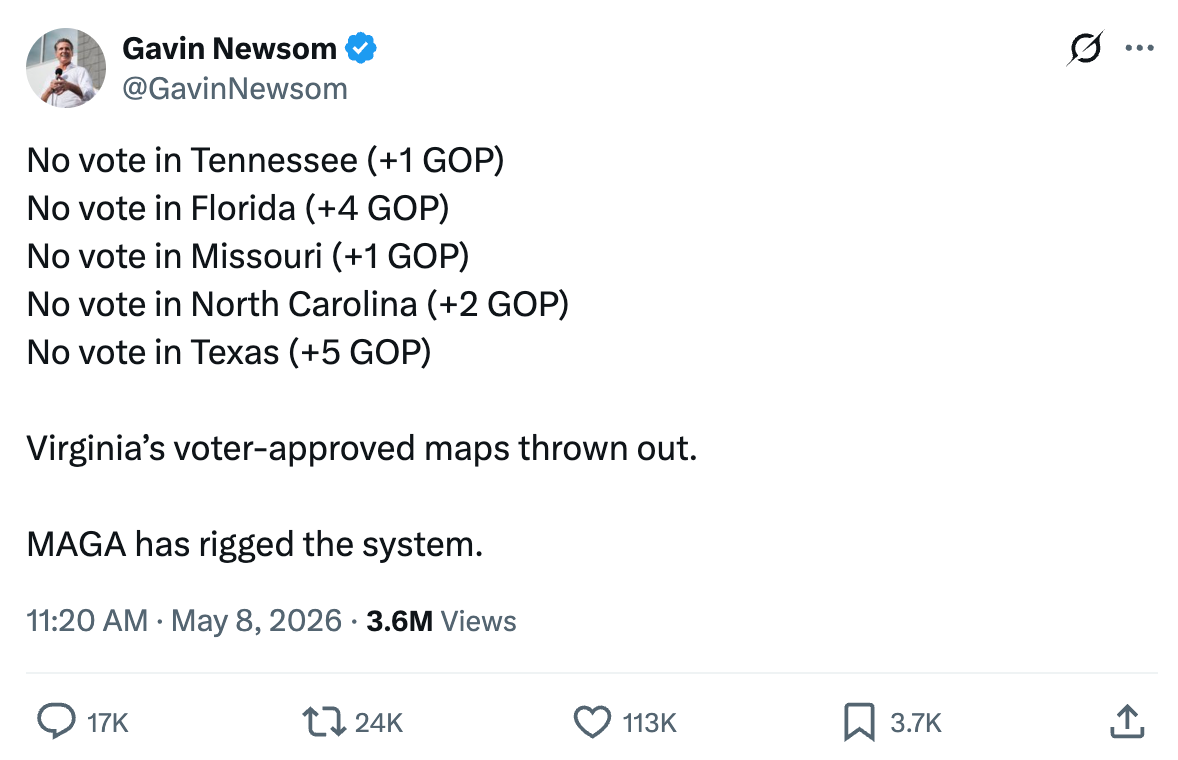
This makes it sound like there is one, unified MAGA-rigged system that yielded all of these outcomes. But redistricting is not done nationally5; different states have different laws, so obviously the processes will look different in different states.
In Tennessee, Florida, Missouri, North Carolina, and Texas, the state legislatures draw their congressional maps. So there is no reason a popular vote would have been required. However, in Virginia, a constitutional amendment was approved in 2020 to empower a bipartisan commission in the redistricting process. That is why a new constitutional amendment was required to override that commission’s map — and, as we now know, in Virginia, approving a new constitutional amendment means allowing the people to vote.
There is nothing nefarious in the fact that some states would have needed a popular referendum to change their maps (or mapmaking process), and others wouldn’t. That isn’t a rigging, and it wasn’t anything done by MAGA: it was simply the result of 65% of Virginians voting to set up a bipartisan commission in 2020. Nor is the Virginia Supreme Court even MAGA-controlled: Virginia is one of two states where the state legislature appoints the court. One of the justices was appointed when Democrats controlled the legislature, three were appointed when Republicans controlled the legislature, and three were appointed when control of the legislature was split.
“MAGA” was also not responsible for the fact that the state Supreme Court ruling was handed down after Virginians voted on the amendment. When this lawsuit was brought before the referendum vote, it was the state’s Democratic attorney general, Jay Jones, who asked the court to hold off on their ruling, arguing that the court could not rule on the constitutionality of an amendment until after it had been considered by the voters. Instead, Jones said, the court should wait until after the vote to consider these questions of constitutionality. Democrats signaled at the time that they would respect whatever decision the court came up with after the vote, and their lawyer specifically acknowledged to the court that whether or not Virginia voters ended up approving the amendment (or by what margin) would have no bearing on the merits of the legal question that would then return before the court. Democrats always knew there was a risk it would play out this way; they were just gambling that if they could get the referendum passed, the Supreme Court would take their side.
Anyone is free to disagree with the Virginia Supreme Court’s decision — there’s nothing wrong with practicing some good old-fashioned textualism! — but suggesting that it is the stuff of a rigged election is something else entirely. It is the easiest thing in the world for politicians and media figures to say exactly the right things in order to rile up their audiences and get them angry. It is harder for them to actually be honest about what they are asking their audiences to get upset about, because that would require delving into complex conversations where the answers aren’t as simple as the partisan bottom-line.
This election season, odds are that we are going to see lots of stolen-election claims, from both sides of the aisle, which seems to be an unfortunate and ubiquitous part of our modern political discourse. The biggest secret of all, the one neither side will tell you, is that many of these legal disputes are complicated. In the months ahead, don’t let them trick you into thinking you have strong opinion on the disputes before you’ve thought through the legal questions for yourself. Don’t let yourself get riled up. Get informed instead.
One way to look at this is: If, tomorrow, Black Louisianans were to start voting overwhelmingly for Republicans, would the Republican-led government start drawing more districts where Black voters formed a majority? If the answer is “no,” then you might assume that their gerrymandering is racist in intent. If the answer is “yes,” then you might think they are actually motivated by partisanship. (For example, the Texas GOP was all too happy to draw more Hispanic-majority districts once Hispanic voters started drifting to the right: in fact, their new congressional map is wholly premised on this idea.)
However, as we’ll discuss, if you think that the VRA is about policies resulting in discrimination, not intending discrimination, then none of this would enter into your analysis.
Weirdly, because of how the VRA is written, it does make this distinction when protecting language groups (only language minorities are protected), but not when protecting racial groups (all races are protected, regardless of their majority/minority status).
In fairness, that law also says that’s only the definition that should be used “unless the context requires a different meaning.” That is pretty vague. Is this a situation where context requires a different meaning? 🤷♂️
The U.S. Supreme Court also has a case pending on a similar question of how to define “Election Day” for the purposes of federal law.
This, by the way, is one of the under-discussed risks of abolishing the filibuster. If we did so, one party with unified control of Congress and the White House could potentially pass a bill overriding the congressional maps in all 50 states, and creating new maps (drawn by the federal Congress) that each state would have to use. This would be one party rigging an election.
But since redistricting is state-by-state, not national in this way, it is harder for one party or the other to rig a national election via redistricting — since, for example, Republicans can do something in Texas that then can responded to by Democrats in Newsom’s California.
Abolish the Electoral College so that candidates are elected based on majority rules, not the absurd system we have now where only certain states can hold sway over elections. And eliminate gerrymandering by using ONLY the Census taken every ten years to define the lines for House and state elections. Lock a bunch of unnamed statisticians (or whatever the best type of impartial people are for this work) in a secure secret location for a few weeks and have them come up with the national plan. Why won't people embrace this solution? Seems logical and fairly simple.
Excellent discussion. It's notable that Nate Silver came out with a map of the state supreme courts this morning showing Virginia as the only state supreme court in the country that does not lean one way or the other politically.
It looks like the VA decision caught many flatfooted but it was widely known their decision was very possible, even likely. Legal pundits who I consider pretty middle of the road like Michael Smerconish, Elie Hoenig and Dan Abrams discussed the case more than once, and felt there was a strong chance it would be overturned.
It's pretty obvious both parties just want to win and the legal arguments are regarded mainly as impediments to be overcome.