



Republican Matt Van Epps won last night’s special election in Tennessee’s 7th congressional district by nine points, taking 54% of the vote to Democrat Aftyn Behn’s 45%.
Stripped of any context about the district, that’s not a particularly close result. It certainly appeared to be enough to satisfy President Donald Trump.
“Congratulations to Matt Van Epps on his BIG Congressional WIN in the Great State of Tennessee,” Trump wrote on Truth Social. “The Radical Left Democrats threw everything at him, including Millions of Dollars. Another great night for the Republican Party!!!”
But the rest of the Republican Party doesn’t seem to feel that way.
After all, Van Epps’ nine-point edge may have been comfortable, but it represents a 13-point shift away from Trump’s 22-point win in the same district last year.
What happens if you apply that same shift across the ballot in the 2026 midterms? Don’t take it from me, take it from Republican strategist Matt Whitlock, a former top adviser at the Senate GOP campaign arm. “If every House district in the country shifted left by this same amount - about 15 points - [in 2026] we would be looking at a blue wave far worse than 2018,” Whitlock wrote on X, noting that Republicans won 15 House seats by under 5 percentage points in 2024 and 28 seats by 5-15 points. Put together, if the swing in Tennessee’s 7th is replicated nationwide, up to 43 Republican-held House seats could be at risk of flipping into Democratic hands.
“This is one of the biggest flashing red light warning signs we’ve seen yet for Republicans,” said Whitlock.
Other GOP officials came away with the same assessment, much less rosy than Trump’s declaration of victory. “Tonight is a sign that 2026 is going to be a bitch of an election cycle,” one House Republican anonymously told Politico. “I’ve personally witnessed the strength of the Dem ground game even here in RED Tennessee,” conservative commentator Tomi Lahren wrote. “We are behind and we can’t stay that way.”
Far from being an outlier, the Tennessee result is perfectly consistent with election results that have been rolling in all year: according to The Downballot, in the 59 other state and federal special elections held this year, Democrats have overperformed the 2024 presidential margin by an average of … 13 percentage points, exactly in line with the overperformance recorded last night.
This is the point in the story where I tell you that special elections are a unique beast and can’t be mapped exactly onto the 2026 midterm environment. And that’s true! Both parties pouring all of their money into a single race in December is not the same as a high-stakes Election Day in November 2026 when 435 House seats and 35 Senate seats will be on the ballot.
Matt Whitlock’s note about the number of House seats that could theoretically be up for grabs if last night’s Democratic overperformance is mimicked across the country is helpful as a back-of-the-envelope calculation, but there’s obviously no guarantee that one Tennessee result will be copied across the board.
Three notes to keep in mind, however:
1. Special election results are somewhat correlated with general election outcomes. Below, for the last four election cycles, I’ve charted how much Democrats overperformed in special elections during the two years preceding the general election vs. how the Democrats performed in the House popular vote on Election Day. As you can see, the results matched up pretty closely in the 2018, 2020, and 2022 cycles (e.g. from 2017-2018, Democrats overperformed presidential margin by 9.9 points in special elections, and then won the House popular vote by 8.8 points in 2018).
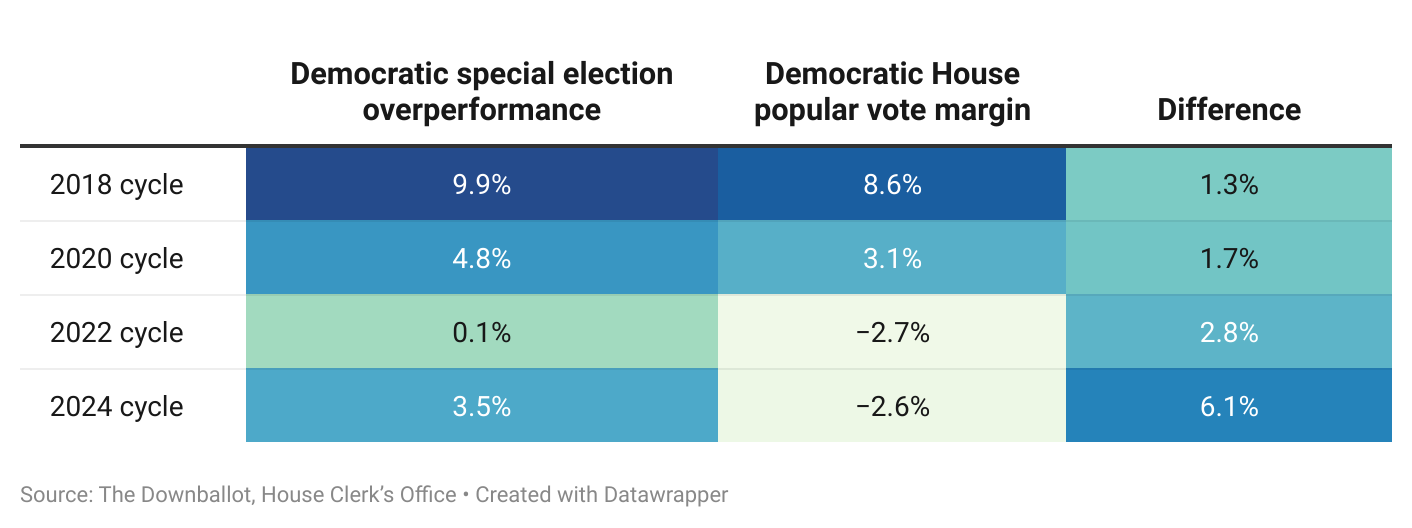
Even if you take the 2024 cycle, which saw the largest divergence between the two metrics, and assume the same divergence will be at play this cycle (chopping an identical 6.1% from the Democrats’ current 13-point overperformance in special elections), you’d still be looking at a nearly 7-point Democratic victory in the 2026 House vote, which would still make for a landslide win. (Of course, the 13-point overperformance level is still subject to change as more special elections take place between now and Election Day 2026. Here’s The Downballot’s spreadsheet, my source for the data above, to track special elections as they happen.)
2. Last night’s turnout was midterm-level. Normally, especially in the Trump era, one of the reasons to take special election results with a grain of salt is that they take place in a lower-turnout atmosphere, and recent elections have shown that Democrats overperform in low-turnout elections. (Note that in the table above, Democrats have overperformed in special elections each of the last four cycles, even when they ended up faltering in the general election.)
But that caveat didn’t apply last night. So far, with more than 95% of precincts reporting, 179,899 ballots have been recorded in the TN-7 special election. In the 2022 midterms, 180,822 ballots were counted in the regular TN-7 House election.
That’s crazy. That means, when all is said and done, more voters will likely have voted in last night’s special election than in the same district’s regular congressional election in the most recent midterm. Which means the shift towards Democrats can’t just be dismissed as the result of a low-turnout environment.
Of course, the electorate who turned out last night won’t be exactly the same as the electorate who turn out a year from now — but the size suggests it’s a much closer approximation than usual. And since we know the results shifted so much from red to blue, we know exactly which party is fueling that larger-than-usual special election turnout. One party’s base seems to be motivated, and it ain’t the Republicans’.
3. The Democratic candidate was well to the left of the district. Aftyn Behn, the Democratic nominee, wasn’t exactly a moderate running in Trump-friendly territory. She was dogged on the campaign trail by comments she had made in 2020 about defunding the police and her self-description as a “very radical person.” Trump called her the “AOC of Tennessee.”
And yet, despite the seeming mismatch in her district, she still managed to overperform Trump by 13 points, likely fueled by widespread dissatisfaction with the president. If such a progressive candidate was able to overperform Trump by 13 points, Republicans are shuddering to think what more moderate Democrats might be able to do in 2026. Most districts up for grabs next year will be well to the left of this one, with Democratic candidates to the right of their nominee here. That’s not a combination Republicans are looking forward to.
Above all, let’s not lose the forest for the trees here. No matter if last night’s 13-point overperformance paints too rosy of a picture for Democrats or (because many of their 2026 candidates will be closer matched to their districts) a picture that isn’t rosy enough, directionally, these results are exactly in line with what we’d expect based on Trump’s approval rating and a simple glance at history.
Since World War II, the party that controls the presidency has lost an average of 25 House seats in midterm elections, which would be more than enough in 2026 to flip the chamber. All the numbers on the margins pale in comparison to this central takeaway: Nothing that we’ve seen so far in 2025 suggests that next year’s midterms will mark a break from that pattern, or that Trump is somehow immune to the political gravity that has ensnared his predecessors (and him in his first term).
Decades of history teach us that a party winning the presidency depresses turnout from that party’s base in the next election cycle, while increasing turnout from the other party. Presidents both disappoint their supporters and animate their opponents to a remarkably consistent degree.
The same is happening now: “Many voters are apathetic and have very little enthusiasm on our side,” Tennessee conservative activist Robby Starbuck wrote this morning. “Why? They think our majority in Congress is failing them due to weak leadership, bad priorities & inconsistent messaging.”
In line with this analysis, Gallup’s November poll recorded a notable drop-off in Republican approval of the president (from 91% last month to 84% now, the first real movement of his second term) and a collapse in Republican approval of the Republican-led Congress (from 61% as recently as July to 23% now).
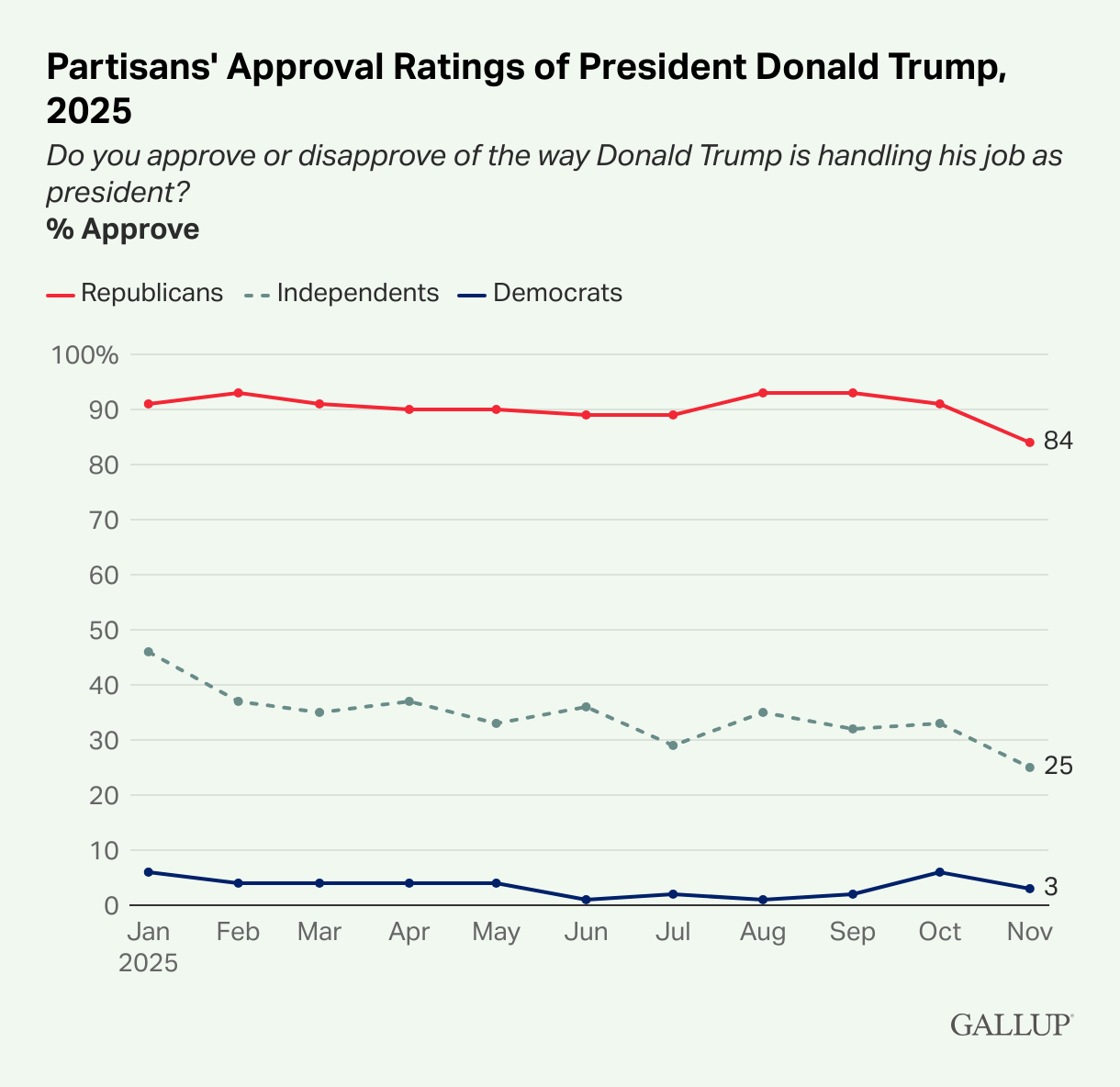
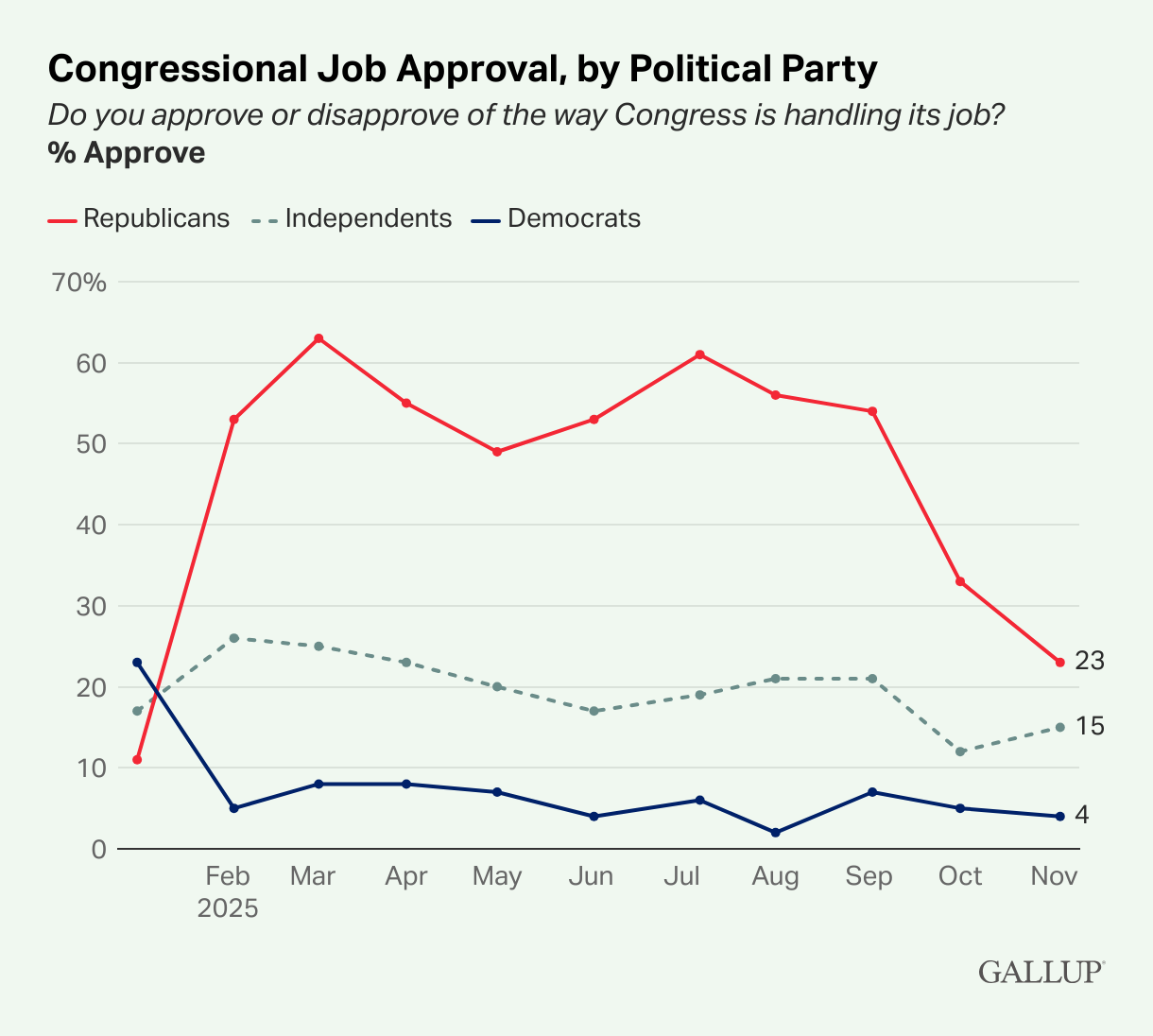
No issue is more important to voters than the economy, and you didn’t need to see results from Tennessee’s 7th congressional district to know that Trump’s approval rating on that topic (36%) makes for a flashing-red warning sign for Republicans.
If anything, I’m not even sure the special election result is the most notable midterm-election-related news that took place yesterday. That may have been this clip from President Trump, who declared that the concept of affordability is a “hoax”:
Expect to see that clip coming soon to a TV ad near you.
“Running from Trump is how you lose. Running with Trump is how you win,” Rep.-elect Van Epps said in his victory speech last night. Sure, maybe in a district Trump won be 22 points. But how about in the 102 Republican-held House districts where Trump performed worse than that in 2024?1 I wouldn’t be so sure.
Trump’s blasé attitude towards American opinions of the economy and inflation (now even more dour than during the Biden era) — and his willingness to risk even higher prices with his unpopular tariff policy — also highlight how the GOP can’t expect that a lame-duck Trump will orient his next year around trying to save them in the 2026 midterms.
As with the elections last month, Republicans are already grappling with the idea of a post-Trump future, where Trump-aligned voters don’t show up at the polls without him on the ballot — and he does little to try to coax them to.
“Special, off-year, and midterm elections historically benefit the party out of power because its voters are motivated to vote, while voters of the incumbent party become more complacent,” Gov. Ron DeSantis (R-FL) wrote this morning. “This is more glaring for today’s GOP because a chunk of voters who put them in power in 2024 are Trump-specific voters; they will vote GOP down ballot when Trump is running but won’t turn out to vote for a typical congressman in a midterm when Trump isn’t running.”
And they certainly won’t turn out without turnout efforts by Trump, who doesn’t seem all that invested in the success of a party he’ll only be leading for so long. Trump didn’t hold a single rally for Van Epps in Tennessee; in fact, as The Atlantic notes, his domestic political travel has basically stopped completely.
Heading into 2026, Republicans might be looking at the worst of both worlds: Trump’s presence in the White House pushing Democrats to the polls — while his absence from the campaign trail keeps MAGA Republicans home. That means they would get all the political negatives of Trumpism without any of the turnout-juicing positives, a toxic combination for the party as the midterm elections creep closer.
Again, using data collected from The Downballot, this includes 20 Republican-held House districts Trump won by 20-22 points in 2024; 55 seats he won by 10-19 points; 14 seats he won by 5-9 points; 10 seats he won by 0-4 points; and three seats he didn’t win at all. Democrats only need to flip three House seats in 2026 to win a majority.
Note that these calculations use the district lines as of 2024, which are not expected to be the same lines used in 2026 in every state.
Excellent column
Cutting through all the numbers maybe the biggest one was the size of the turnout
And the fact she is very liberal, almost a socialist Democrat, has said some very controversial things and brought in AOC
The Republicans showing up in the comments all full of copium 😁😁😁😁