


Good morning! It’s Tuesday, January 20, 2026. Donald Trump was sworn in as president one year ago today. I’ll be talking about Year One with my friend Galen Druke on Substack Live at 3 p.m. Eastern Time:
But first, let’s walk through a bit of the last year (and the last weekend) together:
Back in April 2016, the Boston Globe’s opinion section published a satirical front page imagining what the first few months of a Donald Trump presidency would look like.
At the time, Trump — against all odds — was steamrolling his Republican opposition, increasingly poised to seize the GOP presidential nomination. Trump was an unknown quantity in the political world, and to the extent he was known, it was for being erratic, chaotic, and bombastic. Nobody knew what would come next; here was one editorial board’s best guess:
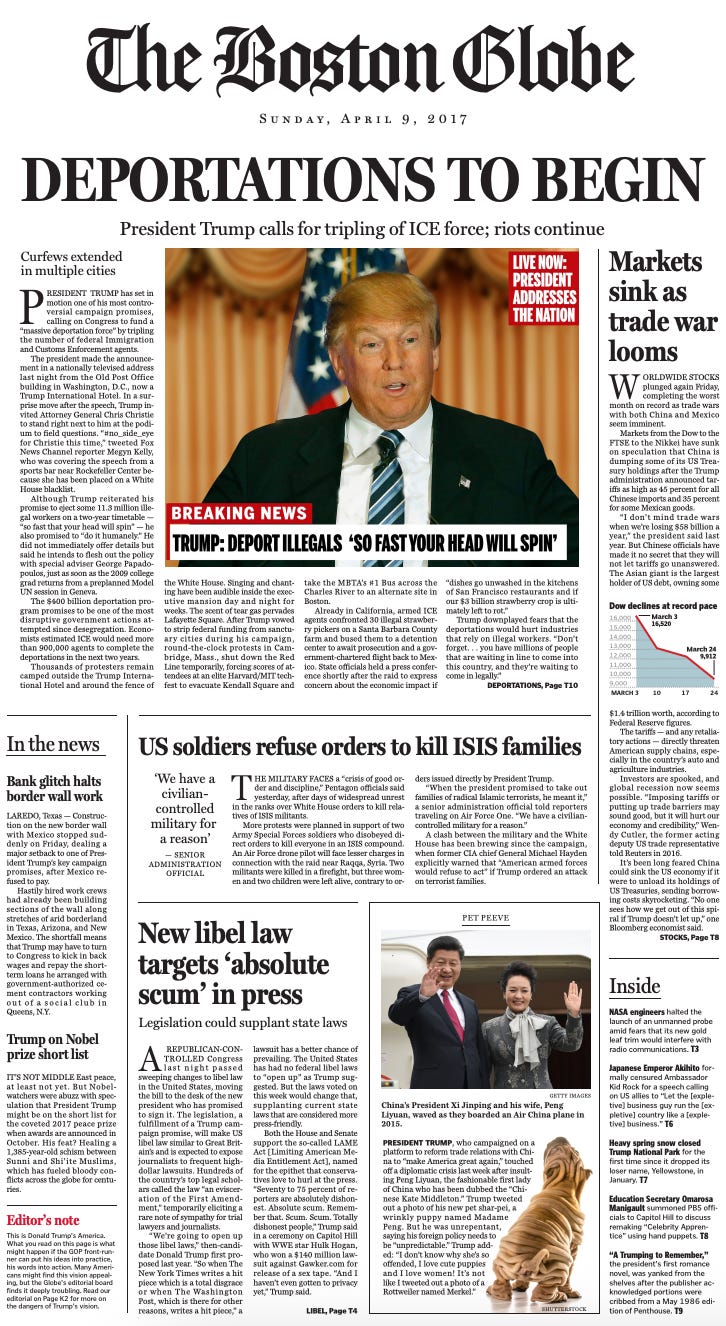
Then, Trump became president, and — as dramatic as his first term seemed at the time — it wasn’t this dramatic. Trump did emphasize deportations, as the Boston Globe predicted, but the annual number of illegal immigrants removed didn’t move much from the Obama era. He did impose new tariffs, but they never reached the levels imagined by the Boston Globe nor did they rattle the markets quite that much. There were never accusations that Trump gave the military illegal orders, and he never made a serious governmental push to crack down on the media. He didn’t name anything after himself (see the box in the bottom-right referencing “Trump National Park”).
Not yet, that is.
The Boston Globe just ended up being eight years ahead of its time. Even if many of their predictions were not borne out in Trump’s first term, they haven’t been far off for his second, which turns one year old today.
In the last 12 months, Trump has pushed far beyond even his own actions from his first term, actually enacting much of what was only threatened in his 2016 campaign and from 2017 to 2021. The Justice Department, under his direct orders, has prosecuted several of his critics and political rivals. He has deployed the National Guard to Democratic-controlled cities against the wishes of state and local leaders. He sent U.S. forces abroad to capture another country’s leader, proclaiming himself the new “acting president” of that country. Deportations have skyrocketed. He has claimed unbounded power to impose tariffs on every country in the world. He has sought to undermine central bank independence by trying to fire a governor of the Federal Reserve. He has knocked down parts of the White House and declared that existing buildings in Washington, D.C. should henceforth be named after him. He has extracted huge sums of money from major news organizations, received a new Air Force One from Qatar, and lined his pockets with a crypto venture, enriching himself to the tune of $1.4 billion over the last year. He is actively trying to expand America’s borders, potentially by force. The Oval Office has turned gold. Pardons seem to be available to the highest bidder, in addition to those who committed violence on his behalf.
If Trump’s first term was an uneasy way-station between the old American presidency and the Trumped-up version, his second term has been full, unvarnished Trump — much closer to what one might have imagined a Trump presidency would look like when he was first shocking the political scene in 2016.
In fact, there have been times in the last year that I’ve thought to myself, “that’s a Boston Globe headline,” meaning: that’s something that’s so completely and cartoonishly Trump-like that it probably wouldn’t have even ended up in a satirist’s most wild ravings about what a Trump-run United States might look like.
This weekend, as if to celebrate the one-year anniversary of his return to the White House (arguably even more improbable than his initial arrival, coming, as it did, after two impeachments, four indictments, and another round of being abandoned by most of the top officials in his party), Trump made sure to enact at least two stories of this beyond-the-Boston Globe variety:
1) He threatened to invade an ally’s territory because he did not receive the Nobel Peace Prize, and promised to impose tariffs until the territory became his.
2) He demanded that other countries pay him a $1 billion tribute in order to join a rival United Nations that would be controlled entirely by him.
Let’s take them one at a time.
First, Trump announced on Saturday that, starting on February 1, 10% tariffs will be imposed on any goods entering the U.S. from Norway, Sweden, France, Germany, the United Kingdom, the Netherlands, and Finland, “due and payable” — by American importers, that is — “until such time as a Deal is reached for the Complete and Total purchase of Greenland” from Denmark, an American ally. If no deal is struck by June 1, the tariff levels will increase to 25%.
“We have subsidized Denmark, and all of the Countries of the European Union, and others, for many years by not charging them Tariffs, or any other forms of remuneration,” Trump wrote on Truth Social. “Now, after Centuries, it is time for Denmark to give back — World Peace is at stake!”
Norway’s prime minister texted Trump on Sunday, hoping to set up a phone call to “take this down and de-escalate.” Trump responded by indicating that he no longer felt such a need to de-escalate after a Norwegian committee had declined to award him the Nobel Peace Prize — appearing to threaten war against Greenland because he had not received a prize for peace.
“Considering your Country decided not to give me the Nobel Peace Prize for having stopped 8 Wars PLUS, I no longer feel an obligation to think purely of Peace, although it will always be predominant, but can now think about what is good and proper for the United States of America,” Trump wrote the Norwegian leader. “Denmark cannot protect that land from Russia or China, and why do they have a ‘right of ownership’ anyway?”
Trump went on to suggest that Denmark’s right to Greenland was not legitimate (“There are no written documents, it’s only that a boat landed there hundreds of years ago”). “The World is not secure unless we have Complete and Total Control of Greenland,” he added.
Second, Trump began circulating invitations for other countries to join an organization called the “Board of Peace,” which was initially thought to be an international panel to oversee the management of Gaza, but now appears to be an attempt to set up a new United Nations in Trump’s image.
If you read the proposed charter of the “Board of Peace,” which was sent to countries this weekend along with an invitation to join, you’ll notice that Gaza isn’t mentioned once. Instead, it says that the group will seek to “promote stability, restore dependable and lawful governance, and secure enduring peace in areas affected or threatened by conflict,” indicating ambitions far broader than just the Middle East.
You’ll also notice that the charter states that “Donald J. Trump shall serve as inaugural Chairman of the Board of Peace,” and also that barely a paragraph of the document goes by without mentioning “the Chairman.”
“The Chairman” will decide which countries are invited to participate. “The Chairman” will be able to remove countries. “The Chairman” will decide when and where the organization meets. “The Chairman” will approve the group’s agenda. All decisions “shall be made by a majority of the Member States present and voting” — “subject to the approval of the Chairman.”
Oh, and also: countries will only receive permanent membership if they contribute at least $1 billion “in cash funds,” which would seem to be controlled by Trump himself, considering the Chairman’s almost complete authority over board operations. And note that I said “controlled by Trump,” not “controlled by the United States”: the U.S. is only mentioned in the document to say that Trump will serve as “inaugural representative of the United States of America” to the board. The charter also does not indicate that Trump’s chairmanship would lapse at the end of his presidency and then go to the next president of the U.S.
The charter says that Trump, not the U.S. president, will be Chairman, and that the next Chairman can only be designated by the previous one. The vision here is not of a new, U.S.-led UN. It’s of a UN led by Trump in perpetuity.
Several countries have expressed hesitance about the “Board of Peace,” including France, which announced that President Emmanuel Macron “does not intend” to accept Trump’s invitation. Naturally, Trump responded this morning by threatening new tariffs against Paris. “What I’ll do is, if they feel like [being] hostile,” Trump said, “I’ll put a 200% tariff on his wines and champagnes, and he’ll join.”
All of this — the threats to invade Greenland, the new tariffs, the $1 billion demand — has created a diplomatic crisis, separating the U.S. from its European allies and threatening to rip NATO apart. It will all come to a head this week in Davos, Switzerland, where Trump and many European leaders will gather for the annual World Economic Forum.
The president hopes to hold a signing ceremony for the Board of Peace in Davos on Thursday. And he seems to want to leave with Greenland in his hands, despite Denmark’s insistence that the island is not for sale.
In a series of Truth Social posts this morning, Trump escalated tensions by posting Macron’s private texts to him and accusing the United Kingdom of “GREAT STUPIDITY” for deciding to hand over a chain of islands to Mauritius, a deal that his administration had previously blessed. He also posted a pair of AI-generated images after 1 a.m. Eastern Time: one showing him planting an American flag in Greenland, with JD Vance and Marco Rubio in tow; and another that showed Canada, Greenland, and Venezuela covered in the U.S. banner.

Does all of this mean that Trump has had a successful first year in office? Well, let’s look at his net approval rating, per Silver Bulletin:
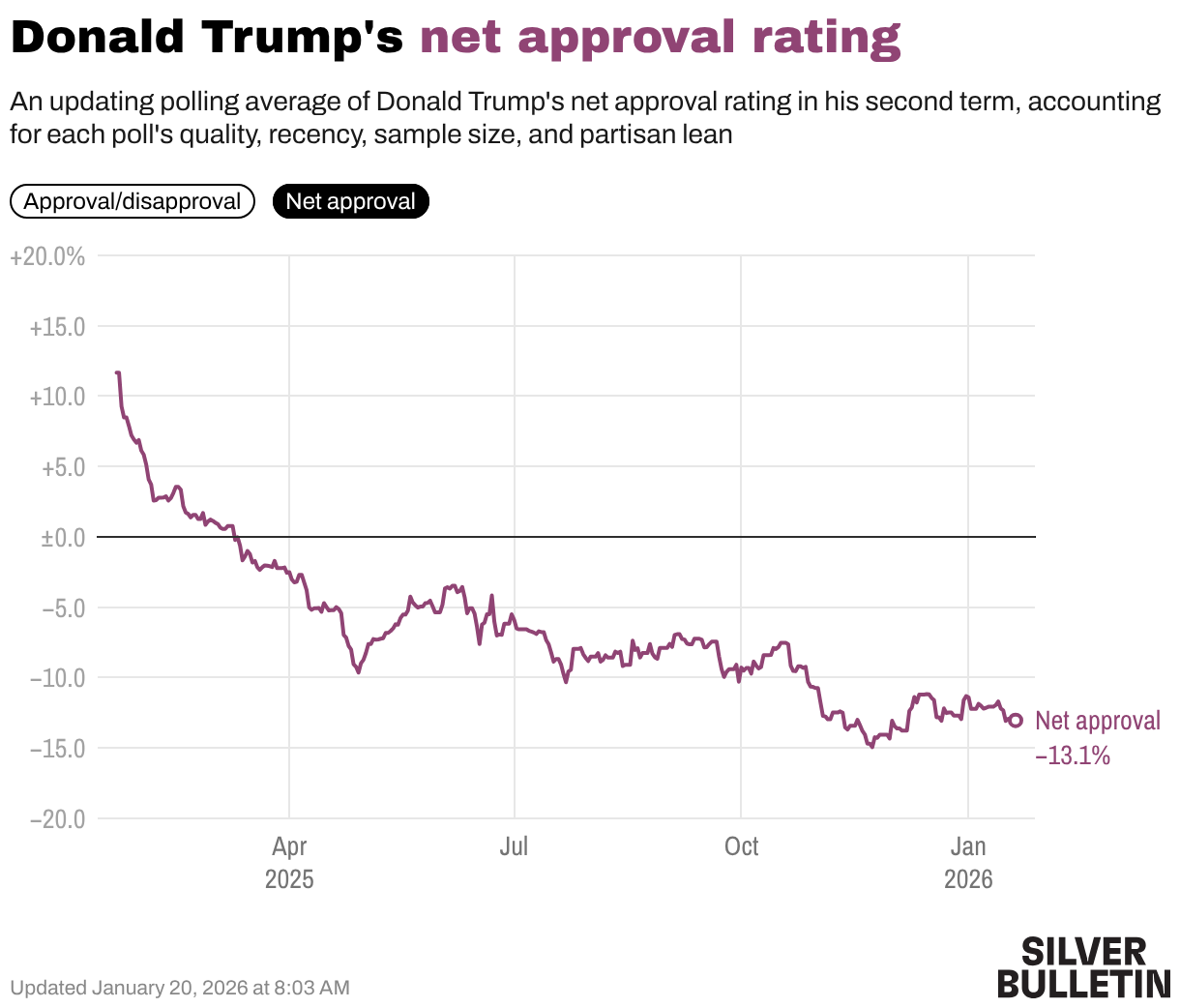
Trump started out the year more popular than ever (net approval: +11.7%). He now boasts a net approval of -13.1%. On average, polls show that 42% of Americans approve of his job performance; 55% disapprove.
Most strikingly, his poll numbers have declined on the two areas that were long considered his strongest: immigration and the economy.
According to a new CNN poll, 55% of Americans say that Trump’s policies have worsened economic conditions in the country. Only 32% say they’ve made an improvement. (Considering how unpopular a Greenland takeover is, the news that Trump is trying to raise prices further to conquer the territory probably won’t help.)
Meanwhile, a CBS poll found that 61% of Americans believe ICE is “too tough.” 52% say the agency is making communities less safe. 54% disapprove of Trump’s deportation program, a five-point uptick from December. While 50% support his deportation goals, only 37% support his deportation approach.
This change in popularity comes as new stories emerge from ICE’s crackdown in Minneapolis, such as the story of one U.S. citizen who was dragged out of his home with barely any clothes on before being returned later that day without any explanation or apology, or the protester who was arrested and had her clothes removed and wedding ring cut off, before being released and never charged with any crime.
Beyond just the realm of popularity, Trump’s term has also been of mixed success. In areas where he boasts complete control (pardons, military operations, White House renovations), he has been able to carry out his will. In areas where his powers bump up against those of Congress or the courts, he hasn’t always been as successful. Very few of his executive orders have been codified into legislation; many of them have been struck down by judges. His revenge prosecutions have been frequently thwarted by grand juries. The Supreme Court has so far blocked him from firing members of the Fed board; they will hear full arguments on it tomorrow. (A Supreme Court decision on his tariff power is also pending, potentially being issued as early as today.)
It is not as if Trump didn’t want, in his first term, to do many of the more cartoonishly Trump-like things he has done in his second. But he was repeatedly constrained by advisers, who held him back from more audacious economic and foreign policy decisions. Trump resented this, and made sure to stack his second White House with advisers who would entertain, and not constrain, his impulses.
However, his polling on the economy and immigration, in particular, show that it was likely these first-term advisers who were protecting him from political freefall, creating the context for his return by pulling him back in these areas and keeping him from legal failures — though he doesn’t see it this way, of course.
Trump’s second term has been governed completely by impulse: a president fully unleashed, though importantly only in terms of everything that comes before a decision is made. What happens after — in the courts, and in the court of public opinion — has not always been as firmly in his control. There are some presidents for whom that might be humbling. For Trump, it likely means a Year Two where the remaining guardrails will try to assert themselves, which will make him try to buck up against them even harder, seeking to push the limits of his power ever farther.
Can we safely say we are no longer headed toward becoming a Fascist country, but are already there?
Trump is and always has been a gutless, arrogant, womanizing rich boy…….and now we see the bullying, unfit, obsessed with power, monster he really is and this monster is the leader of the free world. Journalists need to repeatedly call him out as he is unfit for the presidency