


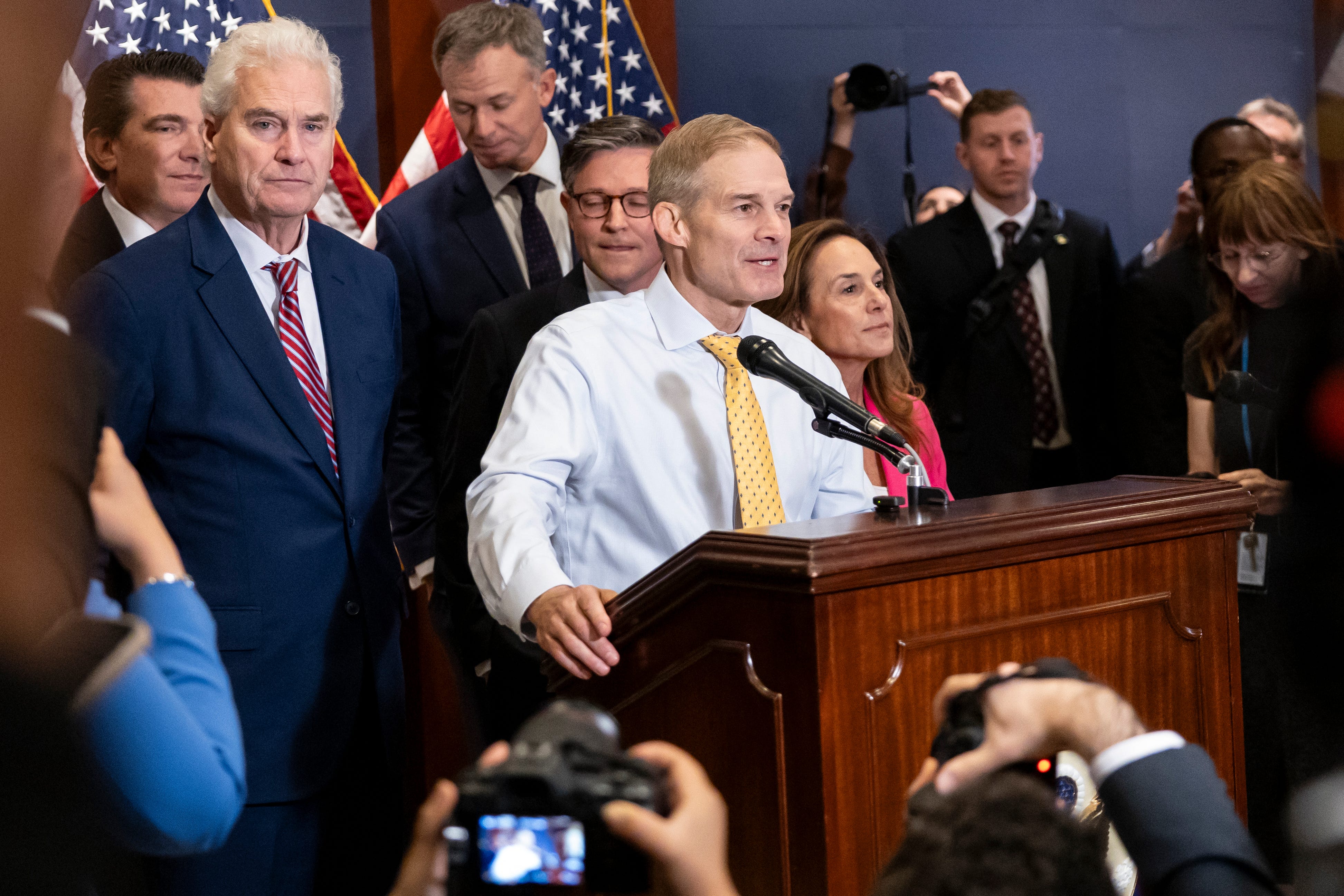
Former House Speaker John Boehner once called Rep. Jim Jordan (R-OH) a “legislative terrorist.” Come January, Jordan will be known as “Mr. Leader.”
Jordan was elected on Tuesday by his GOP colleagues to serve as House Minority Leader in the next Congress, elevating a combative partisan brawler to become the face of House Republicans after their sweeping losses at the ballot box. Jordan triumphed over Rep. Steve Scalise (R-LA), a leadership mainstay, in a private 106-73 vote.
The fight between Jordan and Scalise presented a study in contrasts. Scalise has spent more than a decade methodically climbing the House GOP leadership ladder, serving four years in the No. 3 spot and then the last seven as the No. 2. He has been a constant on the leadership teams of four different House GOP speakers or minority leaders: John Boehner, Paul Ryan, Kevin McCarthy, and Mike Johnson.
Jordan, meanwhile, has been a constant leadership critic for much of that same timespan. He was one of the founders (and first chairman) of the right-wing House Freedom Caucus, which led the charge to defenestrate Boehner in 2015. Then, after the 2018 elections, he challenged McCarthy for the post of Minority Leader.
When McCarthy won, he sought to neutralize Jordan as a rival, handing him plum posts like the top Republican spots on the House Oversight and Judiciary committees. This softened the Ohioan to an extent, but for many on the Hill, seeing Jordan’s election on Tuesday was akin to watching someone who has spent years lobbing grenades at the Republican leader’s office suddenly move into it.
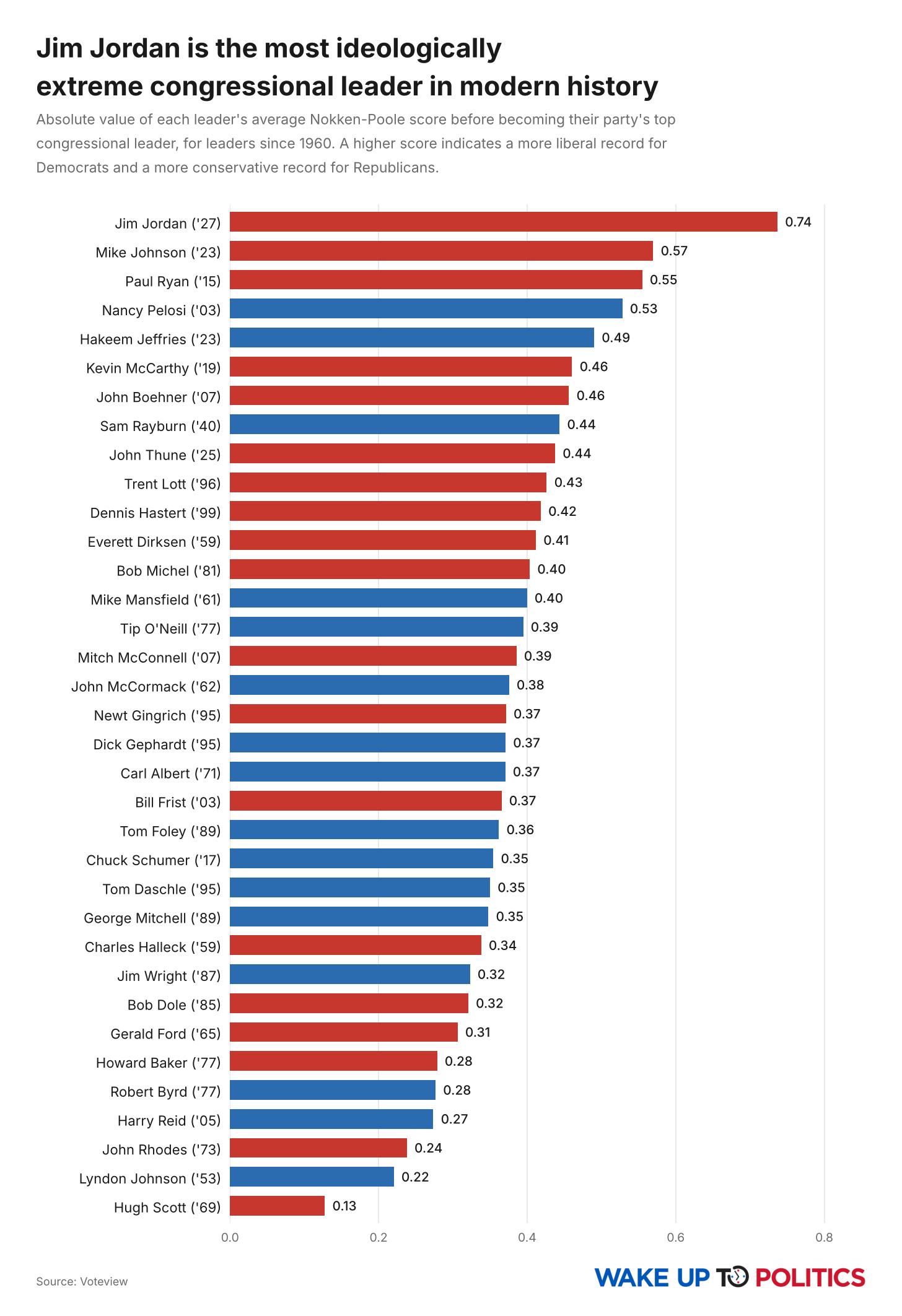
Republicans hope that Jordan will lead the party in aggressively confronting the Democratic investigations that are sure to come. But from a policy perspective, Jordan is, empirically speaking, an unusual choice for Minority Leader. According to a Wake Up To Politics analysis of legislative voting data, Jordan is the most ideologically extreme congressional leader in modern history.
Below, I’ve taken every top Democrat and Republican in the House and Senate since 1960, and calculated their average Nokken-Poole score (a widely used measure of congressional voting records) for every Congress they served in before becoming leader. The metric takes into account every vote a member of Congress takes, assigning an ideological valence to each one in order to score the member’s overall ideology. For our purposes, on a scale of 0 to 1, the closer a member is to 1, the more ideologically extreme they are (for Democrats, that means they’re more liberal; for Republicans, that means they’re more conservative).
Jordan, with a score of 0.74 on that scale (almost as conservative as a Republican can get), sticks out like a sore thumb compared to previous House speakers and minority leaders and Senate majority and minority leaders since the ’60s. Mike Johnson, the current House speaker (who did not seek another term as the top House Republican), is in second place, but with a score of 0.57, there is a significant gap between him and his soon-to-be successor.
In fairness, however, this might not be the best metric to get a sense of where Jordan stacks up in history.
It does mean that he is the most extreme congressional leader in an absolute sense, stretching back to the 1960s. But take a look at the top of the chart: it’s clustered with familiar names from the last few years (not just Jordan and Johnson, but also Paul Ryan, Nancy Pelosi, and Hakeem Jeffries). Perhaps all this chart is telling us is that both parties have become more extreme in recent years, which would make it natural that those more extreme parties are elevating more extreme leaders. It would tell us something about our politics, but maybe not something specific about Jordan.
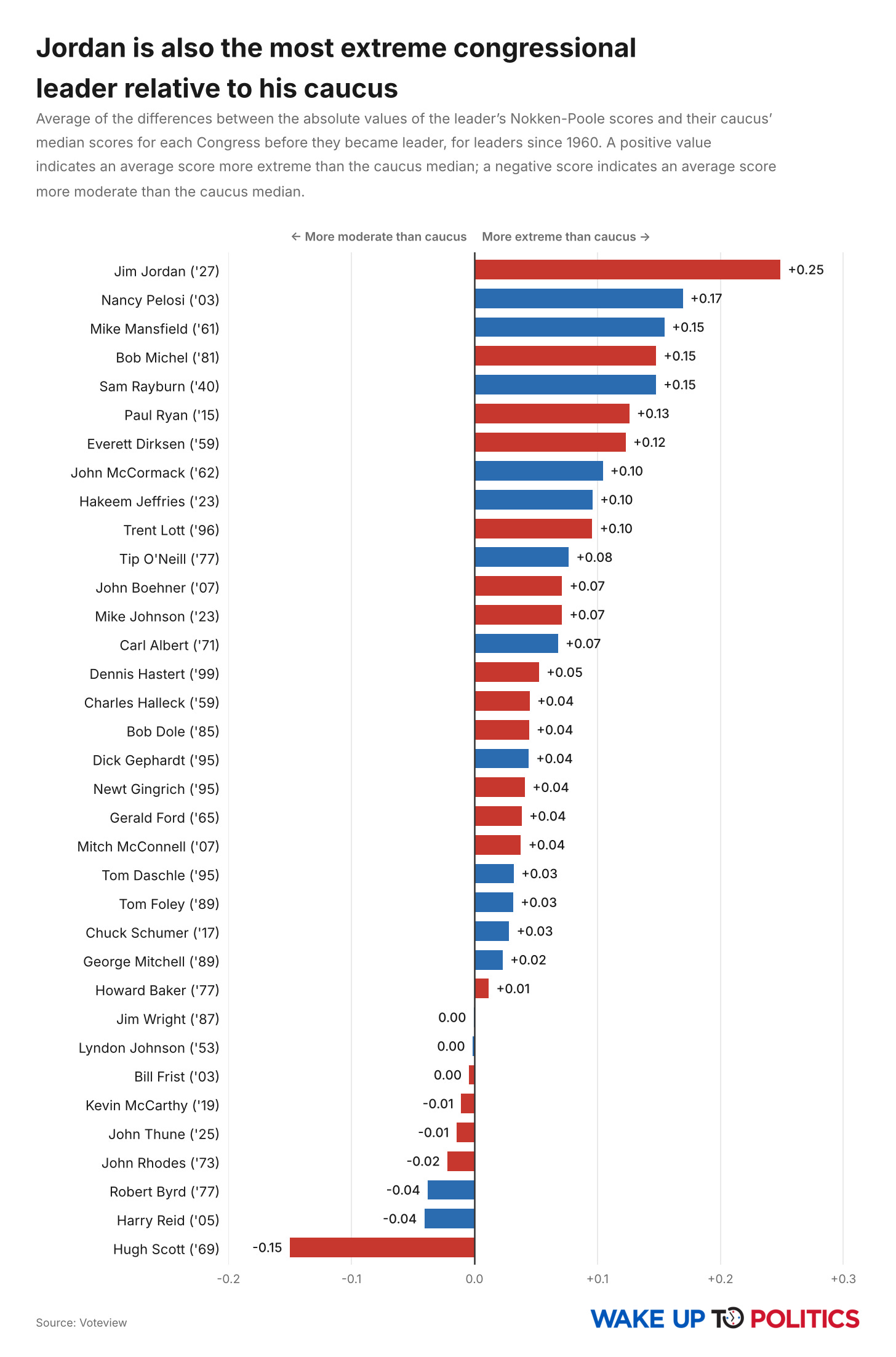
That’s where my second chart comes in. For this next one, I took the median ideological scores of a leader’s party caucus for every Congress they served in before becoming a leader, and calculated the average difference between the leader’s own scores and their party medians.
This tells us not just how ideologically extreme a congressional leader is — but how extreme they are relative to the other members who were serving in their party at the time. It shows how often parties are picking leaders from the center of their caucuses, and how often leaders are coming from the ideological wings. (In this chart, a positive value means a leader was more extreme than their caucus median, either in a liberal direction for Democrats or a conservative direction for Republicans. A negative value means a leader was more moderate than their caucus median.)
Now, we can see that we’ve solved our recency problem. In an absolute sense, for example, Kevin McCarthy and John Thune were among the most ideologically extreme leaders in recent history. But if you place them in the context of their respective caucuses, the picture is different: both scored almost exactly in line with the median of their party caucuses in the Congresses before becoming leader.
But one thing that isn’t different? Jordan still comes out on top. Not only is he the most extreme congressional leader in recent history, but he is also the most extreme leader relative to the ideology of his own caucus. Here, Nancy Pelosi takes the No. 2 spot, but again, there’s an unmistakable gap. Even adjusting for the fact that the House Republican Conference is more ideologically conservative as a whole than in the past, Jordan still sticks out as a highly unorthodox pick for leader, with a voting record that is far to the right even of the House Republicans that elected him. (By comparison, in this chart, Scalise would land about where Mike Johnson does: in the middle.)
For these charts, I used 1960 onward because I thought that was a reasonable starting point for the modern party era. (Leaders who were in their positions as of 1960, but began serving earlier, are included.) But I also extended the analysis out a little further, just to see if the conclusions would remain correct. Out of every leader in the post-World War II era, Jordan remains the most ideologically extreme in an absolute sense.
Compared to the caucus that elected them, only one leader stands out as having been plucked from (ever so slightly) further in the ideological trenches: Kenneth Wherry, a Nebraska Republican who served as Senate Minority Leader from 1949 to 1951. (He was 0.26 points to the right of his caucus median, compared to Jordan’s 0.25.)

For context, Wherry rejected the term “conservative” because he felt it inadequately described his ideology; he preferred to call himself a “political fundamentalist.” Wherry was a dogged isolationist in the years after World War II: he was one of only seven senators to vote against full U.S. entry into the United Nations, one of 13 to oppose the NATO Treaty, and one of 17 to vote against the Marshall Plan (the aid package for post-war Europe that was approved by a Republican-controlled Congress).
Wherry was also a key part of the so-called “Lavender Scare,” leading the charge to purge the federal government of homosexuals (whom he described as “moral perverts”). For Wherry, this was a cause closely connected to his fear of communism: he believed, without evidence, that Adolf Hitler had kept a list of “the names of homosexuals around the world,” and that the list had since fallen into the hands of the Soviet Union, so that they could use it to blackmail gay American government employees into becoming communist spies.
Wherry believed that pretty much every expansion in government spending was evidence of a “socialistic welfare state.” Once, when Ohio Sen. Robert Taft — then the leader of the party’s conservative wing — supported a public housing bill, Wherry questioned whether even Taft (who was known as “Mr. Republican”) was, in fact, becoming a socialist.
The late Nebraska conservative (sorry, fundamentalist) is the only parallel we have to Jordan in the post-World War II era: the only time that Democrats or Republicans in the House or Senate have selected a leader so far removed from the ideological center of their own party.
What will the impact of the choice be?
I don’t want to pretend like the next House Minority Leader is going to dictate the results of the 2028 elections. As of October, 47% of voters were either neutral toward or didn’t know the name of Hakeem Jeffries, the current House Minority Leader, per an NBC poll, while 42% said the same about Mike Johnson, the current top House Republican.
Jim Jordan’s name ID will likely be similarly low.
But Jordan doesn’t need to be well-known to have an impact. As with Trump’s decision to tap Stephen Miller as his post-election chief of staff, Jordan’s election is a telling signal about the direction of the Republican Party after its historic losses: specifically, that the GOP has no intention of fixing the things about their party that voters so overwhelmingly took issue with. (We don’t have Nokken-Poole scores for White House chiefs of staff, but if we did, I have no doubt that Miller would also rank as the most ideological COS in history.)
An AP poll before the election found that 68% of voters (including one-third of Republicans) described Trump as “too extreme.” 55% of voters said the same about the Republican Party as a whole — noticeably more than the 45% who said so about the Democratic Party. House Republicans have now answered those concerns by elevating the most extreme congressional leader in recent history.
With Jordan and Miller at the helm, you should adjust your expectations for congressional bipartisanship next session downward. (However, South Dakota Sen. John Thune, who was re-elected as the top Senate Republican on Tuesday, has been known to dabble in bipartisanship.) Although Trump is highly ideologically malleable, and therefore susceptible to occasional dealmaking, Jordan and Miller are not. They are ideological warriors; it is difficult to think of a time that either one has brokered (or even supported) an across-the-aisle compromise.
Here’s one example I’ve been thinking of.
Hakeem Jeffries, the likely next House speaker, recently said that raising the minimum wage will be one of the Democrats’ top priorities in the next Congress. This is a popular position. A YouGov poll last year found that 69% of Americans support raising the federal minimum wage to $15 an hour. (It has been set at $7.25 an hour since 2009.) A 49% plurality of Republicans were in support.
Left to his own devices, you could imagine Trump embracing a minimum wage increase. During his 2016 campaign, at various points, Trump expressed support for either a $10 or $15 minimum wage (though at other points, he opposed an increase). After his 2024 election, Trump said he “would consider” raising the minimum wage.
Jim Jordan, however, has consistently opposed minimum wage increases in the past. It is hard to imagine him leading House Republicans in support of a minimum wage bill if one reaches the floor.
Every time Jordan leads House Republicans in voting against a popular bill that Democrats put on the floor, it will be that much harder for Republicans to climb out of the hole they’ve sunk into after 2026.
Personally, I don’t think yesterday’s vote on whether to move forward with an impeachment of Defense Secretary Pete Hegseth — which House Republicans squashed — was a good example of this.
Impeachment is a solemn act (only two Cabinet officials have ever been impeached in history), and in this case, there were no hearings or investigation carried out, which made it easy even for Republican lawmakers who have criticized Hegseth to object. From a political perspective, there’s also no evidence that impeaching Hegseth was going to be a particularly popular endeavor. Per YouGov, Hegseth’s impeachment lacked majority support nationwide. It was also backed by only 8% of Republicans, which means GOP lawmakers were roughly where their party’s voters are.
But the forthcoming votes on whether to end the Iran war are a different story. That is an effort that carries majority support, at least according to a Reuters/Ipsos poll, which found that 71% of Americans want Congress to pass a measure ending the war — including 51% of Republicans.
If GOP lawmakers oppose these votes come January, they will be going against a supermajority of the country and a majority of their own party’s voters. (At least according to the Reuters poll. I will be curious to see more surveys on this in the weeks ahead. There is some polling evidence to suggest increased Republican opposition to the war post-election, but I’d like to see more data points.)
This is an example where it could be genuinely harmful for their party’s prospects for Republicans to stay the course. With Jordan as their leader, it’s unlikely any congressional break with the war is forthcoming (though, to be clear, it’s not as though Scalise was about to lead a House GOP revolt against Trump either).
This might seem like surprising behavior from a political party after a loss, but historically speaking, it really isn’t. As I wrote on Monday, presidents tend to double down in the face of midterm losses. Similar dynamics hold true in Congress. A party’s congressional losses tend to be concentrated in battleground districts, which tend to produce more moderate members: that means that when the battleground members are wiped out, the most extreme members are the core that’s left. That’s exactly what happened this year. As Matt Glassman has noted, this means that defeated congressional parties often learn the wrong lessons from their losses — since the Jim Jordans of the world remain, no longer burdened by the more moderate members. It can form a self-propagating cycle of extremism, followed by defeat, followed by more extremism, followed by more defeat.
If Republicans wanted, they could learn from Republican governors who survived the blue wave, like moderates Phil Scott in Vermont and Kelly Ayotte in New Hampshire — or the handful of House Republicans in competitive races who did hold on, like Reps. Jeff Hurd in Colorado (who voted against Trump’s tariffs) and Maria Elvira Salazar in Florida (who recorded an ad bashing Trump’s immigration policy).
Instead, GOP lawmakers are swimming in the opposite direction, taking one of the most conservative Republicans in the House and making him their leader, something no recent congressional party has ever done to this degree.
Fabulous piece, Gabe.
Any article that solidly supports the use of the word definistration is a good one.
I've been looking for a substantive review of the impact of the elections and here we are. Lifting the panel (I would have said skirts a couple of decades ago) of Congress so we can really see the mechanisms and understand their import is invaluable. I do not expect to see anything nearly so insightful.
Long ago and far away I used to read National Review. My father-in-law had a subscription. I don't think I agreed with a single article in the magazine but it helped me see how things worked and how people in charge really did things. Your writing reminds me of that. Without the pomposity and reactionarly bent. And I don't quite so frequently need a dictionary reading your emails. Only occasionally.
When I read your articles I see contributions to history, to the understanding of this era. Keep it up, please.