


Happy Monday morning! Some quick news from me before we dive in today: I’ve started a YouTube channel!
I’ll be using the channel to post all sorts of videos explaining and analyzing our political moment, building on the thrice-weekly newsletters. I’m excited to chat about politics with you in the same non-partisan style you know, but in a new way, using a new medium.
You can watch the intro video below. If you could take a moment to subscribe here, it would be so helpful as I start to grow WUTP on a new platform — and it’ll ensure that you get all the new videos directly to your feed. More to come soon!
Now, let’s talk 2028…
Pete Buttigieg is headed back to Iowa. Ro Khanna and Andy Beshear were just in South Carolina. JD Vance is everywhere promoting his new book and the Iran ceasefire deal. Marco Rubio, conspicuously, is not.
The 2026 midterms are still a little more than four months away. But the jockeying for 2028 has already started.
We obviously have a long way to go before the 2028 elections, and my main focus here at Wake Up To Politics in the coming months will be covering the midterms, the Trump administration, and other more immediate topics. But since whispers about the next presidential contest have already started, I wanted to take some time to lay out an opening baseline for how I’m thinking about the 2028 race, which we can then return to and update as time goes on.
This may seem like a premature exercise, but thinking about 2028 can also help fulfill one of the main functions I try to serve in WUTP: helping you see around corners and think deeply about how American politics is changing and evolving, and spotting where it’s headed. After more than a decade of the Democratic and Republican Party platforms revolving almost completely around Donald Trump (whether in support or opposition), 2028 will be a fascinating moment where the future of both parties will be up for grabs.
It’s never too early to think about who might grab it, if only to inform who (and what) is worth watching until then.
Republicans
I mostly believe the talk about a heated Vance-Rubio primary is overblown.
The whole reason Trump chose Vance as VP was to serve as his ideological heir, and unless Vance loses Trump’s trust in a big way, I expect he’ll be the GOP nominee in 2028.
History is certainly on Vance’s side, and stacked against Rubio. The last time a sitting vice president ran for the presidency and lost his party’s nomination, it was in 1952, when Harry Truman’s running mate, Alben Barkley (who was 74 years old at the time), came up short against Adlai Stevenson.1 Generally, when sitting VPs run, they don’t even face much of a challenge: Al Gore, for example, won all 50 states in the 2000 Democratic primaries, the only non-sitting-president to ever do so. George H.W. Bush won 42 states in the 1988 GOP primaries. You probably remember Kamala Harris’ glide path to the 2024 nomination (not that it involved winning any primaries).
Of course, the ultimate decider in the 2028 Republican primary is likely to be Donald Trump, who has little use for history, so if he wants to buck those precedents and have a contested nomination fight, he’ll probably get it. In fitting with his management style dating back to his business days, when he believed that the best work would emerge through competition among his subordinates, Trump is clearly enjoying pitting Vance and Rubio against each other.
Vance himself has compared this to “The Apprentice,” joking last month: “I just don’t think it sounds like the president of the United States to have a televised competition for who would succeed him as his apprentice. I just think that’s not at all what you would expect the president to do.”
My prediction is that Trump will allow this to go on as a shadow primary for as long as it amuses him, but eventually sit the two men in a room, and anoint Vance as the nominee and Rubio as his running mate. Trump enjoys messy competitions up to a point, but there will also be an appeal in a clean succession process, where Republicans aren’t picking over or debating his legacy, and instead enter 2028 with a pre-determined ticket.
All of this could be complicated by Trump’s expected discomfort with being replaced. He will likely try to push off any 2028 conversation for as long as he can, to postpone seeming like a lame duck. If Vance makes any moves too early, it could backfire. I’m also curious how long Rubio stays in the Cabinet. If Trump does give Vance his endorsement, but Rubio still wants to make a play for the crown, it would be pretty difficult for Rubio to challenge the president’s handpicked successor while serving as secretary of state in the same administration.2 If Rubio does step down sometime in mid-2027, he would have a bit more room to maneuver than Vance, since he would no longer be directly in Trump’s employ.
Vance and Rubio aren’t the only two Republicans positioning themselves for 2028: Ted Cruz is trying to carry the neocon mantle. Rand Paul could try to bring the party in a more libertarian direction. Tucker Carlson remains a wild card. But — at least at this point — it’s hard to imagine any of them having much of a shot, especially if Trump (who still commands 80%+ approval among Republicans) makes his wishes known.
A recent poll from the left-leaning firm Navigator Research found that Vance is about as popular as Rubio among non-MAGA Republicans, and much more popular among MAGA Republicans, which will make him hard to beat. He has also been much more assiduous than Rubio about laying the groundwork for a bid, most importantly as RNC finance chairman, a role that has brought him into close contact with deep-pocketed donors.
From there, my other hot take about Vance is that he’s underestimated as presidential timber in a general election. I’ve written before about this chart from the right-leaning Echelon Insights, which fielded a poll asking 18 questions on social and economic policy, and then sorted respondents into four categories: Conservatives (socially conservative, fiscally conservative); Liberals (socially liberal, fiscally liberal); Libertarians (socially liberal, fiscally conservative); and Populists (socially conservative, fiscally liberal).
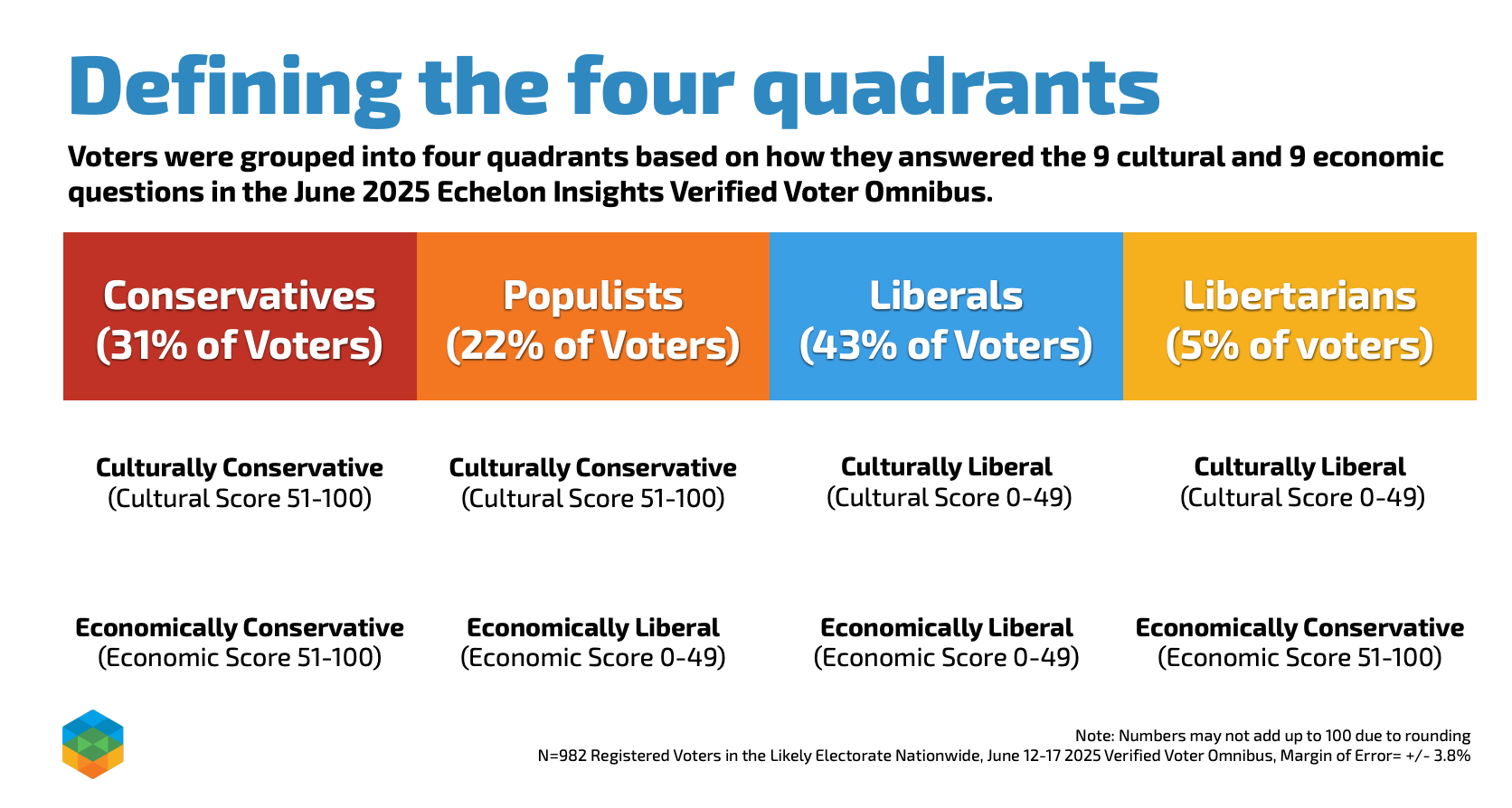
Liberals vote overwhelmingly for Democrats. Conservatives vote overwhelmingly for Republicans. Libertarians are a tiny percentage of the population. Increasingly, the real American swing voters are the culturally conservative, economically liberal Populists. According to Echelon, this is the median position of the American voter (64% of voters are economic liberals, 53% are cultural conservatives, according to their data), which also tracks with many of the stances I identified last week as commanding a public opinion supermajority.
Trump has tried to hit this combination rhetorically, but has never actually governed like an economic liberal. Vance is probably the candidate best suited, in either party, to nail this synthesis, which surveys show is the sweet spot of the American electorate (or at least the refuge of many independent voters). His cultural conservatism is without question; reportedly, he has also tried pushing the Trump administration in a more economically liberal direction behind the scenes, from pushing for a millionaire tax as part of the One Big Beautiful Bill to encouraging more antitrust enforcement.
Vance, unlike Trump, loves pointing to places where he diverges from the business elite. In a recent podcast interview with New York Times columnist Ross Douthat, Vance spoke about the “Christian economic tradition of trying to uplift the poor and supporting your community and being there for people who are really struggling” — and criticized the “business side of the Republican Party” for not heeding that tradition.
The vice president is also adept at channeling anti-establishment sentiment (which is also highly popular these days), but doing so in a calmer tone than Trump (whose combative tone is routinely identified by swing voters as a turn-off). It’s famously hard to be a vice president, when you have to live in the president’s shadow and go to bat for an agenda that isn’t your own, but Vance has tried to show this persona at times, including during the 2024 vice presidential debate, with his recent book where he expressed regret for his “childless cat ladies” comment (something Trump would never do), and in an interview last week where he even charmed Joy Behar of “The View.”
None of this is to say Vance doesn’t have vulnerabilities. He can be awkward at times. He can be too online, spending a lot of time on Twitter (including in spaces that go far beyond the ideological mainstream). A former venture capitalist, he is trying to thread a tough needle on AI, and his boosterism of the unpopular technology threatens to undercut the more populist, anti-business, anti-establishment platform I was describing earlier.
I don’t think the Iran war (or deal) is as big of a vulnerability for him as others do, mostly because a lot will happen between now and 2028, and other issues will likely be on the front-burner. His recent criticism of Israel could cause issues with some Republicans in a primary — “ABDJD2028,” the ardently pro-Israel Rep. Randy Fine (R-FL) recently tweeted (“Anyone But JD 2028”) — though, once again, it places him in the American mainstream in a general election.
Vance certainly has his downsides, and there is no question succeeding Trump will be hard, either because he will make life difficult for Vance in a primary, his successor will have to unite a coalition that one man will have kept together for 12 years, and because the Trump administration is not exactly popular among the general electorate. But (especially matched with Rubio as a running mate), I do think Vance’s ability to blend Trumpism with a more genuine populism (and put a smoother voice on it, more adept at reaching a broader cross-section of voters) is not to be underestimated.
Democrats
Another theme I’ve hit on in recent years is that, while Donald Trump has been an improbably successful electoral phenomenon (at least by the “I’m president and you’re not” standard), that strength has often not carried down to downballot Republicans in swing states, where right-wing Trump imitators have generally failed against generic, moderate Democrats.
For that reason, Democrats have a large bench in several of the states Kamala Harris lost in 2024. Since they need to win these states to win the White House in 2028, it probably makes sense to start there, with Mark Kelly or Ruben Gallego in Arizona or Josh Shapiro in Pennsylvania or Jon Ossoff or Raphael Warnock in Georgia. (Gretchen Whitmer in Michigan also fits into this category, but it doesn’t seem like she plans to run.)
Of these names, Ossoff is undoubtedly receiving the most buzz right now (see the New York Times, Politico, or the New York Times again), and I think there’s good reason for that. If he wins re-election in purple Georgia by a large margin this November, he is likely to rocket to the top of the 2028 speculation.
As with Vance, Ossoff has been trying to establish somewhat in the populist lane, championing bills to lower prescription drug costs and counter “corporate price gouging” while also taking steps to moderate on immigration. He has also been moving into more anti-establishment rhetoric, working across the aisle on banning congressional stock trading and using a series of viral speeches to highlight allegations of Trumpian corruption (and to take on what he calls the elite “Epstein class”).
None of the three candidates Democrats have nominated since Obama have been steady communicators; my main prediction for 2028 is that the party will fall over itself for the first candidate who can speak fluidly both on the stump and off the cuff, and Ossoff checks those boxes (an admittedly low bar, but one the party hasn’t cleared in three consecutive election cycles). Successful presidential candidates also generally defy running in one lane of their party or the other (Obama and Trump are both examples of this); Ossoff is a moderate Democrat who receives praise from the leftist Hasan Piker.
He doesn’t even figure in the current polls, however, nor do most of the other people I named above. Per the Race to the WH average, the current polling top tier is Kamala Harris, Gavin Newsom, Pete Buttigieg, and Alexandria Ocasio-Cortez:
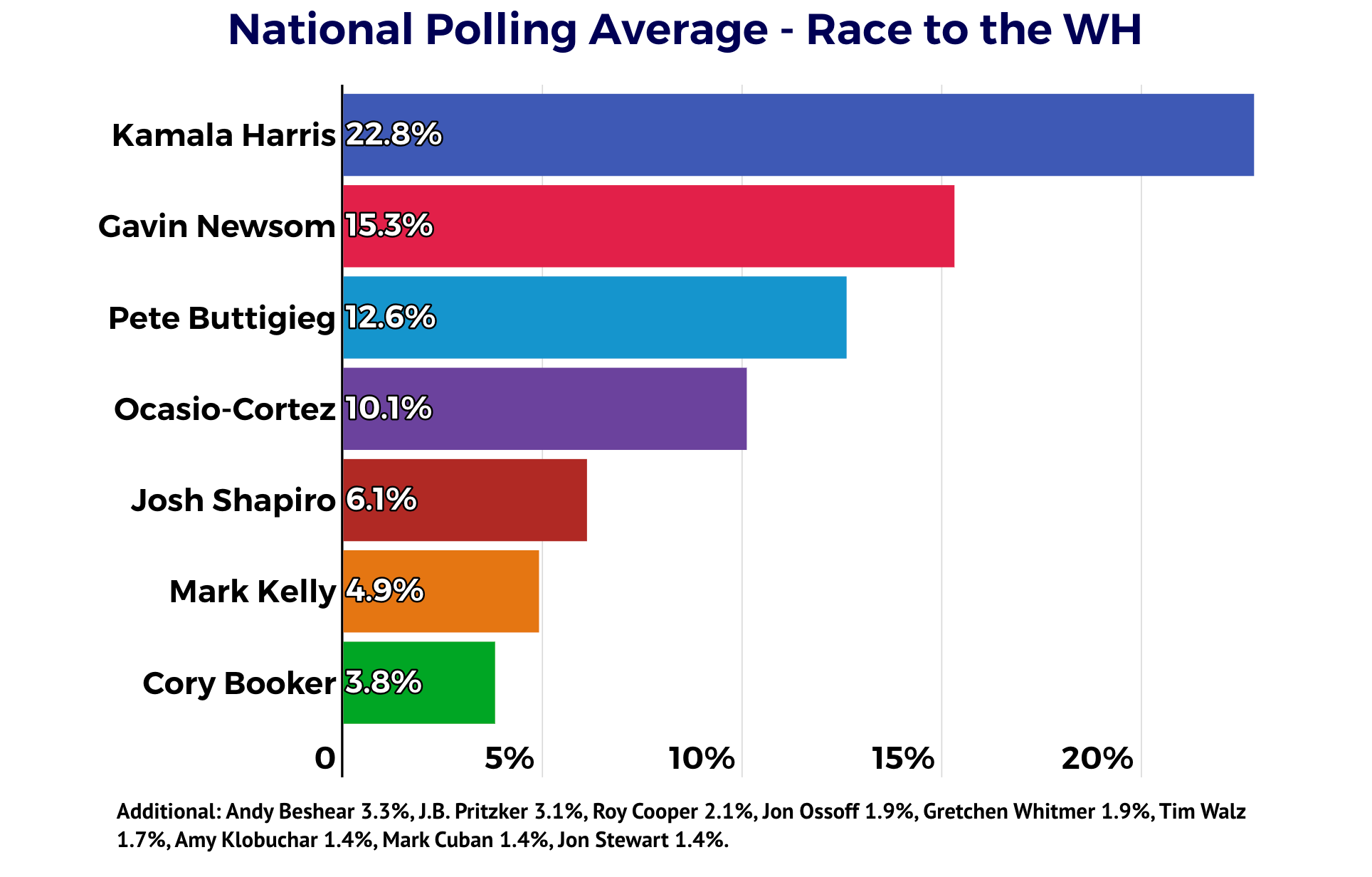
Until proven otherwise, I think the Harris/Newsom lead is mainly a product of name ID. The general rule (except when sitting VPs are running; see above) in presidential primary polling is that the people who are leading this far out generally don’t become the nominee, from Hillary Clinton (2008) to Jeb Bush (2016). That early support usually flows to the biggest names in the race, who people know and recognize. But it often doesn’t stick once fresher alternatives emerge.
Harris has recently been trying out a new outsider, anti-system persona, but a recent interview with Don Lemon shows that she isn’t necessarily better at smoothly articulating it than she was her previous platform. Asked by Lemon if the Electoral College should be eliminated, she replied: “That should be a discussion that we should have. I don’t think that we should eliminate that as a point of discussion for potential action.” I’m just not sure that sort of lawyerly, speaking-without-saying-anything is what’s going to meet the moment for Democrats in 2028.
Moving further down the list, Buttigieg is an interesting candidate, though his main Achilles heel is the same as it was in 2020: his lack of support among Black voters. It’s hard to win a Democratic nomination without support from Black voters. (This is also, by the way, the biggest point in Harris’ favor right now.) Ocasio-Cortez is well positioned to occupy the progressive lane left by Bernie Sanders (without anything approaching her name ID, Ro Khanna and maybe even Chris Van Hollen seem to be planning to run in this lane as well). Progressives are coming off of a run of primary successes, which could continue this week in New York. Young, charismatic, and often clever about where she positions herself in the party’s internal fights, there’s no question AOC will be a force to be reckoned with in a primary.
The 2028 Democratic field will be wide open. Every bit as much as the GOP, the Democratic Party has spent more than a decade existing in the shadow of Donald Trump and will be hungry for new ideas and new faces — and to try new things. All three of the candidates that Democrats tried against Trump were fixtures of the party establishment who made little effort to criticize their own party or separate themselves from its most unpopular features, even as Trump delighted in doing that within the GOP, recognizing that we are living in a moment when party establishments are unpopular.
I’m sure there are names we aren’t thinking of who will rise in the 2028 conversation between now and then. If James Talarico or Graham Plater (yes, even with the scandals) win their races in November, expect them both to receive presidential buzz. I’m sure celebrities like Mark Cuban and Stephen A. Smith will take a look as well. A lot can happen in two years.
General election
The last point I’ll make about the 2028 contest is that I think it’s under-discussed how young it is likely to be. Below, I’ve charted the ages of the major party presidential nominees since 1864, as well as how old some of the prospects we’ve discussed today will be on Election Day 2028.
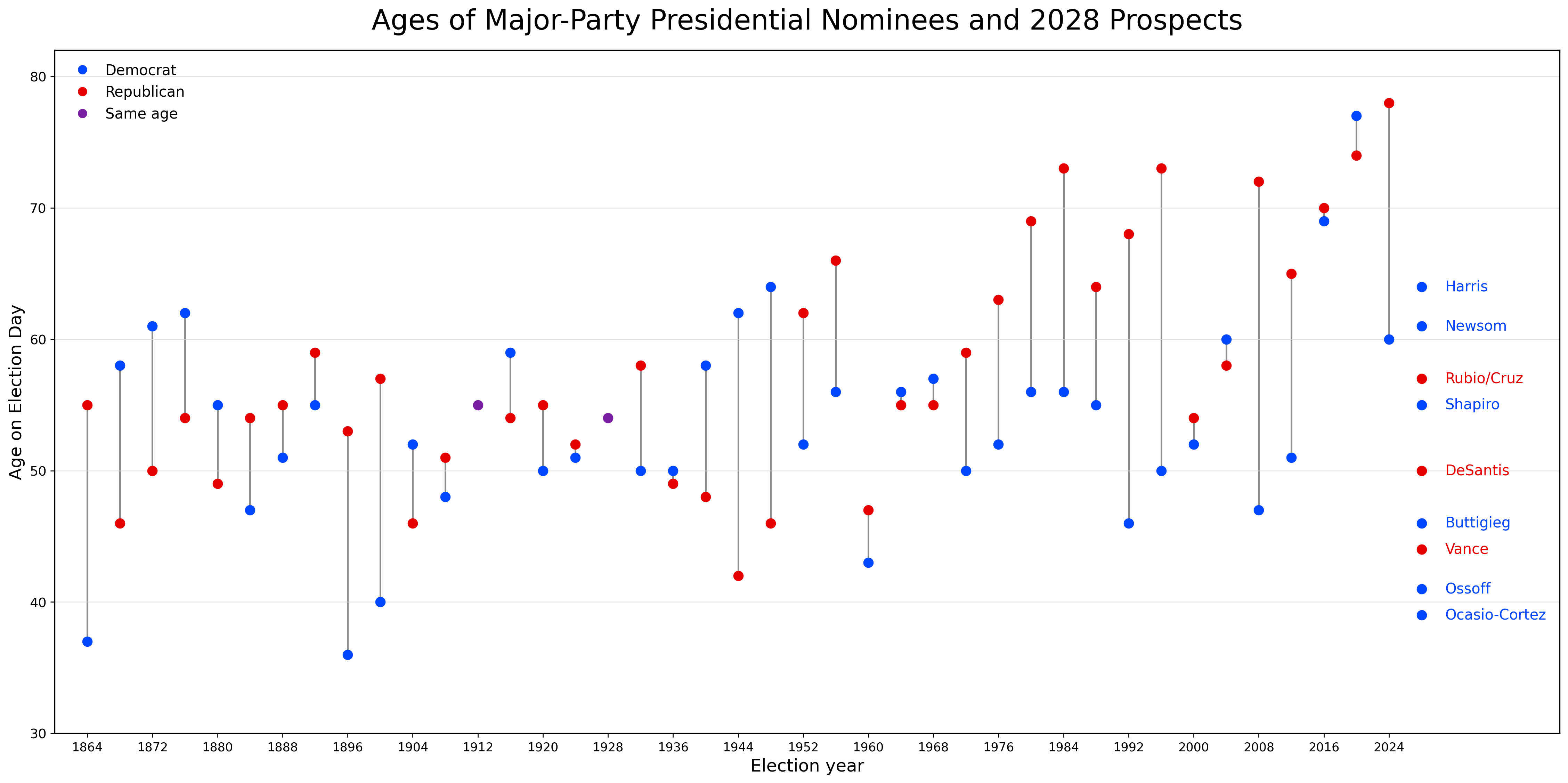
2028 is likely to be the first race since 2012 to feature a nominee who’s in their 50s or younger, and it’s possible that it will be the first race since 2000 where both nominees are.
If the race is between JD Vance (who will be 44) and someone like Jon Ossoff (41) or AOC (39), it will be the youngest presidential matchup since 1960, between John F. Kennedy (43) and Richard Nixon (47).
Maybe it’s naive, but I’m curious if that will change our politics or Americans’ perceptions of it. We have been living in an era where presidents, no matter what they do, are fairly unpopular, with frustration towards the political system and the economy rising year after year. My pet theory is that having a young, charismatic president who is a fluid communicator and tries to speak to voters beyond their base may do funny things to our politics. We think that this dissatisfaction and frustration is endemic — and it certainly is global (look at the UK, about to have their seventh prime minister in 10 years) — but perhaps the type of politicians each party has been putting forward has contributed more than we think.
2028 will be an opportunity not just for new candidates, but new ways of thinking: contenders who try to straddle their party’s divides in interesting ways, fusing and synthesizing different ideological agendas without hewing to the more calcified politics of the past. Don’t underestimate the power these messages could have, from either side of the aisle, when they come from candidates who can articulate their ideas with fluency and ease.
Again, it’s a low bar. But, at least according to the American electorate — many of whom have been “double haters” of both parties’ candidates in the most recent cycles — it’s one neither side has cleared in a while.
At least we have Barkley to thank for the vice presidential nickname “veep,” which was coined by Barkley’s grandson as an informal title for his grandpa.
Speaking of history, the Cabinet used to be a very common presidential stepping-stone (the 3rd, 4th, 5th, 6th, and 8th presidents all served as Secretary of State), but that hasn’t been the case in the modern era. The last president to serve in the Cabinet was Commerce Secretary Herbert Hoover, who was elected in 1928. Hoover is also the last sitting Cabinet secretary to win his party’s nomination, although Hillary Clinton is a more recent example of a former Cabinet secretary winning a party nod.
JD Vance has a lot of positional momentum, but he has no identifiable character, and is constantly engaged in attempting to create the appearance of whatever persona he believes will maximize his future success. There is nothing "in there" aside from sheer ambition. No one likes that sort of person. He is constantly bobbing and weaving and avoiding being pinned down because he doesn't actually stand for anything other than winning. He is the VP for a reason, and would clearly have followed the order that Mike Pence refused.
I appreciate the analysis and am curious why you left out KY Gov Andy Basheer as a possible Dem nominee.