



Is America actually a 50-50 country?
I know, I know: all our normal indicators say the answer is a definite “yes.” The 2024 election was decided 50%-48%. The U.S. House is divided 50%-49%. The Senate is 53%-47%. According to a CNN poll out yesterday, 46% of the country says they lean Republican, while 45% say they lean Democratic.
But if we’re so evenly divided, why doesn’t it show up when you ask about the issues?
Last week, the Pew Research Center released the latest version of their Political Typology study, which posed 80 questions to 10,000 Americans, and then ran a cluster analysis to sort them into nine distinct ideological groups: two solidly on the right, the “No Apologies Right” (comprising 9% of the country) and “Faith First Conservatives” (12%); two solidly on the left, “Leftward Progressives” (7%) and “Loyal Liberals” (11%); two that lean to the right, the “Unconventional Right” (12%) and “Pragmatic and Polite Right” (11%); two that lean to the left, the “Order and Opportunity Left” (18%) and “Left-Out Left” (12%); and one that doesn’t fit neatly into either ideological camp, the “Tuned-Out Middle” (9%).
If you’re curious about which group you fall into, you can take a shortened version of the quiz here.
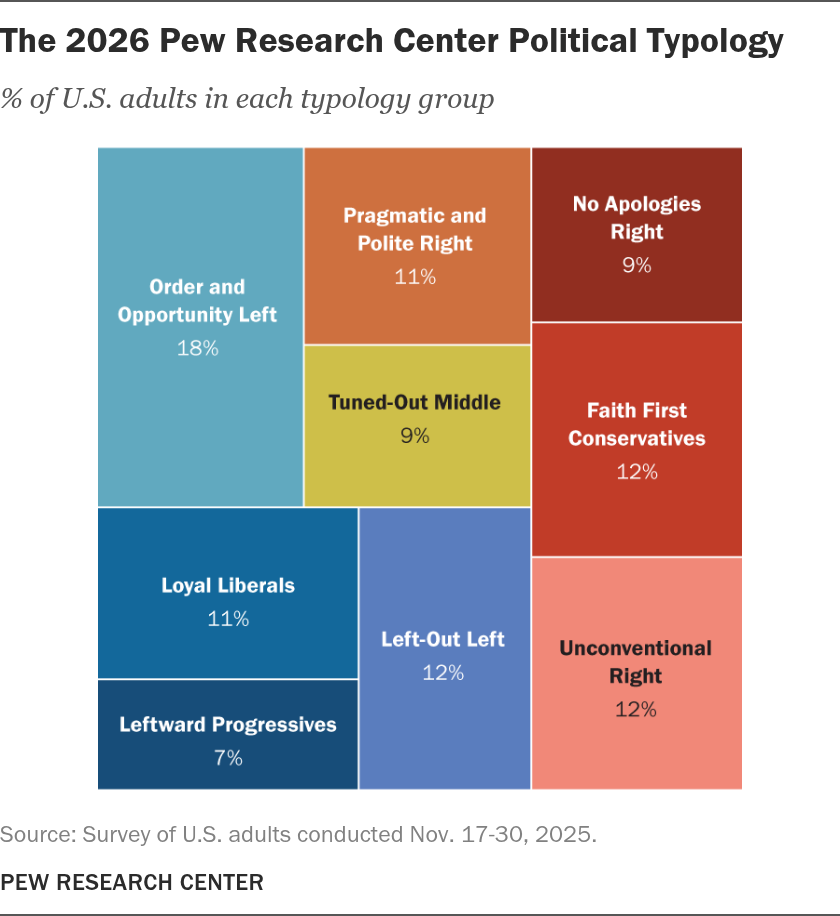
We’ll return to those labels in a moment. For now, I want to dwell on something I started to notice as I combed through Pew’s extensive data.
Pew asked its respondents about all the different issues that dominate American politics: abortion, guns, taxes, health care, voter ID, crime, the list goes on. They specifically chose the issues that are most divisive, the ones that were most likely to highlight the cleavages in American life. And yet, even on this list of issues manicured to draw out what divides us, it ended up showing a lot more unity than you might think.
In fact, when you look past how each individual group responded to each question, and focus on the topline numbers for Americans at large, there are very few questions on which we’re divided 50-50. On almost every issue, a supermajority of the country appears to coalesce around one stance or the other.
65% say that illegal immigration is a big problem. And 65% support a path to citizenship for the illegal immigrants who are currently here. 60% believe abortion should be legal in all or most cases. And 56% say they at least somewhat believe that human life begins at conception. 63% believe that America is strengthened by its diversity. But 57% believe that efforts to promote diversity in schools and workplaces have failed to make life more fair. 58% want to raise taxes on the wealthy, and 63% want to raise taxes on corporations. 67% believe that sex and gender are determined at birth, and 73% are uncomfortable with transgender athletes competing on sports teams that don’t match their sex at birth. 69% agree with vaccine mandates at public schools. 81% disagree with the idea that prison sentences are currently too long. 65% say climate change is a big problem, but 60% oppose phasing out gas cars. 57% believe that people being too easily offended is a big problem, while 70% say it’s personally important to them to try to say things that won’t offend people. 80% support requiring voters to show photo ID. 59% support no-excuse absentee voting. 83% say violent crime is a big problem. 76% say the same about gun violence. 70% have confidence in the police. 76% have confidence in the military. 61% oppose Trump’s tariffs. 68% believe the federal government should provide health care for all Americans. 91% view the deficit as a big problem. 81% oppose reducing Social Security benefits.
It may seem like I’m cherrypicking here, but I’m really not. A handful of Pew’s questions do show a truly evenly divided nation — the important question of whether the federal government should be bigger or smaller came down 53%-46%; the question of whether the U.S. has a responsibility to help Ukraine was split 50%-47% — but beyond those, there is almost always a side that commands a roughly 60% majority, if not more.
This should change our conceptions about the nature of American division. We think of Democrats and Republicans as bitterly fighting for American support on all of these “divisive” issues, but the truth is that there is an active competition over very few of them: Americans have decisively picked a camp on almost every question.
There’s almost nothing that the U.S. is truly split 50-50 on except for party affiliation.
The Centrist Party?
Whenever you see it argued that America is not a 50-50 country, it usually means someone is trying to make one of three points:
That America is not divided, because actually there is a silent majority in favor of conservatism.
That America is not divided, because actually there is a silent majority in favor of progressivism.
That America is not divided, because actually there is a silent majority in favor of centrism.
I hope the list of ~60%-or-higher issues above dispels the first two notions. A silent conservative majority would probably not support tax increases or a path to citizenship. A silent progressive majority would probably not be so trusting of police or believe that sex and gender can only be determined at birth.
What about the third argument? It’s one I hear all the time: pointing to polls showing a rising number of Americans identify as Independents, people will often argue that most voters fall somewhere in the middle of the two partisan extremes. If only there was a third party that could capture this expansive center, they say, it would be destined for the White House, perhaps by combining the above policy platform with an anti-establishment rhetoric that also unites the country (75% say they are frustrated with the government; 72% say they have almost no confidence in elected officials).
The list of America’s issue stances makes this an alluring proposition; the majority stances do tend to be ones shared by political moderates. The next question, then, is whether it’s the same majority, and whether they could then form a political party of their own. After all, if this was a stable coalition that aligned with 60% of the country, it would easily become an all-powerful political force.
Remember: 60% is no small number in American politics. 60% is the proportion of the Senate you need for a majority to be filibuster-proof. 60% is the proportion of the presidential popular vote that some political scientists have pegged as meriting a landslide.
Here is what it looked like the last three times a presidential candidate got somewhere around that benchmark: Lyndon Johnson’s 61% of the popular vote in 1964, Richard Nixon’s 61% in 1972, and Ronald Reagan’s 59% in 1984. A 60% majority is pretty much good for winning almost every state:
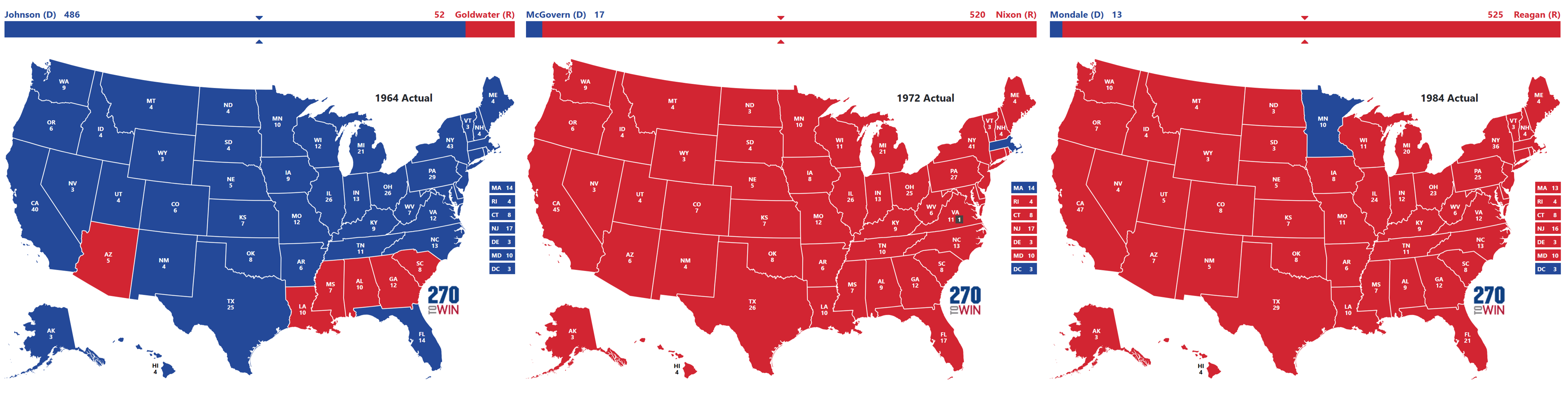
The issue is, there is not a stable 60% majority behind the stances I laid out above.
Clearly, neither the Democratic nor Republican Party memberships are as ideologically homogeneous as we think they are: otherwise, parties that control ~50% of the country wouldn’t routinely control just 30% or 40% of the country on their issue stances. Each of them have a good chunk of their members who appear to be defecting on certain questions. But the messy middle isn’t any more homogeneous.
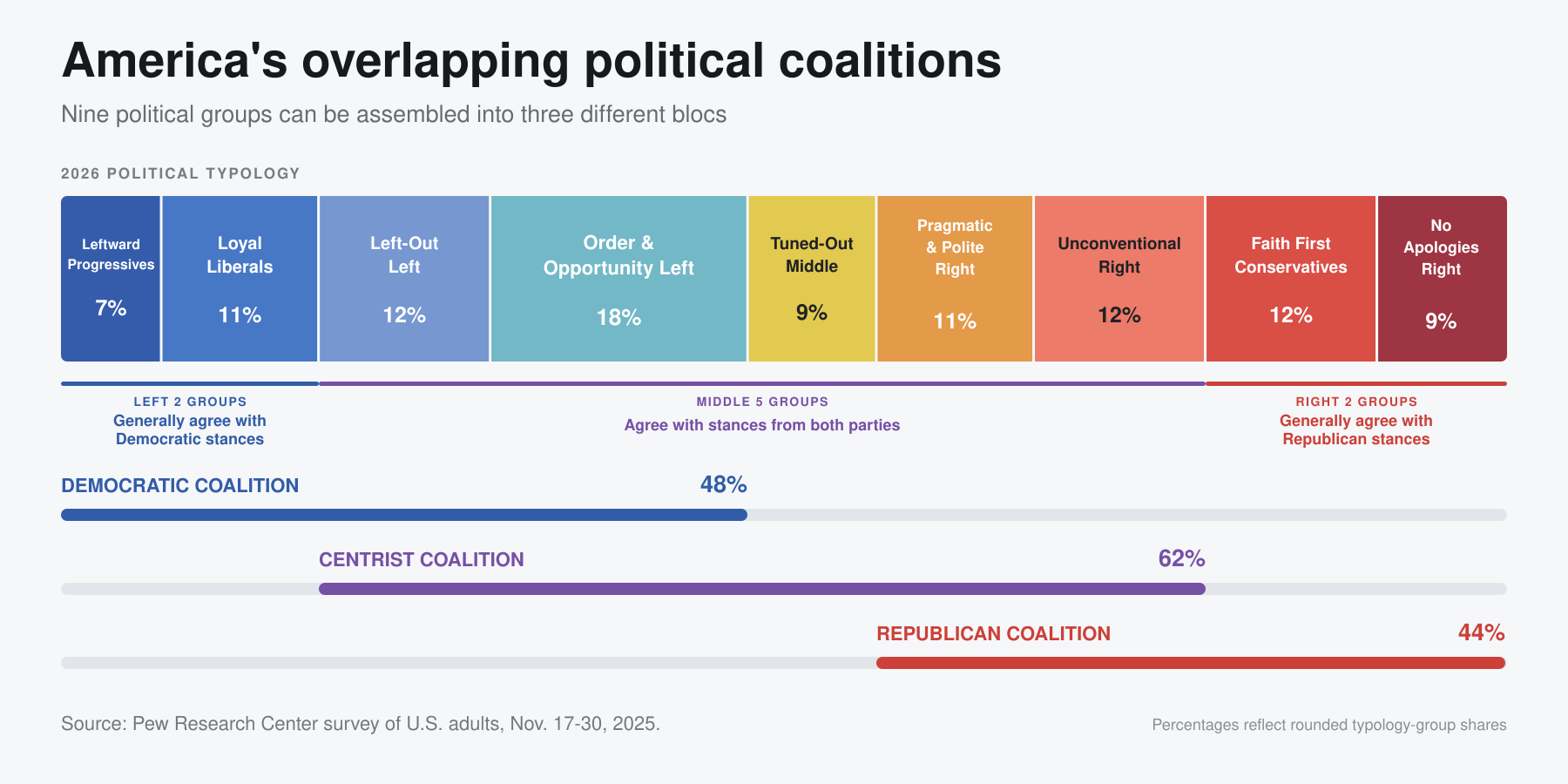
Here’s where it’s helpful to bring in the Pew typology. Pew found that each political coalition has two “anchor groups” who overwhelmingly back their party platforms: “Loyal Liberals” (think Kamala Harris) and “Leftward Progressives” (think AOC), and “Faith First Conservatives” (think Mike Johnson) and the “No Apologies Right” (think Donald Trump). Taken together, these groups are 17% and 21% of the public, respectively.
That leaves the middle five groups on the political spectrum, which represent 62% of the country. Once again, we find a group hovering around that magic 60% number. If these five groups all embraced the moderate positions I laid out above, they could easily team up with an agreed-upon platform, swamp the extremes on either wing, and concoct a 49-state landslide.
But they don’t.
Below, I’ve taken a sampling of questions from the Pew data and pulled: the percentage of Americans who hold the stance; the percentage of people in the middle five groups on the spectrum, our hypothetical “Centrist Party,” who hold the stance; and the percent of the country made up by Centrist Party members who hold the stance.
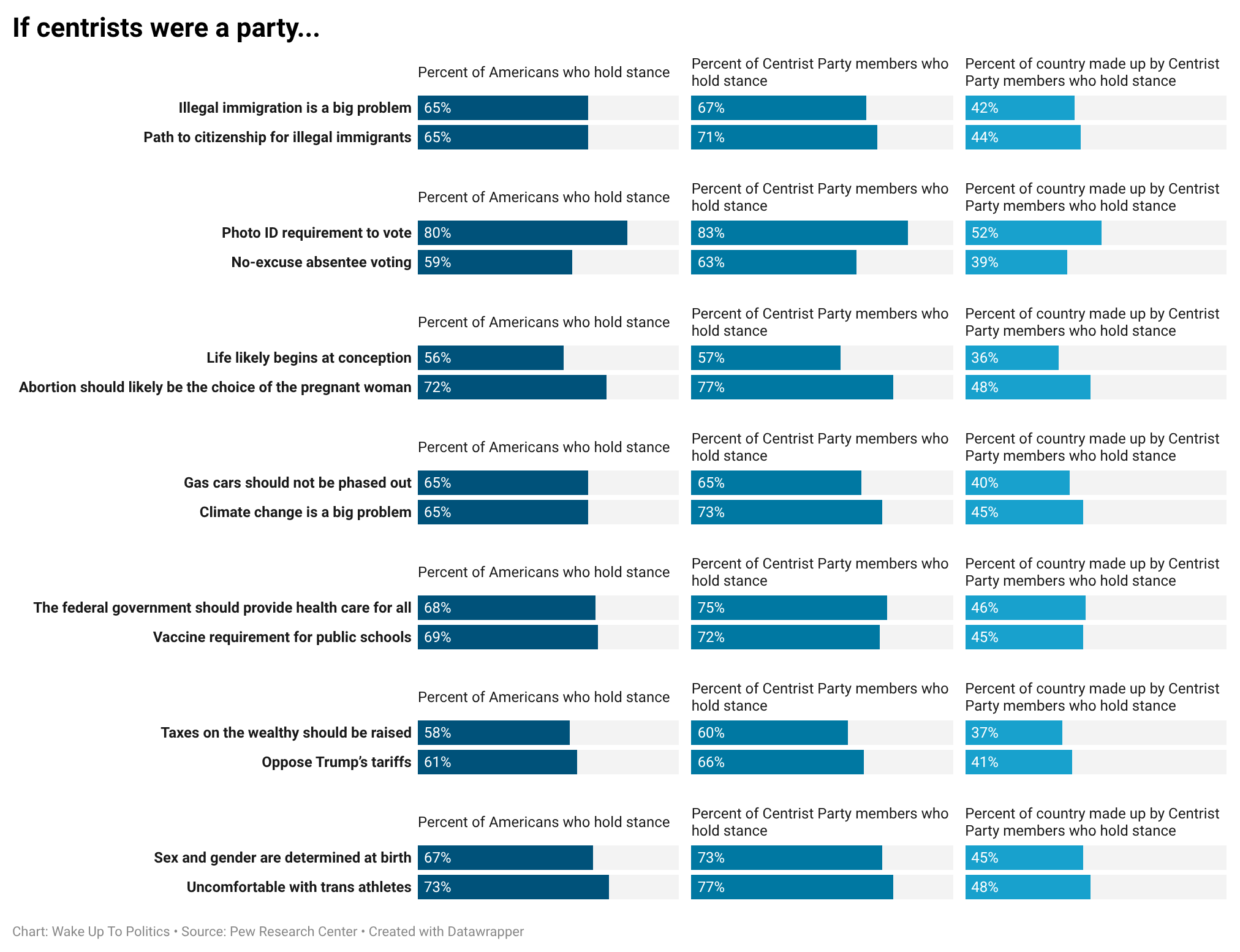
What we find is that around 60% of the country holds each of these stances, which we knew. And that this support is largely built on backing from the Centrist Party, the vast majority of whom embrace each of these positions. But not 100% of them. Since the Centrist Party groups comprise 62% of the country, if 100% of the party agreed with each stance, you could get to supermajority support for each stance just based off support from centrists alone.
But since the “party” is not unanimously behind any of these beliefs, you only get to around 40-45% national support for each stance based on Centrist Party support. That’s an impressive number, but it’s not a majority. To get to a majority on, say, believing that illegal immigration is a big problem, you would need to “borrow” 8% of the country from the right-leaning “anchor groups.”
But what happens to that 8%, all rock-ribbed conservatives, once they learn that your party platform also believes that taxes on the wealthy should be raised? Suddenly, your majority is lost.
The numbers just aren’t there: the 60% consensus is really built on a floating majority, which means an electoral majority built from the middle would be just as unstable and ideologically mixed as the two current party coalitions built from either side. Because it contains internal dissent, it would need support from the wing groups in order to solidify majority support for any of its positions, just as much as the wing groups need support from the middle to win majority support on any of their positions.
And because the “anchor groups” are highly politically engaged, and the middle groups are not, it makes a lot more sense to build a political coalition based on the “anchor groups” and occasionally borrowing from the middle, rather than a coalition based on a disengaged middle that borrows from the wings. Engagement trumps disengagement every time.
The Centrist Party would need wing support from somewhere: it could either pick some stances from one party and some stances from the other (and likely lose any hope of attracting either wing) or it could pick stances from one party (at which point you’ve simply recreated a less powerful version of that party, since your base would consist of that party’s least engaged and reliable members).
Even though the Centrist Party, based on the numbers, seems like it would be more electorally powerful, its own lack of ideological uniformity means it would run into the same need to build a borrowed coalition for its issue stances as the current parties, but this time you would have a coalition that was even less likely to vote. It looks like we’re stuck with two parties driven by the wings for the foreseeable future, rather than a viable party driven by the middle.
Also, don’t forget: this analysis focuses purely on the ability of a party to get to 50% based off support for its issue positions. I haven’t even gotten into the systemic difficulties that a third party would run into, or the fact that not all votes are driven by agreement with a party’s policy platform.
Why this data matters
There is still a lot we can learn from the Pew numbers.
First, we find proof — yet again — that America’s polarization is emotional, not ideological. We are not really divided 50-50 on very many issues. From issue to issue, there is generally a stance with broad public acceptance (it’s just that this majority isn’t composed of the same people for each question). That means that, yes, we have sorted ourselves almost evenly into two political parties and, yes, members of each party strongly dislike members of the other (even though they probably agree with that other party on more than a few issues). But we are not nearly as ideologically split as we sometimes think we are. Our disagreements are much more driven by personalities (who will get to patch together a coalition of firm and loose supporters, which loose supporters will they target, which ones will defect) than they are on policy, about which we overwhelmingly agree across domains.
It also helps illuminate the reality of the two party coalitions.
The four “anchor groups” on the wings may be driving both party platforms, but neither party would exist without the five groups in the center, who make up 56% of the Republican Party and 65% of the Democratic Party. (Of course, these majorities are less likely to participate in politics, especially in primary elections, than the more engaged minorities, which contributes to the imbalance in power.) Both parties are textured and ideologically complex. A full 14% of the GOP is made up of voters who Pew codes as belonging to the center-left side of the spectrum, while 15% of the Democratic camp is made up of voters whose issue positions Pew codes on the center-right.
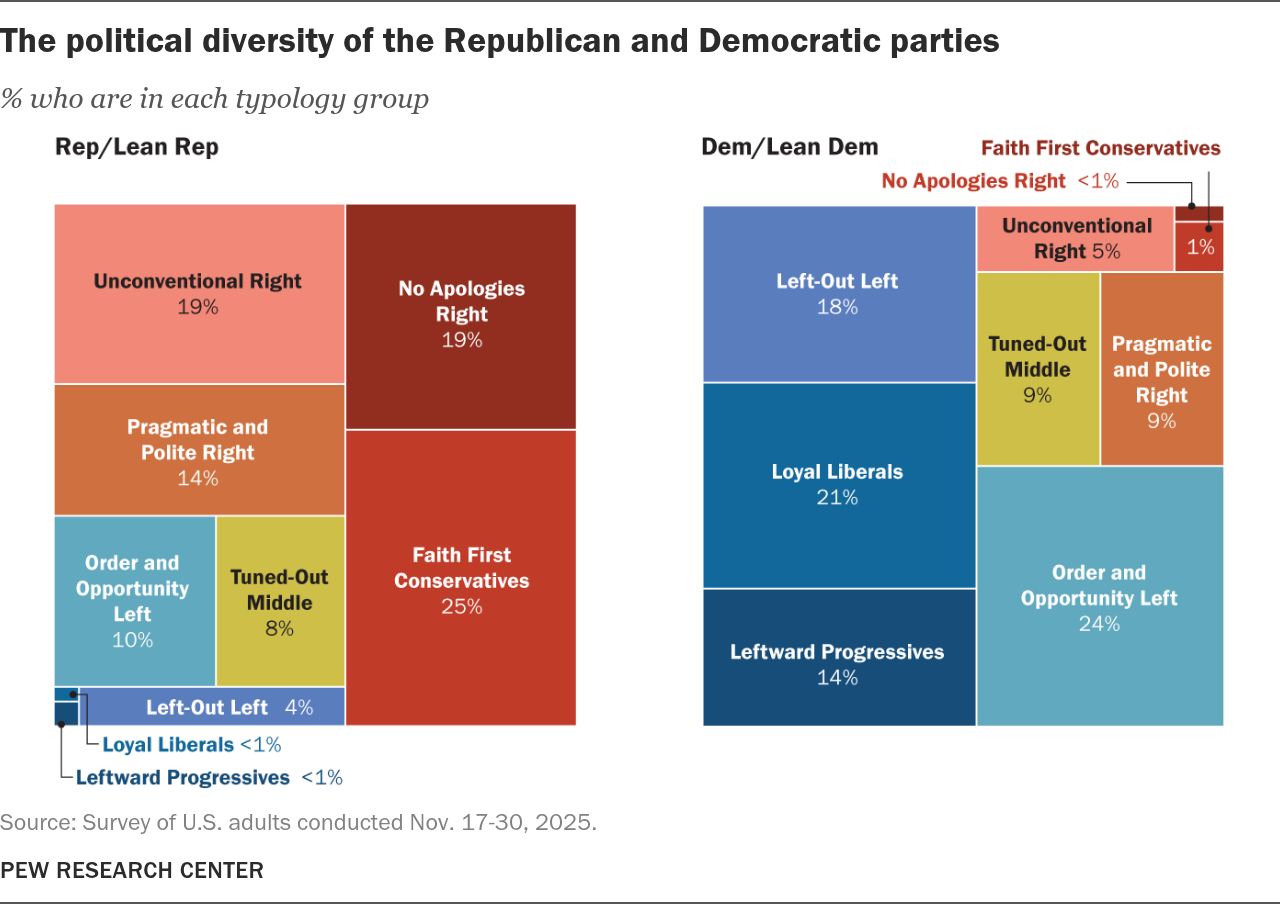
There is so much political coverage about whether the “Leftward Progressives” (think Bernie) and the “No Apologies Right” (think Tucker) have abandoned their party coalitions: Has the far-left broken with the Democrats? Has Trump lost the far-right over Iran? In reality, 96% of Leftward Progressives (and 97% of Loyal Liberals) identify as Democrats; 99% of the “No Apologies Right” (and 95% of Faith First Conservatives) identify as Republicans.
That means any leftist Democrat who defiantly quits the party, and any rightist Republican who does the same, is a statistical anomaly, representative of an infinitesimally small slice of the American electorate. Each party’s real issue, at least in numerical terms, is with the groups towards the center of their coalition: only 65% of the “Order and Opportunity Left” (think Josh Shapiro) identify as Democrats, and just 56% of the “Pragmatic and Polite Right” (think Mitt Romney) identify with the GOP.
Media coverage massively overrates the size of the anchor groups — which, again, make up 17% (the two left-most groups) and 21% (the two right-most groups) of the nation — at the expense of the vast, under-covered middle. This is probably at least partially because there are often no prominent media figures who fall into these groups, and oftentimes few or no national politicians.
Take, for example, the “Left-Out Left,” which is economically liberal (74% support raising taxes on the wealthy) but moderate on social issues (41% believe illegal immigration is a big issue, and 53% believe gender is determined at birth, massively more than the groups to their left). They are also one of the groups least likely to have a college degree (only 29% of them are college educated, fewer than any group on the right) and one of the most racially mixed. Basically no one with this issue profile exists in professional politics, except maybe Bernie Sanders c. 2016 or John Fetterman (though Sanders has since moved away from his pro-gun, anti-immigration, anti-woke positioning, and only 13% of the “Left-Out Left” group have a favorable opinion of the Israeli government, so Fetterman isn’t quite in step with them either). They’re called “left out” for a reason.
Very few in the media fall into this group, and very few of the people the media quote (politicians, operatives, pundits, activists, etc.) fall into this group, which is how a segment that’s even bigger (12%) than either the democratic-socialist “Leftward Progressives” (7%) or the MAGA “No Apologies Right” (9%) gets to be massively under-covered.
This might be fair enough as far as electoral power goes — as discussed, the far-left and far-right groups are far likelier to vote, which means they wield more clout within their electoral coalitions even if they make up a smaller slice of them — but it leaves audiences with a skewed image of America. It also means the members each party sends to Congress are similarly unrepresentative, with 0% of Senate Democrats in favor of photo ID at the polls (a stance held by 69% of their party coalition, per Pew) or 0% of House Republicans voting to codify Roe (a stark drop from the 38% of their coalition who believe abortion should be legal in all or most cases).
Dwelling on the areas where Americans overwhelmingly agree can also underline the unrepresentative nature of media coverage. According to Pew, just 10% of Americans view China as a partner, while 7% say the same about Russia. And yet, Hasan Piker gets coverage for his fawning venture to China, just as Tucker Carlson does for his trip to Russia. These stances are interesting and provocative precisely because they are so rare — but because that then leads to a rush of media coverage, suddenly they seem a lot more widely held than they really are.
It’s understandable to cover the new, the unusual, the interesting. But it must be done in a way that is grounded in real data, ensuring that audiences know that even if a provocative stance is receiving coverage, that should not be mistaken for thinking that a sizable swath of the American public actually holds it. 10% of the country is a lot of people in raw terms: more than 30 million Americans! But it is a small amount as a percentage of the country. Humans are often bad at holding both ideas in their head at the same time. We are such a big country that we forget that even millions of people — many more people than you will ever meet in your life — form only a small American minority.
These same lessons apply to issues like the measles vaccine (supported by 84% of the country) or transgender athletes participating in the sports teams of their choice (opposed by 73%), both of which are covered as though they are much more contested issues than they are in real life — though, of course, both stances also wield disproportionate power in our politics, for some of the reasons we’ve discussed.
In reality, Americans are already overwhelmingly congregated on one side of most issues; the question is simply, out of the two parties with whom they agree on some things but not others, which one will they choose to vote for (or will they vote at all). But just because that split always tends to come down 50-50, it does not mean most people are blindly accepting all the issue stances of the party they choose to join.
We are an “evenly divided” country that happens to agree on quite a lot.
Good stuff here.
"America’s polarization is emotional, not ideological" remains really the punchline of this era.
Also I'll just point out that the Pew data makes no attempt to account for varying salience of the different policy questions it asks. That seems like a potential flaw in their typology: their analysis takes as a given that voters have the same degree of feeling about say taxing the rich as about a path to citizen or whatever else.
I liked the analysis so much I went through the sign-up four times to get through as a paid subscriber, upgrading--it's a tough row to hoe with us, given the multitude of Substacks!
I do have some comments, though: 1) The Tuned-out Middle group (9%) is useless. They are the equivalent of the 10% of Independents who answer "Don't know" to every polling question. They don't vote. Take them out of the calculations.
2) There is very little experience in USA elections of three genuinely competitive candidates, one of which is in the middle and the other two the nominated party candidates. Ross Perot is the only one who comes to mind in a national election, and he got zero Electoral votes. On the other hand, 40% could win if the two parties on the extremes split the other votes. 50% is not actually needed.
3) Finally, I took the Pew quiz the other day and got Order and Opportunity, but I am an extremely loyal Democrat, and not really that moderate (Pew didn't get me right). The only way I would desert them for a 3rd-party moderate was if it were clear the Democrat had no chance to defeat the Republican.
I actually think the future could be four parties, two from the current Republicans and two from the current Democrats, when they fracture along the lines already present. Looking forward to it!