


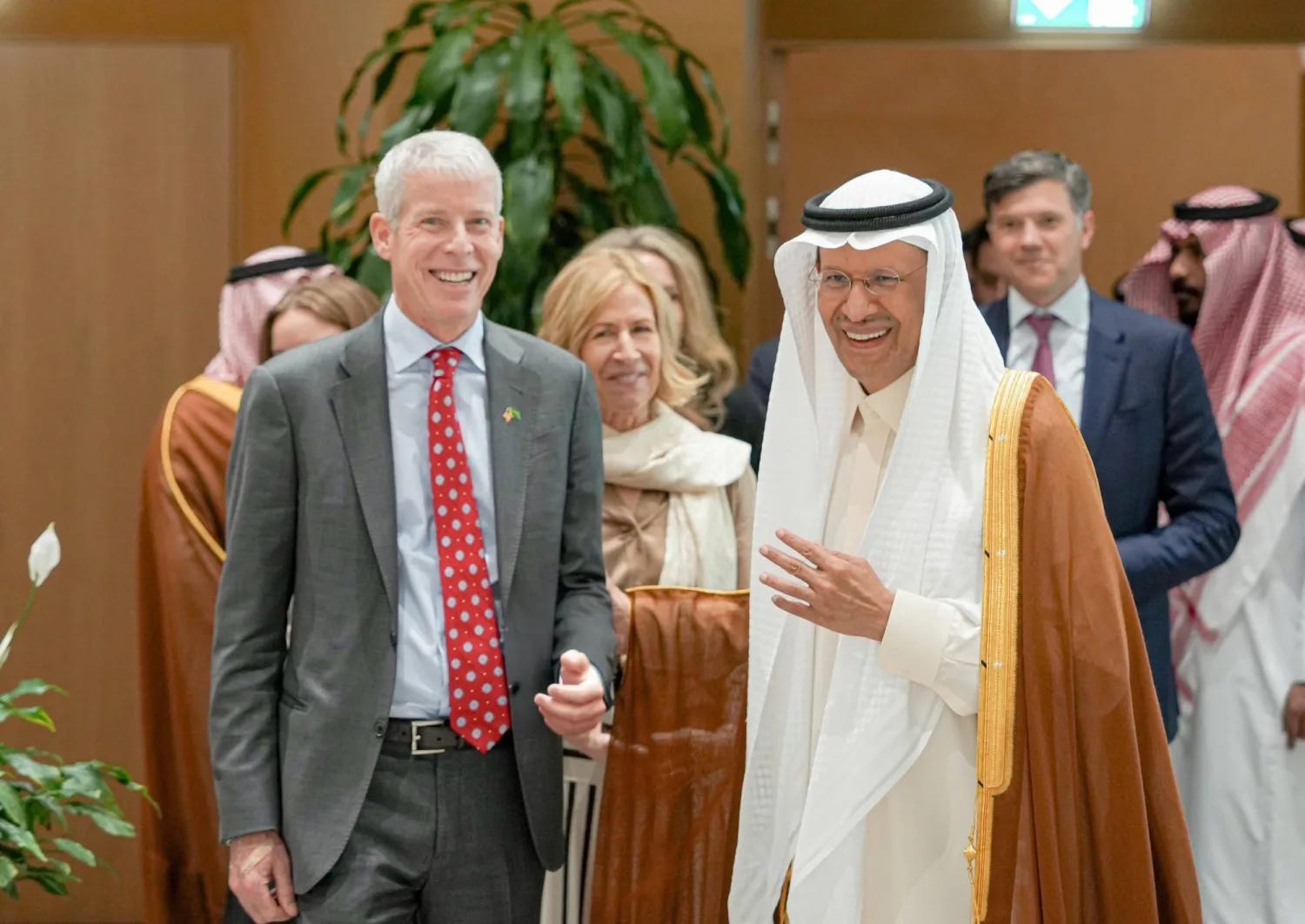
Saudi Arabia has been working towards a civilian nuclear program for decades. The country first expressed interest in nuclear energy in the 1960s, and began developing research centers to pursue the goal in the 1970s and ’80s. In 2008, the George W. Bush administration signed a memorandum of understanding with the Saudis to offer American support.
A civilian nuclear program would help meet the country’s surging electricity demands — but it would also place Saudi Arabia in a position to pursue a nuclear weapon, if it ever chose to do so. (“Without a doubt, if Iran developed a nuclear bomb, we will follow suit as soon as possible,” Saudi Crown Prince Mohammed bin Salman told “60 Minutes” in 2018.) For that reason, discussions about nuclear energy in Saudi Arabia have always been treated with the utmost sensitivity. Many analysts fear that a Saudi nuclear program could set off an arms race across the Middle East, with other countries rushing to catch up.
During the last administration, Saudi nuclear talks took on heightened geopolitical importance, as then-President Joe Biden attempted to ink a “grand bargain” that would have allowed the Saudis to jumpstart their civilian nuclear program in exchange for recognizing Israel.
At this point, the issue touches on many of the thorniest questions in Middle East policy, itself one of the thorniest areas on any president’s desk. So why was a decision reportedly made on such an important question without President Trump’s knowledge?
Last week, Energy Secretary Chris Wright and Saudi Energy Minister Abdulaziz bin Salman reached a civilian nuclear cooperation agreement. This wasn’t some behind-the-scenes development: it was publicly announced as a done deal. Here it is on the Energy Department’s website:
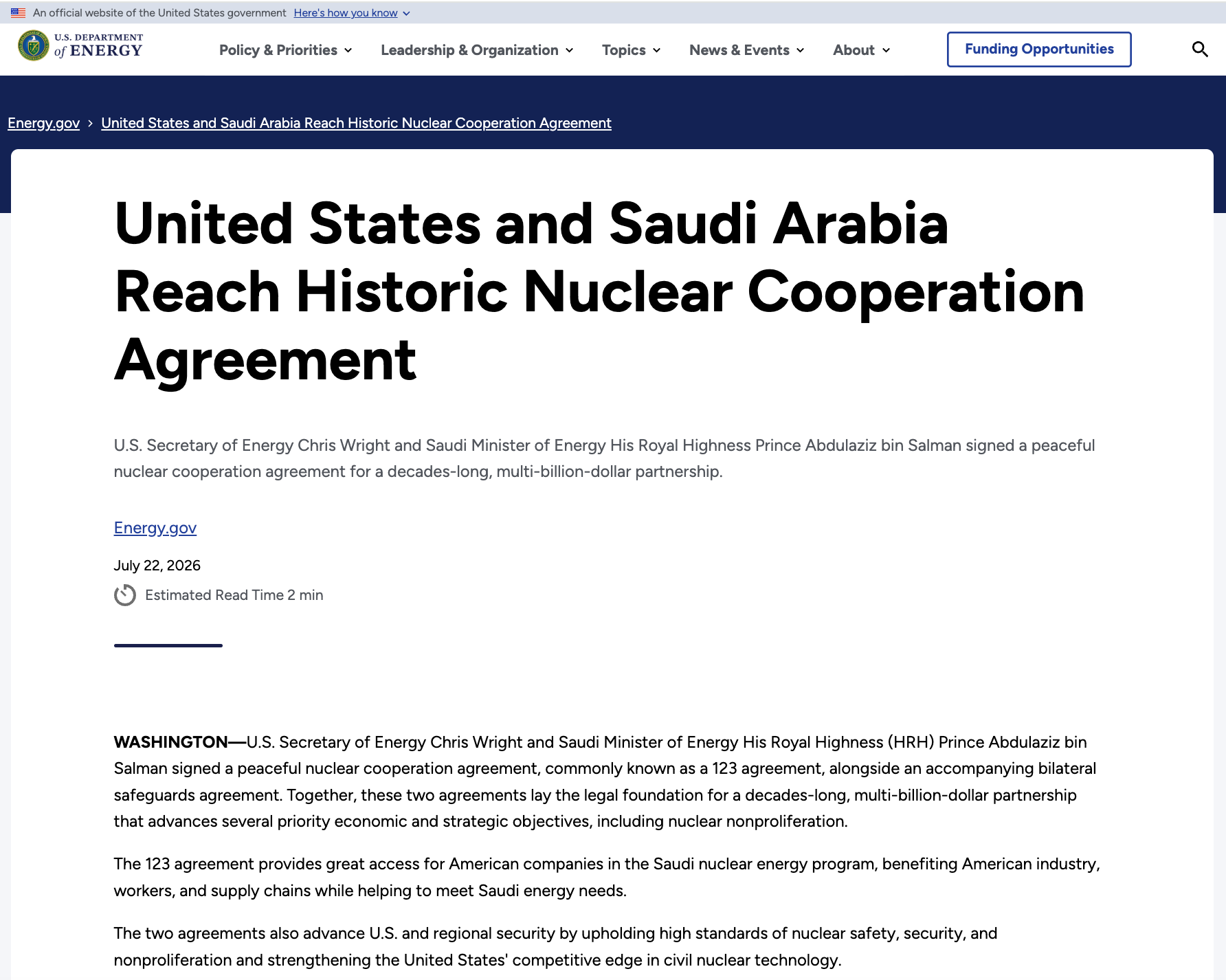
The department hailed the agreement as “historic”; further down in the press release, Wright said that it would deliver “prosperity at home and security to our allies abroad.” The text of the deal was not immediately released, although the Wall Street Journal reported that it was a 30-year, multibillion-dollar arrangement under which Saudi Arabia will have to use American companies as suppliers to build out its nuclear program.
Controversially, the deal laid out a timeline under which Saudi Arabia could eventually enrich uranium on its own soil (as opposed to relying on imported fuel). The agreement includes safeguards to try to prevent Saudi Arabia from using such enrichment for military purposes, though it wasn’t clear how rigorous the inspection regime would be to ensure this.
The U.S.’ 2009 nuclear deal with the United Arab Emirates, seen as the “gold standard” for such agreements, required the UAE to pledge to forgo any domestic uranium enrichment and to commit to tougher inspections. (As CNN notes, the UAE agreement also includes a clause allowing for renegotiation if the U.S. gave better terms to another country in the Middle East, one more way that this deal could have a butterfly effect across the region.) Only 14 countries are currently known to enrich uranium, nine of which have nuclear weapons (plus a 15th, Israel, which is widely believed to possess nuclear weapons as well).
Obviously, anyone can debate the merits of adding another country to this small nuclear club — but the point for our purposes is that the agreement had been finalized. A formal signing ceremony was held at the Energy Department on Wednesday.
By Thursday morning at 7:52 a.m., the whole thing was thrown up in the air. President Trump announced on Truth Social that the nuclear deal was “totally subject to Saudi Arabia joining the very respected and successful Abraham Accords,” the string of agreements from Trump’s first term that saw several Arab states recognize Israel. This had been a condition of President Biden’s during his administration’s nuclear talks with Saudi Arabia, but had not been a requirement set by the Trump negotiators (as evidenced by the fact that Trump’s own Energy Secretary had moved forward with an agreement that made no mention of the issue).
Such a last-minute reversal on such an important agreement (after it had already been signed!) was strange, but stranger still was the explanation that was given. CNN reported last week that Secretary Wright had not told Trump ahead of time that he was going to be announcing the Saudi agreement. The president hadn’t changed his mind so much as he hadn’t known that the deal wasn’t poised to include Israeli recognition, or that it was about to be unveiled.
Trump himself appeared to confirm this on Friday, when asked by a reporter about the Saudi deal after making an announcement about domestic nuclear energy in the Oval Office.
“Mr. President, did you authorize for Secretary Wright to sign the Saudi nuclear deal? If not, why did he sign it?” the reporter asked.
“Well, we didn’t talk about it, but it was always understood,” Trump said, with Wright standing behind his shoulder. “And Chris knew and Saudi Arabia knew that if they didn’t join the Abraham Accords, the deal’s not— I’m not going to do the deal.”
“So why did he sign it?” the reporter followed up.
“Because they understood that in order, you know, subject to Congress and everything else, in order for that deal to go through, they had to sign into the Abraham Accords,” Trump said, although CNN reported that Trump’s negotiators were not aware of the condition and it doesn’t appear that Saudi Arabia was either.
Of course, Donald Trump is not the most reliable narrator, and it’s always possible that he’s not telling the truth. Perhaps he did know that the agreement was going to be signed and had given his approval, but then changed his mind after it started getting criticism from Israel and its friends in places like the Wall Street Journal editorial board.
Indeed, CNN also notes that Trump’s 7:52 a.m. announcement came mere minutes after the deal was discussed on “Fox & Friends” (which Trump is known to watch), with several panelists unfavorably comparing the terms of the Trump-Saudi deal to those that Biden had been pursuing. (The possibility of a “late intervention” from Israeli Prime Minister Benjamin Netanyahu is also raised by CNN, though the network did not have any sourcing to confirm that Trump and Netanyahu spoke about the deal.)
At this point, we don’t know which of these explanations is true. (It’s also possible that Trump didn’t know about the agreement beforehand, but that the discussion on “Fox & Friends” and elsewhere still is what convinced him to override Wright.) But the possibility that the president might not have been aware of a decision of this magnitude (shocking as it might be) is made more realistic by the fact that this pattern has played out before.
As I noted in two previous pieces on this dynamic, administration officials have reportedly made huge decisions without Trump’s sign-off throughout his second term, including cutting off Ukraine aid (twice). The Saudi deal wasn’t even the first time this had happened this month.
On July 14, days after ICE traffic stops led to fatal shootings in both Texas and Maine, the immigration agency issued a nationwide order telling its officers to stop pursuing people in vehicles, a major reversal of Trump administration policy.
By July 15, Trump had reversed the reversal. “We CANNOT give up one of I.C.E.’s most important and effective Crime Fighting tools, THE TRAFFIC STOP!” Trump wrote on Truth Social at 6:45 a.m. “Once we do, we are playing right into the criminal’s hands. The Radical Left Dumocrats would like to see this done, but it won’t happen on my watch. I.C.E., be judicious, fair and smart, and go back and do your very important job.”
Once again, NBC News and the Atlantic reported that Trump had not been aware of the initial policy change in advance. As with the Saudi Arabia shift, some sources were skeptical: There’s “not a chance” that Homeland Security Secretary Markwayne Mullin would have paused ICE traffic stops without telling the White House first, one DHS official told the Atlantic. “Someone got into the big boss’s ear,” the official added. The Atlantic noted that Trump’s reversal came after Steve Bannon, Tomi Lahren, and other conservative media figures criticized Mullin’s decision.
But it is revealing how sensitive the White House is to the implication that Trump might not be read into every policy decision. “Every Cabinet secretary knows that they have to come to the White House for major policy decisions,” an administration official told NBC. “The president sees, hears, reads everything.”
But clearly not every Cabinet secretary knows that: the same official also told NBC that Mullin had paused traffic stops without going to the president. And administration officials also said that Trump was unaware of the Saudi deal. The White House is trying to have it both ways: insisting that Trump is the “final dealmaker” (as Karoline Leavitt said in response to questions about the Saudi deal), while also distancing him from decisions as soon as they run into criticism from his allies.
Personally, I find either explanation to be plausible. (Both, of course, cannot be true.) But the fact that it’s at least possible that Cabinet secretaries feel enough leeway to freelance on major issues like Middle East geopolitics or immigration enforcement is a revealing window into how decisions are made in the Trump White House — and whether Trump really is at the center of them, as he claims.
Of course, he clearly is the final decider: as soon as he puts out a Truth Social post, he can kill a nuclear deal or upend ICE policy. But how much is sneaking through without his knowledge, being enacted by Cabinet officials who assume he isn’t paying attention (except for the rare times when conservative media critiques bubble up to the president, leading him to belatedly step in)?
Nobody expects any president to be involved in every single policy decision made by the United States. The U.S. government is simply too vast and complicated for that to be a reasonable goal. Presidents sign executive orders they’ve probably never read and give speeches they didn’t write. Just this past weekend, Trump frequently interjected surprise at the jokes he was delivering in his White House Correspondents’ Dinner speech, seeming to confirm that his stilted delivery of the address was because he hadn’t previously laid eyes on it.
“Who the hell wrote that line?” Trump said at one point, breaking the fourth wall a bit. “That was actually the only thing I thought was good in this whole fricking stupid speech that they wrote,” he said later on.
That’s the White House Correspondents’ Dinner. Who cares. Frankly, a president in wartime has better things to do than to spend time preparing for a comedic roast.
But setting nuclear policy in the Middle East (the very region we’re at war in, over a nuclear program) or refining a policy on immigration enforcement that has led to multiple deaths in the United States? Those are the sorts of decisions that a president is very much expected to be involved in.
There’s reason to believe that Trump’s Cabinet secretaries don’t think they need to receive presidential signoff before making decisions on those issues, which raises the question of just how much else is slipping by without presidential input, as Trump rages about the SAVE Act and the Lincoln Memorial reflecting pool and (seemingly) checks back into policy only after hearing about his own administration’s choices through conservative media.
>"Of course, Donald Trump is not the most reliable narrator, and it’s always possible that he’s not telling the truth"
I suppose that's one way to put it
Short answer: yes.
The most expensive military in human goddamn history just paused its own bombing campaign because — no bullshit — it ran out of the interceptors it needs to catch what Iran throws back, having flung the rest at the Houthis and shipped a pile to Ukraine. the arsenal's empty. We have a cuck'ed military ass lot that can't get it up hard enough to do anythning. Who is running this glorious clusterfuck? Pete Hegseth, a man his own chickenshit party admits couldn't get reconfirmed today, who spent last week hawking testosterone quizzes to the troops while sitting on the casualty count.
https://thistleandmoss.com/p/what-survives-the-morning-point-at-the-record-then-turn-towards-the-fucking-light