


A recent poll by Marquette Law School asked Americans this question: “Since the beginning of his second term, how often do you think the Supreme Court has ruled in favor of the Trump administration in cases that have reached the court?”
They gave respondents four options: “Often,” “Fairly often,” “Rarely,” and “Never.”
It turns out, both parties think the deck is stacked against them at One First Street. 63% of Republicans believe the court “rarely” or “never” rules for President Trump, while 77% of Democrats believe the court rules for him “often” or “fairly often,” starkly divergent perceptions of reality.1
Partisans are really just following their leaders here. On Tuesday, the Supreme Court left in place a lower court order blocking the Trump administration’s push to create new, nationwide rules for mail-in voting ahead of the midterm elections.2
Senate Minority Leader Chuck Schumer (D-NY) referred to the ruling on the Senate floor yesterday as a rare aberration from a “MAGA Supreme Court” that has “done Trump’s bidding too many times.” Within the same hour, Trump himself blasted the decision as Republicans receiving yet “another bad decision” from the court.
So, which is it? Does the court routinely side with Trump, or regularly rule against him?
The confusion is understandable, because simply following news reports about the court — which often treat every case as a loyalty test, either proving once-and-for-all that the justices are Trump lackeys, or that they’re standing up against him — can leave you dizzy, as the court sides with Trump on the White House ballroom in one case, and then breaks with him on mail-in voting in the next.
To cut through the conflicting signals, I compiled a dataset of all 48 actions the court has taken regarding Trump since January 2025. In the end, neither narrative has it right — but the court is also not wholly unpredictable when it comes to ruling on the president. Looking at how the court has handled Trump’s requests, some broad themes do jump out that make it possible to project how the court will rule on any given case.
First, the court is happy to take almost any available escape route to avoid offering a conclusive ruling on Trump cases. If there is any reason to view a lawsuit against the president as procedurally flawed — either because the wrong person is suing, or in the wrong court, or at the wrong time — the court will frequently take that as an opportunity to temporarily block a lower court order in front of them and punt on the broader issue. When Trump has raised these sorts of process issues to the court, he has generally succeeded; about 15% of Trump-related disputes before the court so far have been resolved this way.
This strategy allows the court to momentarily side with Trump, without taking an opinion on the legal merits of what he is trying to do, while still preserving the possibility that they could block the action down the line if a more properly structured lawsuit comes before them.
We’ve seen the justices take this route in cases on Education Department grants (the plaintiffs were told they had to sue in the Court of Federal Claims, not federal district court); Alien Enemies Act removals (the plaintiffs were told they had to bring “habeas” cases, a certain type of lawsuit); government layoffs (a group of nonprofits were told they could not sue, while leaving open the possibility that a group of unions could); State Department grants (the plaintiffs were told only the head of the Government Accountability Office could sue under the law in question); mail-in voting, the first time it reached the court (the plaintiffs were told they had to wait for Trump’s plan to be finalized); and the ballroom (the plaintiffs were told they had not been sufficiently harmed by its construction to bring a lawsuit), among others.
To be clear, this is not unique to Trump. Many Supreme Court cases (politically charged or otherwise) start by considering whether the dispute is procedurally kosher. The justices similarly threw out major challenges to the Biden administration’s immigration, abortion, and public health policies by ruling that the challengers lacked the standing to bring a lawsuit.
However, many of the court’s critics (including at least one who sits on the bench) have argued that the justices should modify this approach for Trump, who moves unusually quickly and aggressively. The ballroom case is a great example: in its recent opinion, the court didn’t take a stand on whether the construction was legal or illegal; it merely said that the current plaintiff couldn’t sue, while leaving the door open for other challengers to try. But meanwhile, of course, the East Wing has already been knocked down and (according to the White House) the ballroom is 65% done. It’s unlikely another plaintiff will emerge before the construction is complete. (On the other side of the ledger, the justices ruled last month that it was too early to rule on Trump’s mail-in voting plan because the rule had not yet been promulgated. But then, once the rule was finalized, the court did allow it to be blocked this week.)
There are different ways to look at this. You can credit the court for treating Trump just like any other president, acting as procedural nitpicks when plaintiffs challenge their administrations — or you can blame the court for treating Trump like any other president, rather than as the emergency many liberals view him to be. You can paint the court as trying to avoid disputes with Trump, only ruling against him when they absolutely have to — or you could say the court is trying to ensure that any ruling against him is airtight, without any legalistic holes for him to poke.
Either way, it is clear that this is the first factor you have to consider when predicting a Trump case at the Supreme Court. If the president is not arguing on the legal merits of his policy, but rather on a technicality, odds are that the president will win.
Second, we have cases where Trump actually is arguing on the legal merits. Here, there is a key threshold question to ask: Have other presidents used this law to do this thing? When the answer is “yes” — when a case has turned not on whether a president has the authority to do something, but rather on how exactly Trump has carried out a universally recognized presidential power — he has generally won.
We’ve seen this play out in several immigration cases. No one doubts, for example, that the executive branch has the power to make immigration stops. When a case came up last year not about whether ICE had this underlying power, but about whether they were using it correctly (by potentially using race as a factor in deciding who to stop), the Supreme Court declined to intervene.
Similarly, in the transgender policy realm, there is no argument that the president has power over passports (it says so right there in the law). When a dispute arose over whether the president was using this power fairly (by requiring that passports display a citizen’s sex at birth), the justices said it was likely that he was.
Many of these cases have been over policies that have seesawed from one administration to the next. The Biden administration offers Temporary Protected Status or humanitarian parole to a group of migrants; the Trump administration takes it back. The Biden administration changes military policy to allow transgender service members; the Trump administration changes it back. In these cases, everyone agrees the president has a certain power and that other presidents have read a statute the same way, but the way Trump is using that power is controversial or has given rise to civil rights claims. The Supreme Court, at least on its emergency docket, has deferred to the president on each one of these cases.
This has given Trump (like other presidents) leeway to decide how to administer the executive branch in the spaces where all agree the executive branch is in control, from third-country deportations to access to the branch’s own internal communications, dashing challengers’ hopes of thwarting him.
Third, we have cases where the answer to that threshold question is “No, a president has not previously read this statute to give them the power to do this thing.”
These are cases where Trump isn’t trying to execute on normal executive-branch things (but maybe in a controversial way); these are places where he’s tried to excavate old laws and hold them up to prove he has a certain novel power. These are the cases that Trump has lost basically every time.
I think it’s helpful here to try to act like Supreme Court justices ourselves, and look at the laws Trump was bringing to the court as a permission slip for what he was trying to do. I’ll show you the law; you be the judge.
To return to the question of immigration stops, here’s 8 U.S.C. §1357(a):
Any officer or employee of the Service authorized under regulations prescribed by the Attorney General shall have power without warrant—
(1) to interrogate any alien or person believed to be an alien as to his right to be or to remain in the United States.
Or on revoking Temporary Protected Status, here’s 8 U.S.C. §1254a(b)(3)(B):
If the Attorney General determines under subparagraph (A) that a foreign state (or part of such foreign state) no longer continues to meet the conditions for designation under paragraph (1), the Attorney General shall terminate the designation by publishing notice in the Federal Register of the determination under this subparagraph (including the basis for the determination).
Again, litigants might quibble with the specific ways the Trump administration has carried out these powers (though, as stated, the Supreme Court has generally not been sympathetic to those challenges). But the question in these cases is not whether the administration can do what it’s trying to do in general. It’s clear from the statute that it can.
Now, let’s take a look at the two statutes Trump was using to argue that he could set new requirements for mail-in ballots. First, he pointed to 39 U.S. Code § 401:
Subject to the provisions of section 404a, the Postal Service shall have the following general powers:
…(2) to adopt, amend, and repeal such rules and regulations, not inconsistent with this title, as may be necessary in the execution of its functions under this title and such other functions as may be assigned to the Postal Service under any provisions of law outside of this title.
OK, so the Postal Service can adopt rules that are necessary for it to carry out its functions. Which legal function did the Trump administration say necessitated the mail-in ballot rule? It pointed to 39 U.S. Code § 404:
(a) Subject to the provisions of section 404a, but otherwise without limitation of the generality of its powers, the Postal Service shall have the following specific powers, among others:
(1) to provide for the collection, handling, transportation, delivery, forwarding, returning, and holding of mail, and for the disposition of undeliverable mail.
This one feels like much more of a stretch! It is probably not necessary, in order for the Postal Service to collect and handle mail, for the agency to adopt a rule requiring states to send it lists of the voters pre-approved to receive mail-in ballots as part of an effort to combat voter fraud. The Postal Service seems to have delivered mail for many years without needing to do that!
To bolster its case, the Trump administration pointed to previous Postal Service rules constructing specific regulations for transporting “cremated human and animal remains” and “replica explosives.” See, the administration said, if we can regulate those specific types of mail, we can regulate ballots!
But, as the attorney Adam Unikowsky pointed out, those regulations stem from a law that allows the Postal Service to regulate deliveries that may “injure the mails or other property” (such as cremated remains that could leak or replica explosives that could cause panic and wreak havoc). Absentee ballots, fraudulent or not, do not harm mail or property.
And, so, without any clear grant of executive power from Congress or the Constitution — and plenty of provisions to the contrary, including the Elections Clause (which gives power over elections to Congress and the states) — the Supreme Court blocked Trump from carrying out his mail-in ballot rule.
I won’t march through the exact text from other cases, but the same thread runs through Trump’s other major Supreme Court losses. No other president had used the International Emergency Economic Powers Act to impose tariffs. The Supreme Court said Trump couldn’t. No other president had read the 14th Amendment as allowing them to limit birthright citizenship. The Supreme Court said Trump couldn’t. No other president had deployed the National Guard without a governor’s consent under the statute Trump had invoked. The Supreme Court said Trump couldn’t.
These are all cases of Trump dusting off an old law and reading it in a completely novel way; the Supreme Court has yet to entertain any of these readings, even as it has blessed his controversial uses of other, more conventional presidential powers.3
Finally, there’s one more category. These aren’t cases where Trump has tried to read an old statute in a new way, per se, but a group of cases where Trump argued that a statute was unconstitutional: specifically, statutes preventing him from firing independent agency officials.
This is another category of cases where Trump has won, with the Supreme Court agreeing in the Slaughter case that the chief executive, constitutionally, had to be able to fire top officials in the executive branch.4
Make no mistake, this was a major victory for Trump, though it’s not necessarily an ideological one: the next Democratic president will be just as happy to exert control over the Federal Trade Commission or the National Labor Relations Board, though it still marks a change in how federal policy is executed.
But it is notable that this stands as the one real power Trump has succeeded in adding to the executive toolkit during his second term. Every other attempt he’s made at expanding the powers of the presidency has either ended in a standstill (as with the first category of cases, snarled by procedural issues) or been rejected by the Supreme Court (as with every time the court has considered, on the merits, Trump’s claims that an existing law gives him a power that no other president had claimed).
From this analysis, we can create a handy guide that will predict most Trump-centric SCOTUS outcomes:
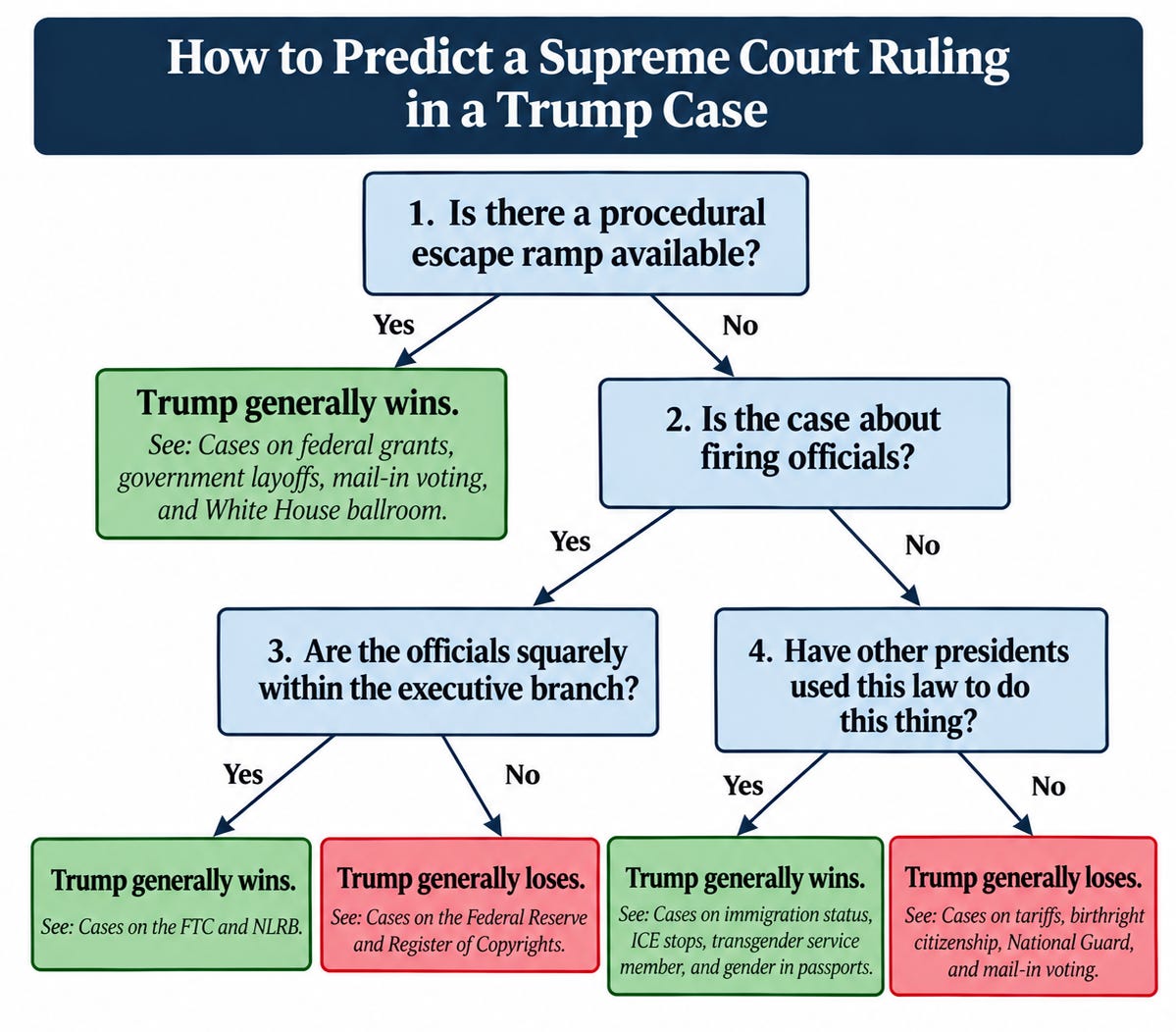
This helps us understand why both sides are so convinced that the justices are either Trump puppets or Trump haters.
Trump’s opponents don’t like that the court tends to give him the benefit of the doubt on procedural legal questions and on questions of whether he’s correctly applying a known presidential power (including in controversial areas like gender and immigration), or that the court has given him new power over independent agencies.
Trump’s allies don’t like that, on many of the issues most important to the president — tariffs, birthright citizenship, National Guard deployments, mail-in voting — the court has declined to carve new presidential powers out of flimsy statutory language.
It’s up to you to decide whether the court blessing these more conventional presidential moves (and adding one big power to the toolbelt) or blocking these more aggressive, Trump-specific actions should carry more weight when judging the Supreme Court’s relationship with Trump.
But, with these rules of thumb in mind, you can at least cut through the thicket of cases a little easier. When wondering whether the Supreme Court is likely to rule with the president or not on an upcoming dispute, the right answer isn’t a reflexive “yes” or “no.” It’s asking four more questions about the case, which will generally prove predictive of which way the justices will lean.
Naturally, Independents fall right down the middle: 51% believe the justices “rarely” or “never” side with Trump, while 49% believe they do so “often” or “fairly often.”
The exact vote count was not given, but only conservative Justices Clarence Thomas and Samuel Alito dissented, meaning the case was an apparent 7-2 loss for Trump. None of his three appointees to the court stated an objection. “These are not the people I interviewed to serve on the United States Supreme Court, they are merely a shell of their original selves,” Trump wrote on Truth Social.
Personally, although the case was technically a Trump procedural victory — because the justices said the plaintiffs had brought the wrong type of lawsuits — I also count in this category the court’s ruling on the Alien Enemies Act, because that ruling still made clear that aliens deported under the 1798 law needed to receive due process (which Trump was trying not to give, in a novel interpretation of the law).
Note, though, that for Trump to win, the official in question has to be squarely in the executive branch. The court has declined to side with Trump in two firing cases, one involving the Federal Reserve and the other involving a legislative agency (the Library of Congress).
Great explanation. Broken out this way the Supremes' decisions even seem to have a consistency that makes some sense, which gives me back a little more faith in them.
I find your analysis very interesting, enlightening even, if it is accurate (which I believe it is, at fist sight).
Not being american, however, I might have missed the part where you break into percentages your "compiled dataset of all 48 actions". I admit I sometimes (often ?) skipped over a paragrah here and there, when I did not know the case your were describing...
Could you add this information (percentages), in each green or red box of your drawing ? this way we could see whether the supreme court rulings ended up being against or in favour or Trump ? Or explain why it would be a silly idea to do that, maybe ?
In any case, it would be much appreciated.
And if the answer is already in your text, forgive me please and just answer "read better", which I shall do