


“The test of a first-rate intelligence,” F. Scott Fitzgerald once wrote, “is the ability to hold two opposed ideas in the mind at the same time, and still retain the ability to function.”
Not to cast aspersions on anyone’s intelligence, but the 21st century political ecosystem is not particularly adept at doing this. In many political conversations these days, there is often little room for nuance or the possibility that two things might be true at once.
Let’s see if we can change that. When it comes to the White House ballroom, four things can be true at once:
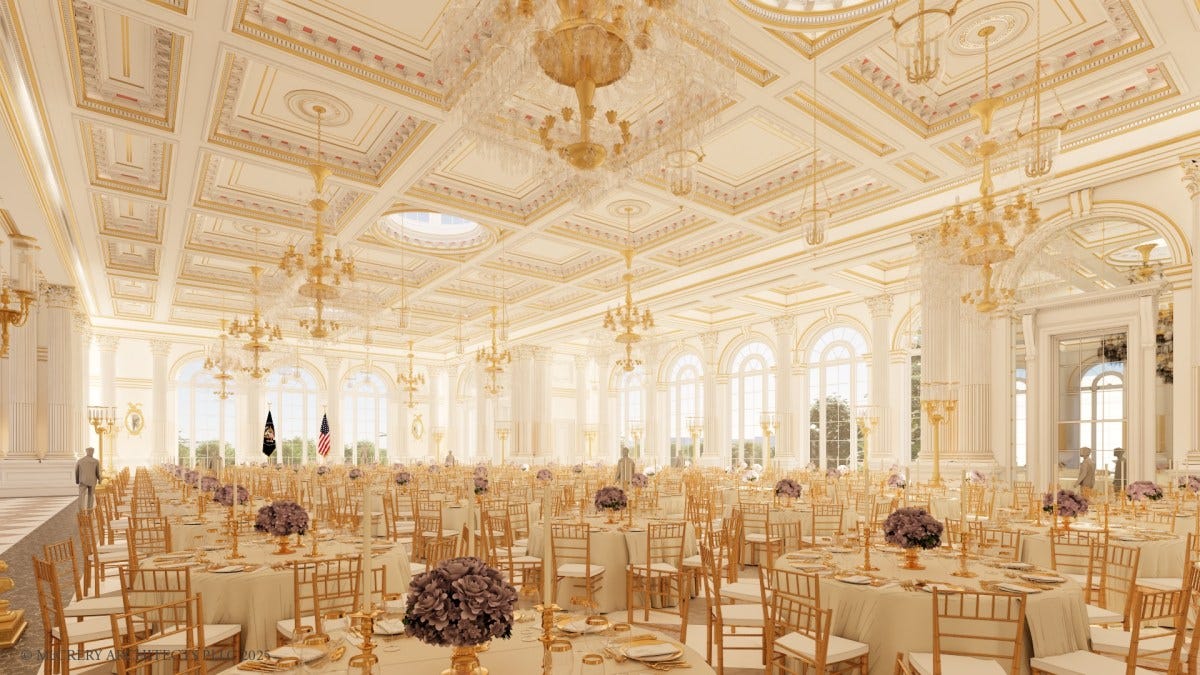
It’s not crazy to think that the White House might need more of an event space. It’s a little silly that the president of the United States needs to put up tents every time he wants to host more than 200 people.
That doesn’t mean it’s that big a deal. If I were president, this would be something like #8,379 on my list of priorities.
Thinking the ballroom makes sense as a policy matter doesn’t mean it’s legal for the president to build it unilaterally. That is a decision best left to Congress.
But that also doesn’t mean just anyone can sue to stop the president from trying. Normal legal rules should still apply.
Earlier this week, the Supreme Court paused a district court ruling that would have blocked President Trump from moving forward with construction of his ballroom. The vote was 5-4, with Chief Justice John Roberts and the three liberal justices in dissent, and the rest of the conservative justices in the majority.
In my opinion, both groups of justices got something right: Roberts and the liberals were right about the ballroom construction being likely illegal, but the conservative majority was right that the group challenging it probably lacked the standing to sue.
This is not normally an issue I would devote much attention to. As I’ve already gestured at, I think there are fine arguments for the White House having a ballroom, but it’s not really an issue I find that important. I’m not an architecture reporter, and I won’t try to moonlight as one.
But I actually think the ballroom case is worth considering, because it lets us take a deeper look at an important concept you might not know much about: standing doctrine, the framework governing who gets to sue over what.
It also raises an important separation-of-powers question with implications that go far beyond the ballroom: Are there times when a president might do something illegal, but no one is able to challenge it in court? It’s a question that has come up repeatedly throughout Trump’s second term, on issues ranging from the ban on TikTok to the war in Iran.
In a presidency that has been marked by brazen executive actions — on which the courts have served as the primary check — it’s never been more relevant to think through this possibility. We’ll do that together this morning. But first: let’s do a bit of a ballroom talk to help understand how these legal gaps come about.
What Roberts and the liberals got right
We’ll start with where I agree with the Supreme Court minority: it was likely illegal for President Trump to unilaterally knock over the East Wing and start building a ballroom in its place without first getting approval from Congress.
The Constitution gives Congress the power to “dispose of and make all needful Rules and Regulations respecting the Territory or other Property belonging to the United States,” such as the White House. The president (even a president with relevant experience in the field) is given no competing real-estate power in the Constitution.
Congress has exercised this authority in numerous ways, including with 40 U.S.C. § 8106, which states:
A building or structure shall not be erected on any reservation, park, or public grounds of the Federal Government in the District of Columbia without express authority of Congress.
President’s Park, on which the White House sits, is a public ground of the federal government in Washington, D.C. Therefore, Congress needs to give express authority to build any structure, such as a ballroom, there. It may be President’s Park, but it is still within Congress’ jurisdiction.
The Trump administration agrees that it has no constitutional right to build a ballroom, but points to two statutes where it says Congress delegated that power to the executive. The first is 3 U. S. C. §105(d)(1), which states:
There are authorized to be appropriated each fiscal year to the President such sums as may be necessary for the care, maintenance, repair, alteration, refurnishing, improvement, air-conditioning, heating, and lighting (including electric power and fixtures) of the Executive Residence at the White House.
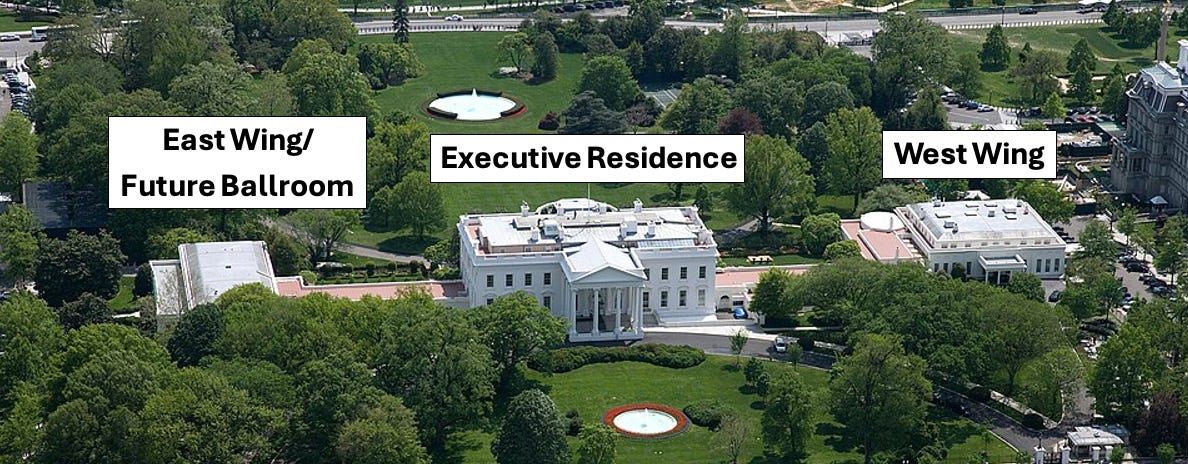
However, the ballroom is not being built as part of the “Executive Residence” of the White House, which is distinct from the East Wing, the part of the building that was knocked down and is being replaced with Trump’s new event space. Even if that were not the case, it would be a stretch to say that destroying an entire wing of the White House and building something new counts as the sort of “alteration” or “improvement” that Congress had in mind here.
“We would not expect” authorization for such a major project to come alongside “such anodyne matters as the President’s ability to use congressional appropriations to maintain power outlets and keep the building warm,” wrote the appeals court judges whose ruling against the ballroom was blocked by the Supreme Court.
And even if that were not the case, this statute still wouldn’t allow the president to do anything, because this statute is not even directed at the president. It is what’s known as an “authorizing statute,” which is a directive from Congress to itself, authorizing not outside action, but future legislative appropriations. (Remember: federal funding is often disbursed according to this weird, two-step process, where Congress first passes an authorizing statute, allowing itself to appropriate money for a certain purpose, and then an appropriations statute, where it actually does so.)
All this statute is doing is letting Congress appropriate money for White House maintenance; by itself, it’s not a permission slip for the president to do anything. Indeed, for the current fiscal year, Congress appropriated $2.475 million under this authorizing statute — not nothing, but also not enough for a $400 million ballroom. (The fact that Trump says the ballroom will largely be funded by private donations is neither here nor there. The project would still need to be authorized by Congress under the statute giving lawmakers power over D.C. public grounds.)

The second statute that the Trump administration points to is 54 U. S. C. §100101(a), which states:
The Secretary [of Interior], acting through the Director of the National Park Service, shall promote and regulate the use of the National Park System by means and measures that conform to the fundamental purpose of the System units, which purpose is to conserve the scenery, natural and historic objects, and wild life in the System units and to provide for the enjoyment of the scenery, natural and historic objects, and wild life in such manner and by such means as will leave them unimpaired for the enjoyment of future generations.
Once again, it’s quite a stretch to say that this broad language about the Interior Secretary being able to “provide for the enjoyment of the…historic objects” at National Park sites (of which the White House is one) equals permission to build a presidential ballroom.
Congress does not “hide elephants in mouseholes,” the late Justice Antonin Scalia famously once wrote. Nor do they typically hide ballroom authorizations in laws about conserving nature.
And that’s it: that’s everything the White House has pointed to in order to say that the ballroom was legally authorized. Personally, I do not find it to be much, especially in light of the fact that Congress has typically passed specific laws to approve major White House renovations in the past.1
That said, just because the construction is likely illegal, it doesn’t mean that this lawsuit is the right one. Indeed, the Supreme Court majority didn’t take a view on the legality of the ballroom, because they ruled that the lawsuit against it was likely improper. And that’s what brings us to standing doctrine.
What the conservative majority got right
The landmark Supreme Court ruling on standing is Lujan v. Defenders of Wildlife, from 1992.
It says that, for someone to sue in a federal court, they have to have suffered a “concrete and particularized” injury. If I defame Taylor Swift in this newsletter, you would not have standing to sue, because you did not suffer any harm stemming from what I wrote. But Taylor Swift might have been harmed, so she would have a stronger standing case (no matter the merits of her underlying defamation case). Standing requirements prevent the courts from being clogged up by frivolous lawsuits from people who haven’t actually suffered a legal injury.
In the case of the White House ballroom, the Trump administration was sued by the National Trust for Historic Preservation, a congressionally chartered (but privately funded) nonprofit. They sued under something called associational standing, which allows an organization to sue on behalf of a member if that member would have standing on their own and the lawsuit relates to the mission of the organization.
As their injured member, the National Trust put forward Professor Alison Hoagland, a historian who used to work for the National Park Service and has written several books on the architecture of Washington, D.C.

Here is how Hoagland described her injury in a court filing:
I live on Capitol Hill, about 2 miles from the White House. I first moved to DC in 1977 and stayed until 1994, then returned in 2009 and have been here ever since. I travel to the White House neighborhood frequently to attend meetings, view exhibits, and have medical appointments. In the past year alone I have attended two rooftop gatherings with views of the White House. I regularly walk through portions of President’s Park, including Lafayette Square, in order to enjoy the historic buildings, the beauty of the L’Enfant Plan (which placed the President’s House on axis with 16th Street), and the innovative preservation project concerning the buildings surrounding Lafayette Square (overseen by Jacqueline Kennedy). I also regularly view the White House from the south side, whether driving by on Constitution Avenue or walking on the Mall.
…As a resident of Washington, D.C., I intend to continue to travel to the area around the White House, to walk through Lafayette Square, to attend functions in neighboring buildings, and to continue to be impressed by this iconic building. In the past I have had reason to be in the area about once a month, and I expect that pattern to continue. In addition, when the National Trust holds its board meetings in Washington, which it does at least annually, it usually holds them at the Decatur House on the northwest corner of Lafayette Square. I plan to attend those meetings in 2026.
Just as I was not compelled by the White House’s case that Congress had authorized the ballroom, I can’t say that I’m too compelled by Hoagland’s case that she has been injured by its construction.
To be fair, she’s not coming completely out of left field here. There is a thing called “aesthetic standing,” which dates back to a 1972 Supreme Court case and allows plaintiffs to sue when they use a certain area in the environment or outside world in a way that would be disrupted by a proposed change.
The appeals court judges in the ballroom case noted that past D.C. Circuit cases have granted aesthetic standing to people who fish in a river that was being polluted, an insect enthusiast who took annual trips to photograph a specific beetle that was being disturbed, and astronomers whose view of the sky was being impacted by light pollution. They, like Roberts and the liberal Supreme Court justices, ruled that Hoagland fit into this lineage.
However, there are some clear differences. While you can’t see a specific beetle if it’s not there, or the sky if it’s being polluted, Hoagland can continue to walk by the White House and go to her rooftop gatherings even if the ballroom is built. She might not like what she sees — but that isn’t an injury. Hoagland wants to “continue to be impressed by this iconic building.” But aesthetic standing, broad as it may be, is about being able to continually carry out a given activity, not about continually guaranteeing one’s subjective enjoyment. (After all, being impressed by something isn’t even internally stable: the same person could be impressed by one building one day, and not impressed by the same building the next. Their legal standing wouldn’t shift depending on their mood.) The fundamental activity Hoagland is referring to here — frequently being near the White House — will not be interrupted by construction of the ballroom.
If you remember the standing standards laid out in Lujan, the other issue is that an injury has to be “particularized,” like the specific person with an interest in that one specific beetle or the specific people who fish in that one specific river. It is always going to be easier to challenge a change to a local landmark that you might have a specific connection to than a national symbol like the White House, which obviously a lot of people walk by and a lot of people feel a generalized connection to.
To address this, Hoagland notes her professional interest in the White House as an architectural historian. Again, in her own words:
The White House affects my own research on more locally focused architecture in two ways. As one of the first prominent government buildings in the new capital city, it drove development around it, helping to define commercial and residential areas while also serving as a landmark defining [the original D.C. architect Pierre] L’Enfant’s plan for the city, and attesting to the promise that city construction would follow. Secondly, as the most important house in the city, the White House was also on the leading edge of all improvements—running water, water closets, electricity, etc. A study of Washington’s architecture without the White House as a reference point would be incomplete
In her court filing, Hoagland repeatedly praises the L’Enfant Plan, which promoted “republican simplicity” in making the White House look more like a house than a palace. But Hoagland has no legal right for the L’Enfant Plan — however admirable — to be carried out in perpetuity, and she can still continue to study the history of the White House and how it once looked without it still looking the exact same. A historian of Victorian-era England has no legal right for Victoria to still be Queen.
I happen to be sympathetic to Hoagland’s affection for the “republican simplicity” of the original White House. But, as a legal matter, how the White House will look in the future doesn’t really have a bearing on her ability to study how it has looked in the past.
If not her, who?
Would anyone have standing to sue? It’s possible, and the Supreme Court ruling technically leaves the door open for the ballroom to be blocked if such a person were to materialize.
Clearly, local architectural historians are out. Someone whose taxes go towards funding parts of the White House renovation also wouldn’t qualify: the Supreme Court has repeatedly dismissed the idea of taxpayer standing outside of specific circumstances.
One obvious answer is Congress, though there are issues there too. The Supreme Court has generally blocked individual members of Congress from bringing these sorts of lawsuits when they haven’t been authorized by their chamber and when legislative remedies are still available. The court has expressed more openness to lawsuits authorized by an entire chamber of Congress, which could become a possibility if Democrats retake the House. But the law there is still unsettled, and the fact that legislative remedies — like passing a law blocking the ballroom — would still be available might hurt the hypothetical case.
Finally, the Trump administration previously suggested that people affected by the noise of the ballroom construction might have standing to sue. (Per the president himself, Melania Trump is “not thrilled” with all the noise, so perhaps she is a potential plaintiff?) No one in this category has filed a lawsuit as of yet.
There’s also the possibility that no one has the standing to sue over the ballroom — even if it’s against the law.
We’ve seen Trump take advantage of this dynamic before. Courts have generally said that neither troops nor members of Congress have standing to sue over military conflicts (even those unauthorized by Congress), which leaves little judicial space to challenge Trump over the Iran war. Similarly, when the president refuses to enforce a law — such as the TikTok ban — it’s not always obvious who might have standing to sue. Trump’s acceptance of a plane from Qatar, in potential violation of the constitutional requirement that he seek congressional approval before receiving foreign gifts, falls into this same category.
These all speak to alleged violations of the U.S. Constitution: the Declare War Clause. The Take Care Clause. The Emoluments Clause. But, under standing doctrine, not every constitutional foul comes with an obvious plaintiff. If the president breaks the law, but nobody is specifically injured, does it make a sound?
Prior generations have wrestled with just this problem. The late Justice Harry Blackmun, dissenting in the landmark Lujan standing case, warned that the ruling represented an “unseemly solicitude for an expansion of power of the Executive Branch.” Justice Scalia, quoting an earlier precedent, responded in his majority opinion that the courts are not supposed to be “virtually continuing monitors of the wisdom and soundness of Executive action.”
The courts are meant to settle private disputes that emerge in response to specific injuries. “Vindicating the public interest (including the public interest in government observance of the Constitution and laws) is the function of Congress and the Chief Executive,” Scalia said.
Over the years, there have been some proposals to rejigger the status quo. During Watergate, then-Sen. Walter Mondale (D-MN) proposed creating a legislative office that would be able to bring a lawsuit attempting to “require an officer or employee of the executive branch of the United States Government, or any agency or department thereof, to act in accordance with the Constitution and laws of the United States,” when requested by just six senators or 24 House members.
Earlier this summer, as part of a column outlining a hypothetical fourth branch of government, I proposed a “Fourth Branch Solicitor General,” who could bring lawsuits if the president was violating his constitutional responsibilities, as requested by a certain number of lawmakers.
Then again, the common response to ideas like this is, If Congress can vote to bring a lawsuit, couldn’t they also vote to stop the president through legislation? And if they can’t, doesn’t that suggest there isn’t a majority of Congress who oppose the given executive action, which means the president is acting in accordance with the will of Congress anyway? Why do lawmakers need to go to the judicial branch before they’ve even tried to exhaust their own legislative options?
The response to this is generally that, whatever legislative options Congress could be taking, they almost never actually take them — which means the system, as constructed, isn’t working. There is also the fact that, even if Congress were to pass a law constraining the president, the president could veto it, meaning the executive branch will always be one step ahead of the legislative branch in these competitions: able to take action as long as nobody has standing to sue them; able to block legislative solutions with their veto pen.
Then again, the veto was very much part of the constitutional design, so its use isn’t exactly a good argument for the judicial branch to start taking on cases that they might be constitutionally prohibited from taking.
The truth is, although progressive commentators are painting the Supreme Court’s ballroom decision as a betrayal of the separation of powers, standing doctrine is itself a product of the separation of powers. Descending from the Constitution’s command that the courts only take up “cases” or “controversies,” it is the court system’s attempt to stay within its jurisdiction without becoming a free-ranging referee for every dispute under the sun.
Through the decades, liberal and conservative jurists have repeatedly traded places in how they look at standing doctrine. Sometimes, a case being thrown out on standing grounds will be cheered by Republicans (as in the ballroom ruling); other times, it will be celebrated by Democrats (as when the Supreme Court, in 2024, unanimously ruled that a conservative group lacked standing to challenge medication abortion). While President Trump mocked Alison Hoagland as a “woman walking her dog, who has absolutely No Standing to bring such a suit,” he hasn’t always been a fan of standing doctrine either.
“The Supreme Court had ZERO interest in the merits of the greatest voter fraud ever perpetrated on the United States of America. All they were interested in is ‘standing,’ which makes it very difficult for the President to present a case on the merits,” he tweeted in 2020, after the court declined to hear his challenges to that year’s elections results.
There is a fair critique that — like everything else in the judicial realm — standing is in the eye of the beholder: held up by a justice as an attempt to enforce the separation of powers when they don’t want to hear a case, and swept aside by the same justice when they do.
Still, the broader concept represents the idea that the Founders did not intend for the courts to become an all-purpose arena to duke out policy disputes. Before they take any case, judges pauses to at least debate whether they are hewing to that vision.
I understand the frustration that my first assertion (the ballroom construction is likely illegal) can be sidestepped simply because of the second (this lawsuit is likely flawed). Shouldn’t the first statement be given more priority than the second? Not in the American judicial system, no.
Sometimes, liberals urge judges to grab more power for themselves and grant more expansive standing claims. Other times, conservatives will do exactly the same thing. But no matter who wins out in any given case: luckily, the Founders did create an all-purpose policy arena, and it’s located just down the road from the Supreme Court. In almost every case, when one side or the other blames the Supreme Court for ducking a case on standing grounds, their desired outcome is still very much available through the good, old-fashioned legislative process, if only they can persuade a majority of Congress to exercise it.
The Trump administration correctly notes that some White House additions have been made without legal authorization, including Gerald Ford’s construction of a swimming pool in 1975 and Trump’s first-term construction of a tennis pavilion. But most renovations on the scale of the current ballroom have received congressional sign-off, including the initial construction of the East Wing.
I'm wondering why the Anti-Deficiency Act doesn't come into play--the WH is spending money Congress did not authorize specifically. Has that been declared null and void by a court, or is there no one charged with (or choosing to) enforcing it?
Great essay. Standing is the issue here and I agree it's difficult to say Hoagland was somehow injured by the ballroom construction.