


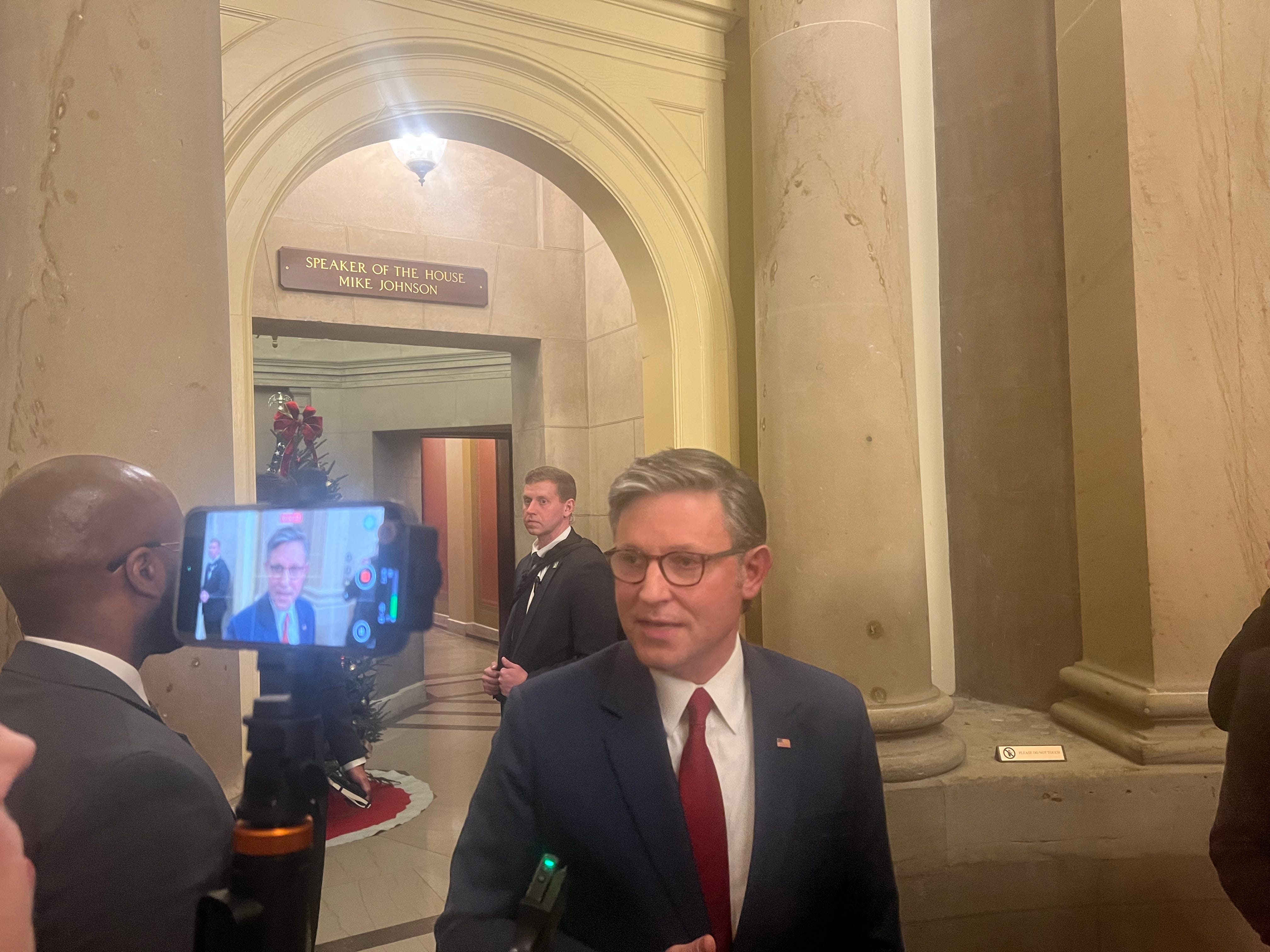
House Speaker Mike Johnson has spent most of 2025 pulling rabbits out of hats.
At the beginning of the year, nine Republicans were withholding their support for him to be re-elected speaker, but after keeping the vote open for almost an hour, he managed to scrape by. At one point in July, a key procedural vote for the One Big Beautiful Bill Act had five GOP defections. Johnson kept the vote open for almost six hours this time; the holdouts eventually caved and backed President Trump’s signature legislation.
But now, with the year winding to a close and House GOP frustrations boiling over, Johnson’s magic appears to be wearing off. He may now be longing for the days of keeping votes open for hours and hours on end. At least then, he controlled the floor.
Last month, I wrote about the recent uptick in discharge petitions: a previously little-used procedural tool that allows 218 House members (a simple majority) to wrest control of the floor from the speaker and force a vote on a bill without his sign-off. (Typically, the speaker — through his influence over the Rules Committee — sets the House floor schedule. If he doesn’t want a bill to get a vote, usually it doesn’t.)
At that point, three discharge petitions had notched 218 signatures this year: one from Rep. Anna Paulina Luna (R-FL) to allow pregnant House members to vote remotely; another by Reps. Thomas Massie (R-KY) and Ro Khanna (D-CA) to release the Epstein Files; and a third by Rep. Jared Golden (D-ME) to overturn a Trump executive order preventing most federal employees from joining unions.
Since then, not only did the Epstein bill pass,1 but so did the bill repealing Trump’s executive order on federal unions, with 20 Republicans in support, a notable rejection of both Trump’s policy and Johnson’s floor control that hasn’t received much coverage.
Then, on Wednesday, four moderate House Republicans — New York Rep. Mike Lawler and Pennsylvania Reps. Brian Fitzpatrick, Rob Bresnahan, and Ryan Mackenzie — signed onto House Minority Leader Hakeem Jeffries’ discharge petition forcing a vote on extending the soon-to-expire enhanced Obamacare subsidies for three years.
This was a big split with Johnson: signing a discharge petition not over an ancillary issue but over one of the most prominent issues in politics right now and one not authored by a rank-and-file Democrat but by the very Democrat trying to take Johnson’s gavel next year.
The move speaks to how frustrated centrist Republicans are with Johnson, over forcing them into voting for the One Big Beautiful Bill, over keeping the House out of session for 50+ days during the shutdown, and now over refusing to extend the enhanced Obamacare subsidies. All four of the discharge petition’s signatories hail from swing districts, which means they are highly vulnerable in the 2026 midterms: they are very worried about having to campaign next year without re-upping the enhanced Obamacare tax credits, which 74% of voters want extended.
Johnson and the moderates held talks over the last few days about adding the subsidies as an amendment to the Republican health care bill that passed yesterday (more on that below), but those negotiations fell apart when Johnson insisted the subsidies be offset by spending cuts. So the centrist Republicans (typically the least likely members of Johnson’s conference to revolt) did the unthinkable: teamed up with Democrats to force a vote.
I was at the Capitol yesterday and spoke to both top Democratic congressional leaders, plus several House and Senate Republicans. Here’s what you need to know, on both the policy and political implications:
What this means for the Obamacare subsidies
The enhanced tax credits are set to expire on December 31. There now will be a House vote on extending them, though that won’t take place until the first week of January, after the credits have lapsed. (Theoretically, the Democrats’ bill could be restructured before the vote to make it retroactive.)
Why the wait? Because seven legislative days have to pass between a discharge petition notching 218 signatures and the underlying bill receiving a vote. “That’s the rule,” Johnson told reporters Wednesday. “There’s no way around that.”
There is a way around that, though: if Johnson wanted, he could lean on the Rules Committee (which is controlled by his appointees) to set up a vote on the bill this week, before the House recesses for the year, seeing as it will receive a vote at some point anyway. But Johnson has no intention of doing that (and it’s possible the Rules panel wouldn’t follow his lead), so a January vote it is.
At that point, the three-year subsidies extension is poised to pass the House, with support from 213 Democrats and at least four Republicans (but likely more). The legislation will still have to pass the Senate, however, to become law. There, prospects for the bill (at least in its current form) are much slimmer, considering the same bill failed to overcome a filibuster last week, receiving 51 votes instead of the required 60.
Four Senate Republicans — Susan Collins (ME), Josh Hawley (MO), Lisa Murkowski (AK), and Dan Sullivan (AK) — backed the subsidies extension in that vote. Nine more would have to join for the bill to advance.
I asked Senate Minority Leader Chuck Schumer on Wednesday what his plan was to flip those nine Republican votes once the bill comes over from the House. He didn’t seem to have one. “It is up to [Senate Majority Leader John] Thune,” Schumer said, adding: “We already had every Democrat vote for the three-year clean extension. We hope Thune would put it on the floor and let it pass.”
But even moderate Senate Republicans I spoke to Wednesday did not seem ready to approve the Democratic bill without changes. “It would be silly for them to think that we’re going to vote this week on something that we all voted against last week,” Sen. Thom Tillis (R-NC) told me.
When I asked if he was hearing from Democrats willing to make a compromise, Tillis pointed to nearby Sen. Susan Collins (R-ME): “There’s a lady walking around here right now who’s led a lot of discussions on how to bridge the gap, and hopefully we can keep the discussions going.”
Collins then told reporters that the success of the House discharge petition boosted “momentum” for extending the subsidies, but that Republicans would be pushing for the measure to include an income cap. The original Obamacare subsidies were only available to recipients who made up to 400% of the federal poverty level (currently, $62,600 for a single person), but when the subsidies were expanded during Covid, Democrats eliminated that upper limit. Republicans are now hoping to restore it.
Other sticking points include whether a compromise bill should include language more fully banning federal health care funding from flowing towards abortion.
Sen. John Fetterman (D-PA) suggested to me that holding another Senate vote on the bill poised to pass the House would be “just gestures that doesn’t deliver health care affordability for anyone,” since it is likely to fail in the upper chamber. “I think the easiest way is a quick, easy one-year [extension], and then spend ’26 figuring out the changes and where it’s going to be,” he said.
Meanwhile, the House voted Wednesday for Johnson’s alternative health care plan: the Lower Health Care Premiums for All Americans Act, which would make it easier for small businesses to group together to offer health insurance with lower premiums, allow employers to offer workers tax-advantaged funds to pay for individual health insurance, and impose regulations on pharmacy benefit managers, among other changes. It would not extend the enhanced Obamacare subsidies.
The Democratic bill “would only impact 7% of Americans,” Johnson told reporters after the vote, referring to the segment of the country who receives subsidized Obamacare. “The bill we just passed impacts 100% of Americans.” The measure was approved 216-211, along party lines except for a “nay” vote from Rep. Thomas Massie (R-KY).
The non-partisan Congressional Budget Office (CBO) estimates that the GOP bill would reduce the average Obamacare enrollee’s health care premiums by 11% per year, but increase the number of people without insurance by 100,000 each year, because of a change in the bill that would make premiums cheaper for some Obamacare enrollees but increase them for others, likely leading some to drop their coverage.
The CBO has previously estimated that failing to extend the enhanced subsidies would lead to premiums going up by an average of 4.3% in 2026 and 7.7% in 2027, and lead to the number of uninsured Americans rising by 2.2 million in 2026 and 3.7 million in 2027.
What this means for Mike Johnson
“Have you lost control of the House?” CNN’s Manu Raju asked Speaker Johnson on Wednesday.
“I have not lost control of the House,” Johnson responded.
But that’s really the sort of thing where, if you have to say it, you’re probably not in a great position. When I put the same question about Johnson to House Minority Leader Jeffries, he responded with a smile: “The situation speaks for itself,” he said.
The Obamacare discharge petition was the fourth to reach 218 signatures this year, the most for any two-year Congress since the 75th Congress, which met from 1937 to 1939 — a historic show of dissatisfaction from House Republicans with how their speaker is controlling the pace (and content) of legislation on the floor.
And don’t forget: the 119th Congress still has another year left. The broad expectation on Capitol Hill is that more discharge petitions are coming down the pike, which means even more records could be broken.
Rep. Tim Burchett (R-TN) told me that he believes Johnson still has floor control, but that the discharge petitions aren’t going to stop. “Neither party really wants to work, and they want to do a lot of messaging and bogus stuff, and older folks just kind of fall in line up here,” he said. “Younger folks aren’t going to do it. I think you’ll see more of it.”
Asked what she attributes the uptick in discharge petitions to, Rep. Nancy Mace (R-SC) — a Johnson critic — responded bluntly: “The lack of policy” being passed by the House. With only one major legislative accomplishment under their belts for the year, many House Republicans are agitating for more to bring back to their districts ahead of the midterms.
Burchett and Mace have both signed on to another pending discharge petition, for a bill to ban members of Congress from trading stocks while in office. The petition currently has 74 signatures, including 59 Democrats and 15 Republicans. Rep. Seth Magaziner (D-RI) plans to introduce a discharge petition next year for a bill that would also ban stock trading for the president and vice president, in addition to lawmakers. That petition is likely to attract enough Democratic signatures that it could reach 218 — though that would require at least five of the 15 Republicans to sign onto a bill that could be seen as targeting Trump.
Mace told me that backers of the stock-trading ban are set to meet with Johnson today.
For his part, Johnson told reporters that the floor revolts are simply a result of his leading one of the smallest House majorities in history — though he also acknowledged that means that he has less power than previous speakers.
“Things operate differently when you have a small majority,” Johnson said. “In the old days, a discharge petition would never be used by the majority party or anybody in it because the speaker had a long stick that he would administer punishment for that. I don’t have that, because we have a small margin.”
None of this means that Johnson’s job is necessarily vulnerable in the coming months — as long as he retains support from Trump, who was also crucial to all of Johnson’s 2025 victories that I referenced above — but it does show that congressional Republicans are growing concerned about their prospects in 2026 and restless about not being given much to do to address it. Johnson will continue to face pressure in the new year to quell those concerns.
Meanwhile, Johnson isn’t wrong about his thin majority: he was effectively bailed out twice on Wednesday by Democratic absences that allowed him to narrowly have his way. A procedural vote was approved 204-203; if any of the 16 absent Democrats had voted, it would have failed. (One of those Democrats was attempting to vote at the time, sparking outrage from the party that the vote was closed.) And a vote on a Democratic resolution to “direct the removal of United States Armed Forces from hostilities within or against Venezuela that have not been authorized by Congress” narrowly failed 211-213; if three of the four absent Democrats had voted, the measure might have passed.
In both of these cases, there were Republican absences too, which means Johnson could have held the votes open longer to track down the missing GOP members and win in the end — but the close shaves reflect how tight of a margin he’s working with. His conference is set to shrink even further in the new year, when Rep. Marjorie Taylor Greene (R-GA) bids farewell to Washington.
Who were the 16 absent democrats? I can see 1 or 2 emergencies. Do your job!
Did Mike Johnson every really have control of the House? He has never impressed me as a man with great political skills. Since he was elected Speaker, he has been riding on the discipline and pressure emanating from the White House. It is no coincidence that the fragility of his situation comes at the same time that the President is facing perilously low approval numbers, appears to be faltering in his political judgment, and people are already starting to talk about him as a lame duck.