


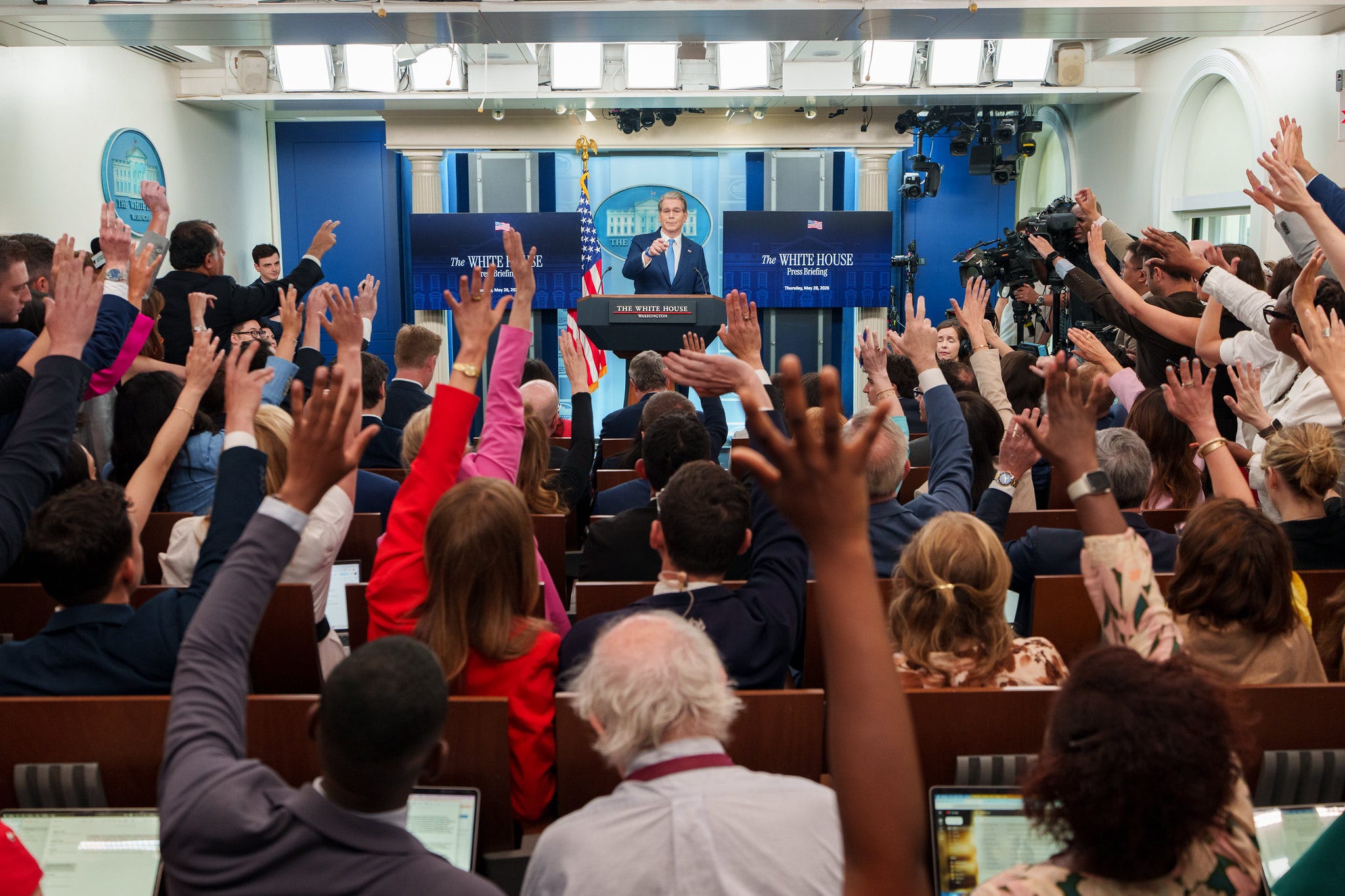
President Donald Trump escalated his war with the press on Friday, announcing on Truth Social that he was banning three news outlets — CNN, MS NOW, and Politico — from the White House.
Correspondents for each organization attempted to access the White House over the weekend; in line with Trump’s edict, all three were denied entry and told their credentials no longer worked. Here are four thoughts:
#1: The first White House correspondent was a 29-year-old reporter named William Price, though in Washington he was better known as “Fatty.” In 1896, towards the end of Grover Cleveland’s second term, “Fatty” Price stationed himself outside the White House gates, where he stood every single day, trying to weasel information out of the people going in and out.
That strategy started getting Price so many scoops for his newspaper, the Washington Evening Star, that soon other reporters started to join him. Suddenly, there wasn’t just a White House correspondent; there was a White House press corps. Cleveland’s successor, William McKinley, took pity on the horde of reporters standing outside (sometimes in rain or snow) and became the first president to give journalists space inside the White House (he gave them a table). That grew into a press room under McKinley’s successor, Theodore Roosevelt, and (although the room itself has moved around over the years) there’s been one in the White House ever since.
How remarkable that, every day, journalists are allowed to waltz into the headquarters of the most powerful government in the world, where they have a room to call their own, dedicated to ensuring that Americans remain informed about what their president is doing (whether or not the information they are disseminating is information he wants the electorate to know).
In addition to playing host to the press briefings you see on TV, the White House briefing room is also open for reporters to use as a workspace on a standing basis. It is a fascinating ecosystem unto itself. Journalists for some top outlets have dedicated desks in the back, but when a briefing is not going on, you will generally see reporters from a range of outlets walking around the room, or holed up in a briefing room seat, working on their laptop.
The briefing room represents quite a cross-section of America — or, really, the whole world. There are usually some oddball characters milling about, many of whom are longtime fixtures of the briefing room: an ultraconservative Episcopal priest, an old lady who ran her own news service with her husband, many eccentric foreign correspondents. You would be shocked at how many fringe characters have gained access to the White House over the years, under the philosophy that America does not license its journalists; the First Amendment protects a random blogger (hi!) just as much as it does the New York Times. There has generally been a pretty low bar for journalists to be let into the briefing room.
Trump’s aides, to their credit, have largely continued this tradition — allowing a number of independent journalists into the briefing room, myself included.
The same philosophy of transparency pervades other government buildings in Washington, including the Capitol, where members of Congress literally cannot walk onto the House or Senate floor without first passing a pack of journalists trying to ask them questions. No law requires them to answer — but they can’t walk by without at least facing the press.
To state the obvious, not every world power handles things this way. There is no space in the Kremlin (the headquarters of the Russian government) or the Zhongnanhai (its Chinese counterpart) where reporters have standing access; the buildings are opened to journalists on an event-by-event basis. Even then, it is only a highly manicured list of reporters who are allowed in. In both countries, it is common for journalists to have their credentials pulled for reporting on information the government doesn’t want people to know.
In Russia, publishing “false information” about the war in Ukraine — including even calling it a “war” — is a crime, punishable by up to 15 years in prison. In China, before being accredited, journalists are required to pass an exam proving their loyalty to the country and their familiarity with Xi Jinping Thought, the ideology of China’s leader. America should not take for granted how open and accessible our government buildings are — or at least have been historically.
#2: Donald Trump sure loves losing lawsuits. The reason why the White House has traditionally thrown open its doors to such a wide range of journalists is not merely the beneficence of past presidents, many of whom have, in fact, despised the press with a white-hot fury. Instead, it is largely due to the First Amendment, which has repeatedly come to journalists’ protection in past White House access cases, a list of precedents that strongly suggests Trump is not headed for a victory here.
Last year, when the White House tried to kick the Associated Press out of the presidential pool, the rotating group of reporters who follow the president around each day, a three-judge panel of the D.C. Circuit Court of Appeals essentially ruled that he could. Being part of the presidential press pool gives a reporter extra access to places like the Oval Office or Air Force One; the D.C. Circuit panel ruled that journalists have no First Amendment right to access this type of restricted space.
However, Trump’s victory in that case explains why he is likely to lose this one. In that very same opinion, the D.C. Circuit panel wrote:
When the White House opens its facilities to the press generally, as it does in the Brady Briefing Room, it cannot exclude journalists based on viewpoint.
The president can pick and choose which reporters come into the Oval Office, a space where only a handful of journalists are allowed. But when there’s a space that’s open to the general press, the First Amendment prohibits the White House from practicing viewpoint discrimination when deciding which reporters are allowed to enter. Crucially, on Friday, the president didn’t just ban CNN, MS NOW, and Politico from specific private spaces; he banned them from the White House entirely, including places like the briefing room, where courts have said credentialing decisions can’t be made in response to an outlet’s ideology or content.
The three news outlets filed a lawsuit against Trump this morning. Their filing, as has now become commonplace, uses Trump’s own words as its best supporting evidence, quoting his Truth Social post to prove that the exclusion of CNN, MS NOW, and Politico was rooted in their content. After all, Trump literally wrote that the decision was “as a result of their constant ‘reporting’ FAKE NEWS!”
The outlets sued under the First Amendment, alleging both retaliation and viewpoint discrimination. But they also sued under the Fifth Amendment, which enshrines the right to due process. There is also a lineage of White House press cases that reinforces this right in this context. As far back as 1977, a D.C. Circuit panel ruled that the White House owed due process to a journalist who had been denied access, which had to take the shape of “notice of the factual bases for denial, an opportunity for the applicant to respond to these, and a final written statement of the reasons for denial.”
During Trump’s first term, judges similarly ruled that the White House had violated the due process rights of journalists by revoking (without explanation) the credentials of Jim Acosta (then of CNN) and Brian Karem (then of Playboy).
By contrast, in 2023, the Biden White House unveiled new credentialing rules governing press access; one reporter who didn’t fit the eligibility standards sued, but the D.C. Circuit ruled against him, finding that the standards were not based on viewpoint and came with enough explanation to satisfy due process rights.
There is not necessarily a First Amendment right for there to be a White House briefing room. But as long as one exists, the White House is not allowed to decide who has access to it based on ideology or according to willy-nilly standards; any decisions must be rooted in viewpoint-neutral rules that have been comprehensively explained. Since that is not the case here, it is hard to see how Trump could win his case.
#3: None of this will help Trump. The president’s approval rating is at about 38%, according to Nate Silver’s average. Polls increasingly seem to suggest that a “blue wave” will crest in November’s midterms, almost certainly washing Trump’s party out of control in the House and potentially the Senate as well.
Banning CNN, MS NOW, and Politico will not help Trump receive more favorable coverage from those outlets, any more than Richard Nixon’s banning the Washington Post from some White House social events helped him receive more favorable coverage from the Post (the newspaper continued reporting on Watergate, which ultimately brought about his downfall) or Barack Obama’s brief attempt to shut out Fox News brought him better coverage from the cable channel.
It will also mean less TV coverage of Trump overall, which will be miserable for a president who loves to see himself on television. Just like print reporters have a press pool for covering the White House (the one that the AP was kicked out of), TV networks have one too. When you see the president on TV signing an executive order or answering questions from reporters in the Oval Office, that footage comes from whichever network is that day’s “TV pooler.” The responsibility rotates between ABC, CBS, CNN, Fox News and NBC; the footage recorded by the day’s pooler is then shared with numerous mainstream TV networks, including local news outlets.
Ironically, CNN was scheduled to be today’s TV pooler, which is obviously no longer possible now that their access to the White House has been cut off. This morning, the other networks that make up the TV pool announced that none of them would take CNN’s place. In fact, as of today, the five networks have decided to suspend the TV pool entirely, a remarkable show of solidarity from competing news outlets.
That means, until further notice, none of the major TV networks will be recording the president’s movements or comments on a day-to-day basis; because they were the ones responsible for disseminating the footage to other networks, this could mean that a lot less Trump will be on your TV screens soon. Trump is not going to like that; in fact, he might privately be grateful once a court inevitably strikes down his ban.
Deeply unpopular and facing expected losses in November, the president is lashing out. But punishing journalists is unlikely to yield more positive coverage (or more coverage, as Trump always desires), nor will it succeed in distracting from the core economic problems that have destroyed his political standing.
#4: One more way the ban will backfire. In a broad sense, Trump’s reprisal against these outlets represents his desire to live in an information environment of his own making, where he only needs to hear positive news about his presidency. In their book “Regime Change,” the New York Times journalists Maggie Haberman and Jonathan Swan chronicle the absurd lengths that White House staff will go to in order to shield Trump from displeasing (but accurate) information.
In one scene, ahead of “Liberation Day,” Trump is trying to decide the tariff rates he will impose on other countries. To inform this, his Commerce Secretary, Howard Lutnick had brought a printout listing out how high of tariffs different countries imposed on the U.S.
But Trump insisted that India and China set higher tariffs than Lutnick’s printout showed. “No, these are bullshit numbers,” Trump told Lutnick, according to Haberman and Swan. “These are fucking bullshit.”
“No, these are the real numbers! They come from USTR,” Lutnick said, referring to the office of the president’s own U.S. Trade Representative, Jamieson Greer, who was also sitting in the Oval Office. “Right, Jamieson? Jamieson, say these numbers are real. Jamieson, speak up.”
But Greer, apparently unwilling to contradict the president, stayed silent. Meanwhile, Trump yelled out for his close aide Natalie Harp to find him the “real” numbers (meaning, the numbers he wanted to see). “Natalie, give me the real numbers,” he said. “Do your Google, do your computer thing, and give me the real numbers.” Harp was unable to find the “real” numbers, since the numbers in Trump’s head did not, in fact, exist.
Living in a world like this — where all information is “bullshit” unless it comports with your own pre-conceived assumptions — makes for maximum comfort. But it rarely redounds to a president’s benefit, in the long run, for him to be shielded from the truth.
As I wrote in July 2024, Joe Biden’s White House suffered from a similar case of epistemic closure, where poll numbers showing just how weak he was running against Trump clearly were not reaching the president’s desk.
But whether or not a president likes the truth, the truth has a way of winning out. In Biden’s case, reality eventually crashed into him in the form of Democratic lawmakers telling him, no, you are not as popular as your aides have told you. For Trump, the reality check will likely come courtesy of voters in November.
Hiding from bad information doesn’t change it, so a president might as well be aware of the truth while he still does have an opportunity to react to it and make a situation better. Remaining cloistered in a bubble can be nice, but all it ends up doing is forestalling the inevitable.
Stfu. It’s only a few of them. The press pool is huge. They barely fit in the room. Now fuck off.
The whole main stream press walked out on the Hegseth debacle. The main stream press supported CNN's lawsuit over Acosta.
The press didn't interview TR. He "interviewed" them. Read the book "Theodore Roosevelt For the Defense" He took over a whole courtroom