


Happy Friday! It’s been a newsy 48 hours, with Indiana Republicans delivering a crushing blow to President Trump’s redistricting dreams, a grand jury delivering another blow to his revenge prosecutions, the House breaking out into discharge petition chaos, the Senate rejecting dueling health care bills, and Kilmar Abrego Garcia exiting ICE custody.
I’ll be covering all those stories in the days ahead — let me know in the comments if there are ones you’re particularly interested in.
This morning, like every Friday, we have our exclusive column for paid subscribers, where I’ll be answering these questions:
Does inflammatory rhetoric still hurt candidates in the age of Trump?
How broad are the president’s pardon powers? Can he pardon someone for a crime not yet committed or charged?
Is this the least productive Congress in history?
How will the Supreme Court carve out the Fed from presidential firing powers?
If you’re not already a paid subscriber, I hope you’ll consider signing up below. I also just wanted to flag that if you head over to wakeuptopolitics.com/subscribe, you can purchase a gift subscription for a treasured friend or relative — or, perhaps, an enemy who you want to punish by subjecting them to my analysis. What a great present for the holiday season!
Have a great weekend, everyone.
A comment I received in response to my piece on Jasmine Crockett and the potential Democratic Tea Party… Q: For good or bad, “inflammatory thing person said” is no longer a metric for whether a candidate gets a vote or not in this country and feels like lazy analysis.
Q: Pragmatism voting versus extremism voting. I was thinking about Jasmine Crockett and noticing her name thrown out a lot. I may be a Pollyanna here but I don’t want to vote for her because it’s mean to make fun of someone in a wheelchair. It’s hard for me to imagine voting for someone so outwardly unkind. However it may be the extremists that generate more votes. Maybe being unkind gets the votes?
I understand this impulse in the age of Donald Trump, I really do. But I’m just not sure there’s much evidence to support it.
One case study that comes to mind is Democrat Jay Jones, the Attorney General-elect of Virginia. Jones, as you may recall, won his race last month despite the emergence of text messages he had sent musing about the death of a Republican colleague and his children. Doesn’t get much more inflammatory than that.
I know what you’re thinking: Jones won. Doesn’t that prove the point of these two questioners? Well, let’s take a deeper look into the results.
On the same day that Jones was elected Attorney General, Democrat Abigail Spanberger — without any comparable scandal — was elected Virginia Governor, setting up a perfect natural experiment for how inflammatory comments influence election results. Below, I’ve charted how Jones and Spanberger performed among various groups of interest, according to NBC exit polls:
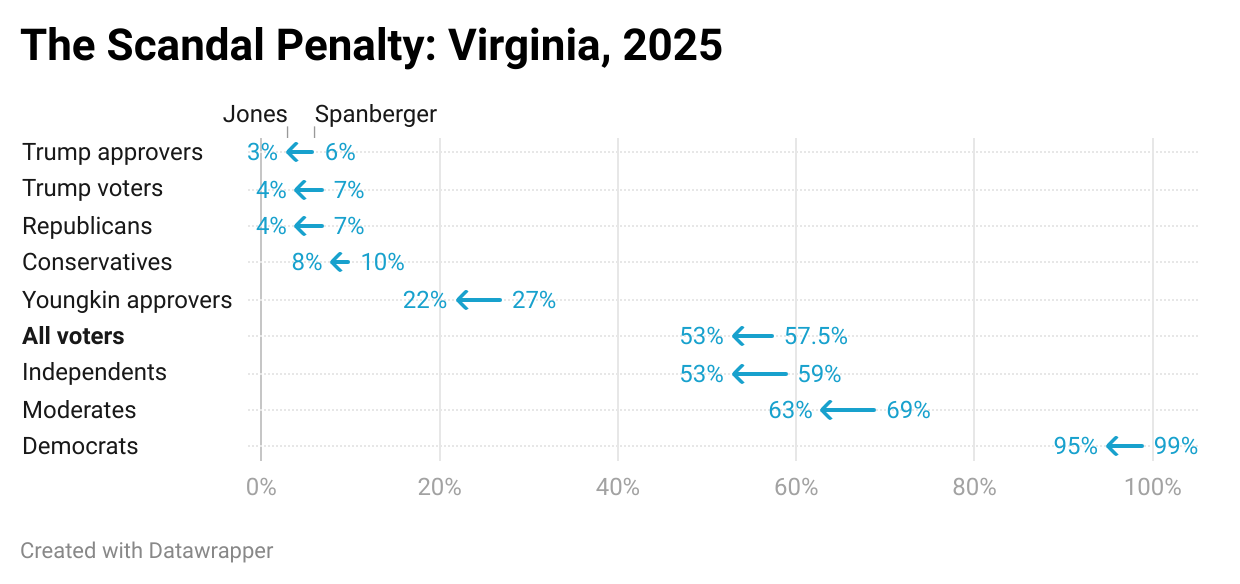
The gap here is not huge, as you can see. Jones performed almost as well as Spanberger with all these constituencies, but in every group, there was a persistent lag of about three to five percentage points.
Lo and behold, overall, Jones performed 4.5 percentage points worse than Spanberger among the statewide electorate.
And in Virginia, that was still enough for Jones to win. The state is Democratic-leaning enough, and Spanberger won by enough, that trailing behind her by ~5 points still lifted him to victory.
Perhaps in another era, Jones’ “scandal penalty” would have been even larger, and this tells us something about the Trump era and how voters have become more OK with scandals. But even if the penalty is ~5 points, that is still a pretty meaningful jump in a country where most important elections are razor-thin and pretty far removed from the idea that “scandals don’t hurt candidates anymore.”
Because, to bring this back to the race both questioners are asking about: Jasmine Crockett does not have five points to lose.
Crockett, to be clear, has no single scandal that rivals Jones’. But the Texas congresswoman, who jumped into the Senate Democratic primary in the state this week,1 has said plenty of inflammatory things, including referring to Texas Gov. Greg Abbott as “Governor Hot Wheels” (he uses a wheelchair) and suggesting that Hispanic voters who support Trump have a “slave mentality.”
The recent high watermark for Democrats in Texas was Beto O’Rourke in 2018, who received 48% of the vote to Ted Cruz’s 51%. To take the “scandal penalty” we calculated based on a sample size of one, if Crockett underperforms O’Rourke by five points, she’d be looking at a 43%-56% loss. Crockett, or any Texas Democrat, needs to overperform the baseline, not underperform. She has no margin of error, no reservoir of Democrats to draw on like Jones had. Even supposing that the only net change for being inflammatory is zero points — in that it doesn’t hurt you, but also doesn’t help you — then that wouldn’t be enough for Crockett to win. For a Democrat to win in Texas, they’ll need to bat a perfect game. Anything that turns off any significant portion of voters (like, say, Hispanics who voted for Trump in 2024 and Democrats now need to win back) is already too costly when you’re starting from a deficit.2
This is why victories like Jay Jones’ are a prime example of survivorship bias. Yes, he won. But I think we tend to focus more on the scandalous victories that surprise us than the scandalous defeats we expect, of which there are more (examples below). And besides, Jones winning doesn’t answer the real question of whether being inflammatory hurt his campaign, only that it didn’t end it. For our purposes, his margin, not the pure win/loss record, is more helpful. And he won by a margin that, if replicated, would not be enough for a Democrat in a state where they don’t already have a large edge (like, for example, Texas).

While it’s true that states with lots of Democrats will often still elect inflammatory Democrats, and states with lots of Republicans will often still elect inflammatory Republicans, there just aren’t a lot of recent examples of controversial candidates running in competitive states but winning anyway — and certainly not of controversial candidates running in states where their party started from a deficit but winning anyway.
Donald Trump’s political project has simply not proved highly replicable in the places that matters, in that Trump imitators have managed to win in Republican-friendly territory but almost never in battleground states: the 2022 elections are a great example, where Republicans won the nationwide House vote but blew highly winnable races in states like Arizona, Georgia, Pennsylvania, and Michigan because controversial Trump-like candidates simply did not resist penalties for scandal in the same way Trump (sometimes) has. (There are even examples in recent history of controversial Trump-backed candidates losing in deep-red territory, not just purple territory. See Alabama, 2017.)
Somewhat ironically, on the Democratic side, the best example for a loose-cannon candidate winning in a battleground state might be John Fetterman in 2022? The Democrats who win competitive races (the Raphael Warnocks and Elissa Slotkins of the world) simply aren’t much like Jasmine Crockett, just like the Republicans who do the same (see: Brian Kemp or Dave McCormick) aren’t much like Trump.
There are plenty of examples to support the much narrower claim that a candidate “being extremist” or “saying inflammatory things” no longer poses much of a penalty in primary elections. But in truly competitive general elections in states with electorates that are divided (or that already lean against the controversial candidate)? There’s really not a single strong example of that strategy working.
Except, of course, for Donald Trump.
So how has he managed to escape scandal and controversy when his protégés and imitators on both sides usually don’t?