


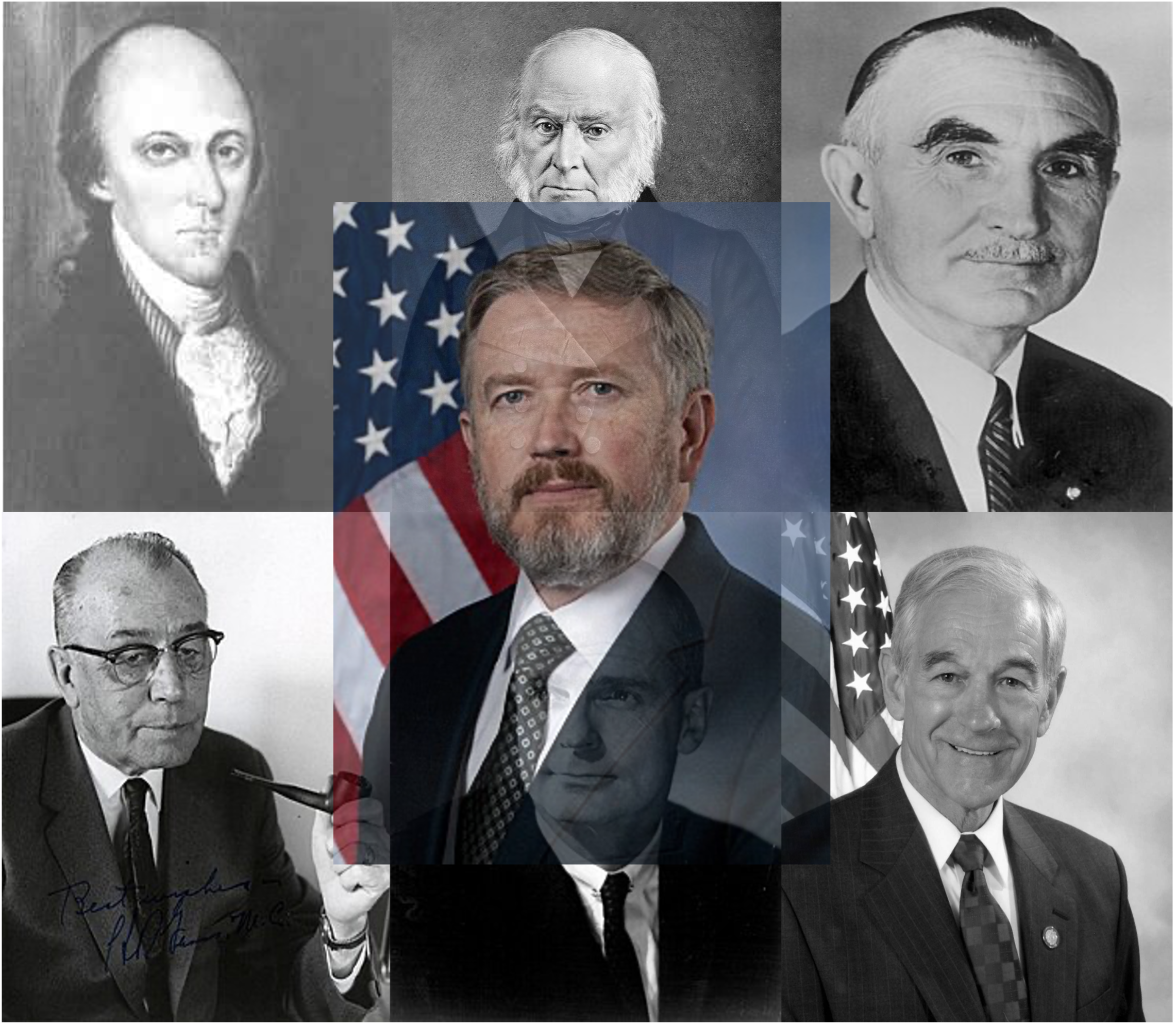
President Trump scored yet another victory in his intraparty revenge tour Tuesday, as Rep. Thomas Massie (R-KY) was defeated by a Trump-endorsed primary challenger, three days after Sen. Bill Cassidy (R-LA) met the same fate and two weeks after a group of Republican state legislators in Indiana did as well.
The main takeaway from last night’s results is that Trump, despite the fact that he has rarely been less popular nationally, has never been more powerful within the Republican Party. After these latest victories, some Republicans are speaking about Trump’s sway over the party with almost religious fervor: “The power of Donald Trump is real,” Sen. Lindsey Graham (R-SC) said after Massie’s defeat. “Donald Trump was saved by G-d so he could save the world,” Rep. Randy Fine (R-FL) wrote, celebrating his colleague’s ouster.
But within Congress, Massie and Cassidy’s departures will also reverberate for reasons that have nothing to do with Trump himself — and which are different for each man.
Cassidy’s defeat represents the loss of yet another dealmaker. With the Louisianan gone, at least seven of the 10 senators who negotiated the bipartisan infrastructure package — only five years ago! — will be out of office come next year. Cassidy also helped broker the bipartisan gun control deal the next year, in addition to having worked with Bernie Sanders on drug prices and with Chris Murphy on a landmark mental health package.
I have written previously about the risks of Congress losing dealmaking moderates like Cassidy; they are real and only getting more so. But today, I want to dwell on what is lost when the Massies of the world are run out of Washington: the cranks, the curmudgeons, the contrarians.
Most members of Congress blend together. Almost all of them carefully toe their party line; if their leadership says to vote “yea” or “nay,” or heel, or jump, they do so. They could cut out the middleman and hand their voting card over to Hakeem Jeffries or Mike Johnson, and no one would notice any difference.
That’s never been Massie’s style. In his 13 years in Congress, Massie has been the sole dissenter in votes to sanction China, Iran, and North Korea. He has voted “no” on almost every government spending bill that has come up for a vote. In 2014, he voted against awarding a Congressional Gold Medal to Jack Nicklaus, and in 2020, he forced an in-person vote on a Covid relief bill, angering both parties by making them come back to Washington during a pandemic.
These are not popular positions. But Massie does not believe in sanctions, no matter how odious the country in question. He does not believe in massive spending bills, no matter what is being spent. He doesn’t think awarding medals is a good use of Congress’ time. And he thought that, maybe, a $2.3 trillion package (the largest stimulus bill in U.S. history) shouldn’t be approved without a recorded vote.
More recently, this stubborn streak has put him crosswise with the president, on issues like the Epstein Files, the war in Iran, the One Big Beautiful Bill, and tariffs. But unlike Cassidy — who voted to convict Trump in his second impeachment trial and refused to endorse him in 2024 — Massie’s issues with Trump were not about whether Trump should be president, or whether he is fit to hold the office.
Massie is simply suspicious of Jeffrey Epstein, opposes foreign intervention, supports deficit reduction, believes tariffs should be imposed by Congress, and has held these beliefs for years. He has always supported Trump for president, but when Trump diverged from Massie’s position on these questions, Massie had no problem breaking with his fellow Republicans. After all, he’s had a lot of practice doing it, before Trump ever entered the equation.
Massie has long been a thorn in everyone’s side, and it’s no surprise that it was ultimately his undoing. But the thing is: Congress has always had this sort of lone dissenter, that member who is comfortable being the “1” in a 434-1 vote, the resident Crank. And it needs one. Every group does. It needs the person who says, “I know we all agree on this, but are we sure?” They are an obstacle to unanimity, a guardian from groupthink.
This is a long and storied role in Congress, and with Massie on his way out the door — courtesy of Trump, who has no patience for principled contrarianism — it’s not clear there will be anyone to fill it.
America was founded by Cranks: John Adams spent months pissing off everyone in the Continental Congress, until they finally agreed to declare independence. (Though that didn’t stop him from also defending the British soldiers who participated in the Boston Massacre, because he believed in the right to counsel. Total Crank Move.) Then, once independence (and, ultimately, the new Constitution) became mainstream, another group of Cranks protested and dissented and got us the Bill of Rights.
The First Congress had a Crank. William Maclay was a senator from Pennsylvania who basically hated everyone he came across. Cranks are often the skunk at the garden party, the ones telling everyone to slow down and remember that even if things seem good now, they might not be forever. In Maclay’s case, he bitterly fought George Washington’s uses of executive power at a time when everyone loved George Washington, trying to remind his colleagues that Washington would not be president forever.
“He is but a man, but really a good one, and we can have nothing to fear from him, but much from the precedents he may establish,” Maclay wrote in his diary, which is the most detailed account we have of the First Congress. When George Washington appeared before Congress to propose a treaty, and again to deliver the State of the Union, Maclay encouraged lawmakers to be careful about how they responded. (Some wanted to send Washington a tongue bath of a letter in response.) He tried to ensure that the president’s salary wouldn’t be inordinately high (and that the president wouldn’t get extra money to spruce up his residence as well).
Maclay thought that Washington was trying to import the “British mode of business,” and that his allies wanted to give the president “every appendage of royalty.” When the question of presidential immunity from prosecution came up, Maclay pushed back: “I said that, although President, he is not above the laws.” Cranks are often ahead of their time.
Later, Adams’ son John Quincy followed in his father’s cranky footsteps. As a former president, JQA returned to serve in the House. Without any higher heights to climb, he had few cares to give. He became the congressional contrarian, laboring mightily to repeal the House’s “gag rule” — which prevented debate over slavery — and rising again and again to try and read abolitionist petitions into the congressional record, until eventually (after an eight-year battle) the gag rule was rescinded by a successful motion from the former president.
Oregon Sen. Wayne Morse, who I wrote about on Monday, was a Crank. So was the iconoclastic Wisconsin Sen. William Proxmire, who used to give out the Golden Fleece Award, given to the use of government spending that he deemed most wasteful that month. (Example: a National Science Foundation grant to compare whether sunfish were more aggressive when they drank tequila or when they drank gin.) There was also Iowa Rep. H.R. Gross, another legendary penny-pincher, who even pushed back against spending federal funds to pay for the gas that would fuel the Eternal Flame at John F. Kennedy’s gravesite.
There are familiar Crank themes throughout history. They’re often opposed to government spending and opposed to foreign intervention. They’re usually a little conspiratorial in nature. They’re often fierce defenders of civil liberties, even in times of war, when it isn’t popular to stand up for a particular group’s freedom of speech.
No one likes Cranks in their time. But they’re often vindicated down the road. Morse was so comfortable in dissent that he was one of two senators to vote against the Gulf of Tonkin resolution, which authorized LBJ to use force in Vietnam without a formal declaration of war. (His “early prophecies and warnings about Vietnam were such that we all owe him a great debt,” a Republican colleague later acknowledged.) For the rest of his tenure, every time a measure came up (even an appropriations bill) that would have the effect of supporting the war effort, More voted “nay.”
Similarly, no one looks back fondly on the “gag rule.” Proxmire gave a speech on the Senate floor every day for eight years — more than 3,000 speeches in all — stubbornly pushing his colleagues to ratify the Genocide Convention, until finally they did so. Time magazine once referred to Gross as a “useful pest.”
“But, as self-appointed caretaker of the congressional conscience, he has his own unique value,” the magazine continued. “The House needs a man like H. R. Gross—although one is probably plenty.”
Indeed, you don’t want a chamber of ideologically unflinching one-man operators. But having one or two in every generation, to hold a mirror up to the rest of Congress, is better than a chamber full of yes-men who never question the party line or the reigning consensus of their day, be it adoration for George Washington or support for Vietnam. (In a recent interview, Massie referred to such go-along lawmakers as “NPCs,” video-game lingo for “non-player characters.”)
In the modern era, these cranks have often been located on the extreme ends of the ideological spectrum: libertarians on one end of the aisle, democratic socialists on the other. Bernie Sanders can be a Crank, and he has used that stubbornness to slowly move the center of gravity in the Democratic Party on several issues, including the minimum wage and health care. The first time he introduced a resolution to block an arms sale to Israel, in 2024, it received 18 votes. When he did so again last month, its support had grown to 40 senators.
On the right, Massie is the inheritor of a tradition established by the former Texas congressman, Ron Paul, who was known as “Dr. No” for his practice of opposing every bill that he did not believe was explicitly authorized by the Constitution. Massie, who lacks Paul’s medical degree, has been nicknamed “Mr. No.” Trump, meanwhile, calls him “Rand Paul Jr.,” a nod to Paul’s son, now a Kentucky senator and fellow thorn in the president’s side. Kentucky seems to be the hotbed of the latter-day Congressional Crank Caucus.
If there is any issue on which Massie will one day seem prophetic, it will possibly be the national debt, which — as of last month — has now ballooned to equal the size of the entire U.S. economy. I cannot say whether our $31 trillion debt will ever spark the crisis that some believe it will, but if it does, Massie (who invented his own wearable debt clock to pin on his lapel, offering a visual reminder of its amount while walking around the Capitol) will have a right to feel some vindication.
Cranks are not perfect. They’re often gadflies who don’t play well with others. They frequently court controversy, and Massie is no exception. He was accused of antisemitism in 2023, when he seemed to suggest that members of Congress were more interested in “Zionism” than “American patriotism,” and again last night, when he said that he had difficulty conceding to his rival because “it took a while to find Ed Gallrein in Tel Aviv.” (Gallrein is not Jewish, but was backed by several pro-Israel groups, helping make their race the most expensive House primary in history.) Then again, his criticisms of Israel have certainly gained more popular support with time. In 2023, one month after October 7th, he cast a 420-1 vote against a resolution affirming Israel’s right to exist. (He explained that he supports Israel’s right to exist, but disagreed with language in the measure that conflated anti-Zionism with antisemitism.) In 2024, he was the only House Republican to boycott an address to Congress by Israeli Prime Minister Benjamin Netanyahu.
One issue with Democrats and Republicans always voting in blocs in Congress is that Democrats and Republicans nationwide are not nearly as homogenous. According to a recent poll, Republicans are split, 45% to 44%, on whether they have confidence in Netanyahu. Is there any reason why the 44% should not have representation among congressional Republicans? There are so many issues where 20%, 30%, 40% of a party’s members feel one way, but none of the party’s members in Congress represent that stance — unless free-thinking dissenters like Massie are willing to step out of line.
To name one example, according to this week’s New York Times/Siena poll, 23% of Republican voters disapprove of the war in Iran. But only about 1% of Republican lawmakers have voted against the war, including Massie. Just yesterday, another joined this faction: Cassidy, whose “yea” vote helped advance a Senate resolution to end the war for the first time since it started. Did Cassidy, who has voted “nay” on the last seven of the same resolutions, suddenly change his mind? Or did he change his vote now that he no longer has to worry about facing a Republican primary electorate, now that he has been defeated?
What are the odds that the true number of anti-war Republicans in Congress isn’t at least closer to the number among Republican voters? There is a time for lawmakers to vote in accordance with their districts, but there is also a time for lawmakers to vote in accordance with their consciences — and not just once they no longer fear being defeated for re-election. Congress needs lawmakers like Massie, who has been voting his conscience on Iran since the beginning of the war, precisely because he has so much practice breaking from the pack.
Mirror dynamics exist on the Democratic side. Former Sen. Joe Manchin, a certified Crank, pushed back against big-spending Democratic legislation during the Biden era and warned that the Biden administration moved too far to the left to win re-election. In the fullness of time, after an inflation spike and Kamala Harris’ defeat, there are many Democrats who wonder whether they should have heeded Manchin’s warnings. No organization benefits from groupthink.
Cranks are often targeted. Morse lost re-election because of his early opposition to Vietnam. Manchin is no longer in office, without a home in either party. In 1938, Franklin D. Roosevelt took on a group of Cranks who opposed his court-packing plan, supporting their opponents in Democratic primaries in an (ultimately unsuccessful) effort to purge his party of dissenters.
Trump — less popular than FDR, but even more powerful within his party — has now succeeded where Roosevelt failed, having ousted Massie, who he had called “the worst Congressman in the long and storied history of the Republican Party.”
Ironically, Trump has some of the qualities of a Crank. He is an old man, as they often are. He is stubborn. He is willing to cut against the grain, and fight back against the consensus positions of his own party and of Washington at large. Sometimes, he has even done so on the precise issues Massie is now battling him on.
But Trump is as ideologically flexible as it comes, and now appears to have dropped these contrarian ideas like isolationism. Massie has long since recognized that casual relationship to ideology that Trump and many of his voters hold. Back in 2017, he recounted traveling around Kentucky the year before, and realizing that many of the voters who had once supported him and the two Pauls were now on board the Trump train.
“All this time,” Massie said, “I thought they were voting for libertarian Republicans. But after some soul searching I realized when they voted for Rand and Ron and me in these primaries, they weren’t voting for libertarian ideas — they were voting for the craziest son of a bitch in the race. And Donald Trump won best in class, as we had up until he came along.”
Even though Trump has sometimes been a lone dissenter, he has no tolerance for others doing so, certainly not when it means dissenting against him. Massie has opposed deficit-busting bills and foreign adventurism under presidents of both parties (there aren’t many members of Congress who voted against Obama’s intervention in Syria and Trump’s intervention in Iran). And he has long said that tariffs are the province of Congress, even as he has simultaneously said that they should replace the income tax, a Crank position if I’ve ever heard one. (How many lawmakers are pro-tariff, but insist they receive a vote in Congress?)
“We haven’t had a vote on tariffs since I’ve been in Congress,” Massie wrote back in 2019. “Similar to war powers: the power to tax is vested solely with Congress yet Congress is full of weak leaders on both sides of the aisle who won’t assert our authority or exercise our responsibility.” As soon as those positions caused issues for Trump, Trump cut him loose.
Trump has tried to purge other Republicans for even less. Last week, he called for the ouster of an ally, Rep. Lauren Boebert (R-CO), who committed the sin of campaigning for her friend Massie. (Boebert was also one of the four Republicans, with Massie, who signed the discharge petition to force a vote on releasing the Epstein Files. This is another issue that required crankery to force into the open, but once it did, suddenly everyone was on board: the bill ultimately passed unanimously.) Just yesterday, Trump endorsed a primary challenger against Sen. John Cornyn (R-TX), who has generally stood by Trump in the last decade, because Cornyn “was very late in backing me” in 2024.
“John Cornyn is a good man, and I worked well with him, but he was not supportive of me when times were tough,” Trump said.
Trump’s endorsement will undoubtedly make it harder for Republicans to keep the Texas Senate seat: Cornyn’s challenger, Ken Paxton, has been indicted, impeached, and scandal-plagued. Trump doesn’t care. He would rather be the unquestioned king of a minority party than the tenuous leader of a broad but fragile coalition. He has long since proven that he would rather control something like 35% of the country, as long as he controls it with an iron fist, than try to negotiate his way to something larger.
Ultimately, this is unhealthy for a political party, if only for the obvious reason that a solid lock on 35% (plus occasional support from a slice of independents) will sometimes produce victories, but never in a reliable way. Groups that lack dissent will inevitably steer in a worse, less popular direction — more uniform, more orthodox, less appealing to potential converts — which is why you need the 434-1s, the Massies, as a party, and a nation, to raise red flags. Sometimes, they might dissent when it doesn’t count, but that also means they’ll be less afraid than others to dissent when it does. Even if they start out lonely, Cranks rarely give up, which means through stubbornness and persistence, they occasionally bring others around, sometimes to an important cause that they were early to champion. They create a permission structure for issues to go from 434-1, to 425-10, to 385-50, to 335-100, all the way until fringe positions slowly become mainstream and even a majority.
In January, without the gentleman from Kentucky, things in the House might move a little faster. Votes will be a little more unanimous. But when the umpteenth 435-0 vote flies by, or another vote divides perfectly along party lines, just remember what is missing without Massie.
If you keep writing impartial reasonable articles, given the current state of journalism ethics, you will be considered a crank. Good work.
Excellent article, Gabe. In addition to the need for crank politicians, we also need crank PARTIES! Our nation's iron-grip hold on the two major parties fosters blind party loyalty, prevents serious discussion of issues, and disenfranchises voters who don't like their limited choice. All should feel encouraged to vote "Crank" without fear they are "wasting" their vote.