


President Donald Trump’s endorsement is generally seen as a golden ticket in Republican primaries.
On the surface, it seems as though that has held up this year. According to Ballotpedia, a remarkable 96% of the candidates Trump has endorsed in GOP primary elections this cycle have won.
However, that statistic (which Trump is very fond of) is a bit misleading, combining victories that are genuinely impressive — like his successful bids to purge Republican incumbents like Sen. Bill Cassidy (LA), Sen. John Cornyn (TX), and Rep. Thomas Massie (KY) — with endorsements in primary races that were completley uncontested.
When you take a closer look, the power of Trump’s endorsement appears to be fraying.
In gubernatorial elections, for example, Trump has endorsed 10 candidates in contested primary races so far this year (defined, fairly liberally, as races where more than one candidate received at least 10% of the vote). Of those, five have won and five have lost, yielding a much less impressive success rate of 50%.
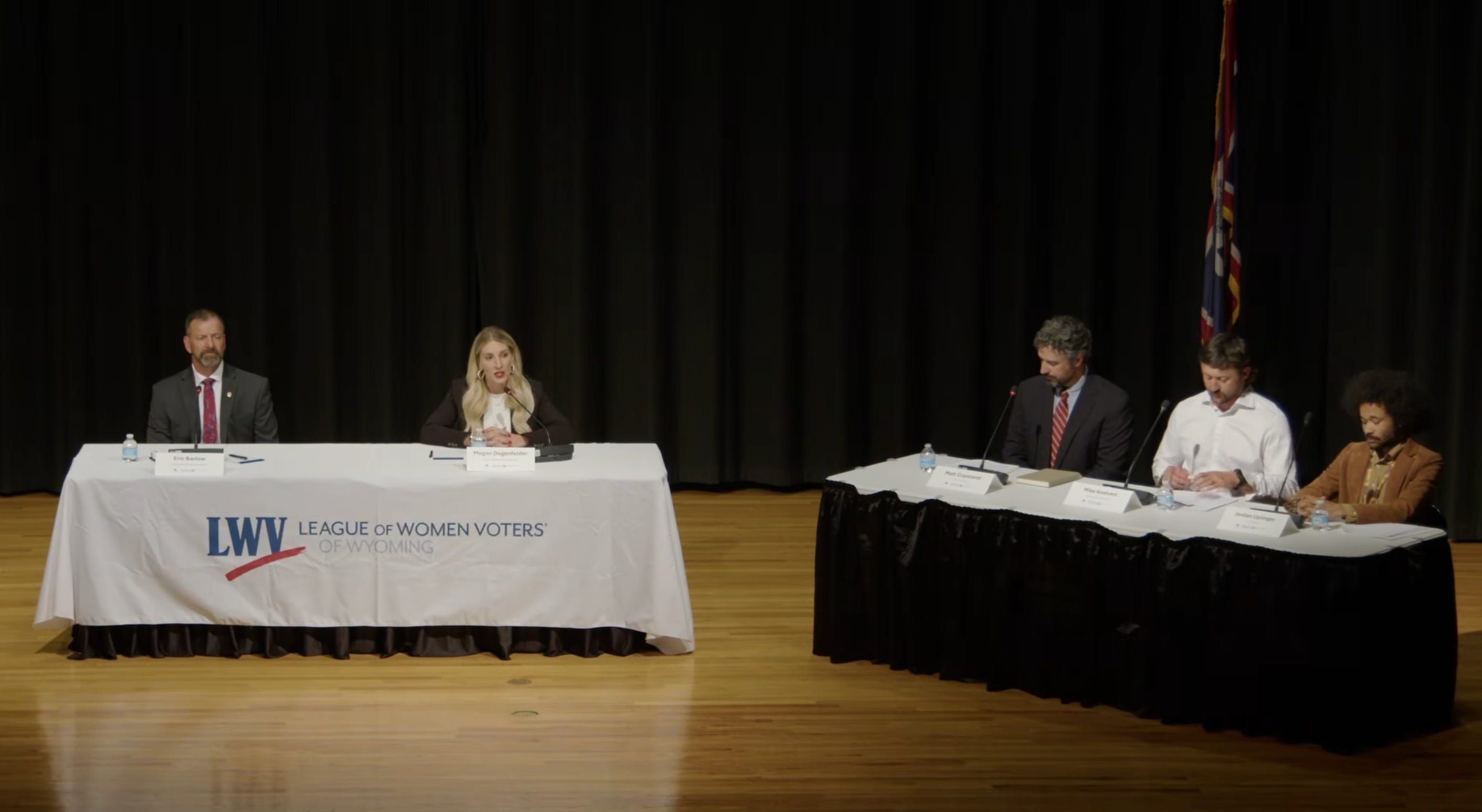
His most recent loss came last night, when Wyoming Superintendent of Public Instruction Megan Degenfelder was crushed in the state’s GOP gubernatorial primary by state Sen. Eric Barlow. Trump urged Degenfelder to run in January (“Should she decide to enter this Race, ‘MAGA’ Megan Degenfelder has my Complete and Total Endorsement”), then reiterated his support in a video last month and two Truth Social posts and a tele-rally this month.
“So get out and vote for Megan Degenfelder,” Trump said during the tele-rally. “And you’re going to be happy. You’re going to say, ‘President Trump gave me a good idea.’ You’ll look back in the years and you’ll say, ‘That was a great, a great choice.’”
Degenfelder finished with 28.1% of the vote, to Barlow’s 44.8%.
She was one of three Trump-backed candidates who fell short in GOP primaries last night, joining Rep. Cory Mills (R-FL) and Florida congressional candidate Catalina Lauf.
In total, according to a Wake Up To Politics analysis of Ballotpedia data, 13 Trump-endorsed candidates have come up short in GOP primaries this year, a far cry from his near-perfect record during the two election cycles in his first term. (Just one Trump-backed Republican lost a primary in 2018, and only four lost in 2020. Trump’s endorsement record was more mixed when he was out of office, with 16 primary losses in 2022 and 12 in 2024.)
Let’s be clear about what this is and what it’s not. These primary results do not indicate a change in the party’s support for Trump himself. But they do represent a stylistic shift in the sort of candidates winning over Republican primary voters.
We’ll tackle the first point first.
It should be stated at the outset that the candidates beating Trump-backed opponents are not anti-Trump Republicans by any stretch of the imagination. In fact, these GOP primary contests are generally a competition over who can tie themselves to Trump the most.
“I’m running for Congress to support President Trump, get inflation under control, and to protect election integrity,” former local news anchor Ryan Elijah, who beat Mills, said in his first TV ad. “Together, we’ll help President Trump make America greater than ever before,” businessman Jim Schwartzel, who beat Lauf, says on his campaign website. Earlier this year, in North Carolina, a Trump-endorsed state senator lost to a candidate who had led the group “Sheriffs for Trump” in 2016.
The fact that the candidates in these primaries — Trump-endorsed or not — all speak the shared lingua franca of pro-Trump Republicanism generally allows Trump to quickly declare victory even when his preferred candidates lose in primaries, as he notes that the winner was pro-Trump, too, and rushes to rally behind them.
“Ryan stands for EVERYTHING MAGA, and is respected by ALL. He has my Complete and Total Endorsement!” Trump wrote this morning on Truth Social, referring to Elijah. (He also added that he had privately told Mills to “get out of the Race, but he wouldn’t listen,” though there was no public indication of this and Trump never rescinded his endorsement.)
Earlier this month, when another Trump-endorsed Republican incumbent (Tennessee Rep. Andy Ogles) was defeated by a primary challenger, the president similarly acted like he had always known it was a lost cause (calling Ogles a “person who I remained loyal to even though he had virtually no chance of winning”) and called the victor Charlie Hatcher a “Great ‘Trump’ Candidate.”
But even if support for Trump has not been on the ballot in any of these races — with everyone more or less on the same page ideologically — the results still paint an interesting trend of Republican primary voters gravitating away from controversial candidates running in Trump’s mold stylistically.
We can use the Wyoming gubernatorial primary as an example. The state’s current governor, Republican Mark Gordon, is known as a mild-mannered, mainstream conservative who has crossed swords with the state legislature’s Freedom Caucus over issues like Covid policy and government spending.
Eric Barlow, who won last night’s primary, was seen as being in Gordon’s mold, while Megan Degenfelder, who Trump had endorsed, was viewed to be “considerably more pugnacious,” having made highly charged issues like DEI and gender policy the cornerstone of her tenure as state education chief and her gubernatorial campaign. A third candidate, retired Marine Corps colonel Brent Bien, was also aligned with the state Freedom Caucus.
“Barlow’s victory suggested that Wyoming’s heavily Republican electorate preferred a lower-key leader similar to the incumbent governor, Mark Gordon, rather than a bomb-throwing conservative or culture warrior,” as the New York Times put it. In the same night, at least 14 members of the state legislature’s Freedom Caucus were defeated, suggesting a farther-reaching move away from hard-edged candidates.
A similar story has played out this year in other Republican gubernatorial primaries. In Minnesota, Trump threw his weight behind Mike Lindell, the former MyPillow CEO who gained notoriety for promoting Trump’s lies about the 2020 election. Lindell lost the Republican primary last week to Lisa Demuth, a more conventional politician who currently serves as speaker of the state House. (Lindell, true to form, has refused to concede.) Another neither Lindell nor Demuth were seen as particularly likely to win the governorship in blue-tinted Minnesota, GOP primary voters went with the candidate who had at least a better shot at flipping the statehouse, over a zanier alternative.
Earlier this year in Georgia, another leader of Trump’s 2020 election denial movement — Burt Jones, who was tapped as one of the “fake electors” after that campaign — lost the GOP gubernatorial nod to businessman Rick Jackson, a former Liz Cheney donor, despite Trump having endorsed Jones. Jackson was not anti-Trump (though he did admit, “like JD Vance and Marco Rubio…I was late to the Trump Train”), but he was not the candidate most clearly in Trump’s mold.
This isn’t just a matter of GOP voters elevating more traditional pols to be chief executives, or only thronging to that type in swingy territory. The same story has played out on the congressional level, and in deep-red seats.
The two Trump-endorsed House incumbents who lost in primary challenges this year, Cory Mills (last night) and Andy Ogles (earlier this month), were both plagued by scandal: Mills faced allegations of fraud and sexual assault; Ogles was being investigated for his campaign finances and had routinely provoked controversy over his Islamophobic social media posts. (“Muslims don’t belong in American society,” he wrote on X this year.)
Their losses showed that the Trump strategy of just blowing through scandal works only for him: voters (even Republican voters) are not willing to give politicians (even ones endorsed by Trump) anywhere near the same forbearance as they are willing to give the president.
The other Trump-backed congressional candidate to lose last night was Catalina Lauf, who served in his first administration but who did not have deep roots in the state she was running in (Florida), having lost two previous congressional campaigns in Illinois. Eventual victor Jim Schwartzel painted her as a carpetbagger, noting in ads that he had raised his family and started a business in the district.
Extending beyond just races with Trump endorsees, you can see a broader backlash brewing to the conventional wisdom that primary voters in both parties routinely pick the most outlandish candidate on the ballot.
As I’ve noted previously, several influencer-politicians have fallen short this cycle, including Jack Schlossberg in New York and Kat Abughazaleh in Illinois. And so have several politician-influencers: many of the most rabble-rousing House members on both sides of the aisle will be gone next year, now that Matt Gaetz and Marjorie Taylor Greene have resigned, and Jasmine Crockett, Nancy Mace, Chip Roy, and Ralph Norman have lost bids for higher office. (A former politician in this mold, Missouri’s Cori Bush, also came up short in a comeback bid this month.)
With the losses of Ogles and Mills — plus the retirements or resignations of Eric Swalwell, Chuck Edwards, and Tony Gonzales — Congress will also be rid of many members who have found themselves in ethical hot water, proving that a scandal penalty very much still exists in American politics. Another unsuccessful Trump endorsee this cycle, Texas Agriculture Commissioner Sid Miller, was embroiled in corruption scandals and promoted conspiracy theories about the Black Lives Matter protests and 2020 election before being defeated by a challenger backed by Gov. Greg Abbott.
Other losses that fit this broader pattern last night include those of James Fishback and Dan Bilzerian, two far-right Republicans who racked up social media views to promote their openly racist and anti-semitic campaigns for (respectively) Florida governor and U.S. House, before both coming up short in Tuesday’s primaries. (Although, it should be noted, Bilzerian lost to Rep. Randy Fine, a congressman who himself has courted controversy.)
None of this means that ideologically extreme candidates do not still win primaries, as evidenced just last night by democratic socialist Angie Nixon’s surprise win in the Florida Democratic Senate primary.
But there does appear to be a bar above which many primary electorates require their candidates to sit. I call this the Logan Roy Rule, after the “Succession” character’s biting line directed to his own children: “You are not serious people.”
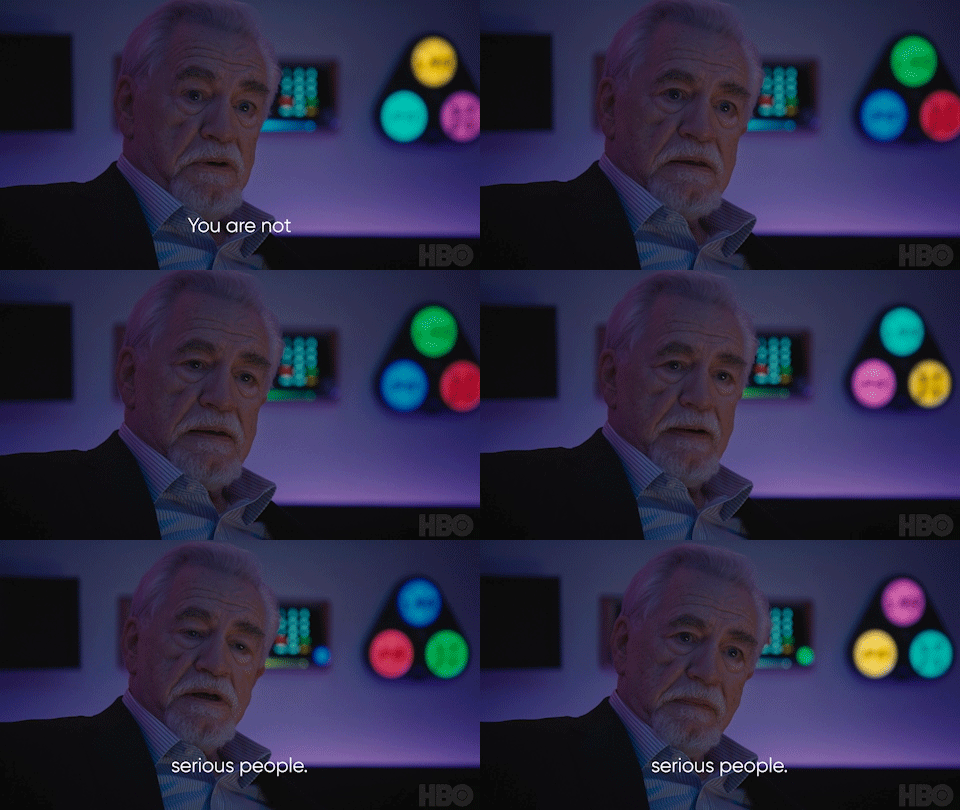
American voters are being offered tons of unserious candidates lately. But they mostly seem to be rejecting them — not necessarily balking at their ideologies, but declining to go along with contenders who don’t have real jobs, or don’t live in the district they’re running in, or who have been tinged by scandal. American voters — yes, even in the year 2026, with our politics as maligned as they are — still seem to want politicians who are serious people.
Trump tends to endorse candidates in his own mold: unconventional, hard-edged, doused in scandal. The fact that so many of these contenders have gone down in flames should tell us something about the state of American politics, and the replicability (or lack thereof) of Trump’s improbable rise. Voters have frequently proven willing to give Trump a pass. The same can’t be said for many other candidates, including those that he’s promoted.
This is what I so appreciate about WUTP. You do such a good job of breaking down the "shouting" into "This is what is under these numbers." This one was particularly interesting to me. Thanks Gabe.
But then scandal ridden Ken Paxton beats John Cornyn.