


“Only Supreme Court justices and schoolchildren are expected to and do take the entire summer off,” Chief Justice John Roberts once joked, decades before he joined the bench and was able to reap the benefits of that annual vacation as well.
The court’s summer recess began at the start of this month, allowing the justices to go teach classes in Iceland and Hawaii or attend music festivals in Germany. But two unlucky justices stayed behind for one more tour of duty: testifying before Congress.
It was strange to watch Justices Elena Kagan, a liberal Obama appointee, and Amy Coney Barrett, a conservative Trump appointee, answer instead of ask questions for once.
“You’re in a different situation now,” Sen. John Boozman (R-AR) observed. “You’re not hearing an argument. You’re actually giving an argument, and I think so far you’re doing very well.”
“It’s easier to be up there,” Kagan replied, as she sat at a witness table and stared up at a dais not unlike the one she normally presides from.
Kagan and Barrett were engaging in a ritual that was once common, but has fallen into disuse. Every year, Supreme Court justices — like any other government agency — request that Congress set aside a certain portion of the federal budget for their use. Most government agencies then have to send a representative to testify before the House and Senate Appropriations Committees, to justify their piece of the pie.
Supreme Court justices used to do this, too. According to the Congressional Research Service, at least one justice testified before Congress at least once every year between 1960 and 2011. But that was the last time any of the justices faced questioning in the Senate; no justice has appeared before the House since 2019.
That seven-year drought was broken Tuesday when Kagan and Barrett sat for back-to-back hearings in the House and Senate, defending a Supreme Court budget request that has ballooned, from $100 million in Fiscal Year 2019 to $228 million for Fiscal Year 2027.
As the two justices explained, the change is mainly due to increased security needs coming from the skyrocketing level of threats they are receiving. Barrett recounted an episode from May, when she was the victim of a “swatting” (meaning someone falsely called the police saying there were gunshots in her house, which often leads law enforcement to rush in, causing fear and chaos).
“Maybe I lack imagination, but I didn’t expect that performing this service was going to put me in the position of explaining to my children what a bulletproof vest was and why I had to wear one,” Barrett also said.
The justices live in “an entirely different world” today than they did when Kagan joined the court in 2010, she said. “I just walked out on the street,” Kagan explained. “I had no security with me at any time. I drove back and forth to work by myself.” The director of the Office of Personnel Management, a fairly obscure officeholder who is essentially the government’s HR person, had more security than Supreme Court justices, she said.
After Justice Antonin Scalia died while on a hunting trip in 2016 — with the nearest federal marshals two hours away — and again after threats began to rise in the aftermath of the Dobbs leak, the court began to get more serious. The justices now live encased entirely in a bubble, with security details that follow them wherever they go, which unfortunately appears to be the modern price to be paid for public service, as all three branches of government clamp down in response to violent incidents.
Just this week, a man with a gun was arrested while asking for directions to the Supreme Court building. In 2022, one month after the Dobbs leak, an armed man called 911 on himself and admitted that he was planning to assassinate Justice Brett Kavanaugh. There has also been a wave of “pizza doxxings” against federal judges, where unsolicited pizza deliveries show up at jurists’ homes, often with the orders listed as being for Daniel Anderl, who was killed in a 2020 shooting at his family’s home. The gunman’s intended target was his mother, a federal district judge.
“The message that these pizzas and other things that are sent to us is fairly clear,” Barrett said Tuesday. “They’re often sent to members of our immediate extended families as well. They’re meant to intimidate and they’re meant to harass… Justices and judges throughout the country continue to do their jobs without fear or favor, but it is a very threatening environment.”
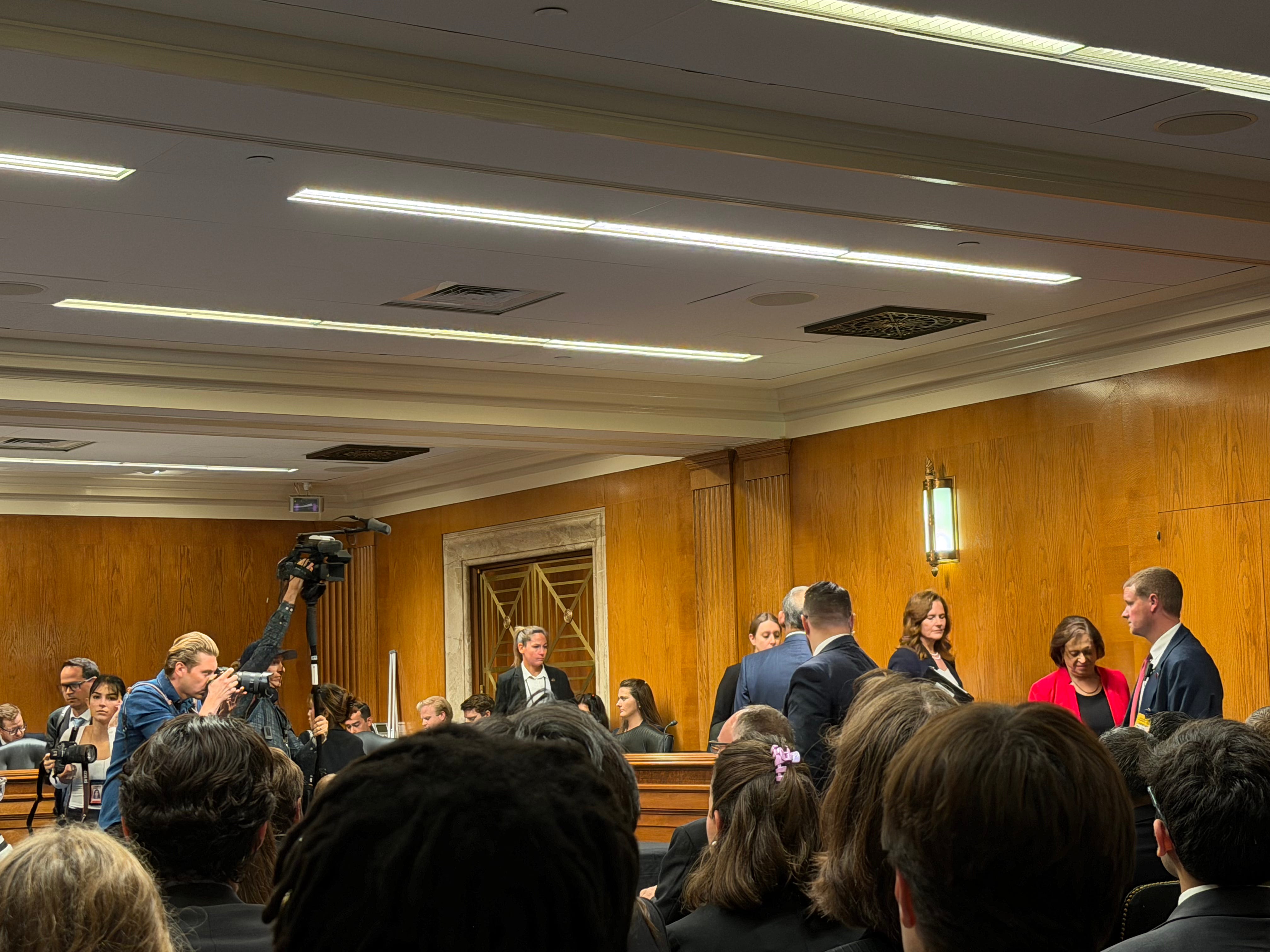
I was in the press section during the justices’ appearance before the Senate, intrigued by this unusual collision between the legislative and judicial branches. It was a rare opportunity to see the justices tread ever so slightly into commenting on matters beyond the individual cases before them.
Both Kagan and Barrett spoke openly and frankly about the toll that now comes with serving in the public eye. Kagan also offered her condolences on the death of Sen. Lindsey Graham (R-SC), recalling the moment from her confirmation hearing when he teed her up for a perfect joke about where she was on Christmas Day. (“Like all Jews, I was probably at a Chinese restaurant,” she said.)
Kagan expressed appreciation for Graham’s support during her confirmation, noting: “It is not very often that a Republican votes for a nominee from a Democratic president. Similarly, it’s not very often that a Democratic senator votes for a nominee of a Republican president. Those are the times we live in.” Justices rarely break the fourth wall and acknowledge the rising tide of partisan polarization.
Lawmakers were instructed to only ask about the court’s budget, but inevitably a few took the chance to press the justices on other matters.
Democratic members asked about the court’s so-called “shadow docket,” which it uses to consider emergency requests that set the status quo while cases work their way through the courts. (Kagan, who has criticized the secrecy of the docket in the past, said she thought the court was doing a better job explaining itself.) Republican members asked about the foreword Kagan wrote to a judicial manual that included a controversial section on climate science. (Kagan said she never read the chapter, which has since been withdrawn.)
Asked about adding an enforcement mechanism to the ethics code that all nine justices agreed to, Kagan said she believed the court would be “better off” with one (though she said there are “real complexities” about how to do it), while Barrett said she was “less certain” about the necessity. At another point, Barrett let slip that the court had begun requiring employees to sign nondisclosure agreements, something the court had declined to confirm when the New York Times reported it in February. (The Dobbs leak repeatedly came up throughout the hearing, which was especially interesting since I was sitting next to Politico’s Josh Gerstein, one of the two reporters who broke that story, as the lawmakers and justices discussed it.)
We also heard that rarest of things from a Supreme Court justice — an apology — when Kagan expressed remorse for a $30 million request for extra security funding that the court sent earlier this year (and Congress approved), outside of the normal budget cycle. “We apologize if we did anything procedurally improper,” Kagan said, explaining that the sudden request came because the U.S. Marshals Service had informed the court that it no longer had the funds to protect the justices’ homes, which meant the Supreme Court Police needed more money to pick up the slack.
What we were witnessing used to be a fairly normal interbranch dialogue between Congress and the Supreme Court. “Unlike federal departments, the Supreme Court is not a creature of Congress, but it’s a creature of the Constitution itself,” Sen. Bill Hagerty (R-TN) said on Tuesday. Still, he added: “The judicial branch is not wholly insulated from Congress,” if only because judges rely on legislators for funding.
In his Supreme Court newsletter “One First,” Georgetown’s Steve Vladeck has noted the other ways in which Congress used to frequently intervene in the court’s operations. Some of these were flagrantly political (in 1802, the Democratic-Republican-led Congress passed a law that effectively blocked the Federalist-majority court from meeting for over an entire year; in 1869, lawmakers reduced the size of the court to prevent Andrew Johnson from replacing any justices, and then grew it again as soon as Ulysses S. Grant took office). But others were more neutral ways of keeping the court in check, like the 1978 law which created financial disclosure requirements for justices or statutes that used Congress’ power (per the Constitution) to structure the court’s docket and ensure the justices hear certain types of cases that are in the public interest to be taken up.
There is probably a middle ground the modern Congress could take, between passing laws to shape the Supreme Court for partisan purposes (which would decrease judicial independence and trust in the courts) and absenting itself from this once-active back-and-forth entirely (and therefore making the court much less accountable, which also isn’t great for public trust).
Gabe Roth, executive director of the non-partisan judicial reform group Fix the Court, told me that there is growing awareness in Congress about the need to jump back into these interbranch conversations, after years of mostly letting its powers atrophy and allowing both the president and Supreme Court to largely run freely in their domains (even though the Constitution gives Congress significant power to rein in both).
“I think that there’s been a lot of frustration from Congress on all sorts of issues, not just with the court, about the the abrogation of power of Article I and the arrogation of power that Article III is pulling in,” Roth said. “And when you see those things across the spectrum, also with the immense power that the Trump administration is trying to wield, I think Congress is getting frustrated. So it’s not just in the SCOTUS context. It’s across the board.”
In recent months, lawmakers have introduced bills requiring the Supreme Court to include explanations in its “shadow docket” decisions, creating a rotating panel of judges that would help decide which cases the Supreme Court hears, adding an enforcement mechanism to the ethics code and toughening the court’s rules on gifts, and mandating that the justices spend 10 days a year sitting in on circuit court panels (reviving the old circuit-riding practice, as an attempt to ensure that the justices aren’t insulated from the rest of the court system or the country).
All of those measures have been introduced by Democrats, though Roth noted “there’s nothing liberal about an ethics framework, there’s nothing liberal about a gift ban. They would apply equally to the justices who are appointed by Republicans and those appointed by Democrats.”
In past years, Republicans have introduced various judicial reform bills as well, Roth pointed out. “Inspector General for the judiciary? That was a Chuck Grassley idea. Inspector General for the lower courts? That’s a Chuck Edwards idea…Recusal explanations? That was a Darrell Issa bill.”
Currently, there is one bipartisan court-related bill moving through Congress, the Cameras in the Courtroom Act, which would require the Supreme Court to permit TV cameras in all of its sessions unless a majority decides against it for a specific case. The measure unanimously passed the Senate Judiciary Committee last month, although Roth said it was unlikely to pass the full chamber this Congress, since Senate Majority Leader John Thune (R-SD) is not expected to bring it up for a vote and it lacks the support from all 100 senators needed to bring it by unanimous consent.
The issue came up only briefly during the House hearing, when Rep. Rosa DeLauro (D-CT) noted that Congress has cameras “everywhere.”
“Is that good or bad?” Kagan shot back. “It’s very good! It’s called transparency!” DeLauro responded. Having interbranch conversations doesn’t mean that lawmakers and judges will always see eye to eye.
I am so excited by the prospect of those court accountability bills!! It would be so amazing if they could pass. Maybe after midterms.
Good to see some folks in Congress recognizing that they have neutered themselves over the years. Both parties have gotten into the bad habit of having the Supreme Court bail them out rather than try to solve matters legislatively. Since most members of Congress are almost routinely re-elected, thanks largely to gerrymandering, you'd think they've be more willing to take a chance.