


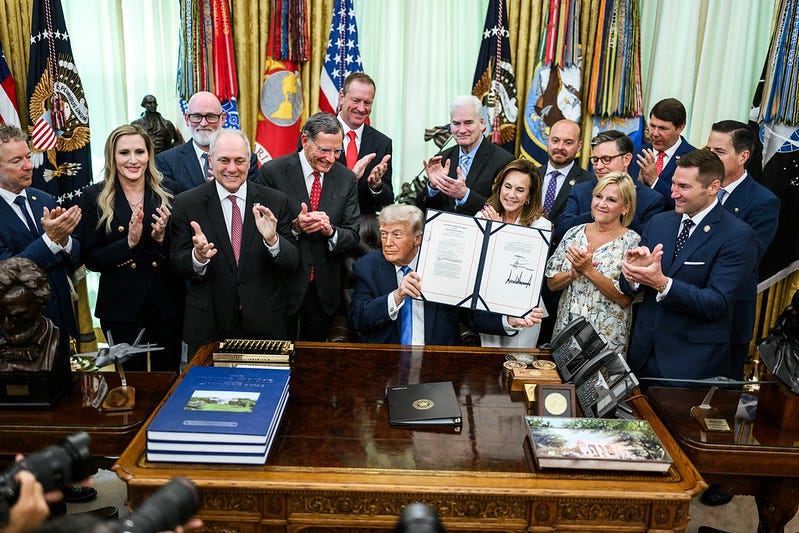
Last week, surrounded by Republican lawmakers in the Oval Office, President Donald Trump signed the Secure America Act into law.
The measure, which will fund Trump’s immigration enforcement agenda, was the 98th law and second major party-line package of his second term, following the One Big Beautiful Bill Act. Its enactment was a significant legislative accomplishment for the president, especially as it came after the bill was temporarily derailed by Trump’s $1.8 billion “Anti-Weaponization Fund.”
The story behind the law was long and twisting. Immigration and Customs Enforcement (ICE) and Customs and Border Protection (CBP) were supposed to be funded for the next fiscal year by October 1, 2025, like all government agencies. But none of the government was funded by then, sparking a 43-day shutdown that lasted until mid-November. The entire government was then funded by a continuing resolution that lasted until the end of January. By then, Congress had approved all of its annual appropriations bills — except the one for the Department of Homeland Security (DHS). This was right after the killings of Renée Good and Alex Pretti, who were shot by ICE and CBP officers, respectively, while protesting Trump’s immigration crackdown in Minnesota; Democrats refused to fund either agency unless the dollars were accompanied by reforms.
This led to a DHS-specific shutdown that ended up stretching on for another 76 days. At points during this time it seemed like the two parties might be able to agree on ICE reforms to unlock the funding (Markwayne Mullin, the senator-turned-DHS secretary, was negotiating a deal that would have offered significant concessions), but the talks fell through. Ultimately, the two parties agreed to disagree. In April, lawmakers decided to fund all of DHS — except for the controversial parts — through a normal appropriations bill (meaning it was subject to the 60-vote filibuster threshold), while Republicans would fund ICE and CBP through a party-line reconciliation bill (taking advantage of a specialized process that requires only a simple majority to advance).
The Secure America Act was that reconciliation bill, bringing an end to the 252-day saga between the start of the fiscal year and the point when funding for ICE and CBP was finally resolved. Note that through this entire time, including two extended shutdowns, neither agency actually stopped operating in any way, because they had already received a huge funding plus-up from the One Big Beautiful Bill (the last GOP reconciliation bill), far above what they were set to receive from the normal appropriations process (and ended up receiving through the Secure America Act). As we will see, the Secure America Act also went beyond what a typical appropriations bill would have done, funding ICE and CBP for the entire rest of Trump’s second term, ensuring that the agencies can operate for the next three years without risk of a Democratic shutdown.
For the One Big Beautiful Bill, I put together a series of comprehensive guides to help walk WUTP readers through the measure, to ensure you understood every provision of a very consequential law (and, hopefully, help give you the tools to read a piece of legislation for yourself). This morning, I want to do the same thing for the Secure America Act — but don’t worry: unlike the One Big Beautiful Bill, which was 331 pages and took six newsletters for us to get through, this law is only five pages. We’ll be done in one day!
The brevity is largely due to the simplicity of the law’s purpose (funding ICE and CBP, versus the several different goals stuffed into the Big Beautiful Bill), but it is also because of what’s missing from the package. As it turns out, some of the most important features of the Secure America Act are what it doesn’t say. We’ll discuss that further down; for now, let’s start out with what it does say.
I promise: I won’t go word-for-word. You can follow along with the exact text of the bill here, but we’ll follow its basic structure below.
A close reading of the Secure America Act
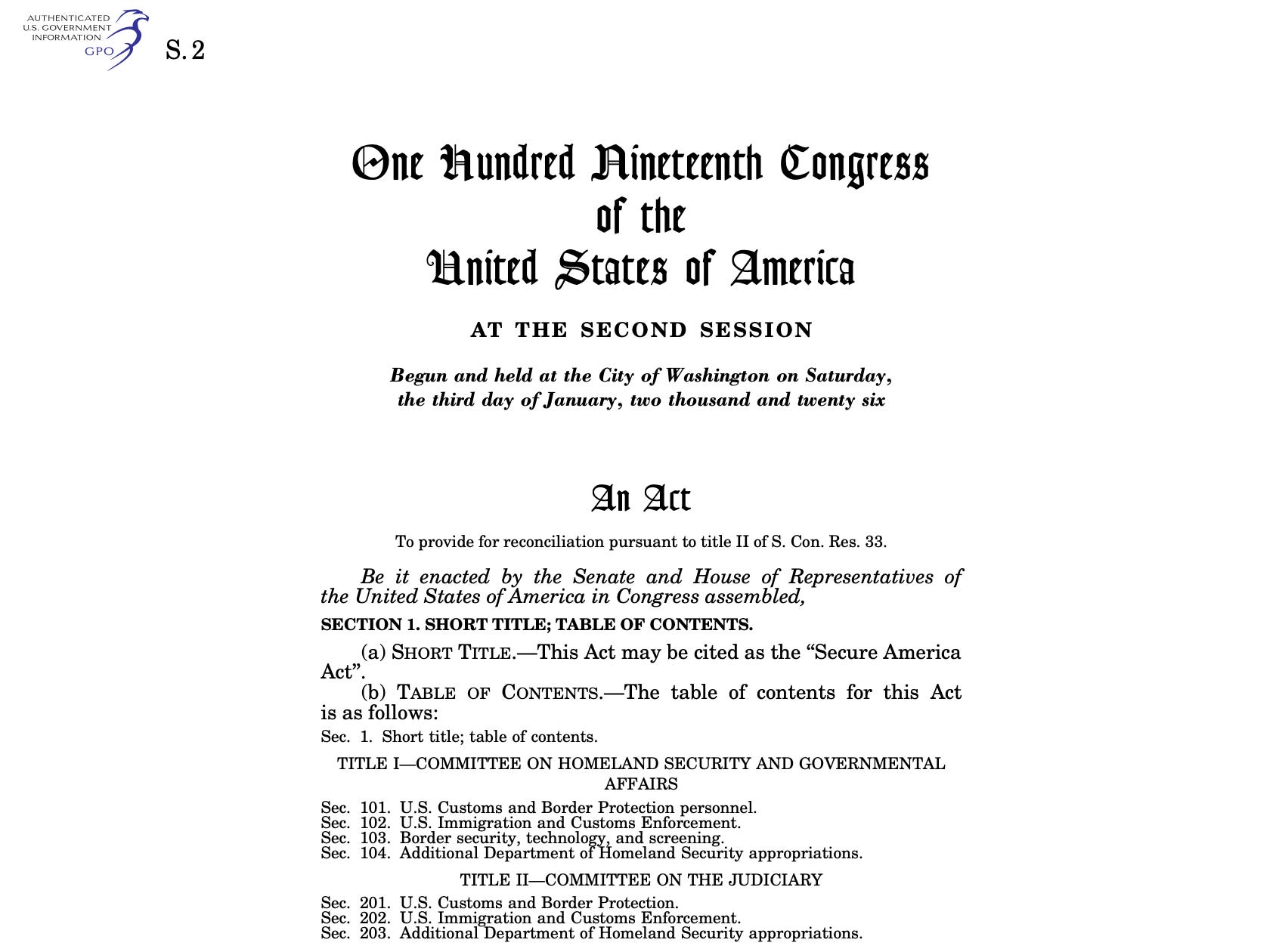
This is how the bill starts. Note the bill number (S. 2): normally, bills are numbered by the chamber (“H.R.” or “S”) and order they were introduced in. There’s an exception for the first 20 bills, though: S.1 through S. 10 are reserved for the majority party’s leadership, to be used whenever they want in the congressional session for the bills that are most important to the majority; S. 11 through S.20 play the same role to highlight the priorities of the minority.
Republican leaders have not introduced S. 1 yet. This was S. 2. The GOP has used three of its other reserved slots, for bills on immigration, abortion, and transgender participation in women’s sports. (Democrats have not used any of their slots, perhaps a telling indication of a party uncertain of its priorities in the Trump era.) The House follows this same practice: the Big Beautiful Bill was H.R. 1.
As we continue reading, we can also see the bill’s formal title (“An Act to provide for reconciliation pursuant to title II of S. Con. Res. 33”) and its “short title,” the Secure America Act. Typically, the first section of a bill is devoted to giving itself a more catchy name.
As we’ve discussed in the past, the reconciliation process allows majority parties to skirt the 60-vote filibuster, but only for bills that follow a strict regulation known as the Byrd Rule, which requires every part of a reconciliation bill to focus on taxes or spending. For this reason, minority parties — just to be difficult — will often raise an objection to the section of a reconciliation bill that gives itself a “short title,” since that is a part of the bill that has nothing to do with taxes or spending. Democrats chose not to do that this time, however, so this bill is officially the Secure America Act (unlike, for example, the Inflation Reduction Act and the One Big Beautiful Bill Act, both of which are officially known by their longer, formal titles.)
Then, we have the table of contents, which gives us an idea of the more substantive content we’re about to start reading.
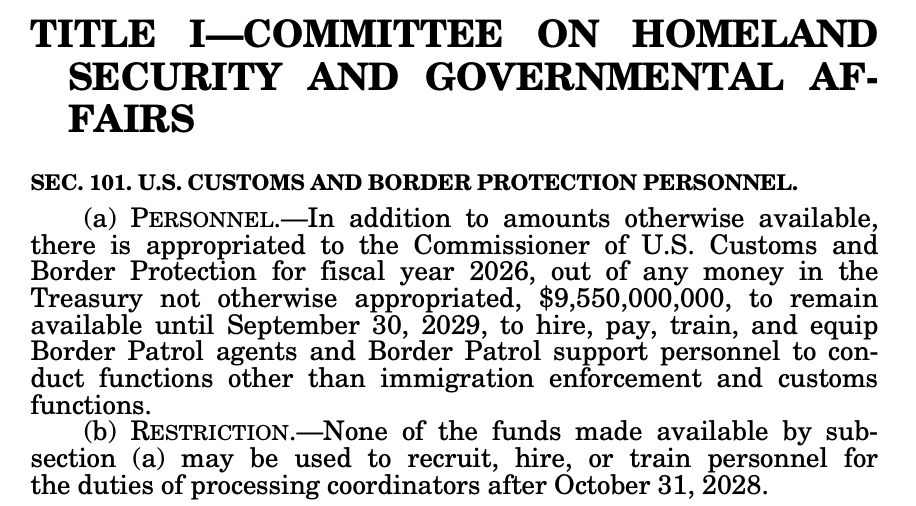
And we’re off to the races! This provision, as you can read, pours $9.55 billion into the CBP coffers in order to hire, pay, and train Border Patrol personnel who aren’t involved in immigration enforcement. (We’ll get to them later.) This includes any number of administrative and support staffers who work for CBP but aren’t actually on the ground apprehending illegal immigrants.
It also includes “processing coordinators,” a position that was created during the first Trump administration to handle intake and processing for individuals apprehended by Border Patrol agents, as well as transporting them to Border Patrol custody and overseeing “care and hospital watch, feeding, and cleaning duties” at Border Patrol facilities. (Before, all of these functions had to be performed by Border Patrol agents themselves.)
The overall $9.55 billion being given to CBP in this section is available through September 2029 — except any funds that are used to hire processing coordinators expire in October 2028, ensuring that a smaller chunk of the cash goes to hiring these officials, who have been compared to social service workers for the immigration system.

I won’t include the entire text of this section, but it basically provides $7.45 billion to ICE through September 2029, also for hiring, paying, and training personnel who aren’t directly involved in immigration enforcement.
As a reminder: CBP is generally in charge of handling security at the border, while ICE oversees interior immigration enforcement in the rest of the U.S. (although this distinction has become muddied in the Trump era, as some Border Patrol agents have been deployed away from the border).
The main sub-agency within CBP is the Border Patrol. ICE, meanwhile, includes two main units: Homeland Security Investigations (HSI), which investigates transnational crime, and Enforcement and Removal Operations (ERO), which apprehends, detains, and deports illegal immigrants in the interior of the U.S.
Because this section handles non-immigration-enforcement ICE personnel, it covers the funding for HSI. The section also specifically says that $108.5 million of the $7.45 billion should be used to hire and pay HSI personnel who investigate cases of child sexual exploitation and rescue the victims.
This was a provision championed by Sen. Josh Hawley (R-MO), with an assist from former NFL quarterback Tim Tebow. According to Fox News, DHS currently has only seven forensic analysts dedicated to child exploitation investigations; this provision will fund 200 additional investigators and analysts, the largest-ever federal investment in combatting child trafficking.

This section gives $3.45 billion more to CBP (again, through September 2029) for procuring new technology for screenings at the border.
That includes “new nonintrusive inspection equipment and associated civil works, including artificial intelligence, machine learning, and other innovative technologies, as well as other mission support, to combat the entry or exit of illicit narcotics at ports of entry,” as well as upgrading “border surveillance technologies” and the “biometric entry and exit system” at the border.
It also includes funding for a new generation of AI-powered autonomous surveillance towers that are set to be constructed across the southern border (continuing a program that expanded under the first Trump and Biden administrations).
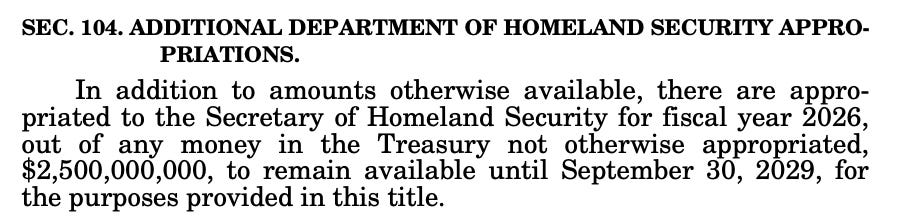
And here’s $2.5 billion more that will go to DHS, to be used between now and September 2029 for any of the purposes outlined in the previous three sections. There are no specifications beyond that, giving the department pretty broad leeway in how it wants to use these funds.
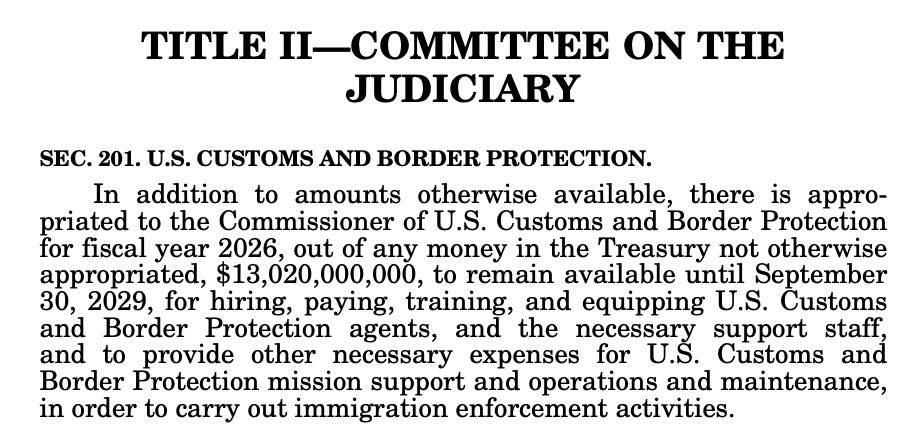
Now we’ve made it to Title II of the law, which is everything that’s covered under the jurisdiction of the Senate Judiciary Committee — which means the actual immigration enforcement funding. (Title I was everything under the jurisdiction of the Senate Homeland Security Committee, which oversees much of DHS, but not the functions related to immigration law. Committee jurisdictions can be confusing.)
This first section of the title provides $13.02 billion to CBP for hiring, paying, and training the personnel who are involved in carrying out immigration enforcement activities.

And this is the accompanying provision for ICE, which will receive $31.075 billion for carrying out immigration enforcement activities — including hiring, paying, training, and equipping officers, agents, investigators, and attorneys; transporting and deporting illegal immigrants; improving technology, including body cameras; maintaining facilities, among other uses.
Here’s an interesting part of this section, which says that $350 million of the new ICE funding has to be specifically earmarked for immigration enforcement activities in places that are not “qualified cooperating jurisdictions”:
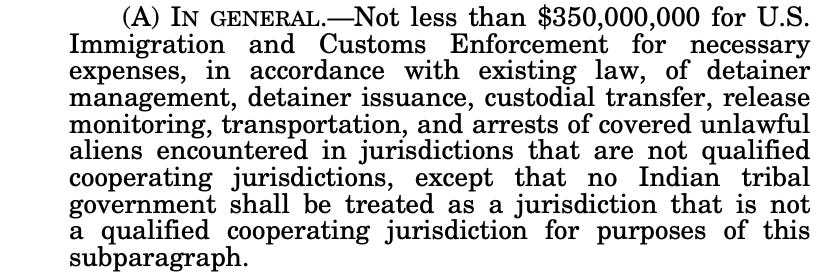
What’s a “qualified cooperating jurisdiction”? Basically, there’s something called a Section 287(g) agreement, which ICE signs with cities and states to formally deputize their local law enforcement officials to carry out immigration enforcement. There are several forms this can take, including local corrections officers screening people who are already being held in their jails to see if they are illegal immigrants and then, if they are, flagging them for ICE or empowering local police officers to make immigration arrests in the course of their routine police duties.
More than 1,900 jurisdictions in 39 states (shown on the map below) have Section 287(g) agreements. You’ll notice that several Democratic-led states ban their cities from entering into these agreements, including California, Washington, and Illinois.
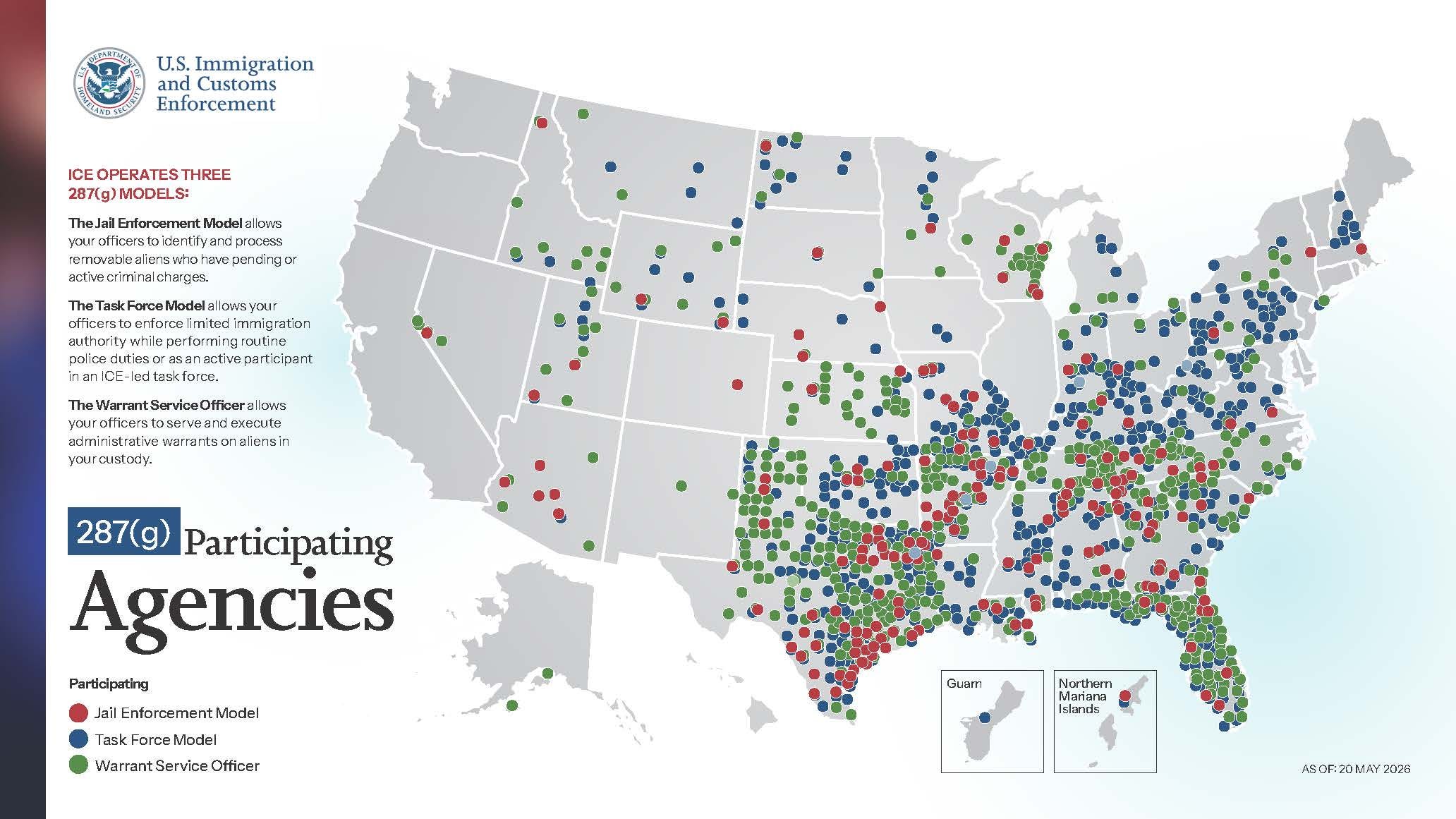
This provision of the Secure America Act will specifically require ICE to use certain funds to focus on these blue cities and states that don’t have Section 287(g) agreements.
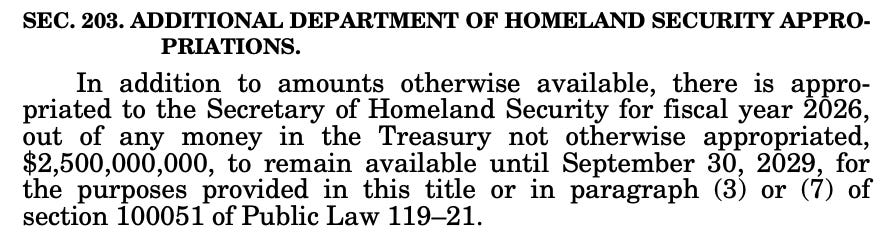
And here’s the final section of the law: another broad, wrap-around grant of funding, this one giving $2.5 billion to ICE for carrying out any of these immigration enforcement activities outlined above or in Section 100051 of Public Law 119-21 (which is the part of the One Big Beautiful Bill Act that provided funding to ICE).
Congratulations! You’ve read the entire Secure America Act.
In total, the law provides $38.5 billion in funding to ICE, $26 billion to CBP, and $5 billion that can be used by either agency — a total of $69.5 billion. The funds are all available for the next three years.
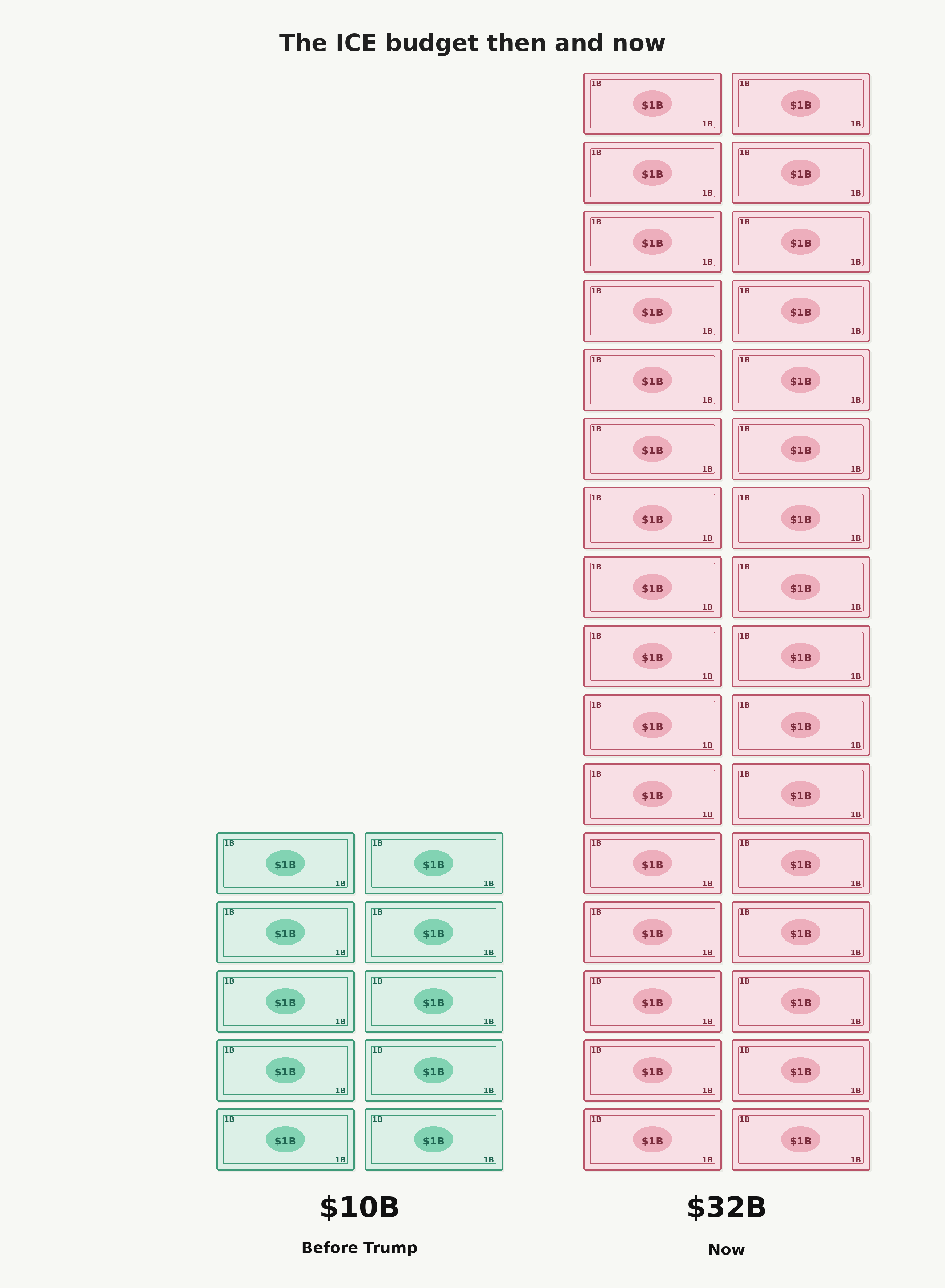
By way of comparison, ICE received $10 billion in funding in Fiscal Year 2025. After receiving $75 billion over four years in the One Big Beautiful Bill (starting in 2025), and now $38.5 billion over three years in the Secure America Act (starting in 2026) — assuming the funding is spaced out evenly — that comes out to an annual budget of around $32 billion for the rest of Trump’s term. ICE was already the highest-funded federal law enforcement agency after the One Big Beautiful Bill; now, it will be operating with more than triple its previous budget.
What the Secure America Act doesn’t say
The new law is so short for a few reasons. First, of course, it doesn’t include any of the potential ICE reforms (requiring judicial warrants, banning arrests at schools or churches, expanding use of body cameras) that Democrats and Republicans had been discussing before negotiations collapsed and the GOP decided to fund ICE and CBP alone.
Second, there were several provisions that were originally planned to be in the bill that fell out. This includes $1 billion that the initial Judiciary Committee draft was set to provide to the Secret Service (including for security upgrades to the new White House ballroom), which was taken out when the Senate parliamentarian ruled that it didn’t comply with the Byrd Rule. (Republicans likely could have re-worded it so that it would pass the Byrd test, but GOP senators didn’t fight for it, likely a sign that enough of them had concerns about funding the ballroom anyway.)
The initial draft also called for $1.457 billion to be provided to the Justice Department, including to fund anti-fraud efforts, as well as programs combatting drug crimes and terrorism. This funding ended up being stripped out of the final package as well, likely to make it so that Democratic amendments involving the DOJ (such as proposals aimed at the “Anti-Weaponization Fund”) couldn’t be construed as germane to the bill, and therefore would have required 60 votes, instead of 51, to be added to the bill during the extended voting series known as a vote-a-rama.
But finally, the bill is short because it is very vague. Appropriations bills generally include very specific language, or at least come with detailed committee reports with very specific language, governing how the funds being given to the executive branch will be used. Because this measure skirted the normal appropriations process — part of a growing trend of majority parties taking advantage of the reconciliation process so they can appropriate without bipartisan input — it included none of these normal strictures.
That means ICE and CBP will have much more free rein to use this funding than they normally would, not just because the law creates two big pots of money that are basically available for DHS to be used at will, but also because even the pots of money attached to more specific purposes lack the specificity that appropriations bills usually include. Appropriations bills also often set up strict regimes requiring agencies to make regular reports to Congress on how they are using the funds allocated to them; the Secure America Act includes none of these requirements.
A key way that Congress sets limits on how the executive branch uses funding is through provisions creatively known as a “limitation provision.” These are peppered all throughout appropriations bills: Agency X is given Y Dollars to Do Z Thing, provided that none of these funds are used to do A, B, or C.
There are several “limitations provisions” that are typically included in ICE funding bills. Here’s an example from Fiscal Year 2024 (the most recent time ICE funding went through the regular appropriations process), prohibiting any funds in that package from being used to place restraints on pregnant women in DHS custody:

Here’s another example from that same FY 2024 law, prohibiting any funds in the law from being used to destroy documents pertaining to deaths or sexual assault that take place in DHS custody:
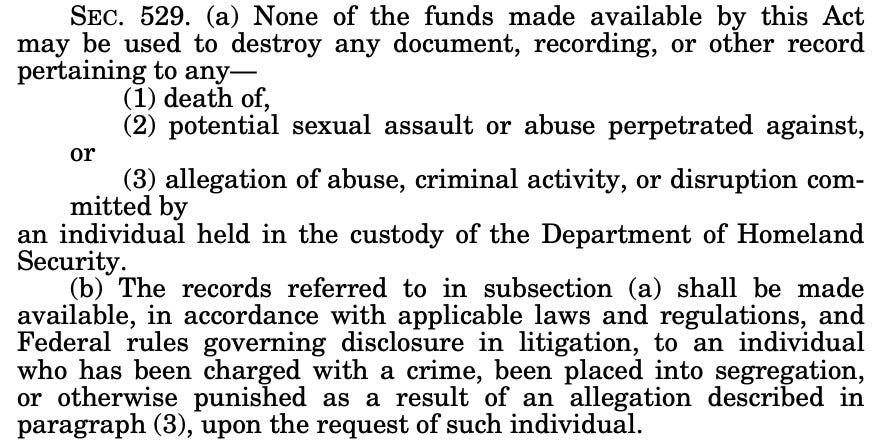
These limitation provisions — which are generally attached to ICE appropriations every year, with bipartisan support — were not included in the Secure America Act, which effectively functioned as this year’s ICE appropriations bill.
Notably, Sen. Patty Murray (D-WA) introduced an amendment to the Secure America Act that would have added these limitations back into the bill. Interestingly, Democrats didn’t force a vote on the proposal, even though this was during a vote-a-rama, when there is no limit to how many amendments either party can put up for a vote.
A Democrat familiar with the budget process told me that party leaders typically decide which amendments will be put up for a vote during a vote-a-rama — hundreds are generally proposed, but only dozens are actually voted on — though, in theory, there is nothing stopping any individual senator from going rogue and insisting on a vote on their amendment. The Democrat said that, during past reconciliation fights, Senate Minority Leader Chuck Schumer (D-NY) had tried to ensure that no Democratic amendments actually succeeded during vote-a-ramas (to be able to say that the final product is the work of Republicans alone), and that Schumer typically sought to coordinate the amendment votes so that they all aligned with a central message. In this case, that central message was largely about Trumpian corruption (hence the many votes on the Anti-Weaponization Fund), which — cynically, along with the fact that it might have passed — could explain why Murray’s amendment was not brought to a vote.
No matter the reason, the amendment was never brought up, which means a process that was jumpstarted by a Democratic effort to add more restrictions on ICE could actually end with the agency facing fewer restrictions, including ones relating to the treatment of pregnant women and the destruction of important records.
The Democratic source noted that in the House GOP’s proposed Fiscal Year 2027 DHS appropriations bill, which passed in committee last week, some of the traditional limitation provisions were made retroactive, so that they would include Secure America Act funds, by terming them as prohibitions on any federal funds being made available for a certain purpose, rather than just prohibitions on funds in that specific act.
For example, the GOP used this device to ensure that language about prohibiting DHS from blocking members of Congress from visiting ICE facilities applied to all federal funds, which would retroactively include the Secure America Act. While the FY2027 bill includes the limitations regarding pregnant women and record destruction, however, it does not make those limitations retroactive. “That was a choice,” the Democratic source said, pointing out that it shows the GOP was aware that the reconciliation bill lacked those limitations, but actively chose only to apply some of them to the Secure America Act funds.
There have already been legal fights around DHS trying to avoid congressional site visits by arguing that they were using One Big Beautiful Bill funding (which also lacked limitation provisions). The Trump administration has largely lost these battles, although the Democratic source said that Trump’s arguments would now have stronger legal standing, since before some ICE funding was coming from the Big Beautiful Bill and some was coming from regular appropriations, muddying the waters. Now, all of the agency’s funding will be coming from the two reconciliation packages, making it less likely that — say — hypothetical money used to destroy records of deaths in ICE facilities would have come from legislation that included the limitation provisions.
Democrats could hypothetically try to retroactively add these provisions in the Fiscal Year 2027 appropriations bills. Indeed, nothing is permanent just because it is in a reconciliation bill: in FY2027, especially if Democrats control the House, they could try to claw back some of the Secure America Act money and threaten a shutdown if Republicans don’t agree. Of course, they would have to use other agencies as leverage, however: even if Democrats force a shutdown in hopes of altering the Secure America Act, ICE would still have access to its vast store of funding unless or until any changes to the Secure America Act are actually written into law.
ICE will not be immune from being used as a negotiating point in future shutdown fights. But it will be immune from being shut down itself while those disputes play out, at least in the next funding fight and potentially for the entire rest of the Trump era.
The use of reconciliation to advance, with only 51 votes, bills that would typically require 60 votes has already poked enormous holes in the legislative filibuster. The increased use of this device for funding that typically goes through the regular appropriations process, in turn, spells trouble for the future of spending negotiations across party lines. If majority parties can unilaterally ram through large pots of funding, making them shutdown-proof and free of significant limitations for extended periods of time, why wouldn’t they? The long-held tradition that the two parties work together to set funding levels in Congress, keeping spending stable (and consistent restrictions in place) no matter who is in the White House, may soon be a thing of the past.
This makes me sad, when Congress is punitive instead of working to make Americans lives better. I would have rather the money go to health care or fund social security not this vindictive hate.
I’m left thunderstruck by Chuck Schumer’s decision not to offer any amendments. Amazing.