


Good morning! It’s Monday, January 26, 2026. Protesters are clashing with federal agents on the streets, sometimes fatally. States are clashing with the federal government in court. And Democrats and Republicans in Congress are clashing over whether to plunge the government into yet another shutdown.
We have arrived at a highly combustible moment in American life, and a key moment in President Donald Trump’s second term.
These overlapping confrontations began on Saturday morning, when a 37-year-old American citizen named Alex Jeffrey Pretti, an ICU nurse at a VA hospital, was shot and killed by a Border Patrol agent in Minneapolis. Pretti was the second person killed amid the federal immigration crackdown in the city, following the shooting death of Renée Good earlier this month.
If you watch videos of the two confrontations, it is striking how quickly both episodes went from peaceful to deadly. Just moments before Good was killed, she smiled at the ICE agent who would shoot her and said, “I’m not mad at you.” Seconds later, she was dead. In Pretti’s case, just before his death, he was standing and filming federal agents, calmly observing them as they reportedly carried out an immigration operation.
Good was driving a car when she was shot, and her death sparked intense debate over the threat she and her vehicle may have posed to the ICE agent who shot her. Although subsequent video analysis showed that the wheels of Good’s car were pointed away from the officer, her car also appeared to have made at least some contact with him, potentially leading him to perceive a threat from the 4,000-pound SUV whether or not one actually existed in that moment.
With Pretti’s death, there is much less ambiguity: despite the Trump administration’s heated rhetoric, no evidence has emerged so far to suggest that Pretti posed any major threat to the Border Patrol officer who killed him.
Just before he was shot, Pretti seemed to be trying to help a woman who had been pepper-sprayed by another officer. A group of agents then pinned Pretti to the ground, restrained him, and struck him several times. Pretti, who was permitted to carry a concealed firearm in Minnesota, had a handgun with him; one of the agents could be heard yelling “gun!” As the below video shows, one agent then removed Pretti’s gun, shortly before another agent starts shooting at him.
It is possible that the agent perceived a threat after hearing the word “gun,” but if that was all that precipitated the shooting, it would seem to speak to either a training failure, a feeling of impunity on the part of Trump-era immigration agents, or both. Presumably, the agent should have been able to see that the hands of the person he was shooting were both empty, his weapon already removed. The person was restrained and on the ground, defenseless. And yet the agent chose to shoot him — not just once, but 10 times, and fatally.
White House deputy chief of staff Stephen Miller described Pretti as an “assassin” who “tried to murder federal agents,” a claim that was reposted by Vice President JD Vance. Secretary of Homeland Security Kristi Noem claimed that Pretti “attacked” the officers and was “brandishing” his gun at them. Border Patrol commander Gregory Bovino said that it “looks like” Pretti “wanted to do maximum damage and massacre law enforcement.”
No evidence has been produced to support any of those claims. There is no video showing Pretti attempting to attack the federal agents at any point, nor is there film in which he brandishes (or even touches) his weapon.
State and federal officials are currently clashing over who will conduct the investigation into Pretti’s death. ICE’s Homeland Security Investigations branch is leading the federal probe, with assistance from the FBI, meaning the Department of Homeland Security (which houses both ICE and Border Patrol) is effectively investigating itself, a highly unusual arrangement. (The FBI is leading the investigation into Good’s death. Six prosecutors and one agent have resigned after being told to focus their investigation on Good and her widow, instead of the ICE agent who killed her.)
Minnesota officials have said they were denied access to the scene of Pretti’s death and blocked from obtaining evidence, which is also highly unusual. A Trump-appointed federal judge granted a request from the state on Saturday to temporarily block the Trump administration from “destroying or altering” evidence related to Pretti’s death; a hearing on the matter is set to take place this morning.
A separate hearing will also take place this morning over Minnesota’s request to halt the federal immigration crackdown in the state entirely. A Biden-appointed federal judge had previously denied Minnesota’s request, but the state re-upped it in light of the Pretti shooting.
In their filing, Minnesota officials noted that “in the first 11 months of 2025, from January 1 to November 30, there were no officer-involved shootings in Minneapolis where the Minneapolis Police Department was involved.” By comparison, they wrote, “this is the third shooting and the second fatal shooting by [federal] agents in Minneapolis in less than three weeks.”
“Operation Metro Surge is not just unlawfully invasive,” the officials wrote, using the official name for the federal operation in Minneapolis. “It is deadly.”
Unlike many of the controversies of Trump’s second term, this one appears to have touched a nerve on both sides of the aisle.
In addition to the Lisa Murkowskis and Susan Collinses of the world, Republican lawmakers who normally march in lockstep with the Trump administration have called for Pretti’s death to be investigated.
“I expect a prioritized, transparent investigation into this incident,” Sen. Pete Ricketts (R-NE) wrote on X, reaffirming his support for immigration enforcement as well as the need to “maintain our core values as a nation, including the right to protest and assemble.”
“I’m disturbed by what I’ve seen from today’s video from Minnesota,” said Rep. Michael Baumgartner (R-WA). “Politicians, protesters, and law enforcement all have an obligation to deescalate the situation in Minnesota. As with any officer-involved shooting, this demands a thorough investigation,” Rep. Dusty Johnson (R-SD) echoed.
House Homeland Security Committee chairman Andrew Garbarino (R-NY) quickly requested that the leaders of ICE, Customs and Border Protection (CBP), and the U.S. Citizenship and Immigration Services (USCIS) appear in a hearing before his committee.
These are not the type of Republicans who typically raise concerns about Trump administration actions. According to Politico, a growing number of GOP lawmakers are privately worrying about the political impact of Trump’s immigration campaign ahead of this fall’s midterm elections.
These concerns are reportedly present inside the Trump administration as well: according to Fox News and CNN, there are growing frustrations within the Department of Homeland Security over the agency’s response to Pretti’s death.
Notably, President Trump — who frequently displays finer-tuned political instincts, and looser ideological commitments, than the officials around him — has also diverged in his response from some of his advisers. While officials like Miller and Noem quickly blamed Pretti for his death, calling him a “domestic terrorist,” when pressed twice by the Wall Street Journal on whether the officer who shot Pretti had done the right thing, Trump demurred both times.
“We’re looking, we’re reviewing everything and will come out with a determination,” Trump said.
“I don’t like any shooting. I don’t like it,” Trump added. “But I don’t like it when somebody goes into a protest and he’s got a very powerful, fully loaded gun with two magazines loaded up with bullets also. That doesn’t play good either.”
Trump said that his administration had done a “phenomenal job” in Minnesota, but signaled a willingness to withdraw immigration officials there. “At some point we will leave,” he said, and keep a “different group of people there for the financial fraud.” On Truth Social, Trump praised an interview with House Oversight Committee chair James Comer (R-KY) in which Comer said that the administration should “maybe go to another city” and leave Minneapolis.
This morning, Trump signaled a change in federal leadership on the ground in Minnesota, announcing that he was sending White House border czar Tom Homan to the state and that Homan “will report directly to me.”
On Capitol Hill, the biggest question is how this weekend’s shooting will impact the fight over government funding.
Six out of the 12 appropriations bills have already been signed into law. The rest of the government is currently being funded by a continuing resolution that is set to expire at the end of the day on Friday.
Before this weekend, the House had passed all of the remaining appropriations bills in three separate packages (one for the Departments of Defense, Labor, Health and Human Services, Transportation, and Housing and Urban Development; another for the Departments of State and Treasury; and another for the Department of Homeland Security). The first two packages passed with sweeping bipartisan support; the Department of Homeland Security (DHS) funding bill passed with only seven Democrats voting in favor.
Crucially, all three packages were then stitched together by the House and sent to the Senate as one.
Initially, the mega-package was expected to proceed easily in the Senate this week (even with the more controversial Homeland Security bill attached), with the eight moderate members of the Democratic caucus who voted to end the government shutdown in November likely to vote in support, thereby averting a second shutdown.
After the second fatal shooting in Minneapolis, the situation has markedly changed. Five of the eight moderates — Sens. Catherine Cortez Masto (D-NV), Dick Durbin (D-IL), Tim Kaine (D-VA), Angus King (I-ME), and Jacky Rosen (D-NV) — have announced plans to oppose DHS funding in light of the Pretti shooting. The other three Democrats who voted “yea” in November (Pennsylvania’s John Fetterman and New Hampshire’s Maggie Hassan and Jeane Shaheen) have not yet indicated a position, but their support would not be enough for any funding bill that includes DHS to pass.
“Senate Democrats will not allow the current DHS funding bill to move forward,” Senate Minority Leader Chuck Schumer (D-NY) said in a statement. Democrats have signaled willingness to support advancing the other five appropriations bills if they are detached from the Homeland Security bill — setting up a DHS-specific shutdown — although Republicans have so far said they will not allow the bills to be separated out.
The two sides have five days to come up with an agreement. Even if no appropriations bill or continuing resolution for the Department of Homeland Security is approved, the Trump administration’s immigration campaign would likely continue unaffected.
ICE received $75 billion in the One Big Beautiful Bill Act, a pot of funding which would not be disrupted by a government shutdown. During last year’s shutdown, the Trump administration used that funding to keep ICE operations active.
Public opinion has turned overwhelmingly against the Trump administration’s immigration crackdown.
In a YouGov poll, only 20% of Americans said that Pretti’s shooting was justified. (48% said it was not justified, while 32% said they weren’t sure.) YouGov also found support for abolishing ICE had skyrocketed, with 46% of Americans in support, 41% opposed, and 12% unsure. (As recently as last June, only 27% backed ICE’s elimination, with 45% opposed.)
A CNN poll after Good’s death found that a slim majority of Americans (51%) believe that ICE enforcement actions are making cities less safe. 31% say that ICE is making cities safer, while 18% say there’s been little effect either way. Only 26% of Americans in the poll said that Good’s shooting represented an appropriate use of force.
A CBS News poll around the same period found that 61% of Americans believe ICE is being “too tough,” compared to 15% who believe the agency is being “not tough enough” and 24% who said the agency is acting “about right.” 56% of Americans said the Trump administration is prioritizing “people who aren’t dangerous criminals” for deportation, compared to 44% who said dangerous criminals were being prioritized.
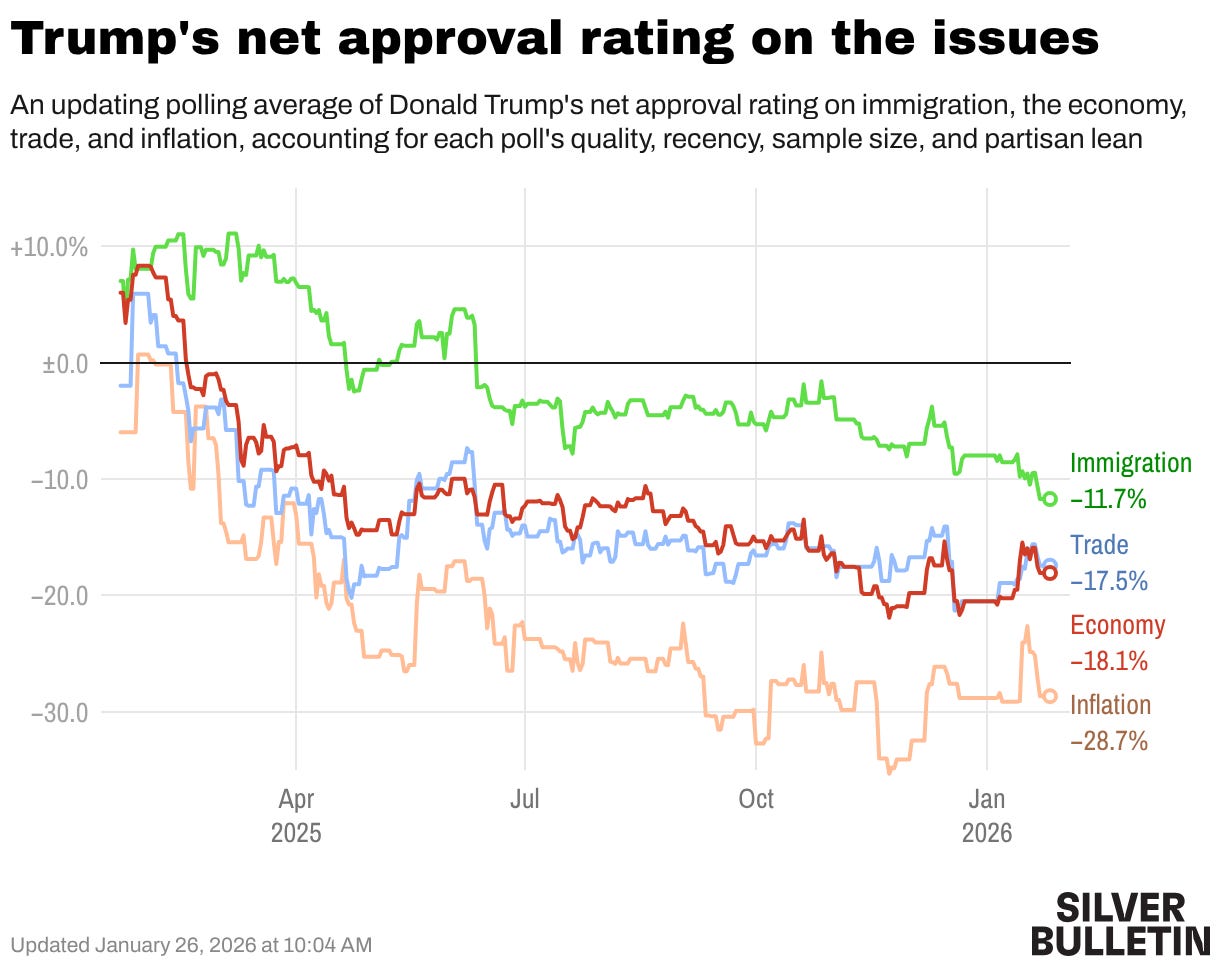
According to the Silver Bulletin average, immigration remains Trump’s best-rated issue — but that isn’t saying much, since his average approval rating on the issue is -11.7%. It’s just higher than his approval rating on other issues, like trade (-17.5%) and the economy (-18.1%), where his ratings are even more dismal. As recently as June, more Americans approved than disapproved of Trump’s handling of immigration; his performance on the issue has become steadily less popular since then.
In addition to the fatal shootings of Good and Pretti, there are several stories of American citizens, individuals with active refugee status, and targets without warrants being swept up in Trump’s immigration crackdown in Minnesota.
Trump has posted about Minnesota several times on social media in the last 48 hours, although at other points, he has appeared not fully engaged with what Punchbowl News has called “the most serious political crisis” of his second term.
On Saturday night, hours after Pretti was killed, Trump hosted a black-tie screening at the White House for a documentary about his wife, socializing with the queen of Jordan, the CEO of Apple, and other guests. The next morning, he posted a 448-word missive on social media about his forthcoming White House ballroom.
Comments from administration officials characterizing both citizens who were recently slain in Minneapolis by ICE officers have been widely reported. What I haven’t seen is any notable reaction to the rush to judgement that comprise these statements. Within minutes of Ms. Good’s shooting President Trump labeled her a “professional agitator” with no time to have established the truth of that statement. It is this inflammatory rhetoric that illustrates that this administration is committed to neither truth, justice, nor The American Way.
As always Gabe incredible details..."Minnesota officials noted that “in the first 11 months of 2025, from January 1 to November 30, there were no officer-involved shootings in Minneapolis where the Minneapolis Police Department was involved.” CHILLING