


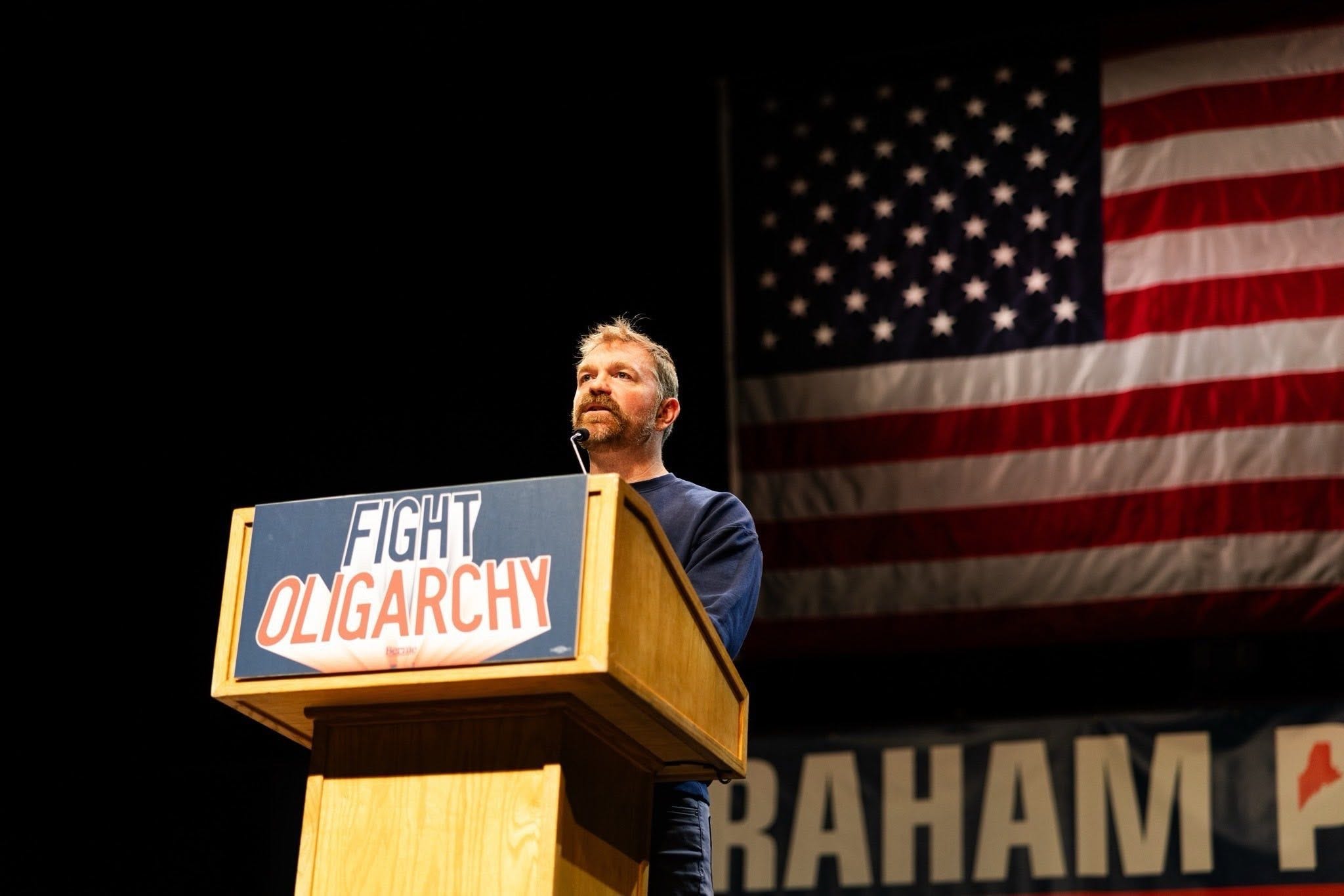
Maine’s Senate primaries are tomorrow, but we already know the outcome of both races. Incumbent Susan Collins, who is running for a sixth term, is set to win the Republican primary; Democrat Graham Platner will be nominated to challenge her.
I rarely write much about primary contests that are so lacking in suspense, but for Maine, I will make an exception, both because it is one of the key states that will decide control of the Senate this November — and because of the sheer amount of controversy swirling around Platner.
The New York Times reported on Thursday that an ex-girlfriend of Platner’s, Lyndsey Fifield, alleged that Platner was sometimes “physically threatening” towards her, especially after drinking, “leaving her shaken and sometimes afraid.” Fifield said that Platner “regularly grabbed her by the shoulders — sometimes hard enough to leave marks — and, on one occasion, yanked her out of a cab by her wrist after an argument when she wanted to stay in the car.”
During another argument, Fifield recounted, “he twisted her arm behind her back, shoved her into a bedroom and held the door closed from the other side so she couldn’t get out, telling her to remain there until she was ‘calm.’” Fifield eventually fell asleep inside the room. Fifield works professionally in Republican politics, including past stops at the Heritage Foundation and Nikki Haley’s 2024 presidential campaign.
In interviews with the Times, two other ex-girlfriends of Platner’s also raised concerns about his behavior, while three more described him positively. Fifield’s allegations (which Platner denies) came after the revelation (which he admits) that his wife discovered that he had been sending sexually explicit texts to several women shortly after they were married. And after the controversy about his (now-covered) tattoo, which resembled (unknowingly, he has said) a Nazi symbol. And after his past Reddit posts were unearthed, showing him blaming women for being raped and mocking a Purple Heart recipient.
Here are eight thoughts on the Platner situation:
#1: I do not know whether Fifield’s allegations are true. The Times spoke with friends of hers who confirmed that her relationship with Platner was “emotionally volatile,” but were unable to corroborate the physical altercations she described. (Fifield said she did not tell anyone about them at the time, and did not expect they could be corroborated.)
I do know that Democrats, in the past, have run with allegations of sexual misconduct no matter their level of corroboration, such as Christine Blasey Ford’s claims against Brett Kavanaugh, for which there were no eyewitnesses or anyone who had been told about them at the time — and, of course, that Republicans (who are now taking the allegations against Platner on faith) dismissed the allegations against Kavanaugh on those grounds. This does not mean that the claims against Platner, or Kavanaugh, are false or true. But it does speak to a bipartisan relationship with allegations of sexual misconduct that seems to be largely situational, without coherent standards: when confronted with allegations that lack corroboration, both parties appear to judge a case almost entirely based on their previous opinion of the alleged perpetrator.
#2: This means that there is no longer any political home for “believe all women” as a mantra, although wasn’t that true already? It’s not as if Tara Reade’s allegations against Joe Biden (which also lacked corroboration) gained much purchase in 2020.
Still, you can see the awkwardness of this transition playing out, as some Democrats continue to embrace Platner while also saying they believe Fifield. “I think he should apologize. I believe what he did was wrong, was misogynistic, was toxic or volatile,” Rep. Ro Khanna (D-CA), who held a rally with Platner on Friday, told NBC News. “I know he’s ashamed of it and I certainly think it would be appropriate to apologize and say how he now understands why it’s important to stand up to a misogynistic culture.”
“I believe her,” Khanna said even more directly, speaking to CBS News about Fifield.
The issue being, of course, that Platner has denied Fifield’s allegations, which means Khanna is essentially saying that Platner should apologize (and feels shame) for something Platner insists did not occur. It is hard for these stances to co-exist. If Khanna believes Fifield, does it bother him that Platner doesn’t? Does he think Platner is lying? Does he mind that, presumably, no apology is forthcoming, even for something that Khanna himself views to be a credible allegation of physical aggression?
#3: Even if no one but Platner and Fifield know the truth about the allegations of aggression, can we all agree that Platner is almost certainly being dishonest about the tattoo?
I will be honest here: I consider myself to be fairly well-informed about history — though I am not a “World War II buff,” as Platner has apparently been since he was a teenager — but if I had seen the below image of a Totenkopf at a tattoo parlor (or on someone’s body) before this Senate campaign, I would not have recognized it as a Nazi symbol and probably would have assumed (as Platner said he did) that it was a skull-and-crossbones. Maybe that’s an embarrassing oversight on my part, but it’s the truth.

For that reason, I am willing to believe that Platner also didn’t recognize the symbol when he put it on his body, on a night of drinking in 2007 while in the Marine Corps. But it does not seem possible that Platner went the next two decades without recognizing the symbol — if for no other reason than CNN has reported that Platner literally replied to a Reddit post about the Totenkopf in 2019 and noted in his response that U.S. service members sometimes use similar symbols.
On top of that, Fifield not only told the Times that Platner would refer to the tattoo as “my Totenkopf” (and that he and other members of his unit specifically selected the symbol because they viewed themselves as a “death unit” like the SS), but also shared texts that she sent to her friends last summer (months before Platner says he was aware of the tattoo) saying that he “has a Nazi tattoo on his chest.”
Platner says he did not know what the symbol was until late last year, but what are the odds that his ex-girlfriend would have been aware of it but never told him, or that he commented on a thread about the symbol seven years ago but didn’t realize it was on his chest? (“Well, she certainly didn’t send that text to me. So whoever she sent it to and was talking to, that’s — I can’t say why, but I will say that I certainly didn’t know,” was Platner’s defense when asked about Fifield’s text by MSNOW.)
It seems fairly likely to me (especially since she has texts as evidence) that Fifield is telling the truth about the tattoo (at least about him knowing what it was in the intervening years), and that Platner is not telling the truth about the tattoo. That doesn’t necessarily mean Fifield is telling the truth about her other allegations, or that Platner is not telling the truth about the other allegations, but it is a telling sign.
#4: As I wrote before the latest allegations against Platner, it is then up to every Maine voter to decide where their line is for unacceptable behavior, and whether the allegations against Platner place him on the other side of it, just as Texas voters will have to do the same regarding the allegations against Ken Paxton.
Do they believe the allegations against Platner? If not, why not? If so, are they disqualifying? If not, would they feel the same if there was an “R” next to his name? Is there a line at which he would lose your support? Is their calculation changed, on the one hand, by the fact that this race could decide control of the Senate? Is it changed, on the other, by the fact that Susan Collins is a moderate who voted to convict Donald Trump after his second impeachment — the sort of Republican whose defeat Democrats often mourn, and who they often say the entire party should be more like?
Every voter will have to decide these questions for themselves. This question of whether to embrace unsavory personal qualities in the name of preferable policy outcomes is the same calculation many Republicans have been performing in regards to Donald Trump for years (although it has been strange to see some Democrats suggest that it is a phenomenon that started with Trump, or that his candidacy is when voters started overlooking allegations of sexual misconduct: Bill Clinton, anyone?)
Considering all that has been alleged against Trump, it is certainly hard to take seriously comments like this one by RNC Chairman Joe Gruters, responding to the Platner allegations (“Every single Democrat needs to come out and condemn this, or they are complicit. Full stop”), though it also becomes harder to take seriously Democratic calls that Republicans abandon Paxton.
#5: I can’t say how Maine’s voters will perform these calculations. There is obviously a sizable faction of Maine Democrats who have been willing to support Collins in the past, which might mean that they will be willing to do so again when confronted with a candidate with so many vulnerabilities. But there is also reason to believe that these same Democrats might be done giving leeway to Collins, in a year that is expected to be so favorable to Democrats and when the Republican president’s approval rating is so low.
I’ll tell you one thing: although I am normally a relative defender of polling (see here after 2022 and here after 2024), I make an exception for Maine, one state that pollsters just do not seem to have cracked. The most famous example is Collins overperforming her polling by 12 points (!) in 2020, but as Nate Silver points out, Collins also overperformed her polls by eight points in 2014 and seven points in 2008.
It’s entirely possible that pollsters have finally figured out Maine this year, but considering how much Collins tends to overperform by, I won’t be placing bets on it. This is a case where I just won’t be watching polling much either way: I’ve been burned too many times before. We’re flying blind. (The RealClearPolitics average currently shows Platner with a 7-point edge.)
#6: Out of all of this, the greatest mystery for me remains how Platner emerged from nowhere to become the presumptive nominee in one of the cycle’s marquee Senate races.
Or, not “nowhere,” exactly. Platner has marketed himself as a working-class oysterman, though it does seem there are some holes in that story. Platner came from wealth: his grandfather was a renowned architect who designed the Windows of the World restaurant that once sat atop the World Trade Center, as well as a brand of pricy chairs that was beloved by Donald Trump; the candidate himself attended the prestigious Hotchkiss School, although he was expelled. Also complicating his story as an oysterman, on his campaign financial disclosure form, the only significant compensation he reported from his oyster business came from a restaurant owned by his mother. His parents paid $200,000 of his $205,000 home.
His sudden rise appears to have been facilitated by Fight Agency, a political consultancy whose leaders count Zohra Mamdani, John Fetterman, and Ruben Gallego as past clients. According to Politico, Fight heard about Platner through a network of “union officials, community organizers and grassroots progressives”; they are the reason why a political unknown was able to launch his campaign with a slickly produced video and a profile in the New York Times.
We also know that Platner’s parents are active in local Democratic politics, including as donors, per the Times, and that he spent time in D.C. working as a bartender on Capitol Hill and socializing with various political operatives (including, on the Republican side, Fifield).
How he got onto Fight Agency’s radar and became a Senate candidate in the first place is still somewhat hazy to me, although the fact that he was able to catch on so quickly once he was in the race remains an impressive political feat, speaking to his talents as well as to the very real frustrations many Democrats feel towards their party establishment.
#7: Speaking of, what is Janet Mills doing? The 78-year-old governor ran a lackluster campaign against Platner before eventually exiting the race — only to reappear last week by saying, “People have the impression that I ‘withdrew’ or ‘dropped out,’ but I simply suspended active campaigning. I am still on the ballot.”
What? Was Mills telling people to vote for her? Is she still running against Platner? If nominated, would she return to the race? Like her whole campaign, it wasn’t exactly clear. If Mills had made a comment like that in the last few weeks, and then started aggressively campaigning against Platner, it’s possible that she could have stopped him from winning the Democratic nomination. But her vague comments, matched with no real return to the campaign trail, are the definition of “too little, too late.”
However, since Mills will be on the ballot, as she said, it will be interesting to see what percentage of the vote she gets tomorrow as a zombie candidate. If she receives a significant chunk of protest votes, it could raise pressure on Platner to drop out. According to Maine law, after he wins the Tuesday primary, Platner could withdraw by July 13 and be replaced by a nominee chosen by state Democratic officials. There is no sign he plans to do that, or would have much incentive to (from his perspective, why get out when he has even odds of winning and doesn’t feel much allegiance to the party?), but that is the theoretical escape route.
#8: The fact that Democratic primary voters didn’t have much of a choice for a key Senate seat beyond a septuagenarian governor and a scandal-plagued outsider obviously doesn’t speak well of the Maine Democratic Party. I thought about writing a piece comparing the Maine Democratic Senate field and the California Democratic gubernatorial field — another blue state with a long list of Democratic elected officials, but seemingly none anyone was excited about — but the truth is, the contexts are very different.
In Maine, it’s not really a question of available talent, it’s just that most of the credible candidates were afraid to go up against Collins, so they ran for governor instead (that primary field is packed), or liked her enough that they didn’t want to run against her, in the case of Jared Golden, the moderate Democrat in a Trump-won district who once worked on Collins’ staff. And that’s how the party ended up with one establishment favorite and one outsider, and then once the establishment candidate barely campaigned and never caught fire, just the latter.
To his supporters, Platner’s outsider status is obviously part of the draw — and it certainly differentiates him from those who have gone up (and failed) against Collins in the past — although the thing about running for city council and then state legislature and then House and then Senate is that it means you are repeatedly and comprehensively vetted along the way, as we are now watching happen in real-time.
Great summary. I also don't understand how these issues about Platner are only coming out now, and weren't discovered earlier in the election cycle when he didn't have all this momentum.
To be blunt here, the DNC establishment and media landscape at large are against Platner not merely because of these scandals, but because he is a progressive candidate.
Look, I'm willing to concede that yeah, that totenkopf is a bad fucking look, he definitely knew. But also he was then a commie on reddit in 2019? Nazism and Communism are opposing ideologies, so he can be one or neither, but not both.
His sex scandals are bad on the surface, but if you look at the origins of the sexting allegations you'll find that platner and his wife made amends on that long ago, and the leaker was a confidant to Platners wife who then betrayed her trust.
I don't know much about the abuse accusations, so I won't comment on them directly. However, it is worth noting that all Zionist/Israel suporting Democrats are Pro-Rape. Israel trained rape dogs. Israelis had a "Right to Rape" protest. They're killing palestinians. This is in addition to not offering policies that benefit the material wealth of Americans at large. Whereas with Platner, he both denounces Israel and is Pro Medicare for All. He condemns the invasion of Iran directly on a moral ground and not merely on a procedural basis. He condemns billionaires and refuses PAC money. He does all these things and more, for all his previous misconduct, he has come to a position that stands with the people, instead of againsg.
He isn't a perfect candidate, but his ideals and beliefs for which he stands in conjunction with his actions and compassion on the campaign trail make him a great candidate.