


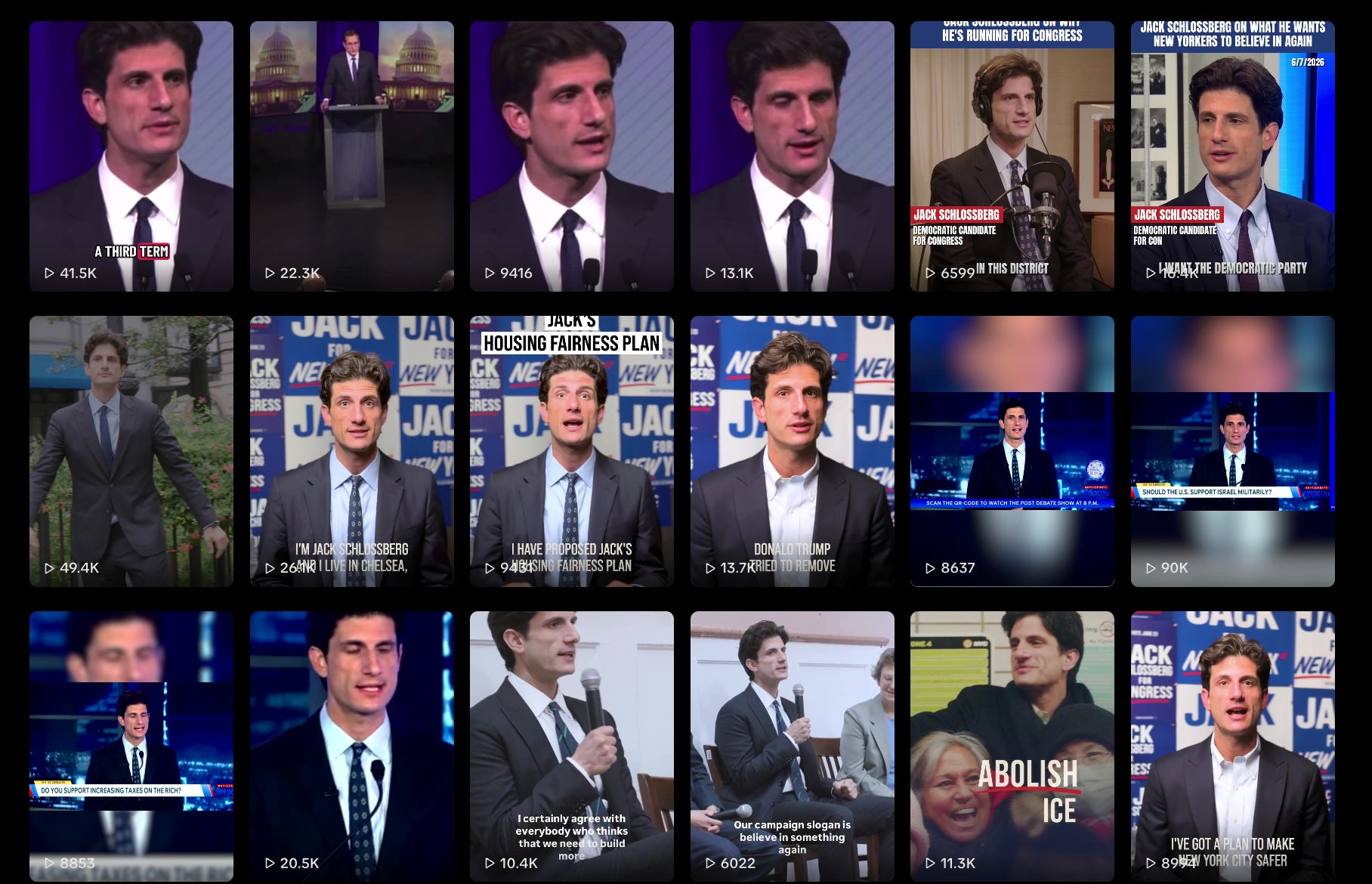
Attention, we are told, is the currency of modern-day American politics. Jack Schlossberg is good at getting it.
Schlossberg, the 33-year-old grandson of John F. Kennedy, has used his family name and self-described “silly goose” style — watch him skateboard while reciting poetry, or joke about having a child with Usha Vance — to amass an enormous audience on social media platforms like Instagram and TikTok. His posts frequently turn into national headlines and sit-down cable interviews on the secrets of politics in the age of social media.
One thing he isn’t good at getting: votes.
Schlossberg has spent the last six months running in the Democratic primary in New York’s 12th congressional district, joining several others in pursuit of the seat long held by retiring Rep. Jerry Nadler in Manhattan. His famous lineage, as well as his skill in getting attention through unique, often absurd, social media posts, has guaranteed him a level of coverage that most House candidates can only dream of, including interviews with the top editors of Vanity Fair and The New Yorker, as well as profiles in every major publication. “The Kennedy Scion Riding Online Fame Into a Big-Money Primary,” the Wall Street Journal called him.
The primary was last night. Schlossberg finished with 10.8% of the vote, a distant third. With a fraction of Schlossberg’s 2 million social media followers,1 Micah Lasher (26,000 followers) and Alex Bores (130,000) each got more than triple his number of votes, 39.1% and 35% of the total, respectively.
In fairness, Schlossberg is not alone.
Earlier this year, Kat Abughazaleh — another political influencer, with a social media audience of 1.5 million — sought the Democratic nomination in Illinois’ 9th congressional district. Abughazaleh came closer than Schlossberg, but she lost as well, drawing 26% of the vote to Daniel Biss’ 29.5%.
In 2025, Deja Foxx tried to similarly convert her perch on political social media (total following: 795,000) into a position of political power, seeking the Democratic nod in a special election for Arizona’s 7th congressional district. “A Political Influencer Could Seriously Win a Seat in Congress,” Politico said. Not quite. Foxx won 22% of the vote to Adelita Grijalva’s 61%.
Each of these candidacies has followed the same pattern. A political influencer launches a campaign for Congress. The national media goes crazy, covering them closely. They run against a local elected official, who lacks online fame but boasts political experience and connections on the ground: Bores and Lasher are each New York state assemblymen whose districts overlap with NY-12; Biss is the mayor of the city at the heart of IL-9; Grijalva was a member of the county board of supervisors, and sat on the local school board for 20 years before that.
In each race, the local official received the imprimatur of the longtime House member who was vacating the district: Nadler endorsed Lasher; Jan Schakowsky endorsed Biss; Grijalva’s father Raúl had been the congressman from AZ-7 until his death opened up the seat. And each time, the veteran official won. Local connections beat out online buzz.
It’s not surprising that social media influencers are trying to run for office: masters of previous attention economies have tried to do the same whenever their given medium was at the peak of its dominance. The Gilded Age newspaper barons Joseph Pulitzer and William Randolph Hearst both served stints in Congress. (Even earlier, Benjamin Franklin — who you could say was an influencer, just dispensing hot takes through almanac entries instead of tweets — owned a printing press while serving as governor of Pennsylvania). The 1920 presidential election featured two newspaper publishers squaring off against each other: Republican Warren Harding (of the Marion Star) vs. Democrat James Cox (of the Dayton Daily News).
In the second half of the 20th century, prominent writers and columnists like William F. Buckley Jr., Upton Sinclair, Norman Mailer, Gore Vidal, and Jimmy Breslin all tried to go from commenting about politics to becoming politicians (running, respectively, for New York City mayor, California governor, New York City mayor, U.S. House and U.S. Senate from New York, and New York City Council president, all unsuccessfully). The radio and TV era saw people like Pat Robertson, Pat Buchanan, and Al Franken run for office.
There is, clearly, an insatiable and timeless instinct among people who talk about politics for a living to eventually think, Hey, I know as much about what’s going on as these bozos, and I have a huge audience of people who listen to what I have to say. I should throw my hat in the ring. (No, this isn’t a campaign announcement.) Social media influencers are no exception to this centuries-old trend. But so far, they’ve been really bad at it.
In addition to Schlossberg, Foxx, and Abughazaleh, there is also Cenk Uygur, co-host of “The Young Turks” (which commands 6.6 million followers on YouTube), who ran for a House seat in California in 2020, landing in fourth place with 5.9% of the vote. (The Democrat who advanced instead was a state legislator.) On the Republican side, the pro-Trump influencer CJ Pearson (combined following: 1.8 million) sought a state House seat in Georgia that same year. He lost to a county commissioner whose only social media presence is a Facebook account with 774 followers. Not 774,000. 774.
Spend enough time on political social media and you will encounter all of these names. Online, they’re powerhouses. It made no difference on the ballot.
There are, of course, a handful of exceptions. Brandon Herrera, whose pro-gun YouTube page “The AK Guy” has 4.2 million subscribers, came within 354 votes of ousting then-Rep. Tony Gonzales in a Republican primary in Texas in 2024. Then, this year, he bested Gonzales by 859 votes in the first round of a rematch; they would have gone to a runoff, but Gonzales dropped out after the revelation that he had an affair with a staffer who then killed herself. Assuming that he wins the Trump +15 district in November, The AK Guy is headed to Congress.
Marjorie Taylor Greene, who was already a prominent QAnon influencer when she unexpectedly won her first primary in 2022, and Lauren Boebert, who had several viral moments before entering politics, are also arguable exceptions — though for both Greene and Boebert, posting was a side-hustle. Each were also business owners (Greene ran a CrossFit gym and a construction company; Boebert ran a gun-themed restaurant).
Many of the influencers I’ve mentioned came from the extremes of their parties, but this column is not arguing that primary voters are prone to rejecting candidates from the far-left or right. In fact, the Democratic Socialists of America had a triumphant primary night in New York just yesterday, as three of New York City Mayor Zohran Mamdani’s handpicked congressional candidates rode to victory, ousting two incumbent House members and the handpicked successor of a third.
However, primary voters do seem to reject candidates for whom their only experience is talking about politics into a camera. Right-wing candidates with business experience (Greene, Boebert) and left-wing candidates with working-class backgrounds (AOC) can still win with similar ideological platforms as the aforementioned influencers, as can state legislators like Ilhan Omar or Rashida Tlaib. (Mamdani’s candidates last night included a state assemblyman and the former New York City comptroller. Darializa Avila Chevalier, who ousted Congressional Hispanic Caucus chairman Adriano Espaillat, is a PhD student and local activist.)
After all, there are plenty of ways to build the sort of local relationships that a successful congressional campaign requires. Posting just isn’t one of them. The influencer-candidates have faced persistent questions about how rooted they were in their local community: Abughazaleh and Uygur didn’t even live in the districts they ran in when they launched their campaigns. Much of Foxx’s political work had been done outside of her district. Schlossberg, meanwhile, entered his race with barely any work experience; his CV consisted mainly of four months working at the Obama State Department and six articles while working as a political correspondent for Vogue during the 2024 election. On his financial disclosure form, he reported zero earned income from 2025, though he was kept afloat by four multi-million-dollar trust funds.
Several of these next-gen candidates also faced concerns about their work ethic: The New York Times reported that Schlossberg often disappeared for long stretches during the campaign, including to take naps. (Schlossberg has noted that he was still grieving the recent death of his sister during the campaign.) Abughazaleh once slept through a candidate forum. (She said that she had narcolepsy.)
The candidates, perhaps accustomed to interfacing only with boosters on social media, often resent this scrutiny. “People are obsessed with geography over the issues,” Uygur said. “You guys are so focused on the timeline of my résumé,” Schlossberg groused in (another) Times interview. “Yeah, I mean, I think people are right,” he told The Guardian sarcastically. “The Democratic party has been way too cool. We’ve been too exciting… What we really need right now is to just act like social media doesn’t matter, and being cool isn’t important.”
“I understand that content creation is a new profession and that for a lot of people it’s not synonymous with a quote-unquote real job,” Schlossberg told The New Yorker. “But I’ve been arguing with evidence supported by facts, very clear arguments made on behalf of the issues that I think are important.”
These primary outcomes should challenge our assumptions about the importance of attention in our changing political environment. Some analysts, like Chris Hayes and Ezra Klein, have argued that attention is the lifeblood of modern politics, the most important commodity for a candidate to have. But who is better at getting attention than online influencers, who are essentially attention merchants? Schlossberg, in particular, is an attentional mastermind.
But his loss and those of his contemporaries show that the mere ability to grab attention may not be all it’s cracked up to be, even in the very-online year of 2026. We also know that local and national campaigns are different: somewhat paradoxically, the latter might be easier to win, at least for attention-grabbing candidates, since there is no expectation that a candidate will shake every hand or kiss every baby in a nationwide campaign. When running in a congressional district, however, person-to-person relationships will clearly take you a lot farther than social media follows. (It has also been noted that many of the influencers I’ve written about raised huge gobs of money … but mostly from donors out of state, reflecting large bases of support — sometimes even larger than the size of their congressional district — just not in the place they needed it the most.)
A focus on attention underrates the lingering power of these local political machines — be they incumbents handing their seats down, or the power of an endorsement from a Trump or a Mamdani, and the groundswell of door-knockers and organizers that come with that. Every time these influencers run, they give interviews insisting they have found a new way to campaign: that is, entirely online. Journalists generally take these claims seriously, either because profiles of these influencer candidates are good for clicks, or because they genuinely believe that these candidates have found a novel way to spin attention into votes.2
And yet, each time, old-fashioned politicking wins out.
Even on the national level, there is much that a focus on attention can miss. Donald Trump, for example, receives more attention than anyone else in politics, perhaps more than any president in recent memory. He is also historically unpopular. All press is not, as he (and some of his critics) believe, good press. It also matters whether that press is magnifying ideas and arguments that Americans agree with.
Just as we see this with influencers who try to become legislators, we also see this with legislators who try to become influencers, for whom boring, standard-issue Local Official type also seem to be a Kryptonite. On the left, the attention-grabbing representatives Cori Bush and Jamaal Bowman were defeated by a county prosecutor and a county executive, respectively, in 2020 primaries. On the right, Steve King lost to a state legislator in a 2016 primary; so did Madison Cawthorn in a primary in 2020.
In fact, for all the talk about lawmakers trying to be TikTok stars, it doesn’t seem to be a great career move. In addition to the four listed above who lost primary challenges, Matt Gaetz and MTG have since resigned. Jasmine Crockett, the Texas Democratic congresswoman known more for her viral moments than her legislative record, failed to win a Senate primary earlier this year, while Nancy Mace, the rabble-rousing South Carolina Republican, came in a dismal fifth place in a gubernatorial primary a few months later.
In case you haven’t caught onto the theme, Crockett lost to a more mild-mannered state legislator, while Mace came up short against a lieutenant governor and a state attorney general who both lack her skill for the dramatics.
Cawthorn once boasted about hiring more communications than legislative staffers in his congressional office. Perhaps he should have re-thought his strategy. There is no question that social media prowess can play a role in 21st-century politics, and it is not as though boring candidates always beat attention-getters. But attention-getters generally need some sort of résumé, or proof of legislative accomplishments, to be successful. Voters don’t appreciate being treated like social media followers: even in this online age, they seem to expect more from their legislators than just content.
And they certainly don’t seem to be thronging to candidates whose only life experience is as political influencers. By now, several of these candidates have run, and their social media followings have brought them enormous media buzz and hype — but not political success on the ground. Remember that the next time you start hearing rumblings about the next great influencer-candidate. You can probably put your Hasan Piker or Candace Owens for Congress poster back where you found it.
To calculate social media followings in this article, I’ve used a candidate’s combined following on TikTok, Instagram, X, YouTube, Facebook, and Bluesky. These are the totals as of today, so they may not reflect the totals at the time of an election — though, if anything, the winning candidates in these races would probably be expected to have gained followers since the election, not the losing influencers.
This also leads to skewed expectations about who will win, or at least skewed coverage levels. Regular readers of several New York-based publications will have been much more informed about Schlossberg, who came in third place, than Lasher, who will be their next congressman.
Pundits will often see so much social media buzz for a candidate that they assume it’s indicative of real-life support, although the two metrics are plainly not connected. In some cases, supporters of a candidate (cocooned in a social media bubble where their pick is discussed non-stop) will be so surprised this doesn’t translate electorally that it leads to allegations of voter fraud. Spencer Pratt, the reality TV star, received a lot of attention but only 25% of the vote in his social media-infused campaign for Los Angeles mayor. According to Donald Trump, this is evidence of fraud.
My “take” may be a little glib, and it’s meant to complement your perceptive essay rather than argue with it. But I suspect part of what’s going on here is that following online influencers and voting for representative governance candidates are two very different activities. I suspect stats would show that to a significant extent it’s two different kinds of people engaging in the two activities.
No doubt there are other factors explaining the gap, but my guess is that this explains a lot of it. It would be interesting to know how many fans of an influencer vote against them, or vote at all. I also assume that my point would be more relevant in primaries where only the most politically active citizens turn out.
Gabe, since you love statistics and graphs, how about one overlaying two curves: number of social media followers by age and voter turnout by age. The reason social media isn't a great campaign strategy may be very simple.