


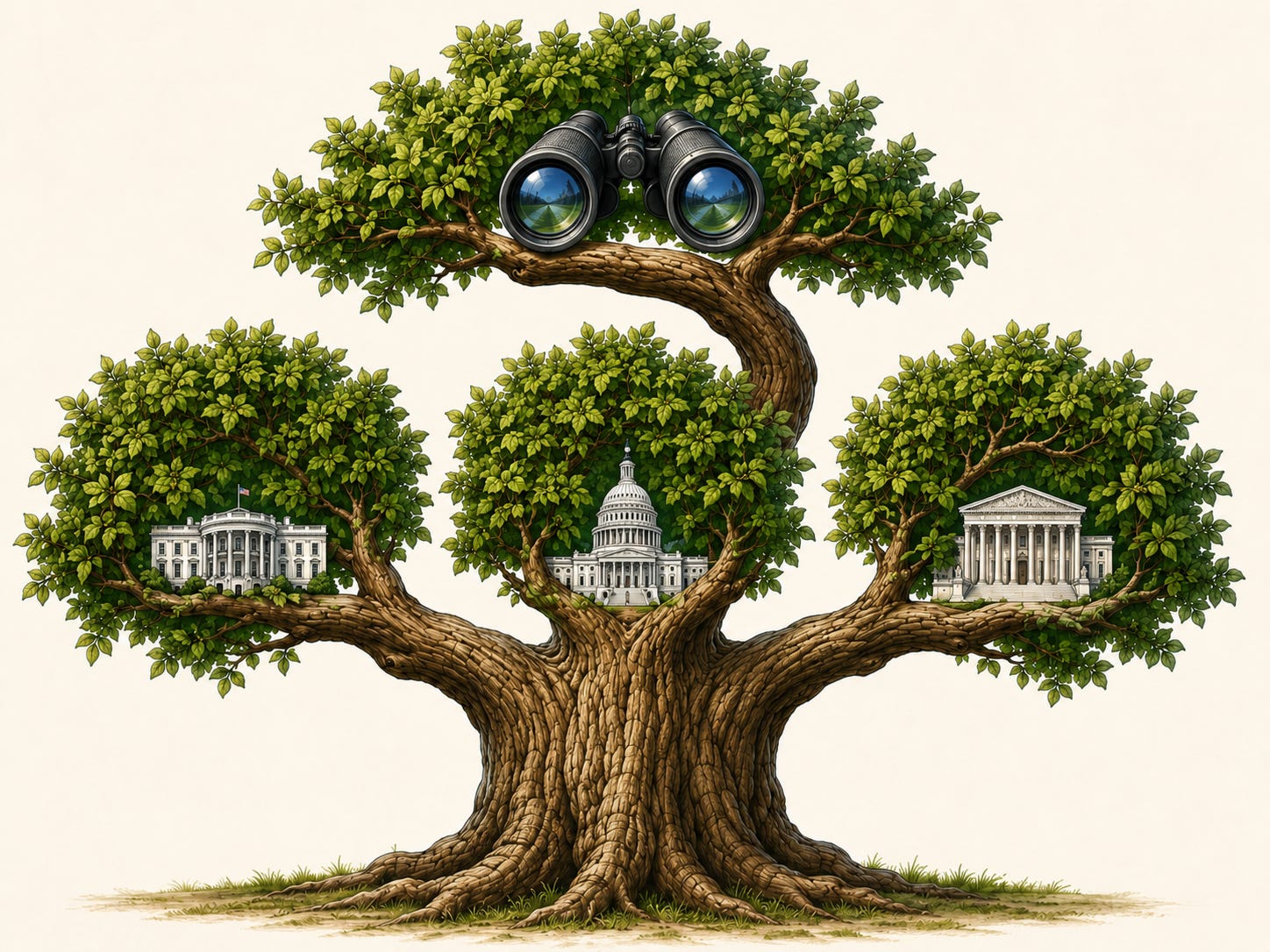
As America approaches its 250th birthday, I’ll be writing a series of pieces taking a step back, looking at our political system and ways to improve it. This morning, I share my biggest-picture idea for a political reform that could increase trust and transparency in government. — Gabe
Tom Kean won the Republican nomination to serve another two years as the U.S. Representative from New Jersey’s 7th district last night. Congratulations, Mr. Congressman. Normally, when a candidate wins an election, they hold a victory party. Kean didn’t, nor did he deliver remarks in any other setting after the results were announced.
This would be surprising if it weren’t for the fact that Kean, a sitting congressman, has been missing for almost three months. He last voted on the House floor on March 5; he has missed 104 votes since then. His office has barely explained his disappearance and reporters who have searched for him have come up empty. Reportedly, not even the House Republican leadership knows where Kean is. Kean issued his first statement on the matter yesterday, saying that he will “transition from virtual work to in person work within a matter of weeks,” at which point he pledged to be “completely transparent as to the nature of my medical condition.” Until then, nothing. Kean continues to receive his $174,000 salary and to run for re-election.
The weird thing is, this isn’t even the first time something like this has happened recently. In July 2024, retiring Rep. Kay Granger (R-TX) mysteriously stopped showing up for House votes; she would never cast another vote again for the rest of her five months in office. It was later revealed that Granger had been living at a memory care facility in Texas; her son eventually confirmed that she had been “having some dementia issues.” She continued drawing her taxpayer-funded salary the entire time, without ever disclosing her medical issues or offering a public explanation of her absence.
There isn’t much the House can do in a situation like this. No one can force a member to resign; there is no way for voters to recall them. Technically, any member who hasn’t publicly declared that they are absent due to “the sickness of himself or of some member of his family” is supposed to have their pay docked, though this is never done in practice. It is also hard to imagine two-thirds of the House agreeing to expel a colleague because of a medical absence — it would surely be seen as impolite — and the House Ethics Committee, the chamber’s internal accountability arm, does not generally probe these sorts of issues.
Which means someone who is paid almost $200,000 annually can simply fall off the face of the Earth, without explaining it to his constituents or his leadership, depriving an entire congressional district of a working House member.
This is far from the only way that Congress fails to police itself. Here is the lede of a story yesterday from CNN:
After the White House Correspondents’ Dinner several years ago, a congressman asked a young female staffer from another office to have a threesome. A few months later, he pulled the staffer onto his lap and tried to kiss her.
In 2023, a male chief of staff messaged a former congressional intern looking for a job and propositioned her sexually, writing that he would “own” her and offering to Venmo her money if she complied.
A member of Congress texted a senior leadership staffer in 2017 asking the color of her underwear while she was in his sight line.
Gross, gross, and gross. None of these three women reported their experiences to the Ethics Committee, CNN said, because they knew it involved a convoluted process that can take years to wind through, and even then, often ends in no punishment for the member but consequences for the victim, since their names are often released, which can make it difficult for them to find another job in politics.
On Capitol Hill, one source told CNN, the Ethics panel is known as the “member protection service,” because of its reputation for treating fellow members of Congress with kid gloves. (Especially in an era of slim majorities, members of the panel are often incentivized not to blow the whistle on their same-party colleagues, if it could lead to a resignation and cause vote-counting problems for their leadership. This then becomes a non-aggression pact between the two parties.) It has been 18 years since the Senate Ethics Committee punished anyone within its jurisdiction and 15 years since the House Ethics Committee has recommended a censure, even though plenty of censurable conduct has taken place since then.
Across all three branches of government, the internal accountability mechanisms that exist are broken.
After Watergate, inspectors general were installed across the executive branch to investigate agency misconduct. But IGs can be fired by the president, and Trump purged 17 of them immediately upon entering office. There is also no IG position for the White House itself, which leaves no one to investigate, say, the president’s 3,711 stock trades in the first quarter of this year, many of which involved companies with business before the government. The White House is supposed to receive conflict-of-interest guidance from the Office of Government Ethics, the head of which Trump has also fired and replaced on a temporary basis with a succession of his own close aides, rendering it toothless.
In the judicial branch, the Supreme Court adopted an ethics code in 2023, but it came with no way (and no one) to enforce it. Lower court judges are at least subject to something of an internal ethics process led by a body called the Judicial Conference, but it leaves much to be desired. Just last month, a Judicial Conference committee released a report finding that a district court judge had engaged in sexual intercourse with a law enforcement officer … in the judge’s chambers … during business hours … while the judge’s staff could hear … and lied when they were confronted about it.
Despite all this, the Judicial Conference affirmed another panel’s decision that the judge should only have to write letters of apology to their clerks, and should not even be publicly named (much less punished), in part because their fellow judge “had otherwise rendered exemplary service to the court.” This despite the fact that the judge was loudly having sex in their office while on the clock working for American taxpayers. The word “otherwise” is doing a lot of work there. (Media reports have since identified the judge as Eleanor Ross, an Obama appointee based in Atlanta.)
The three branches are supposed to investigate themselves, and each other. But the internal mechanisms often fail because of excessive chumminess in the legislative and judicial branches (no one wants to investigate a colleague and, too often, perpetrators of misconduct are given brownie points for “otherwise…exemplary service”) and because the president can fire anyone who investigates him or his appointees in the executive branch. Congress also regularly abdicates its responsibility to investigate the other branches, generally letting the judicial branch work its problems out for itself and only expending real resources probing the executive branch when the president hails from another party. And neither side now trusts the executive branch to properly prosecute public officials, with allegations of “weaponization” looming over both the Biden and Trump administrations.
It’s time for a fourth branch of government that can hold the other three accountable.
This Accountability Branch could house the inspectors general that are currently arrayed, without much job security, across the executive branch. A White House inspector general could be added to investigate the president and his closest aides, as well as a Congressional Inspector General, who could offer legislative aides and constituents a safe and reliable way to blow the whistle on congressional misconduct, and a Judicial Branch Inspector General, who could apply the same scrutiny to federal judges and justices.
These IGs would not have prosecutorial power, but — because the prosecutorial process is clearly not working when it comes to public officials, with the Justice Department either over- or under-prosecuting depending on whether the party affiliation of the subject matches the party of the president — there could be another outfit in the fourth branch, a permanent and independent Office of Special Counsel, that is charged with prosecuting any referrals related to current or former executive branch officials, members of Congress, or judges.
This way, any allegations against officials who are supposed to be working in the public trust can be comprehensively scrutinized by independent examiners, whether it be sexual harassment or financial misconduct or members who are disappearing without explanation. If these misdeeds rise to the level of potential criminality, a Special Counsel would automatically kick in, so the decision to prosecute a Democrat or a Republican isn’t left to a Democratic or Republican administration.
Clearly, what we’ve been trying — hoping that officials will police themselves — has not been working. A big change is necessary to ensure that true accountability is brought to our government.
Who would watch the watchmen? Fourth branch officials would not be completely free agents; they would still be presidentially nominated and Senate confirmed (for terms longer than one presidency, maybe 10 or 14 years), but unlike the current officials who carry out these functions, they could not be removed by the president and they would not be colleagues of the people they are charged with investigating. (They could still be impeached and removed by a supermajority of Congress.) No more executive branch officials investigating executive branch officials, congressmen investigating congressmen, or judges investigating judges: real accountability can only be meted out by actors with some measure of independence. (Full independence breeds excessive power, which is why they would still be subject to the confirmation process. But the current investigators are plainly not independent enough, and provisions could be made to ensure the positions are filled if the political branches refuse to fill them.) You could also have a Fourth Branch Inspector General, just in case allegations of misconduct arise against the examiners as well.
In the short-term, if there are — as I suspect — many incidents of wrongdoing hiding under the surface that the Fourth Branch would begin to uncover and bring out into the open, it is possible that trust in the government would decline. (Though, at 17%, it is not possible to go much lower.) But, over the long run, as these violations are brought into the light, and as Americans see that they are actually being dealt with — not just allowed to fester — those trends might start to reverse. The Fourth Branch could then begin to restore Americans’ confidence in their government, since voters would finally be sure that official misconduct would be addressed, not just swept under the rug or answered with a slap on the wrist.
As we speak, across the government, there is a sitting Republican congressman accused of breaking campaign finance rules and threatening to blackmail an ex by releasing her nude videos, a sitting Democratic congressman accused of making advances toward two interns, a sitting Democratic congressman and sitting Republican congressman both accused of having affairs with staffers, an (unnamed, of course) federal judge who has copped to creating an abusive workplace, not to mention a president who appears to be engaged in all manner of self-dealing — and those are just a handful of the cases that we know about. In each one, there is no expectation that the current ethics processes will succeed in quashing the alleged wrongdoing, which means these officials will continue to serve with minimal scrutiny and no punishment.
There might be some concern that the creation of a Fourth Branch would deprive Congress of its oversight function — but, really, what kind of oversight has Congress been performing to this point? When Congress is controlled by the same party as the White House, it holds no investigative hearings, and when Congress is controlled by a different party than the White House, it holds hearings that are often more publicity-fueled circuses than serious fact-finding missions.
Neither extreme is ideal; it would be much better to have a group of apolitical officials who can carry out sober and serious investigations. Congress can still continue to hold legislative and appropriations hearings, and could still pass new laws to respond to the misconduct uncovered by the Fourth Branch, but would much really be lost by having fewer “oversight” hearings where lawmakers bloviate for the cameras and more investigations carried out by people who are actually interested in arriving at a full version of the facts?
Once you accept the premise that three branches are not enough, there are jobs you could potentially place under the Fourth Branch, to assume functions that the three existing branches have simply shown themselves to be incapable of independently performing.
In the coming weeks, the Supreme Court is set to rule on a series of cases on the president’s ability to fire heads of what we typically call “independent agencies,” though we all understand these agencies are parked (somewhat awkwardly) within the executive branch. The justices are expected to allow the president to fire members of agencies like the Federal Trade Commission and the Federal Communications Commission, under the logic that there can be no limits on the president’s power over his own branch, while blocking him from firing a governor of the Federal Reserve, under the logic that … well, it’s not exactly clear.
I think it’s possible to think that the Constitution makes the president the head of the executive branch, which means he is able to fire members of that branch, and to think that 237 years of experience has taught us that might not be working well. Some of these agencies, especially the Fed, could be placed within the Fourth Branch, to insulate the agencies from the president but in a completely constitutional way (since the Constitution would have to be amended to create this new branch anyway).
This would lead to some difficult decisions about what would stay in and what would stay out. Ideally, from my perspective, the test would be “is this something we want to be responsive to political dynamics.” This test might call for splitting up some of the independent agencies as currently constituted. It is reasonable to want trade or communications regulations to be in the hands of political actors who voters can either re-elect or defeat; we want these policy decisions to be responsive to the electoral will. But individual decisions over applying these policies to, say, corporate mergers or network licensing? Maybe those are roles we do want segregated from the political system.
Similarly, nearly all experts agree that setting interest rates should be responsive to the long-term fluctuations of the economic cycle, not the short-term fluctuations of electoral politics: that was the whole point of the Federal Reserve in the first place. Campaign finance oversight, currently performed by a Federal Election Commission that has been idle for upwards of a year, also comes to mind as a function that inherently suffers from being overseen by political officials, due to the massive and inherent conflict of interest (not unlike, on the state level, legislators who are allowed to draw their own districts). You could also imagine the Government Accountability Office, Congress’ in-house auditor, or the various statistics agencies (like the Bureau of Labor Statistics and the Census Bureau) as prime candidates for Fourth Branch treatment.
We would want to be careful about this, of course, in order to avoid creating a too-large class of bureaucrats completely detached from electoral accountability. Policy on health care and climate change and guns should change with administrations; you might not agree with every change, but as voters in a democracy, we should have a say over them.
But there are some tasks, like setting interest rates or reporting joblessness or public-sector prosecutions, for which there is very little democratic advantage in having them be politically controlled. In fact, the democracy suffers when these tasks are influenced by political actors who can use these levers to meddle in elections and reduce the information or choices offered to the voters, by skewing the state (or appearance) of the economy or by trying to imprison political rivals. It is only this limited group of tasks, which largely don’t involve policymaking and mostly involve checking policymakers (or neutrally applying the policy they set) — and which the political branches have proven themselves unable to independently conduct — that should be constitutionally set aside and freed from political control.
There’s one more issue that has come up frequently in recent months that our current system cannot answer, but that the Fourth Branch could. We have standing doctrine in our country, which is generally a good thing: it means people can only sue over things that harm them. If I write something in this newsletter you don’t like, you can’t just sue me because you’re unhappy. You would need to show you’ve been injured by it, to ensure that the courts aren’t bogged down by frivolous lawsuits.
But, once again, there is a narrow band of cases that this status quo leaves us without a fix for, and it’s been rearing its head in different ways for months now. If the president refuses to enforce a law (like, say, a TikTok ban), oftentimes no one will have standing to challenge his illegal action. Ditto if he starts a war without congressional approval. Or if he sets up a fund to pay his allies. There could also be a Fourth Branch Solicitor General; if a certain number of lawmakers believe the president is ignoring a law passed by Congress, they could petition this figure to review the case and, if he agrees, sue the president in court, to ensure illegal actions can be stopped even when they lack an obvious plaintiff.
The idea of independent officials reviewing the rest of the government isn’t novel. It is embedded in the logic of inspectors general, even if these figures haven’t been independent in practice, creating the need for this reform. You can also see this understanding elsewhere around the globe. In Taiwan, for example, there are five branches (or “yuan”) of government: the Executive Yuan, the Legislative Yuan, the Judicial Yuan, the Examination Yuan (which oversees entrance into the civil service), and finally the Control Yuan (to which citizens can submit complaints about government misconduct, and which can then investigate public officials and ultimately censure them or initiate impeachment proceedings against them, and propose other remedies to discovered wrongdoing).
We need a Control Yuan of our own. There are things that the current three branches of government are simply not equipped to do, especially when it comes to policing their own misconduct. Some of the fixes we have tried to bridge this gap have either been ineffective, like inspectors general or internal ethics bodies, or of questionable constitutionality, like “independent” agencies. It is time to amend the Constitution to create a Fourth Branch that can police the others and restore trust in government by bringing misconduct out of the shadows and, finally, into the sunlight.
I am a firm believer in sharing creative and risky ideas, not because they are the best, but because they ignite a shared interest in bettering something that is broken or needs improvement. I look forward to future articles like this Gabe! Our nation was founded on thinkers like yourself and ideas like this.
Excellent, Gabe!
This is exactly the “out-of-the-box” thinking that is needed in a seemingly hopeless situation (like our 17% trust ratio in Congress). And yes, this (and your detailed reporting of otherwise overlooked issues) is exactly what I am willing to pay for.