


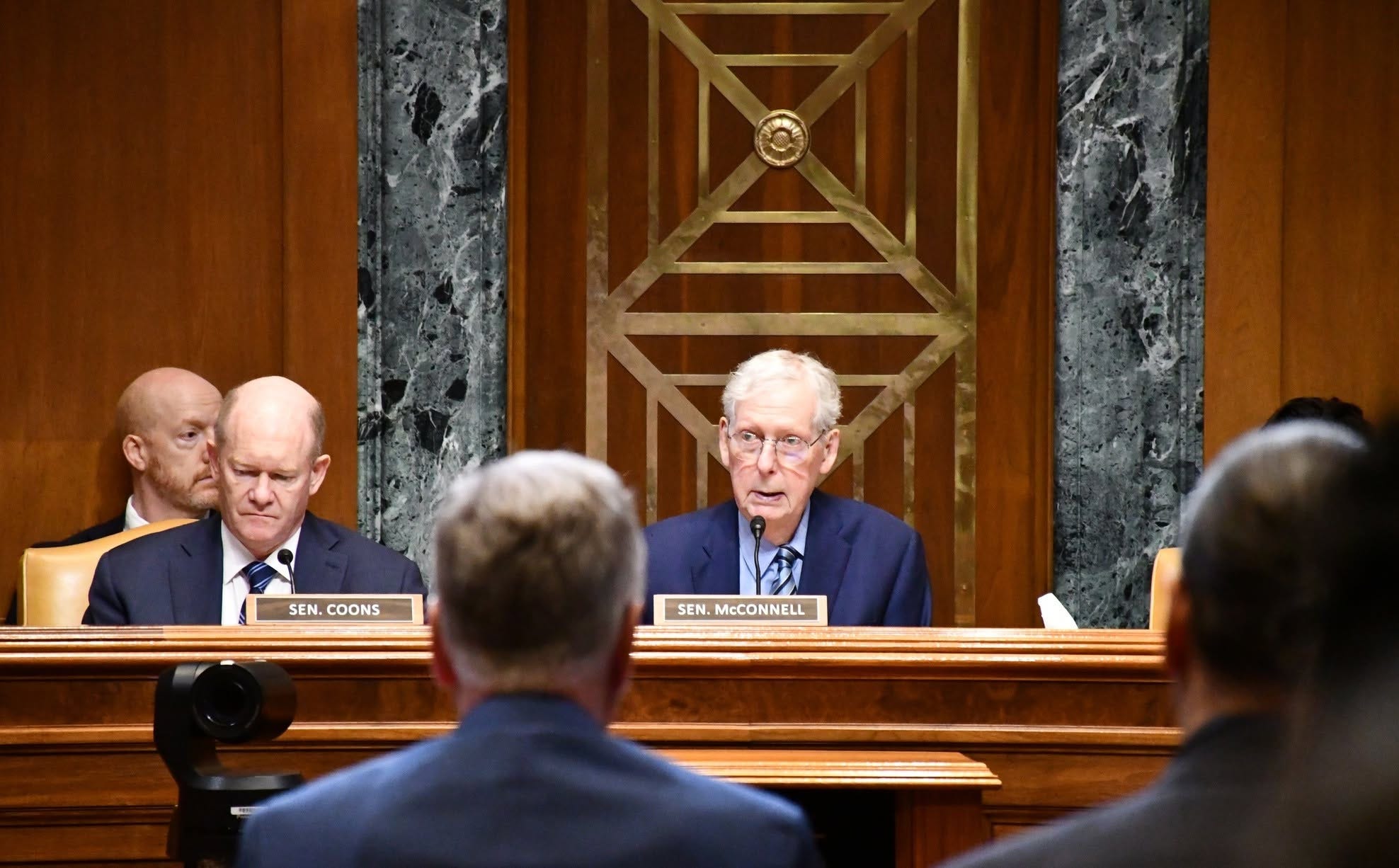
Good morning, friends. I asked for questions yesterday and you all responded with a bunch of great ones — so many that I’ll soon be returning to some of the ones I didn’t get to.
For today, many of the questions revolved around two people — Graham Platner and Mitch McConnell — so we’re going to focus our attention there.
I’ll be answering:
Why Democrats didn’t have a better nominee than Platner to begin with
What happens to Platner now
Whether Platner is right that he wouldn’t have been able to wage a campaign without support from the national party
Why it always takes so long for the media to report on congressional absences
Whether there’s a way for McConnell to be replaced if he never returns to work
As always, thank you so much for supporting Wake Up To Politics. If you’re not already a paid subscriber, I hope you’ll consider signing up and unlocking all of today’s edition. Even if you can’t, you can help out by sharing WUTP with your friends and family: word of mouth is the No. 1 way this newsletter spreads. If you think non-partisan, level-headed, nuanced political analysis is important, I hope you’ll click the “forward” button and encourage your friends to sign up.
Let’s dive in!
Platner
Q: Wasn’t there a better candidate than Platner from the start?
All year, Democrats have been asking themselves, Why is no one else running for Senate in Maine? They aren’t asking that now!
Democrats have gone from despairing over their limited options to being overwhelmed with potential candidates: Maine Secretary of State Shenna Bellows, former Maine Senate president Troy Jackson, former public health official Nirav Shah, former congressional aide Jordan Wood, social worker Paige Loud, and brewery owner Dan Kleban have all announced bids in the last 48 hours.
Where were all these people a few months ago?
Well, mainly running for other offices: Bellows, Jackson, and Shah all ran in this year’s gubernatorial primary (and lost). Wood and Loud both ran in a House primary (and lost). Kleban briefly ran for the Senate seat but was crowded out of the race.
There are a few reasons why none of these people ran for Senate (until now). First, everyone in Maine politics is terrified of Susan Collins, an electoral dynamo who has dispatched every rival who has tried to pick her off (including Bellows, who Collins beat by 37 points in 2014). The open governor’s race (which a Democrat is virtually guaranteed to win, unlike the Senate race) seemed like a much more inviting opportunity.
Second, Democratic leaders froze the field for Janet Mills, the incumbent governor, who took months to decide whether she wanted to run. In the meantime, the party tried to push other candidates (like Kleban) out of the race.
Third, there was probably really only room for one anti-Mills candidate, and Platner quickly captured all of that momentum. This is not unlike the 2016 Democratic presidential primary, where there ended up being significant room for a candidate to soak up support from those dissatisfied with the establishment favorite — but only room for one. (Sorry, Martin O’Malley.)
As it turned out, the two candidates who emerged from this process (Mills and Platner) were both deeply flawed, including in ways that directly undercut what was supposed to be their main appeals.
Mills was supposed to be the electability candidate, but the truth was that she was not especially popular in the state of Maine. Per Morning Consult, Mills’ approval rating is only 51%, which makes her one of the least popular governors in the country.1 She was not some electoral dynamo waiting in the wings. She is also 78 years old at a time when voters are more skeptical than ever of aging candidates, a stereotypically establishment pick at a time when voters are skeptical of establishment picks, and it was clear from the start that she didn’t really want the job: she ran a lackluster, low-energy campaign.
Platner, meanwhile, was supposed to be the working-class candidate, but the truth was that he held no particular appeal among working-class voters. According to a New York Times poll, he was losing to Collins among non-college-educated voters, 37% to 58%, and beating her among college-educated voters, 66% to 32%. Democrats don’t exactly need help winning college-educated voters; in the end, Platner wasn’t bringing that much to the table they didn’t already have, except for a whole lot of baggage.
But because Democrats froze the field for Mills, and Platner was the only outsider candidate willing to buck leadership, they were the only two options presented to Democratic voters. In the end, they may also have been the two worst candidates to face off against Collins, and — bizarrely — Democrats may just be better off having had their nominee implode, since it was probably the only way to get someone not named Graham Platner or Janet Mills on the Senate ballot.
Q: Have we seen the last of Graham Platner?
Well, for starters, it’s worth noting that Platner is still technically a candidate for Senate. He has announced plans to end his campaign, but has yet to file the paperwork to make it official. Per Axios, Platner has told aides he won’t file his withdrawal until Monday — the very last day, under state law, that he can do so and still be removed from the ballot.
The delay is causing heart palpitations in Democratic circles; it’s one final middle-finger to the party establishment, and gives a good idea of where Platner’s head is at as he (probably?) exits the race.
From there, I’ll be interested to see what role he plays in the fall campaign. All of the potential Democratic candidates (even Troy Jackson, his former ally) have made clear that they are uninterested in his endorsement or in campaigning with him. But Platner does still have money in his campaign account; will he donate it to the eventual nominee?2
After this campaign is over, he’ll likely disappear into obscurity. Maybe he’ll start a podcast if he wants to monetize his newfound fame and (in some small corners, at this point) popularity.
I keep seeing Democrats calling Platner “selfish,” and certainly there’s something to that: his decision to run, despite the scandals lurking in his past, jeopardized his party’s chances of winning the Senate. But the reason I hesitate to use that label is that his decision to run, despite the scandals lurking in his past, also completely ruined his life in a completely inevitable way.
Before this, Platner was entirely anonymous. Now, these allegations will follow him for the rest of his life, no matter what he tries to do. His neighbors say they look at him differently. Who knows the state of his marriage.
Launching a campaign like this when you knew there were skeletons in your closet is something darker than selfish. It’s self-destructive. There’s a delusion there and a willingness to gamble with your own life for power, even if there was just a 20% chance of getting power and an 80% chance of ruining your life, that is awfully striking.
Q: Platner said he was only dropping out of the race because it would be impossible to run a campaign without the DNC’s support. But is that historically true?f
In an 11-minute video on Wednesday, Graham Platner denied the allegations of sexual assault that had been leveled against him. But he said he was ending his campaign anyway, because:
Those in power who have the ability to do so are using these allegations as an excuse to take away all of the things that we need to run a campaign. We are going to lose our ability to fundraise. We are going to lose our ability to access voter data. We are going to lose all of the things that any campaign needs on the basic level simply to function. Larger organizations, the national-level party, the bigger donor networks: they have all committed to spending no money in this race if I’m in it.
When Platner says this, he is not referring just to the Democratic National Committee (DNC); he is also talking about the Democratic Senatorial Campaign Committee (DSCC), the Senate Democrats’ campaign arm, and Senate Majority PAC (SMP), the Senate Democrats’ top super PAC, both of which had pulled their resources from Maine after the most recent allegations and said they would only re-invest if there was a different nominee.
These groups can have a huge impact on a Senate race. To see how, let’s use Maine’s last Democratic Senate nominee, Sara Gideon, as an example. In 2020, Gideon’s campaign spent $62.9 million running against Susan Collins. That’s a lot of money.
But basically the same amount — $61 million — was spent by other pro-Gideon groups in that election. That means, out of all the money that poured into Maine that year to elect Gideon, only half of it was raised by her campaign. The other half came from outside groups. The top group spending on Gideon’s behalf? Senate Majority PAC. In second place? The DSCC. Senate Majority PAC alone plowed about $28 million into the race.
So the DSCC and SMP pulling out of the Maine race deprived Platner of about half the funds he otherwise would have received. Per the New York Times, by the time he dropped out, Platner’s campaign had only $1.3 million in the bank, compared to Collins’ $9.7 million. Platner was going to need the outside groups spending on his behalf in order to stay competitive with Collins.
There’s more than money at play here. As Platner hinted at, the national Democratic Party and its state affiliates generally control access to what’s known as the “voter file,” which is the master database that contains information for every voter, whether they’ve voted in the past, what party they likely lean towards, and the party’s past communications with them. No modern campaign can function without it, and state parties have cut off access to disfavored candidates in the past.
Parties also provide all sorts of help organizing, canvassing, communications, digital, get-out-the-vote, and strategic assistance (and even more now after a recent Supreme Court decision). And beyond cutting a candidate off from outside funds, party leaders wield a lot of influence with the sort of “donor networks” that Platner references, and could discourage them from donating to Platner or other organizations supporting his campaign.
Going back to Gideon, she also received outside spending from groups like EMILY’s List, Planned Parenthood, and the League of Conservation Voters. These are the “large organizations” Platner is talking about: Democratic interest groups that would probably also pull their money out if Democratic leaders told them to.
Finally, even if you strip away all the outside spending, Democrats could have hobbled Platner’s ability to raise small-dollar donations for his own campaign. Most Democratic campaigns are powered by the fundraising platform ActBlue, which theoretically could have banned Platner from using their infrastructure. (That’s what happened to Andrew Cuomo before he resigned.)
So, yes: running a modern campaign is about more than just your own campaign apparatus. You also need access to a fundraising platform, a voter file, and outside spending from interest groups and party committees, all of which Platner could have lost. Running a competitive Senate campaign would have been practically impossible without them.
McConnell
Q: Why is the “media” always so far behind on absenteeism? Most recently McConnell: been in the hospital since June 14th but “we” just hear about it beginning of July. The rep from NJ was running for reelection in a primary and most didn’t know he had been out for months. I woman I think in CA was living in a “home.” When a sports figure or famous person checks into a hospital, we find out immediately, yet with our politicians sometimes we never know!