


Happy Friday! Congrats on making it to the end of the week — and what a momentous week it has been in American politics. Thank you all for reading and engaging with the newsletter this week; we have a lot more to come.
And particular thanks to everyone who sent in questions for today’s newsletter. Here’s a sampling of what you all sent in:
Q: How do you think having Democrats in the Senate and the House will affect the government? What do they have the power to do or change?
Q: How much will Congress’ focus be on substantive legislation (even if Trump vetoes it) vs. investigations?
Q: Do you think there’s any chance that Trump works with the Democrats in Congress to pass semi-significant legislation to try and bolster his legacy/avoid being seen as a lame duck?
Q: What is the opinion of Congress as a whole about Jeffries and Schumer being House Speaker and Senate Majority Leader?
Q: Do you think Schumer and Jeffries should be replaced?
Q: Do you think there is an appetite to replace Schumer and/or Jeffries as Democratic Congressional party leaders?
I could go on, but let’s just say there were two clear buckets that an overwhelming majority of the questions fell into:
What will Democrats focus on and actually be able to get done now that they’ve won control of Congress?
Will Chuck Schumer and Hakeem Jeffries still be their leaders?
So I’m going to spend this newsletter gaming out the 120th Congress (the one set to convene in January) and giving you an idea of what the next two years might look like. The way I see it, there are four main decision points dividing Democrats as they head into the majorities:
Materialist vs. Post-Materialist
Fresh Faces vs. Same Leaders
Investigate vs. Legislate
Undo vs. Rebuild
Each of these overlaps in some ways with the more traditional “moderate vs. progressive” divide that’s often discussed in the context of the Democratic Party, but to be honest, none of them fit that cleavage exactly. They are more complicated, and more interesting, than that, which is why I’m excited to dig into all of them with you today.
As always, I hope you’ll consider signing up for a paid subscription to Wake Up To Politics. I’m proud of the coverage we’ve been able to offer here throughout the midterm cycle — and there’s only more to come. When you subscribe, you’re supporting independent, comprehensive political journalism and getting access to bonus posts like this one! What a great deal!
With that, let’s dive in.
Materialist vs. Post-Materialist
So many of you sent in questions asking what the Democrats’ actual legislative agenda will be once they take control in January.
One reason for that, I think, is that Democrats left it pretty vague during the campaign. Sometimes, opposition parties will put out really detailed platforms explaining exactly what they will do in Congress: think the 1994 Republicans’ “Contract with America” or the 2006 Democrats’ “Six in ’06.”
This year, Democrats pretty much just stuck with the message “We Are Not Donald Trump” and rode with that. And to be clear: as a political matter, that was incredibly successful! Not only was that clearly a message that the American electorate wanted to hear this year, but it also succeeded in unifying the party. Not much to fight about there! Of course, though, this only means that they pushed off any internal battles about what the party’s identity is beyond being an anti-Trump vehicle, not that they sidestepped those disputes forever.
As some of you may know, when you introduce a bill in the House, it gets a number based on the order it was introduced in: the 123rd bill is H.R. 123, and then the next bill is H.R. 124, and so on. But the exception is that the first 20 bills each Congress are reserved for the party leaders: the Speaker gets to designate H.R. 1-10, and the Minority Leader gets to pick H.R. 11-20. Typically, the party leaders will use these bills to show which issues their party thinks are most important, representing the signature parts of their legislative agenda.
Below, I’ve categorized the topics of these 10 agenda bills for each party in the last five Congresses:
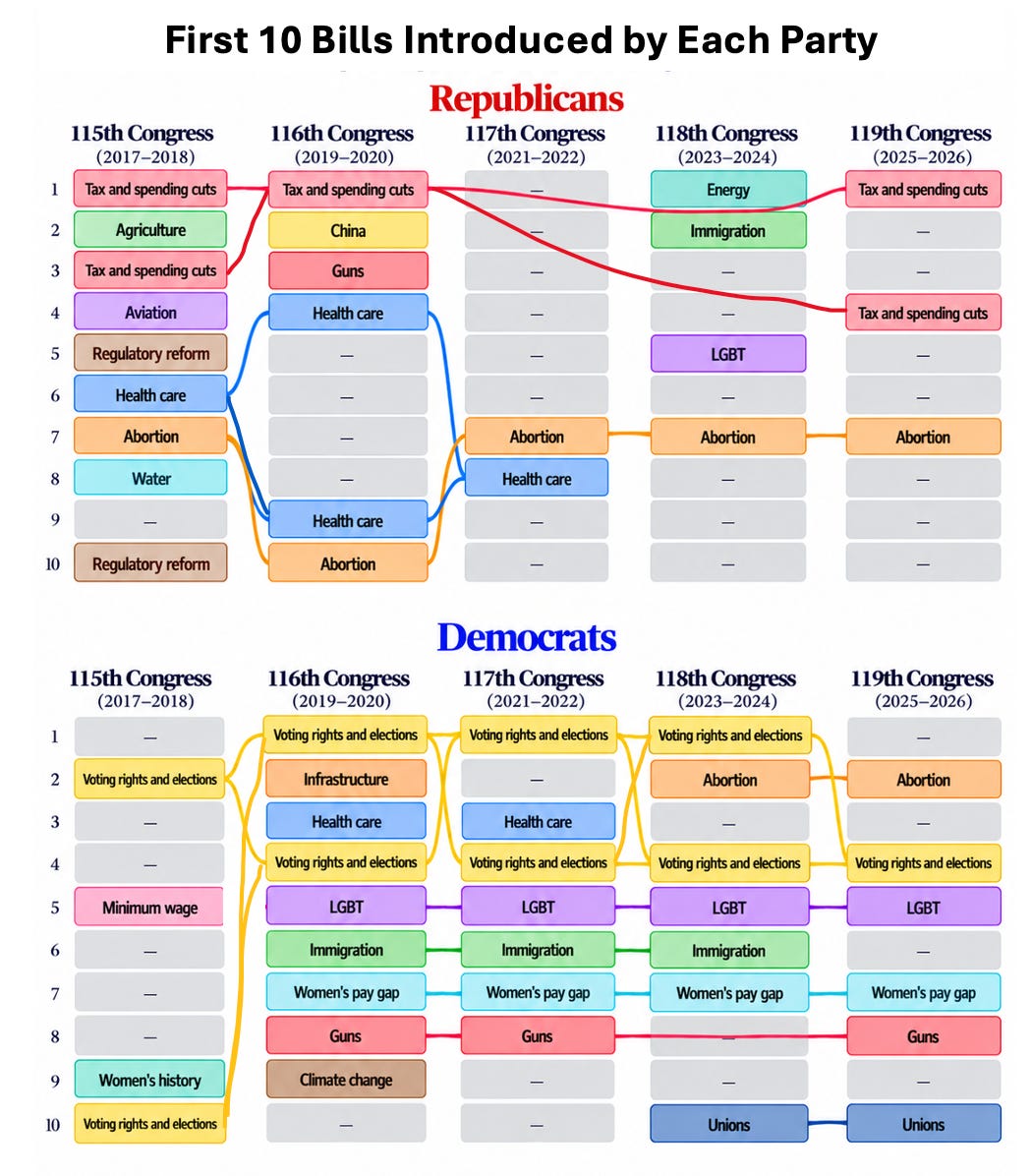
There are a bunch of interesting things we can take away from this graphic. We can see, for example, that House Speaker Mike Johnson has only used three of his reserved slots this Congress, barely even putting forward a legislative agenda: symbolic of the fact that Republicans have mostly run policy out of the White House for the last two years.
On the Democratic side, we can see that a climate change bill only appears in their first-10 lineup once (after the 2018 midterms) and then drops off the radar completely. A bill offering legal status to certain groups of migrants, which had been #6 in the Democratic lineup for the last three Congresses, was conspicuously left off the list in 2025, at the same time Democrats were worrying that they had lost the argument on immigration in light of Trump’s re-election.
But, mostly, it is fascinating to see that in the last five Congresses, nearly all of the Democrats’ top bills have been focused on social, not economic, issues. Their H.R. 1 (or 11) has generally been focused on voting rights and elections. They’ll often check off abortion rights, LGBT rights, immigrants’ rights, and gun control … but have rarely highlighted bills addressing Americans’ material concerns.
I expect that to change in the next Congress. Democrats did not win this year by focusing on social issues; in fact, many of their top candidates sprinted away from the party’s social stances on their way to victory last week. Social issues are inherently divisive; generally, the only way you win the type of landslide that Democrats won this week is by focusing on economic issues, which are more likely to unite a greater segment of the country. Voters have differing views on social issues, but generally perceive the economy similarly; if you can get them to focus on the latter, and not the former, that’s often the ticket to win big.
As a result, I would be surprised if the Democrats’ H.R. 1 next Congress is not an economic bill — which, notably, it has never been in the last five Congresses (even as, in three of those five Congresses, Republicans have cut taxes as part of their top bill).
It will probably be called something like the Make America Affordable Again Act (if that didn’t make for such a terrible acronym: MAAA) and will include elements like:
Undoing Trump’s tariffs
Undoing the Medicaid cuts from the One Big Beautiful Bill
Restoring the enhanced Obamacare subsidies that lapsed last year
Lowering the cost of insulin and other prescription drugs
Banning members of Congress and executive branch officials (including the president) from trading stocks as a way to target government corruption, another top voter concern this year
Historically, Democrats have not tried to package their H.R. 1 in a way that might win bipartisan support. If they keep it targeted to popular policies like those above, I would be interested to see if any Republicans cross party lines to support the measure — or, perhaps more likely, if any Republicans cross party lines once Democrats then move on to holding separate votes on each of these policies individually.
If Democrats flip Alaska and Mississippi (neither of which have been called yet), and win 56 Senate seats, they would only need to win over four Republicans on any of these bills to secure a filibuster-proof majority and send it to the president’s desk. Sen. Josh Hawley (R-MO) is on the record against the Medicaid cuts. Sens. Hawley and Lisa Murkowski (R-AK) have previously voted to extend the lapsed Obamacare subsidies. Sens. Murkowski and Rand Paul (R-KY) have voted to end Trump’s Canada tariffs.
You could also see some less expected defections: after seeing what happened on Tuesday, Republicans up for re-election in 2028 and 2030 might be thinking twice about voting to keep tariffs in place, for example.
The same goes for the inevitable flood of measures to end the Iran war. I also expect Democrats will advance a bill to restrict partisan gerrymandering, which could win bipartisan support if written in the right way. I also find it interesting that it’s been several years since a minimum wage bill made it into the Democrats’ starting lineup; I’m curious whether the party will try to revive that this time around, and whether any populist Republicans (maybe even Trump?) could be persuaded to sign on.
It is still unlikely that Democrats would get above the two-thirds veto-override threshold on any of these issues — so don’t count on any of the above becoming law — but the goal for Democrats will be to force Republicans into a number of tough votes. After Tuesday, it will be interesting to see how many Republicans continue embracing Trump even in his most unpopular issue areas, like tariffs and the war. (Although, it should be noted, many of the Republican moderates in both chambers who would have been likeliest to side with Democrats on these issues were defeated by Democrats on Tuesday.)
What will Democrats do about the social issues that have typically dominated Democratic legislating?
Notably, Democrats barely talked about abortion on the campaign trail this year: in 2024, it was the top issue they aired ads on; this year, it wasn’t even in the top 10, falling behind issues like inflation, health care, and taxes. (Again: this was an economic-issues election, not a social-issues election.) That said, a bill codifying Roe is still likely to be part of the party’s agenda.
Other issues pose more challenging questions. The Equality Act, which prohibits discrimination on the basis of sexual orientation and gender identity “with respect to businesses, employment, housing, federally funded programs, and other settings,” has been the Democrats’ No. 5 bill for several years now.
Even with a number of new Democratic lawmakers who oppose transgender athletes playing on girls’ sports teams (which the Equality Act would arguably require), Democrats would probably have enough of a cushion to pass the bill, just due to the sheer size of their majorities. But will they want to?
On Tuesday, it was very notable that voters in Arizona, Colorado, and Washington state all approved ballot measures requiring student athletes to participate on teams that match their sex at birth, even as all three states (along with the rest of the country) swung towards Democrats in other races. This is a reminder that the Democratic victories were not necessarily a vote of approval for many of the party’s social stances. Will Democrats want to divide the commanding majority of Americans they just won by pursuing policies that many of those voters oppose? If not, they will likely face extreme pressure from the interest groups who have gotten used to having their bills receive prime placement in the Democratic lineup for years now.
Many issues will probably be pushed off until Democrats have a governing trifecta. At some point, Democrats will have to decide if they are willing to raise taxes to finance parts of their agenda (some Democrats are trying to position themselves as the party of tax cuts; meanwhile, a failed wealth-tax referendum in California offers a reminder of the political complications). But while they are out of power, there is little point in spending political capital on tax increases that are doomed to face Trump’s veto.
Will Democrats vote on a bill to end Israel aid, with all the internal fights that will cause? Some members will surely push for it (though their influence will be limited in a 260-seat majority). Others will try to punt on setting a party stance until a Democrat is in the White House.
Fresh Faces vs. Same Leaders
Who will be making those decisions for the party? Here we arrive at the leadership question: will and should Democrats stick with Hakeem Jeffries and Chuck Schumer?